In both math and programming, mutually exclusive sets are a big deal when handling data analysis, probability, and logic. If two sets don’t share any elements, they’re mutually exclusive—their intersection is empty.
When working with Python, checking for mutual exclusivity helps with logical conditions, data validation, and optimizing algorithms. Whether you’re dealing with probability problems or filtering datasets, knowing how to handle exclusive sets can make your code more efficient and reliable.
Join Index.dev to land high-paying remote jobs with top global companies and grow your career as a Python developer.
What Are Sets in Python?
A set in Python is an unordered collection of unique elements. Unlike lists or tuples, sets do not allow duplicate values, and they provide efficient methods for performing mathematical operations such as union, intersection, and difference.
Here’s a simple example of a set in Python:
my_set = {1, 2, 3, 4}
print(my_set)
What Does It Mean for Sets to Be Mutually Exclusive?
- {1, 2, 3} and {4, 5, 6} are mutually exclusive because they share no elements.
- {1, 2, 3} and {3, 4, 5} are not mutually exclusive because they share the element 3.
Now, let's explore different ways to check for mutual exclusivity in Python.
Explore More: 10 Software Development Frameworks That Will Dominate 2025
1. Using the isdisjoint() Method
Python's built-in set class provides a method called isdisjoint(), which returns True if two sets have no elements in common.
Example:
set1 = {1, 2, 3}
set2 = {4, 5, 6}

if set1.isdisjoint(set2):
    print("The sets are mutually exclusive.")
else:
    print("The sets are not mutually exclusive.")
Output:
The sets are mutually exclusive.
Why use isdisjoint()?
- It is the most efficient way because it stops checking as soon as it finds a common element.
- It is readable and easy to understand.
2. Using Set Intersection
Another way to check for mutual exclusivity is by using the intersection (&) operator or the intersection() method.
Example:
set1 = {10, 20, 30}
set2 = {40, 50, 60}

if set1 & set2:
    print("The sets are not mutually exclusive.")
else:
    print("The sets are mutually exclusive.")
Output:
The sets are mutually exclusive.
Alternative Using intersection()
if set1.intersection(set2):
    print("The sets are not mutually exclusive.")
else:
    print("The sets are mutually exclusive.")
Why use intersection()?
- It makes the intent clear: check for common elements.
- Works well when handling more than two sets.
3. Checking Multiple Sets for Mutual Exclusivity
If you have more than two sets and want to check if all sets are mutually exclusive, you can use Python’s any() function.
Example:
def are_sets_mutually_exclusive(*sets):
    for i, s1 in enumerate(sets):
        for s2 in sets[i+1:]:
            if not s1.isdisjoint(s2):
                return False
    return True

setA = {1, 2, 3}
setB = {4, 5, 6}
setC = {7, 8, 9}

if are_sets_mutually_exclusive(setA, setB, setC):
    print("All sets are mutually exclusive.")
else:
    print("At least two sets share common elements.")
Output:
All sets are mutually exclusive.
Why use this approach?
- It works for any number of sets.
- Uses isdisjoint() for efficiency.
4. Using List Comprehension
We can also use list comprehension to check if multiple sets are mutually exclusive.
Example:
sets = [{10, 20}, {30, 40}, {50, 60}]

are_exclusive = all(s1.isdisjoint(s2) for i, s1 in enumerate(sets) for s2 in sets[i+1:])

if are_exclusive:
    print("All sets are mutually exclusive.")
else:
    print("Some sets share common elements.")
Output:
All sets are mutually exclusive.
Why use list comprehension?
- Compact and readable for small sets.
- Not the best for large datasets due to performance concerns.
5. Performance Considerations
- isdisjoint() is the fastest method for checking mutual exclusivity.
- intersection() creates a new set, making it less efficient.
- Using loops and list comprehensions is fine for small datasets but can be slow for large datasets.
Learn More: 13 Python Algorithms Every Developer Should Know
Summary
Mutually exclusive sets play an important role in many programming and mathematical applications, from probability theory to data validation. In Python, you can efficiently check for mutual exclusivity using different approaches, depending on your needs.
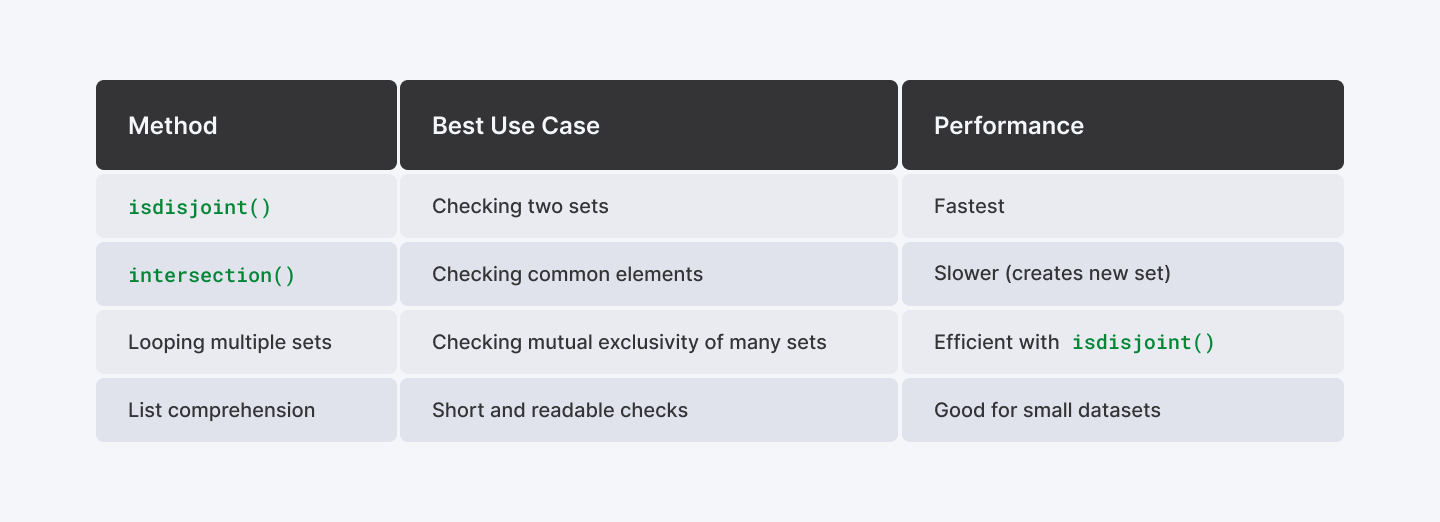
By using the right method, you can efficiently check if sets are mutually exclusive in Python, making your code both clean and performant. Whether you are working with probability models, database queries, or logical conditions, knowing how to handle sets efficiently will make your code more effective.
For Python Developers: Get matched with high-paying Python projects and work remotely with leading companies. Sign up on Index.dev!
For Clients: Hire top Python developers from Index.dev with 48-hour matching, a 30-day free trial, and access to vetted talent.