Corporations have a pent-up appetite to make data-driven decisions nowadays and as a consequence, people whose job role has something to do with data are in great demand. Acknowledging the specific details and criteria of each of the current and new roles in the Data Industry can go a long way towards helping you build a successful career path, and organizations looking to hire Data Analysts know exactly who and what they are beginning to look for to fill such roles.
Since there is a surge in interest in careers in the data industry, this post will assist you in delving deeper into the debate between Machine Learning Engineer and Data Scientist, emphasizing their roles within a firm and demonstrating the abilities connected with each.
Introduction to Data Science
Data Science is becoming one of the most important strengths of any firm desiring to expand and do business smoothly in the twenty-first century, and it has played a big part in the Data Economy. Data Science is a branch of study that blends programming skills, mathematical knowledge, and statistics to derive meaningful conclusions from data.
It can also be defined as the forecast and deduction of data from both structured and unstructured data in order to assist individuals and businesses to make smart decisions and order to better serve their consumers.
As more firms produce enormous volumes of data, they have learned that this data can be used as a catalyst to gain insights into consumer behavioral patterns, identify where flaws happened and how to correct them, assess clients' spending characteristics in terms of objectives, and so on. Analyzing data to stay competitive is now an appealing proposition irrespective of an organization's size or sector.
An overview of Data Scientists
A data scientist is a professional who collects, analyses, and explains massive amounts of data. Many traditional technical roles, such as mathematician, scientist, statistician, and certified computer scientist, are extensions of the position of data scientist.
What do they do
When a firm needs to make decisions, they look for data scientists to gather, process, and derive meaningful insights from data. When a corporation engages data scientists, they will begin investigating all aspects of the business and devising ways for doing thorough analysis utilizing programming languages such as Java.
They will leverage digital experimentation, as well as a variety of other strategies, to assist businesses in growing and prospering.
Introduction to Machine Learning
Data Science includes Machine Learning, which is a branch of Artificial Intelligence (AI). This area of AI creates a class of data-driven algorithms that allow software programs to become very accurate in anticipating future outcomes without having to program them explicitly.
Machine Learning entails the creation of algorithms that take historical data as input and use statistical models to predict new output values, as well as updating outputs as new data values become known.
The relevance of Machine Learning cannot be taken for granted because it is a key differentiator for many businesses. As a result, many businesses are investing massively in order to gain a better understanding of trends in customer behavior, business operational patterns, and the development of new products based on data from previous products' histories.
Machine Learning has become a vital aspect of top organizations' operations, as it can be used for detecting fraud, malware scanning, predictive maintenance, malware threat detection, and business process automation.
An overview of Machine Learning Engineers
Data scientists create models, which machine learning engineers submit. Machine Learning Engineers are in charge of handling data science theoretical models and assisting in their extension to industry applications capable of handling terabytes of real-time data.
What do Machine Learning Engineers do?
Machine learning engineers collaborate at the intersection of software engineering and data science. They use big data technologies and programming frameworks to repurpose raw data from data pipelines into data science models that can scale up as needed.
Machine learning experts frequently design control systems for machines and robotics. Machine learning algorithms enable a computer to discover patterns in its own programming data, educate itself to understand commands, and even reason for itself, thanks to methods developed by machine learning experts.
The following paragraphs will further characterize these roles, then take a glance at their tasks and the prerequisites in both of them, and eventually, their salary ranges. The objective of this analysis is to give you detailed explicit information into the comparison of Machine Learning Engineer vs Data Scientist, to further elaborate and highlight the difference that exists between the two job roles.
Don't fight for tech talent, get access to developers today ->
Data Scientist vs Machine Learning Engineers Responsibilities Comparison
Data Scientist:
- Obtaining and collecting data from a variety of sources
- Processes and cleans data prior to storage
- Identifying the demands of both consumers and businesses, and then developing strategies to meet those needs.
- Developing processes to aid in the monitoring and analysis of performance as well as data accuracy
Machine Learning Engineer:
- Develops Machine Learning Models
- Creates software that aids in the development of machine learning applications.
- Implements Machine Learning algorithms, works on statistical principles such as probability distributions and possible outcomes.
- Ensures flawless information flow and efficient communications between databases and back-end systems.
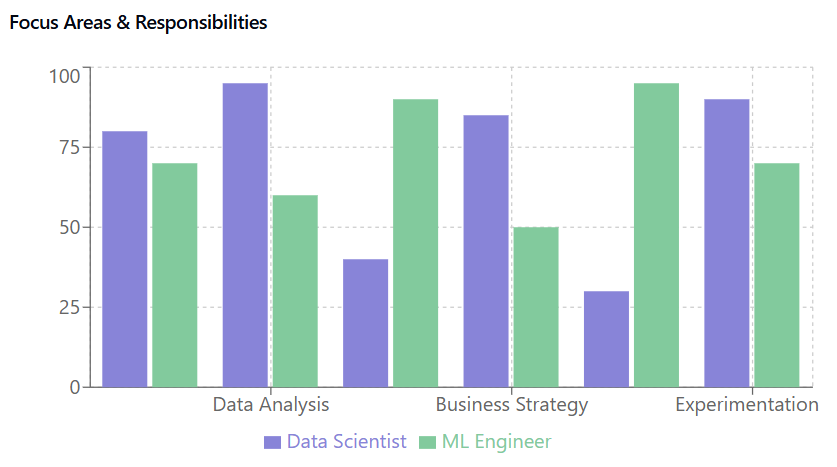
Data Scientist vs Machine Learning Engineer: Skills Required
Most Data Scientists hold a master's or doctoral degree in Computer Science, Mathematics, or Statistics. Additionally there are also a variety of industrial skills that can be utilized to become a successful Data Scientist.
Machine Learning Engineers, like Data Scientists, are expected to have a master's degree or a Ph.D. in Computer Science, Engineering, or similar subjects. A competent Machine Learning Engineer will be familiar with the standard deployment of Machine Learning algorithms that are available via libraries, Machine Learning packages and APIs.
Skills Comparison
Data Scientist:
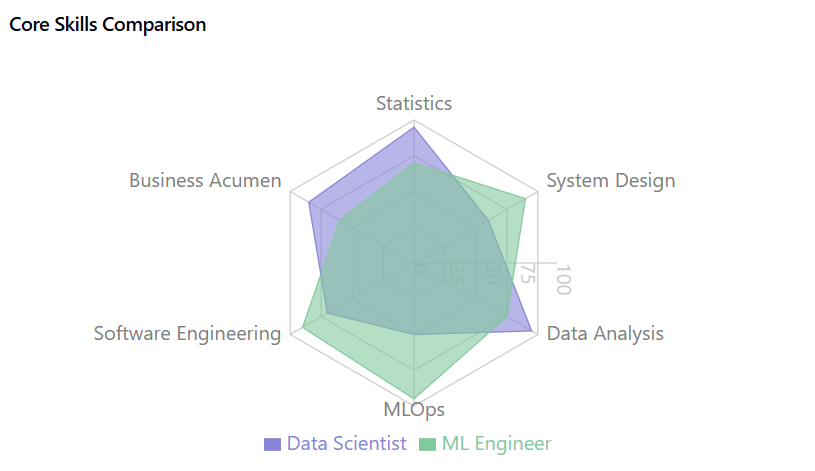
- Skills of SQL, Java, Python
- Knowledge of Complex Statistical Concepts
- Knowing how to use Web Services such as Redshift, S3, Digital Ocean and Spark
- Working with Analytics tools like Google Analytics
Machine Learning Engineer:
- Knowledge of Programming Languages like Python, Java, R, C++, C, JavaScript, Scalia, Julia, etc.
- Knowledge of Applied Mathematics and Distributed Systems
- Knowledge of GitHub/Git
- Working with deployment tools like Airflow, Docker, AWS, Google Cloud
Partner with Index.dev and onboard high-performing software engineering rockstars today ->
Machine Learning Engineer vs Data Scientist: Salary
Because many organizations are investing extensively in insights that can be extracted from the data they collect, Data Scientists are in high demand. As a result, the average compensation of a Data Scientist is around $108,000 per year in the US, however this varies depending on the nature of the work.
Like Data Scientists companies are also looking for Machine Learning Engineers that can create algorithms that allow computers to learn and recognize patterns on their own, improving the business's overall health. A Machine Learning Engineer's average yearly income in the US is roughly $130,000, depending on the company that hires them.
Top Companies using Machine Learning & Data Science
Tesla, Amazon, Bank of America, Google Cloud and Mathworks are some of the big players leveraging Data Science and Machine Learning.
When you look at these two roles, you'll notice that machine learning engineer vs. data scientist jobs aren’t a point of conflict. On the contrary, it's more about the types of projects you'd like to work on. You will get to collaborate on cutting-edge technology and business as a machine learning engineer or a data scientist. And, as demand for top-tier IT talent far outstrips supply, the competition for creative brains will only intensify in the coming generations.
And there's no way to go wrong, no matter which path you take.
Typical Career Paths for Data Scientists and Machine Learning Engineers
As the world increases its dependency on data, Data scientists’ primary concern is on analyzing and making sense of massive volumes of information. They use statistics, graphical methods, and artificial neural networks to explain data patterns and trends. Some of the tasks performed by analysts include data cleaning, data pre-processing, carrying out data exploration and interpretation of results including making presentations or giving reports to various stakeholders. Data scientists are expected to have a good understanding of statistical information, programming languages such as Python or R and knowledge in the relevant field of their industry.
On the other hand, Machine learning engineers are more focused on constructing, developing and implementation of machine learning models. That means their role is much more technology and engineering-based compared to that of Data Scientists. Machine learning engineers specializes in interpreting what the data scientist figures out and in actualizing it to create effective algorithms that can be implemented in applications or certain systems. To solve such tasks they require good knowledge of machine learning frameworks like Tensor flow or Pytorch, software development practices, and often cloud service providers to handle the model distribution and capacity.
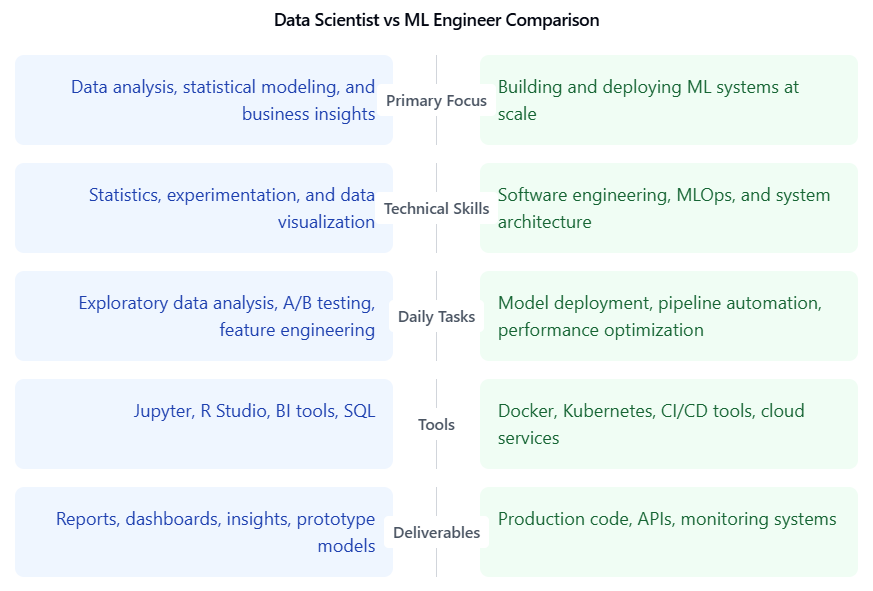
Each field is quickly growing as companies look to unlock the potential of big data as well as artificial intelligence. While practical data scientists tend to often take more creative roles that involve problem solving, machine learning engineers on the other hand are coded into solving algorithms that involve intensive coding skills. As such, it is possible that professionals within these fields would have interrelated work, while at the same time their tasks and duties differ considerably.
Data scientists’ primary concern is on analyzing and making sense of massive volumes of information. They use statistics, graphical methods, and artificial neural networks to explain data patterns and trends. Some of the tasks performed by analysts include data cleaning, data pre-processing, carrying out data exploration and interpretation of results including making presentations or giving reports to various stakeholders. Data scientists are expected to have a good understanding of statistical information, programming languages such as Python or R and knowledge in the relevant field of their industry.
On the other hand, Machine learning engineers are more focused on constructing, developing and implementation of machine learning models. That means their role is much more technology and engineering-based compared to that of Data Scientists. Machine learning engineers specializes in interpreting what the data scientist figures out and in actualizing it to create effective algorithms that can be implemented in applications or certain systems. To solve such tasks they require good knowledge of machine learning frameworks like Tensor flow or Pytorch, software development practices, and often cloud service providers to handle the model distribution and capacity.
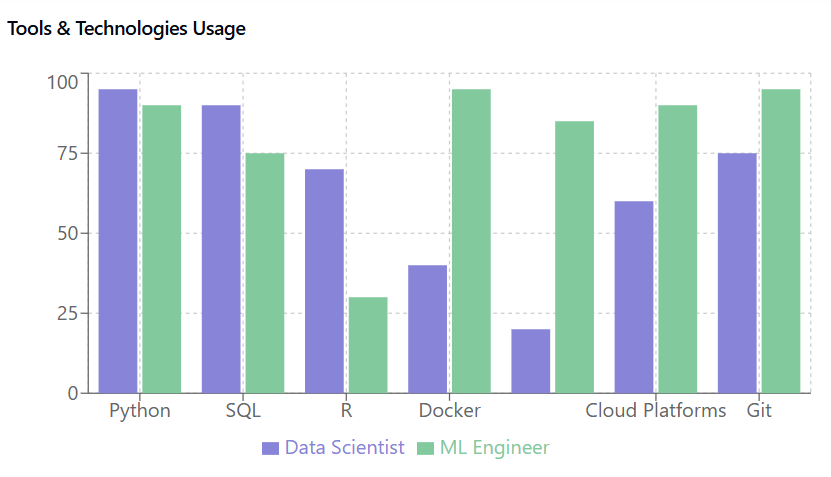
Awareness of these differences is important for newcomers as they develop their professional paths. Those who want to work on a higher level of analysis and interpretation tend to choose data science over machine learning engineering, especially if they also like coding and deploying reliable systems. Last of all, both options provide fulfilment and the prospects for advancement within a constantly developing field of technology.
Collaboration Between Data Scientists and Machine Learning Engineers
Some projects involve data analysis in parallel with model implementation and in such cases, interaction between data scientists and machine learning engineers is inevitable. Data scientists are involved in the process of data analysis and making conclusions from the results, while machine learning engineers develop models that can be implemented and deployed at scale. This coordination ensures the models that are designed are not only efficient but realistic to be implemented in practice.
Real-World Applications
For example, a data scientist calculates a particular statistic when doing a dataset analysis: He creates a model for the potential sales and uses the previous data to forecast the probable future trends. After the model has been validated, a machine learning engineer will then further optimize this model to adapt to real-time data feeds. These two variables also improve the efficacy of the final product since the collaboration results in increased reliability.
Key Challenges Faced by Data Scientists and Machine Learning Engineers
Both roles face several challenges in their careers:
- Data Quality Issues: The experienced data scientists concede that they are likely to work with data which is either incomplete or inconsistent in some ways, thus affecting the model.
- Model Deployment: Production-related challenges can also be a problem for machine learning engineers when deploying the models to different environments or to integrate the new models with other pre-existing systems.
- Keeping Up with Rapid Changes: The two fields of data science and machine learning are fast-growing industries, and it is crucial to keep up with new trends, programs, and standards.
Most common career transitions for data scientists and machine learning engineers
Working data scientists and machine learning engineers may have different career changes throughout their careers based on different reasons and advancements in the technological industry. Here are some of the most common transitions:
1. Data Analyst to Data Scientist
- A lot of individuals enter into this career path through the data analyst position, which entails the gathering, computation and initial analysis of information. Moving up to a data scientist position requires knowledge in other skills that consist of statistical analysis, machine learning and coding languages of Python or R.
2. Data Scientist to Machine Learning Engineer
- Some of the workers might switch to a machine learning engineering role which focuses on model deployment to production. This transition usually comes with a need to grasp more software engineering concepts, system ideas, and cloud concepts.
3. Machine Learning Engineer to AI Researcher
- A number of machine learning engineers may decide to advance their expertise even further by becoming AI researchers. This path may require obtaining academic degrees (such as PhD) and it is more dedicated to the creation of new algorithms or researching theoretical aspects of artificial intelligence.
4. Data Scientist to Business Intelligence (BI) Specialist
- Experts may move from data scientist positions for example, to business intelligence analysts, where the aim is to harness the data for business goals. This process is typically best accomplished with knowledge in BI tools such as Tableau or Power BI and context of business measure.
5. Transitioning into Management Roles
- A Data Scientist or Machine Learning Engineer with a few years of experience can consider ascending to the role of a Data Science Manager or even a Chief Data Officer (CDO). These roles involve leadership skills and the talent of coordinating the data projects with the organizational objectives.
6. Specializing in a Niche Area
- Most individuals decide to work on different subfields like NLP, computer vision or reinforcement learning on the side. This often includes such things as additional coursework or certifications in a particular area of either mechanical or electrical engineering.
The Bottom line
Although data scientists and machine learning engineers have important positions in the analytics spectrum, there is a clear distinction between roles and responsibilities. Data scientists are more fond of data and drawing insights from it whereas machine learning engineers focus on developing and deploying models.
As for those who are thinking of entering this field, it is critical to be aware of these differences. Depending on whether you want to apply the tools to analyze profound data structures or specialized machine learning schemes will dictate the direction of your endeavors.
Index.dev also benefits both domains by providing high paid remote opportunities for professionals and connecting them to UK and US employers. Here’s how Index.dev can assist:
Job Opportunities: The Index.dev service is a platform where users can find suitable job vacancies focused on data scientists and machine learning engineers to help people get a job appropriate to their expertise and interests.
Skill Development: For the professionals, the platform may offer materials and contacts that may be useful for improving one’s skills, or at least those, which are connected with Data Science or Machine Learning model deployment.
Flexible Work Environment: Through the implementation of remote work enabled by Index.dev, practitioners can balance their work lives and personal lives while still being able to work on complex projects that may help enhance their careers.
In a nutshell, it does not matter if you are interested in analytics in data science or engineering in machine learning, Index.dev might become the crucial teammate on your journey.