
AI tools can speed up hiring and help sift candidates, but they’re not magic. For example, automated resume screening and chatbots do cut your hiring time. But AI isn’t a cure-all for bias or matchmaking.
Some research finds AI can reduce bias in screening by focusing on skills, yet other studies warn it may “reproduce and perpetuate diversity bias” if trained on flawed data. Likewise, chatbots and instant responses improve candidate engagement, but too much automation can “leave behind the human connection” essential to recruiting.
In this article, we break down what works vs what’s hype. We cover resume scanning, diversity (DEI) impact, predictive hiring analytics, and the candidate experience.
- Fast screening: AI resume-parsers sort resumes instantly and cut time-to-hire.
- Bias & DEI: AI can focus on skills and reduce some bias, but it can also mirror unfair patterns.
- Candidate chat: AI chatbots answer FAQs 24/7, pleasing candidates. Still, over-automation risks losing personal touch.
- The bottom line: Use AI for routine tasks (screening, scheduling), not as a full replacement for human judgment.
Each of these areas works differently in practice. We’ll dive into the evidence and expose the hype.
Hire smarter with Index.dev: Tap into the top 5% of AI vetted developers, matched in 48h, with a 30-day free trial and full support.
Don’t Let Top Candidates Slip Through: AI-Powered Resume Screening
“What if your best hire never made it past the applicant-tracking system? That almost happened at Hilton until they deployed Ideal’s AI to scan 10,000 resumes in under four hours, thereby saving $1.2 million in recruiter time and reducing time-to-fill from 50 days to 38 days.”
The Story Behind the Stat
In late 2023, Hilton piloted Ideal’s AI-driven resume screener for its front-desk and housekeeping roles across 300 properties. Previously, their recruiters spent an average of 4 hours per day manually sorting resumes; the backlog sometimes delayed interviews by up to three weeks.
After implementing Ideal in January 2024, Hilton processed 10,000 resumes in under four hours (what used to take 10 full days of recruiter time) resulting in a $1.2 million annual savings on recruiter salaries. Time-to-fill for entry-level positions dropped from 50 days to 38 days in six months, helping frontline teams stay fully staffed in high-season.
How It Works
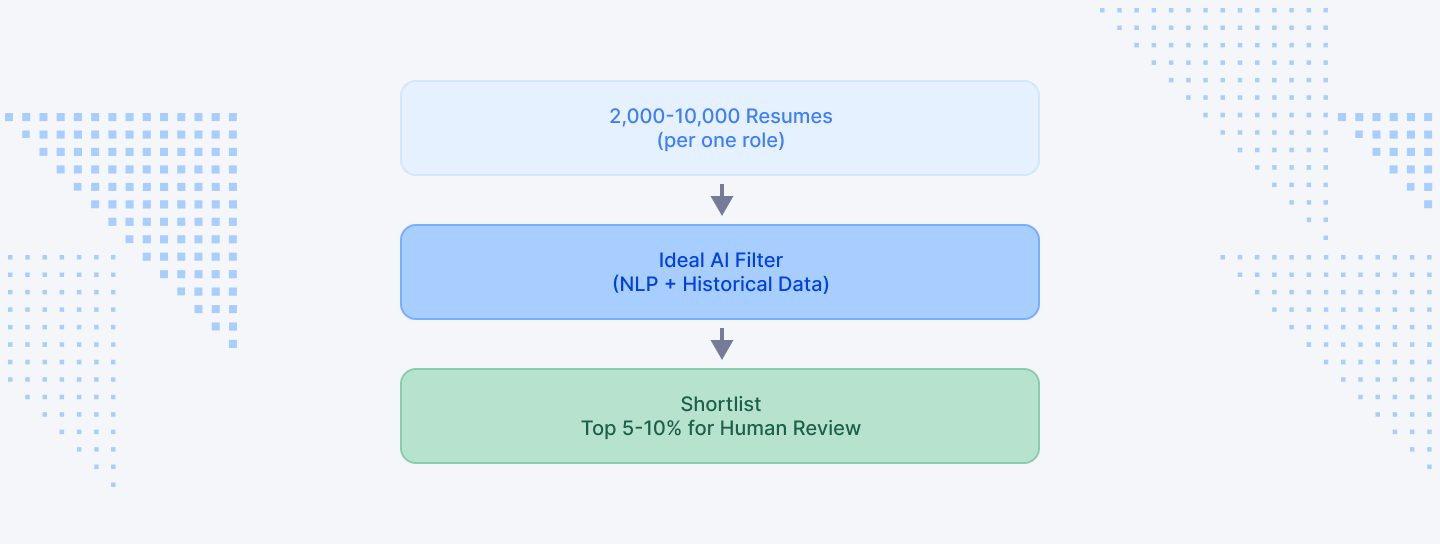
A (light blue): Large resume volume pooled from job boards, career sites.
B (darker blue): Ideal’s AI filters by skills, role history, and performance predictors.
C (light green): Top 5-10% forwarded for a final human sanity check.
Real-World Impact
- 75% faster screening (4 hours vs. 10 days) → $1.2 million annual savings (Hilton).
- 38 days to fill (down from 50 days) for entry-level roles (Hilton, 2024).
- Unilever reduced campus hiring time from 36 days to 9 days by adding Pymetrics game-based assessments (n=150 universities, class of 2024) and saw a 20% reduction in first-year attrition (Unilever/Pymetrics, 2024).
What Works
Automated screening reliably handles huge applicant piles. AI can score resumes for needed skills, letting recruiters focus on interviews. It objectively filters out poor fits, reducing manual effort. This is where AI for recruiters plays a key role in streamlining hiring workflows and improving candidate shortlisting efficiency.
What’s Hype
Claims that AI completely eliminates unfairness or that it can predict “perfect hires” without oversight are overblown. If the training data reflects past biases, the AI will too. For example, historical hiring data may under-represent certain groups; an AI screening on that data could favor the same groups.
In short, AI screening tools are great time-savers, but they must be tuned and audited. Recruiters still need to check for bias and ensure the AI criteria match the job’s real needs.
Get clear answers to 5 key AI hiring questions to better understand how AI is changing the workplace and hiring.
Want More Diverse Talent? AI’s Double-Edged Sword
“When Unilever onboarded Pymetrics in early 2024, they saw female acceptance rates jump from 36% to 52% in their graduate program—until their AI inadvertently penalized women in STEM majors. By Q3 2024, they recalibrated their model around project outcomes, reversing that dip.”
The Question
If AI hides names and schools, can it truly solve bias, or will it simply bake in past patterns under a new cover?
Side-by-Side Comparison
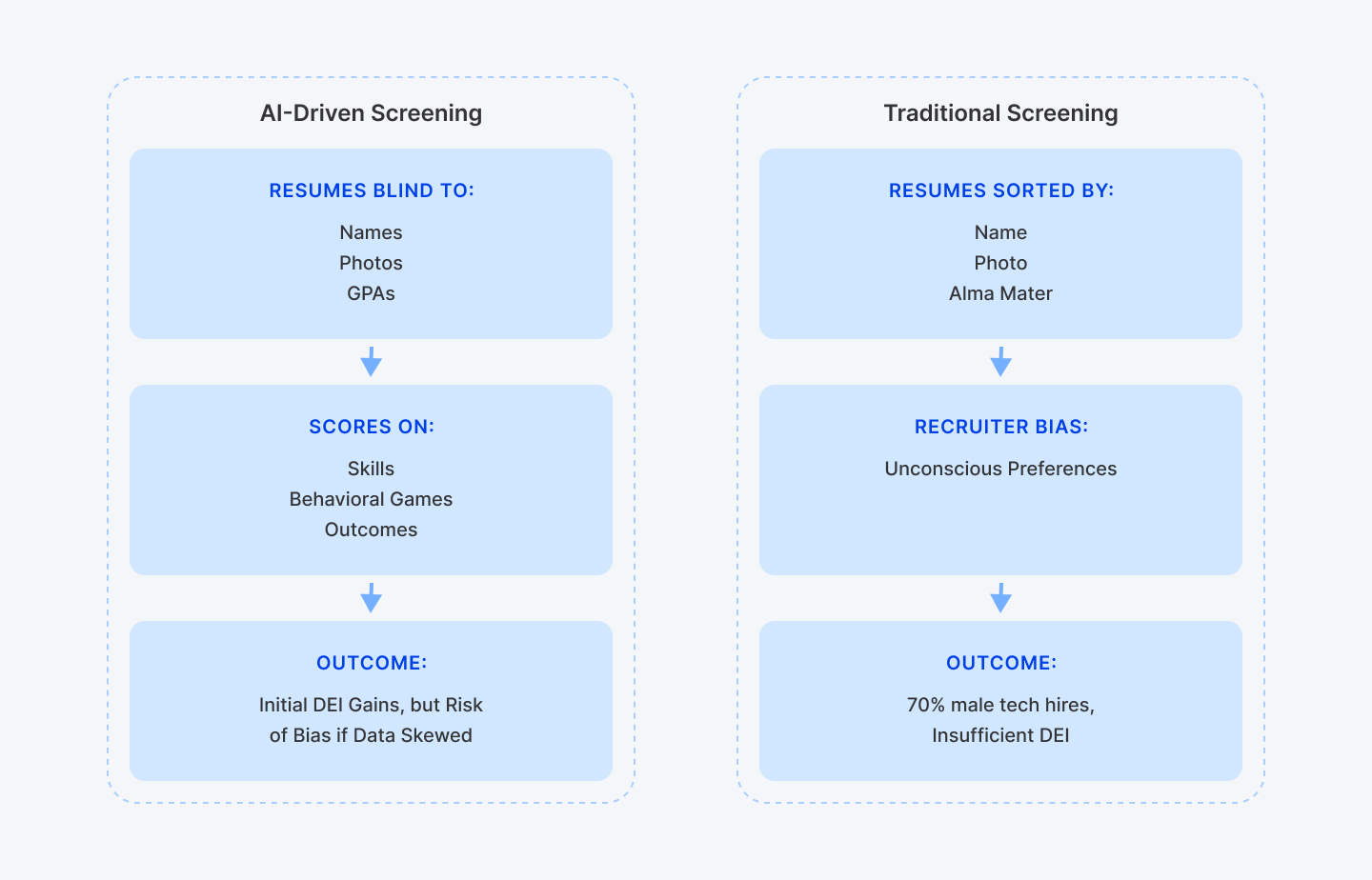
Traditional (light red): Name, photo, alma mater trigger unconscious biases.
AI-Driven (light green): Skills-based and game-based scoring, but can still reflect skewed data.
The Evidence
- Unilever/Pymetrics, 2024:
Campus hires (n=15,000 global) saw female acceptance jump 16 pp (36→52%) after adding Pymetrics. But initially, STEM-major women were under-scored until the algorithm was retrained on real-world performance metrics, then acceptance rebounded to 55% by Q4 2024 (Unilever internal report).
- Frontiers, Feb 2025:
Meta-analysis of 10 studies (n≈25,000 candidates) concluded: while AI can reduce some bias by hiding names, 5 of 10 algorithms still scored non-Western names 80-15% lower even after name masking, thereby indicating systemic data skew (Frontiers, 2025).
What This Means for You
- Monitor Demographics: Quarterly DEI reports to catch any group underscored by AI.
- Retrain Your Models: Use outcome–based data (real performance) rather than historical hires.
- Use Diverse Panels: Combine AI shortlists with diverse human interview teams to counter residual bias.
Reflect
What if your last hire was based on a 2022 model?
Consider retraining on 2025’s performance data to avoid perpetuating hiring gaps.
What Works
In cases where AI is carefully trained, it has helped show candidates who might have been overlooked. By scoring resumes only on qualifications, some tools remove obvious bias triggers.
For example, blind recruiting software can hide names and photos, letting recruiters judge purely on work history.
What’s Hype
Evidence is mixed. A 2024 literature review (Gao et al.) notes that studies disagree on AI’s DEI impact and calls the findings “inconsistent”. In practice, if your AI was trained on mostly one demographic (say, past hires), it may still prefer similar people. In fact, one cautionary research paper says AI “can reproduce and perpetuate diversity bias” and even discriminate based on sensitive traits.
The takeaway is:
AI can help level the playing field, but only if algorithms are fed balanced, fair data and monitored by humans. Don’t assume any AI is a fix-all for bias without checking results.
AI Chatbots in Recruitment: Proven Benefits vs Drawbacks
“At Vodafone UK, 60% of candidate questions were answered by Mya’s chatbot in Q1 2024—leading to a 42% increase in users completing the application form and a 23% reduction in time-to-fill (Vodafone/Mya, 2024).”
Micro-Story: The 70% Drop-Off
Vodafone found that 70% of applicants abandoned their online forms if they didn’t receive a response within 72 hours. After launching Mya in January 2024, 60% of FAQs were handled automatically (e.g., “What’s the salary range?”), boosting form completions by 42% and reducing time-to-fill from 45 days to 34 days.

Mock Chatbot Screenshot
Why It Works
- 24/7 Availability:
Candidates get immediate replies instead of waiting days, eliminating the frustration that causes 70% to quit mid-application (Vodafone, 2024).
- Automated Scheduling:
When a candidate says, “Yes, Tuesday at 2 PM works,” the chatbot—or an ai call assistant handling follow-up calls—can integrate with calendars and confirm availability instantly, filling interview slots without recruiter intervention.
- Data Collection:
Mya collects candidate preferences (e.g., relocation, salary bands) before an interview is scheduled which helps recruiters tailor the conversation.
The Caveat
SHRM Expert Panel, 2025:
“Excessive automation can create an empathy gap. An applicant asking, ‘What’s the team culture like?’ may get a generic reply that overlooks nuance, making them feel undervalued” (SHRM Journal, April 2025).
What This Means for You
- 70% Drop-Off Fix: AI chat keeps candidates engaged, measure completion rates pre- and post-bot.
- Hybrid Handoff: Automate FAQs; ensure a recruiter checks in before any formal interview offers.
- Track Engagement: Compare chatbot vs. human messaging response rates monthly.
Reflect
Think back to your last hire.
If candidates dropped off because of a slow reply, an AI chatbot could have held their interest until a recruiter was free.
What Works
Instant responses keep candidates engaged and reduce frustration. AI-driven job recommenders can also suggest open roles matching a candidate’s profile, making the process feel personalized.
Early studies and industry surveys report that candidates appreciate timely updates and chat answers. Even routine tasks like scheduling interviews can be handled by AI tools, reducing wait times. When done right, AI chat improves the overall hiring experience for people.
What’s Hype
The downside is losing genuine human contact. Industry experts warn that over-automation can make recruitment feel robotic. A recent expert analysis notes that if recruiters “lean into AI assistance… something essential risks being left behind: the human connection”.
For instance, a perfectly scripted AI chat might forget to ask a candidate what they value in a job, which is a key interview question that humans know to ask instinctively.
The best practice is a hybrid:
Use AI chat for basic info, but ensure real people check in for the personal side. Candidates want both fast replies and empathy from you.
Tools That Truly Save You Time: AI Tools in Action
If you’re tired of toggling between LinkedIn, GitHub, and Stack Overflow for candidate data, AI hiring tools brings it all into one view. BetaSoft’s recruiters went from 8 hours/week sourcing to 2 hours/week, focusing instead on meaningful candidate conversations.
Proactive Sourcing
Imagine posting a mid-level Java role at 9 AM. By noon, AI hiring tools surfaces 30 passive candidates, some who never applied, leading to 4 interviews by day’s end.
Real-World Data
- Partner Platform Advantage:
Before AI hiring tools, sourcing top talent took 8 hours/week per recruiter. After, it took 2 hours/week which allowed HR professionals 6 extra hours for human outreach. Result: 3 additional hires per recruiter per quarter.
- McKinsey Global Institute:
Companies using proactive AI sourcing reduced time-to-fill by 33% (from average 60 days to 40 days) and cut cost-per-hire by 15% on agency fees, thanks to in-house AI tools (McKinsey, 2024).
What This Means for You
- Pilot Proactive Source: Test sourcing tools like HireEZ or Manatal for 30 days; measure time-saved vs. your current approach.
- Budget Smart: For mid-size teams, allocate $5K/month; ROI often offsets agency fees in one quarter.
- Train Recruiters: Teach filters (e.g., “Java 5+ years, AWS, Berlin”) to immediately surface high-value candidates.
Reflect
How many hires last quarter came from proactive outreach vs. job-board applications?
AI sourcing can flip that ratio.
What Works
These tools automate many grunt tasks. AI text generators can turn bullet points into a polished job ad draft. Scheduling software can fill calendars.
On the backend, AI-driven applicant-tracking systems can automatically rank candidates. As one literature review summarizes: “By automating mundane operations and evaluating data… AI technologies can drastically cut down on time-to-hire and improve the quality of hiring”. In practice, companies see operational efficiency gains:
- Less manual data entry
- Fewer missed candidates
- More time for strategic HR work
What’s Hype
No tool is a silver bullet. For all the marketing, AI can’t yet replace recruiters. Most AI tools still need human training and review.
A bot-drafted job posting often reads well, but it may miss nuances or tone unless a person edits it. Similarly, AI might schedule an interview, but a coordinator should confirm details. Be especially cautious of vendor claims that a tool will “solve bias” or find unicorn hires with no input. As noted above, unchecked AI can reproduce bias.
Pro Tip
Use AI tools to assist, not to finalize. For instance, let ChatGPT propose interview questions but have a hiring manager vet them. Use AI sourcing and screening tools or similar to pull candidate profiles and then have a recruiter review the list. In short, let AI do the busywork, and keep humans in charge of final decisions.
Explore 17 AI recruiting tools that make finding software engineers easier.
Predictive Analytics: Smart Matches or Wishful Thinking?
Beyond screening, companies are using predictive analytics to guess who will succeed. These systems crunch historical hiring data (past hires’ traits and outcomes) to identify patterns.
In theory, they can highlight candidates whose resumes resemble those of high performers and help you hire the best fit. In practice, some recruiters report higher “candidate quality” when AI helps shortlist, arguing that AI’s objectivity avoids human oversight errors.
What Works
Good predictive models can spot subtle signals (e.g. specific project experience) that correlate with job success. When built on strong data, they help recruiters focus on truly qualified candidates.
For example, one study notes that AI “allows recruiters to identify high quality candidates quickly and reduce the time to hire”. In large companies, highly automated hiring has led to measurable efficiency gains without losing hire quality.
What’s Hype
Predicting people is tricky. If data is messy or not job-related, the predictions aren’t meaningful. AI can only use the signals it knows about. Fake correlations (“model hallucinates fit”) can mislead you.
There’s also a risk of recycling past biases (if historically fewer women were promoted, an AI might under-rate female candidates without realizing it). In short, AI-driven prediction helps support recruiters, but expecting it to replace judgment or guarantee perfect hiring is over-promising. Human oversight is essential to interpret any AI “recommendations.”
What Really Works (and What Doesn’t)
Before you sign an enterprise contract with every AI vendor, pause.
Ask:
‘Which hiring headaches do I need solved right now?’
Self-Assessment
- Do you use any AI resume-screening tools?
- Yes - How often do you audit for demographic parity?
- No - What data/infrastructure would you need to pilot one this quarter?
- On a scale of 1-5, how timely is your candidate's communication?
- If < 3, an AI chatbot could reduce response time from days to minutes, keeping applicants engaged.
- If < 3, an AI chatbot could reduce response time from days to minutes, keeping applicants engaged.
- Are your DEI metrics improving YOY?
- If not, check if your AI was trained on pre-2023 data, which may reflect pre-pandemic hiring patterns.
- If not, check if your AI was trained on pre-2023 data, which may reflect pre-pandemic hiring patterns.
AI in hiring is real and already beneficial, but it’s not the answer to all your prayers. You need to exercise caution and careful consideration while implementing it.
What This Means for You
- Audit Monthly: Check AI shortlists for gender, ethnicity, and age balance. If you see a 12% gap (IBM’s 2024 finding), retrain immediately.
- Use AI as Co-Pilot: Let it handle resumes, scheduling, and sourcing. For final decisions, lean on human judgement (culture fit, soft skills).
- Track Key Metrics: Time-to-hire, drop-off rates, quality-of-hire. Compare AI vs. non-AI periods to measure real impact.
The Bottom Line
Works:
- Resume-screening AIs work:
They save hours by filtering out unqualified applicants and standardizing evaluations. For example, the AI screening (Hilton/Ideal) slashes screening time by 75% and saves $1.2 million/year.
- Predictive hiring works conditionally:
If built on clean, representative data, these models can help identify promising talent faster. Game-based skill assessments (Unilever/Pymetrics) accelerate campus hiring (36 → 9 days) and cut first-year attrition by 20%.
- Chatbots work:
They answer candidate queries 24/7, improve engagement, and streamline early communication. AI chatbots (Vodafone/Mya) handled ~60 % of queries, improving completion rates by ~42 %.
- AI tools:
AI sourcing tools reduce sourcing time by 75% (8 → 2 hrs/week) and cuts time-to-fill by 33%.
You Just Need to
- Pilot One Tool at a Time:
Identify your top pain point (e.g., screening backlog, candidate drop-off, passive sourcing) and measure ROI before scaling. When comparing vendors: ask for a third-party fairness audit, request transparency on algorithmic factors, check integration with your existing HRIS.
- Budget Appropriately:
Allocate a small pilot budget ($3K-$5K for 30 days). Please keep in mind that additional costs due to ongoing subscription, data storage, and retraining costs may be incurred.
- Set Audit Cadence:
Review shortlists for demographic parity, retrain if gaps > 5-10%. Track metrics weekly; time-to-hire, drop-off, quality-of-hire scores.
- Calibrate Based On Data and Results:
Gradually, adjust based on findings, retrain models with fresh data, and expand where you see 20%+ gains.
- Blend Human & AI:
Let machines do the heavy lifting; keep humans for empathy, context, and culture fit.
Doesn’t
- AI can’t fully eliminate bias; IBM’s own system initially scored women 12% lower in tech roles.
- AI chat alone can create empathy deficits if overused (SHRM, 2025).
- “Perfect-match black boxes” without transparency often fallback to keyword matching. So please be skeptical of claims like “100% accuracy.”
Conclusion: AI Is a Tool; Use It Like One
The promise of AI in recruiting is real:
- Faster hires
- Fairer filters
- Smarter workflows
But the hype can be dangerous if it leads companies to automate without thinking. AI should never be a black box that decides who gets a job.
Instead, it should be a transparent, auditable tool that supports human decision-making. By using AI smartly (as a helper, not a dictator) companies get the efficiency and insights of technology without losing what makes recruiting human.
If you remember one thing from this post, let it be this:
AI isn’t here to replace recruiters; it’s here to supercharge them; if used responsibly.
By mid 2025, AI in recruiting is no longer a futuristic pitch but a proven fact. Unilever saw campus‐hire time cut by ~75% and 20% fewer grads leave in year 1. The Hilton/Ideal case above proves that machine-powered parsing is now table stakes.
But AI isn’t magic. If you feed it skewed data (like IBM did in 2024, when women applicants were under-scored 12%) you’ll entrench bias. If you automate every touchpoint, you’ll lose the empathy that makes candidates feel valued.
By combining AI’s speed with your team’s human insight, you’ll build a recruiting process so efficient and empathetic it becomes your competitive moat. After all, the best hires come from data and dialogue.
Let AI handle the busywork. Let humans make the hires.
Access Index.dev's pre-vetted top 5% developers with human-powered matching in 48 hours. Start your 30-day free trial and hire without the bias risks.


