Electron and Node.js are both powerful JavaScript-based technologies that have transformed modern application development, but they serve fundamentally different purposes.
Node.js emerged in 2009 as a JavaScript runtime environment built on Chrome's V8 JavaScript engine, allowing developers to execute JavaScript code outside of browsers. This breakthrough enabled JavaScript to move beyond front-end web development into server-side applications, command-line tools, and more.
Electron, created in 2013 (originally as Atom Shell), is a framework that combines Chromium's rendering engine with Node.js to allow developers to build cross-platform desktop applications using web technologies.
This innovation bridged the gap between web and desktop development, enabling teams to leverage their web development skills to create applications that run natively on Windows, macOS, and Linux.
On one side, Electron empowers you to build feature-rich desktop applications with a single codebase. Conversely, Node.js is known to deliver a robust runtime for scalable server-side applications. This article provide an in-depth analysis of both technologies—exploring their pros, cons, and adaptability for modern cloud-based applications and enterprise solutions.
Need senior Electron & Node.js developers? Hire the top 5% of vetted talent with Index.dev—48-hour matching, 30-day free trial, starting at $50/hr.!
Understanding Electron and Node.js
Overview of Electron
Electron's desktop app development is not just another framework but revolutionary cross-platform services. By cleverly integrating Chromium and Node.js into a single runtime, Electron does something magical by turning web developers into desktop application wizards using web technologies like JavaScript, HTML, and CSS. It offers you a great mix of Native performance and cross-platform flexibility.
Spotlight Applications:
- Slack: Redefining workplace communication
- Visual Studio Code: The developer's ultimate workspace
- WhatsApp Desktop: Proving cross-platform isn't just possible—it's powerful
These apps illustrate Electron’s ability to create immersive, user-friendly experiences across Windows, macOS, and Linux. For further details, refer to Electron’s official site.
Overview of Node.js
Built on Chrome's V8 engine, Node.js isn't playing around. Imagine handling thousands of simultaneous connections like they're nothing more than a light morning warmup. That's Node.js's non-blocking, event-driven architecture in action.
Real-time applications, I/O-intensive processing—Node.js does it all efficiently. With an expansive ecosystem via npm and a robust community, it has become the backbone for many modern web services and cloud infrastructures. Explore more at Node.js official website.
These aren't just technologies. They're your organizational competitive advantage. Electron delivers desktop experiences that feel native, while Node.js powers the backend infrastructure that keeps digital ecosystems running at lightning speed.
Explore More: 10 Software Development Frameworks That Will Dominate 2025
Technical Comparison
Architecture and Core Components
When you compare Electron vs Node.js, the differences in architectural design are fundamental.
- Electron Architecture:
- Multi-Process Model: Electron divides its work between a main process (handling the application lifecycle and native integrations) and renderer processes (each running a web page via Chromium). This multi-process model ensures that the user interface remains separate from backend operations.
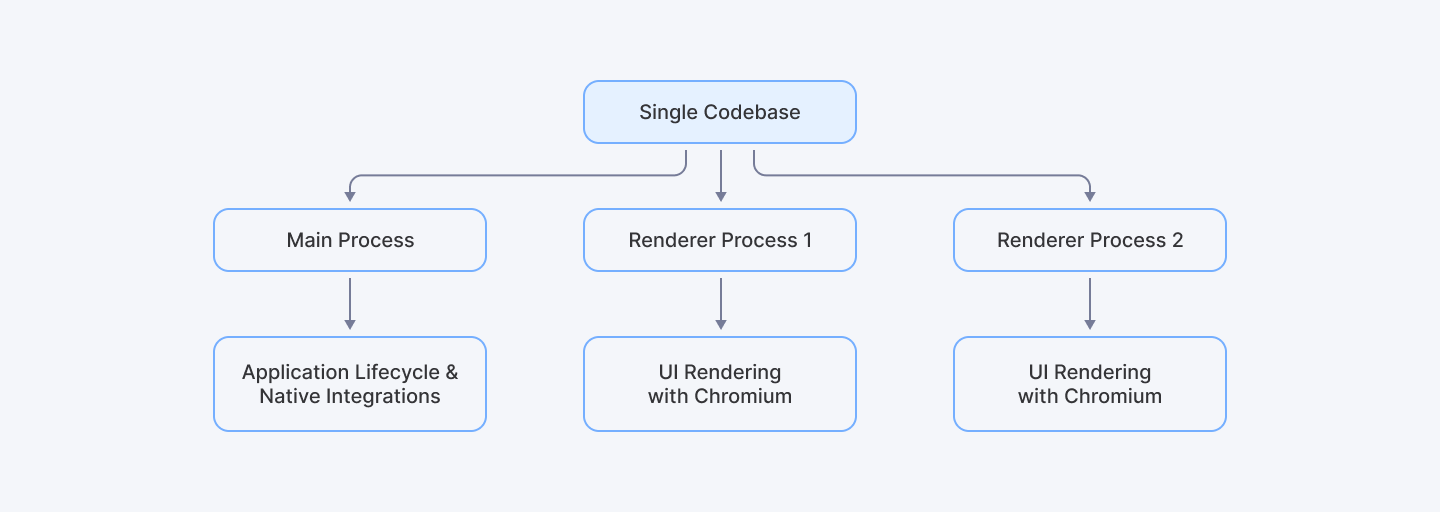
This diagram shows how Electron divides its work.
- Node.js Architecture:
- Single-Threaded, Non-Blocking Event Loop: This design allows Node.js to handle thousands of concurrent connections efficiently, making it ideal for network and I/O-heavy applications.
.png)
The architectural difference isn't just technical. It's strategic, impacting performance and user experience significantly. Technology is about intelligent, purposeful design that makes the impossible look routine, especially in terms of resource consumption and process management.
Development Ecosystem
Both platforms boast rich development ecosystems:
.png)
Here's the unfiltered truth about modern software development: your ecosystem is your competitive edge. Electron and Node.js aren't just tools—they're strategic frameworks that separate the innovators from the followers.
Electron transforms desktop development from a complex puzzle into a streamlined process. By leveraging familiar web technologies, development teams can prototype cross-platform applications with unprecedented speed. We're talking about turning complex ideas into functional desktop experiences without the traditional development headaches.
Node.js is the backend powerhouse that makes scalability look effortless. Its npm repository isn't just a package manager—it's a developer's comprehensive toolkit. With over 68% of professional developers trusting this ecosystem, we're looking at a fundamental shift in backend infrastructure development.
Performance and Scalability
Evaluating Electron vs Node.js in terms of performance involves several key metrics:
- Memory Consumption:
- Electron apps run a full Chromium instance, which can result in higher memory usage compared to lightweight Node.js applications.
- Electron: Typically, Electron applications consume roughly 250 MB at startup, courtesy of its comprehensive runtime environment.
- Node.js: In contrast, a similar Node.js process averages around a svelte 75 MB process that delivers enterprise-grade performance without the computational baggage thanks to its event-driven architecture.

- Loading Time and Overhead:
- Electron may experience slower startup times due to its additional rendering process.
- Node.js, with its lean event-driven architecture, is optimized for speed and scalability in high-traffic environments.
Benchmarks from recent studies highlight that Node.js can handle an impressive amount of concurrent connections without significant performance loss. We're talking about handling 10,000 simultaneous connections without even breaking a digital sweat. This isn't theoretical potential; this is enterprise-grade capability that transforms how serious organizations think about backend infrastructure.
Electron, by contrast, requires a more nuanced approach. It's not about limitations—it's about strategic optimization. While powerful, Electron applications demand meticulous resource management.
Security Considerations
Security remains a critical concern in Electron vs Node.js:
- Electron:
- Cross-site scripting (XSS) and remote code execution vulnerabilities have been noted, highlighting the importance of strong Content Security Policies (CSPs) and dependency management.
- A number of critical vulnerabilities were discovered in 2023, highlighting the need for secure coding practices when developing with Electron.
- Node.js:
- While other platforms are playing defense, Node.js is writing the playbook. They possess an active community that moves fast and helps them to double down on potential security threats. They also engage in regular security updates that make vulnerabilities difficult to cover up.
- Take CVE-2025–23087 as a prime example. Most platforms would panic but Node.js were already ten steps ahead. Their modular ecosystem lets developers swap out vulnerable modules faster.
Market Trends and Business Implications
Adoption Trends in 2024-2025
As we approach 2025, adoption rates for both technologies continue to grow:
- Node.js:
- Research indicates that over 262,000 companies globally have embraced Node.js for backend development, driven by its scalability and performance in handling high-traffic scenarios.
- Electron:
- With the rise of remote work and the demand for cross-platform applications, more enterprises are turning to Electron. Reports show that 56% of companies are planning to adopt Electron-based applications by 2025.
These trends illustrate the expanding role of Electron vs Node.js in modern application development.
Future Outlook
Looking ahead, several trends are set to shape the future of Electron vs Node.js:
- Emerging ECMAScript Features:
- Immutable data structures that were introduced in ECMAScript 2025 revolutionize how we think about code stability. The development paradigms make your applications bulletproof by design. No more unpredictable state mutations. No more debugging nightmares.
- Integration with ML and AI:
- Forget what you know about development workflows. Machine Learning and AI are about to turn your entire process into an intelligent, self-optimizing ecosystem. Imagine applications that don't just run—they learn, adapt, and essentially write themselves.
- Edge Computing and IoT:
- Electron and Node.js are gateways to a world where every device becomes a potential computing powerhouse. Edge devices and Internet of Things (IoT) applications aren't just endpoints; they're distributed intelligence nodes that can process, decide, and act in milliseconds.
Cost Efficiency and Development Speed
Both Electron and Node.js offer distinct advantages in terms of development speed and cost-effectiveness:
- Unified Codebase:
- Utilizing JavaScript for desktop and server-side applications minimizes development time and resource usage—especially valuable for small and medium enterprises.
- Rapid Prototyping vs. Scalable Deployment:
- While Electron facilitates rapid prototyping of feature-rich desktop applications, Node.js is best suited for deploying scalable backend services at speed.
Platforms such as Index.dev see the strategic importance of these technologies. They're not only linking developers—they're connecting the dots between bleeding-edge technologies and enterprise requirements.
Pros and Cons
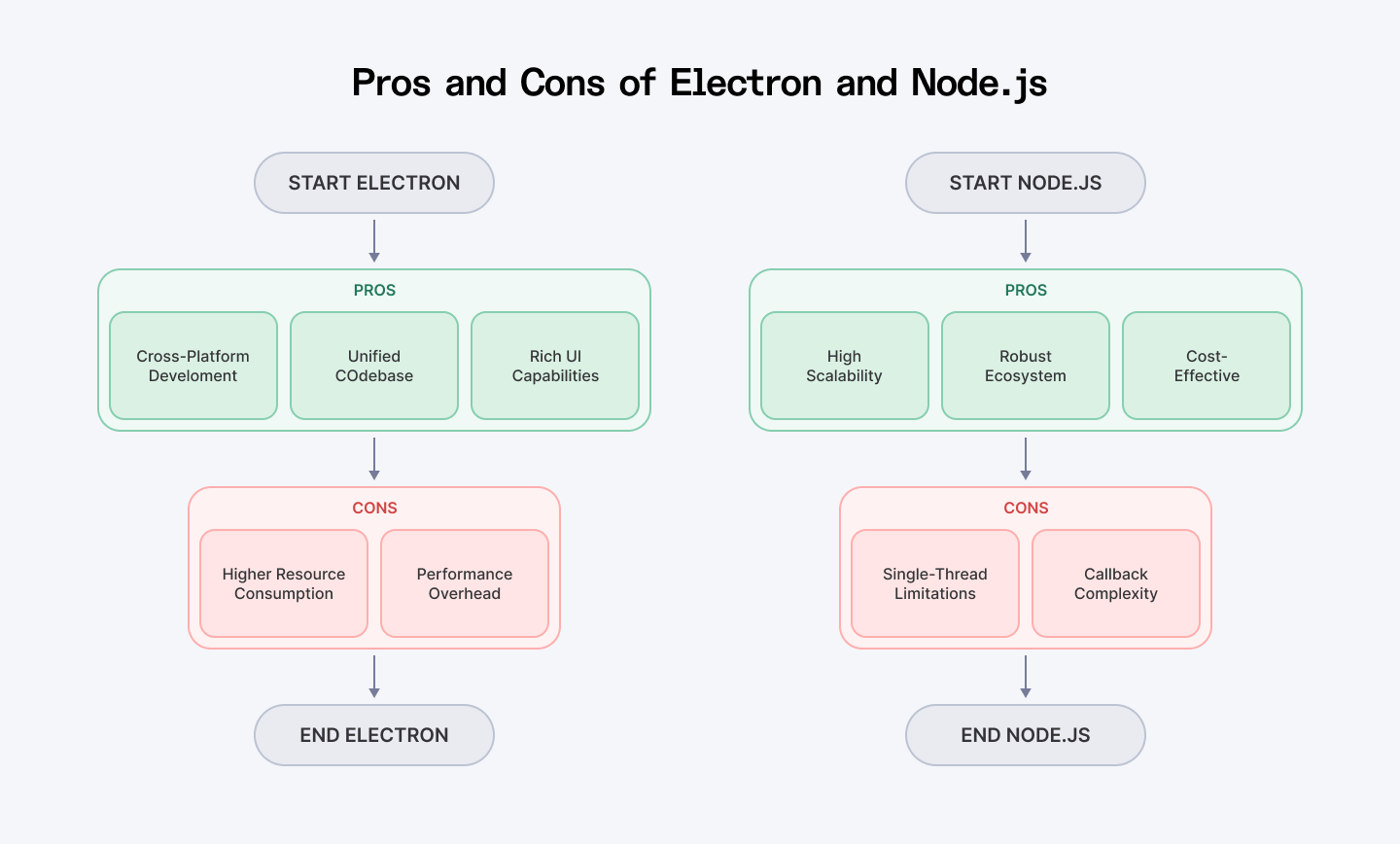
Electron Pros:
- Cross-Platform Development: Build once, deploy everywhere.
- Unified Codebase: Leverage web development skills for desktop applications.
- Rich UI Capabilities: Deliver native-like experiences with familiar web technologies.
Electron Cons:
- Higher Resource Consumption: Bundled Chromium leads to increased memory usage.
- Performance Overhead: Slower startup times compared to native applications.
Node.js Pros:
- High Scalability: Efficiently handles numerous concurrent connections with minimal latency.
- Robust Ecosystem: Access to a massive library of packages via npm.
- Cost-Effective: Lightweight and efficient, ideal for microservices and high-traffic applications.
Node.js Cons:
- Single-Thread Limitations: Although efficient, it may require additional scaling strategies (e.g., clustering) for CPU-bound tasks.
- Callback Complexity: Asynchronous programming patterns can lead to complex code structures without proper management.
Use Cases
Case Studies of Success
Real-world examples underscore the strengths of Electron vs Node.js:
- PayPal (Node.js):
- Transitioning from a traditional architecture to Node.js improved response times by 35%, enhancing backend efficiency and scalability.
- Netflix (Node.js):
- Utilizing Node.js helped reduce startup times by 70%, proving its ability to manage heavy traffic during peak periods.
- Slack (Electron):
- Slack’s desktop application leverages Electron to deliver a consistent, cross-platform user experience while maintaining robust performance.
These case studies highlight that the choice between Electron and Node.js depends largely on the application’s needs and operational demands.
Industry Applications
Desktop Applications
Electron’s capabilities have been demonstrated in leading desktop applications:
- Slack and Visual Studio Code: Both applications leverage Electron to provide rich, interactive experiences across multiple operating systems.
- Enterprise Tools: Organizations increasingly adopt Electron to deliver internal applications that require consistent UI/UX across diverse environments.
Scalable Backend Services
Node.js remains the choice for high-performance server-side solutions:
- Real-Time Data Processing: Node.js’s event-driven architecture makes it ideal for applications that require rapid data exchange and processing.
- Microservices Architecture: Its scalability and modular design support distributed systems that underpin modern cloud infrastructures.
Hybrid Solutions
Many organizations are integrating both technologies to create end-to-end solutions:
- Unified Development: Smart organizations aren't choosing between Electron and Node.js—they're integrating them. A unified JavaScript ecosystem means faster development, consistent experiences, and competitive advantage.
- Combining Electron for the client interface with Node.js powering the backend leads to a cohesive, streamlined architecture that enhances both development speed and operational efficiency.
Recommendations for Developers
For developers planning future projects, consider the following advice when evaluating Electron vs Node.js:
- Choose Electron if:
- Your primary goal is to build a rich, interactive, cross-platform desktop application.
- Opt for Node.js if:
- Scalability, performance, and handling high concurrency on the backend are paramount.
Embracing best practices such as performance profiling, secure coding, and regular dependency updates will be key to leveraging the full potential of these technologies. Don't just adopt technologies—strategically deploy them. Your choice today shapes your technological landscape tomorrow.
Also Check Out: 7 Best Programming Languages for Mobile App Development
Conclusion
Electron and Node.js serve different purposes in the JavaScript ecosystem. Node.js is a server-side runtime for building backend services, APIs, and command-line tools with its efficient event-driven architecture.
Electron combines Chromium and Node.js to enable developers to build cross-platform desktop applications using web technologies (HTML, CSS, JavaScript) that run consistently across Windows, macOS, and Linux.
These technologies are complementary rather than competitive. Electron actually incorporates Node.js in its architecture, demonstrating their relationship. The choice between them depends on your specific needs: Node.js for server-side applications and Electron for desktop applications built with web technologies.
For Developers:
Want to build cutting-edge Electron & Node.js apps? Join Index.dev and get matched with top global companies for high-paying remote projects!
For Clients:
Need top developers for your cross-platform projects? Hire the best through Index.dev's elite network—48-hour matching, 30-day free trial, and more!