The gaming industry will generate an estimated $205 billion in revenue in 2026, up 4.6% from $188.8 billion in 2025, according to Newzoo. That figure exceeds the combined annual revenues of the film and recorded music industries.
Behind every one of those games is source code. Developers choose their programming language based on performance requirements, engine compatibility, and the type of game they're building. The wrong choice can mean months of refactoring. The right choice means faster iteration, better performance, and a smoother path to launch.
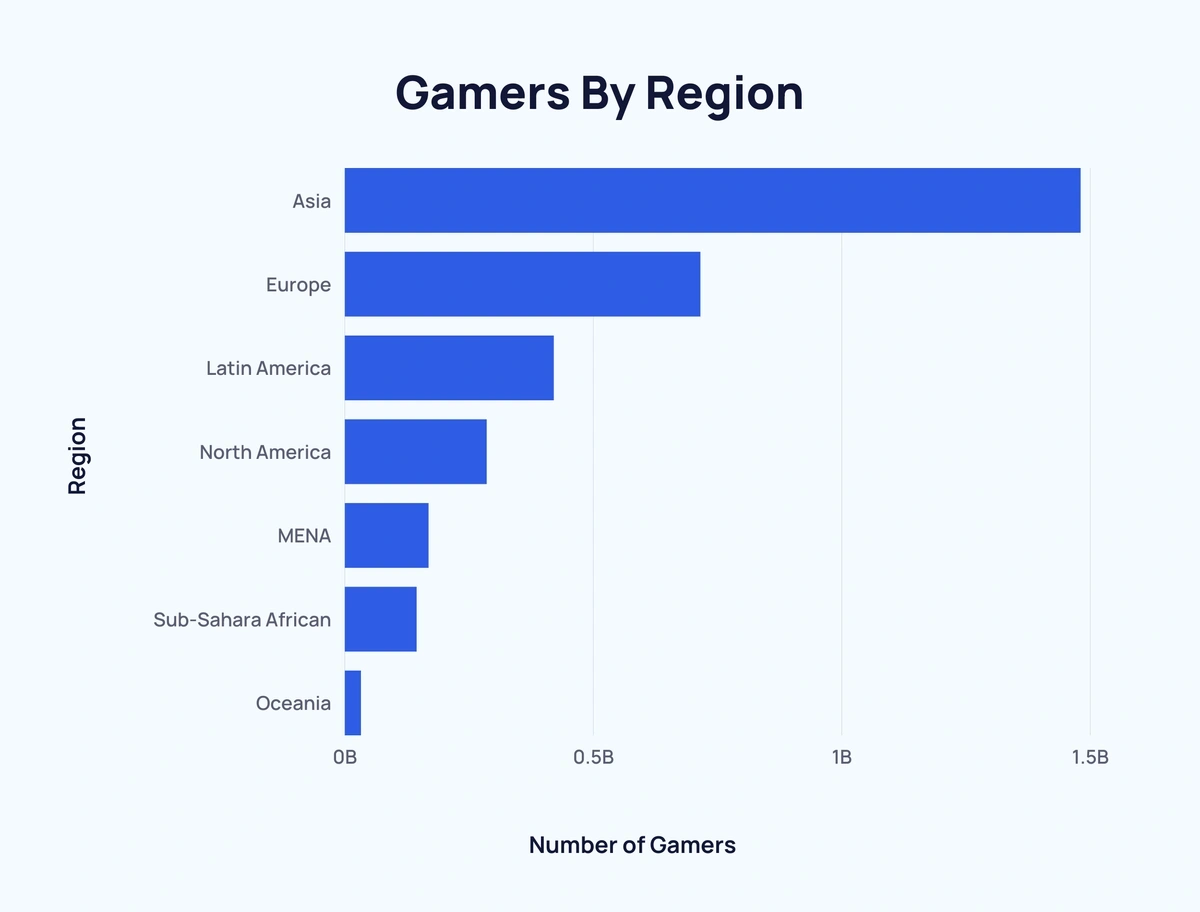
With 3.6 billion gamers across all platforms and mobile gaming alone projected at $107 billion, the demand for skilled game developers has never been higher. Whether you're building a AAA title, an indie platformer, or a mobile hit, your language choice shapes everything.
Need game developers fast? Index.dev places verified senior engineers into your team from day one, including specialists in C++, C#, Rust, and Unity.
Here are the 7 programming languages leading game development in 2026.
1. C++
C++ remains the undisputed king of game development in 2026. It has held this position for over two decades, and for good reason. When you need maximum performance and full control over hardware, nothing else comes close.
C++ powers Unreal Engine 5, the engine behind the most technically demanding AAA titles shipping today. UE5 games earned 31% of all Steam revenue in 2024, making it the single highest-revenue engine on the platform.
3 Key Game Development Features
Performance: C++ delivers the raw speed that modern games demand. It gives developers fine-grained control over memory allocation and CPU usage. For physics simulations, real-time rendering, and open-world games with millions of objects, this level of optimization is non-negotiable.
Close to Hardware: C++ provides direct access to GPU and CPU features. This "close to the metal" capability is critical for low-level graphics rendering, physics engines, and input/output operations. Games built in C++ can squeeze maximum performance from the underlying hardware.
Engine Ecosystem: The major game engines are built on C++. Unreal Engine, CryEngine, and Godot's core all use C++ under the hood. UE5 adoption reached 72% among Unreal developers in 2024, showing strong momentum for the latest version.
Also read: C++ vs Rust: Is C++ being replaced by Rust
Popular Games: Minecraft (Bedrock Edition), World of Warcraft, League of Legends
2. C#
C# is the scripting language of Unity, the most widely used game engine by game count. Unity powers 51% of all games released on Steam and remains the go-to engine for mobile, indie, and cross-platform development.
C#'s combination of strong object-oriented programming, readable syntax, and seamless Unity integration makes it the most accessible entry point for professional game development.
3 Key Game Development Features
Unity Integration: C# is Unity's primary scripting language. Unity's ecosystem provides tools, assets, and resources that cover everything from 2D mobile games to 3D console titles. C# integrates directly with Unity's components and APIs, letting developers focus on game logic and design while Unity handles rendering and physics.
Object-Oriented Programming: C#'s strong OOP model enables developers to organize code into reusable, modular objects. This is essential for managing complex game systems, character behaviors, and interactive elements. OOP keeps large codebases maintainable as projects scale.
Cross-Platform Reach: C# through Unity targets every major platform: iOS, Android, Windows, macOS, consoles, and WebGL. The MonoGame framework extends C#'s reach to Xbox and PlayStation development outside of Unity.
Popular Games: Pokemon Go, Super Mario Run, Temple Run
Apply for C# jobs on Index.dev. High-paying remote software jobs with top US, UK & EU projects.
3. Rust
Rust is the biggest newcomer in game development for 2026. While C++ still dominates, Rust offers the same level of performance with built-in memory safety. No null pointer crashes at runtime. No use-after-free bugs corrupting game state.
The Bevy Engine has become Rust's primary vehicle for game development. Bevy is an open-source, data-driven, entity-component-system (ECS) framework that has grown to 18,000+ GitHub stars and 261 contributors in its latest 0.16 release.
3 Key Game Development Features
Memory Safety Without Garbage Collection: Rust's ownership model prevents entire classes of bugs at compile time. In game development, this means fewer crashes, fewer memory leaks, and less time debugging. You get C++ speed without the C++ footguns.
Bevy Engine and ECS Architecture: Bevy 0.16 introduced GPU-driven rendering for faster performance on complex scenes, occlusion culling, and ECS relationships for entity-entity connections. Developers with a software engineering background tend to prefer Bevy's clean architecture over traditional game engines.
WebAssembly Support: Rust compiles to WebAssembly natively, making it viable for browser-based games with near-native performance. This opens a distribution channel that C++ can't match as easily.
Popular Games: Veloren (open-source voxel RPG), Tiny Glade, various indie titles on itch.io
4. JavaScript
JavaScript's role in game development is tied to the web. With HTML5 now mature and WebGL widely supported, JavaScript-powered games run directly in browsers on any device without installation. For casual games, social games, and gamified web experiences, JavaScript is the practical choice.
3 Key Game Development Features
Web Technology Integration: JavaScript integrates natively with HTML5 and CSS, enabling games that run in any modern browser. No app store approval. No downloads. Players click a link and play. This frictionless distribution is why many casual and social games choose JavaScript.
Built-in Stability and Hosting: Hosting a JavaScript game is as simple as hosting a website. The deployment and maintenance overhead is minimal compared to native game distribution. Updates ship instantly without requiring players to download patches.
Animation and Interactivity: JavaScript's animation APIs, combined with libraries like Phaser, MelonJS, and Three.js, make it straightforward to build visually engaging 2D games and lightweight 3D experiences. The ecosystem of pre-built elements accelerates development, making it ideal for building an interactive portfolio or rapid prototypes.
Popular Games: Angry Birds (web version), Gods Will Be Watching, Cross Code, Wordle
5. Java
Java's platform independence makes it a strong option for mobile and indie game development. Games written in Java run on the Java Virtual Machine (JVM), which means a single codebase can target Windows, macOS, Linux, and Android without major modifications.
3 Key Game Development Features
Platform Independence and JVM: The JVM abstracts away hardware differences. Java games run on any platform with a JVM installed, which includes billions of Android devices. This portability reduces the cost and complexity of cross-platform development.
[Multithreading](https://www.digitalocean.com/community/tutorials/multithreading-in-java) and Performance: Games need to handle gameplay logic, rendering, and user input concurrently. Java's built-in multithreading support manages these tasks efficiently on a single CPU. Combined with Just-In-Time (JIT) compilation and modern garbage collection, Java's performance is more than adequate for most game types.
[Socket Programming](https://www.ibm.com/docs/en/i/7.1?topic=communications-socket-programming) and Multiplayer: Java's robust networking capabilities make it well-suited for multiplayer games. Establishing real-time connections between players is straightforward with Java's socket programming APIs.
Popular Games: Minecraft (Java Edition), Runescape, Mission Impossible III
6. Python
Python is not built for high-performance game development. Its speed can't match C++ or Rust. But it excels in two areas: learning and prototyping. For beginners building their first game or studios rapidly testing gameplay mechanics, Python removes the complexity and lets you focus on the idea.
3 Key Game Development Features
Beginner-Friendly Syntax: Python's readability makes it the best starting language for aspiring game developers. New programmers can grasp core concepts without being overwhelmed by complex syntax, focusing instead on game mechanics and design patterns.
PyGame Library: PyGame provides built-in tools for handling graphics, sound, and user input in 2D games. It's platform-independent, comes with straightforward installers, and has extensive documentation. For small-scale projects and game jams, PyGame is hard to beat.
AI and Procedural Generation: Python's dominance in machine learning makes it useful for game AI prototyping, procedural content generation, and data-driven game design. Many studios use Python for tooling and pipeline scripts even when the game itself runs in C++.
Popular Games: Mount & Blade (scripting), Toontown, Battlefield 2 (scripting layer)
7. Lua
Lua is the scripting language behind [Roblox](https://www.roblox.com/), and in 2026 that alone makes it one of the most important languages in gaming. Roblox has over 80 million daily active users, and all game logic on the platform is written in Luau, Roblox's extended dialect of Lua.
Beyond Roblox, Lua's lightweight footprint and embeddability make it the go-to scripting language for extending game engines.
3 Key Game Development Features
Lightweight and Fast: Lua is designed for resource-constrained environments. Its minimal footprint and high-speed execution make it ideal for mobile games, embedded systems, and any scenario where performance optimization is critical.
Embeddability and Scripting: Many game engines integrate Lua as their scripting layer. Corona SDK, World of Warcraft's add-on system, and numerous custom engines use Lua for gameplay scripting. Its simple syntax enables rapid prototyping and iteration.
Extensibility: Lua extends easily through C/C++ libraries, connecting scripted gameplay logic with high-performance engine codebases. The active Lua community provides libraries, frameworks, and game-specific tools that accelerate development.
Popular Games: Roblox (Luau), Age of Conan, Broken Age
Which Language Should You Choose?
The right language depends on what you're building. Here's a quick reference:
| Game Type | Best Languages |
| Simple / Casual Games | Python, Lua, JavaScript, C# |
| 3D Games | C++, C#, Rust |
| AR/VR Games | C++, C#, JavaScript |
| PC Games | C++, C#, Rust, Java |
| Console Games | C++, C# |
| AAA Games | C++, C# |
| Android Games | Java, C++, C#, Kotlin |
| iOS Games | Swift, C++, C# |
| Web Games | JavaScript, Rust (WASM) |
| User-Generated Content | Lua (Roblox), C# (Unity) |
How Index.dev Helps You Build Game Development Teams
Finding developers who combine deep language expertise with game development experience is difficult. A strong C++ programmer isn't automatically a strong Unreal Engine developer. A skilled C# developer might have no Unity experience.
At Index.dev, we vet game developers for both language proficiency and engine-specific expertise. From thousands of monthly applications, less than 5% are accepted into our talent network. Every developer goes through technical assessments, live coding sessions, and culture fit evaluations before they're available for placement.
Whether you need a C++ engineer for an Unreal Engine project, a C# specialist for Unity, or a Rust developer exploring Bevy, we can match you with verified talent in 48 hours.
Want to go deeper? Explore the most popular programming languages in 2026 or learn how C++ compares to Rust for performance-critical applications.