At Index.dev, we don't believe in "matching and ghosting." We believe in building a career home for the world's best engineering talent.
To make sure we're doing that, we run our Net Promoter Score survey with our engineering talent twice a year, every year. Eight consecutive periods of asking the same honest question:
Would you recommend working with Index.dev to someone in your network?
The answer, consistently, has been yes.
In the staffing and recruiting industry, an NPS above 70 is considered world-class. We've been above that threshold every single time, which puts us among the top-tier service providers globally. Our latest score is 76.79—a result mentioned as world class.
Here’s what we’re seeing, what engineers value most, and how we’re acting on what they tell us.
The Benchmark
Running NPS consistently lets us track trends, catch new challenges early, and celebrate what's working well. It tells us how our team, our processes, and our projects impact engineers day to day. In an industry where expectations shift fast, projects evolve constantly, and remote work can feel isolating, that kind of honest feedback is hard to replace.
For H2 2025, our talent network gave us an NPS of 76.79.
- The 70+ club: We have kept our NPS above 70 for eight consecutive surveys, that’s four years of sustained excellence.
- A network of advocates: 78.57% of our engineers are Promoters, meaning they would actively advocate for Index.dev to their peers.
- Minimal friction: Only 1.79% of respondents are Detractors, a remarkably low figure for a global network of our scale.
It means that three out of four engineers in our network would actively recommend Index.dev to someone they know. It means that even as we scale, the core of what we do, treating engineers like partners rather than resources, is holding up.
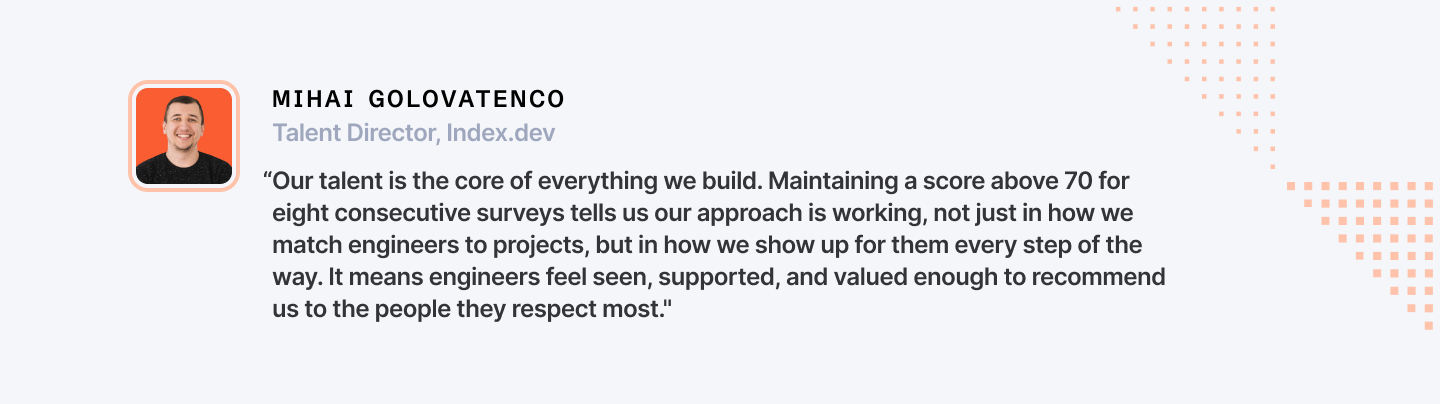
As our Talent Director Mihai Golovatenco, puts it:
“Our talent is the core of everything we build. Maintaining a score above 70 for eight consecutive surveys tells us our approach is working, not just in how we match engineers to projects, but in how we show up for them every step of the way. It means engineers feel seen, supported, and valued enough to recommend us to the people they respect most."
⭢ Curious how we hit our record NPS of 85.45? See the full breakdown of what drove our highest talent satisfaction score yet.
What Our Talent Appreciates
We read every comment. And across every survey, the same themes keep coming back. But none of this happens by chance.
We’ve been able to maintain this level of satisfaction because we don’t just focus on placing engineers. We focus on building the right environment around them.
That starts with how we match.
We don’t just match talent to clients. We match clients to talent. That means working with companies that respect engineers’ time, value their work, and know how to collaborate effectively. It’s a two-way fit, not a one-sided placement.
We also set clear and realistic expectations from the start. Engineers know what they’re stepping into. Clients know what good looks like. That alignment removes friction early and creates a smoother experience for everyone involved.
On top of that, we’ve built a clear framework for collaboration. Who to talk to, how things work, what happens when something changes, it’s all defined. Engineers don’t have to guess or chase answers.
We make onboarding straightforward and practical. No unnecessary complexity, just the information people need to get started and feel confident from day one.
And behind all of this, our internal tools support the experience. From timesheets to reporting, everything is designed to be simple, transparent, and easy to use, so engineers can focus on their work, not on admin.
That foundation is what enables the feedback we see below.
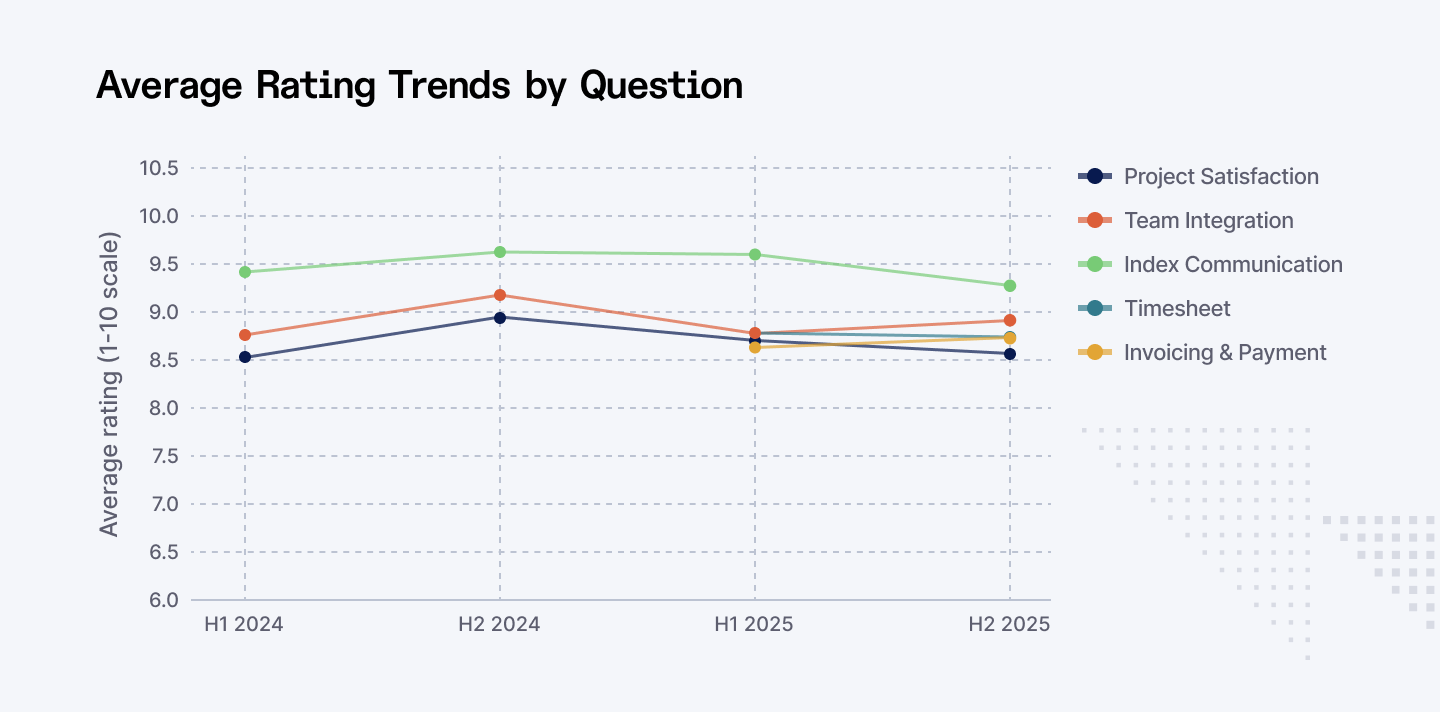
Here's what our engineers value about working with Index.dev:
The way we work together
This is one of the strongest and most consistent signals across all eight surveys. Engineers know what's expected of them. They know who to talk to. When something comes up, they get answers, fast.
That doesn't happen by accident. Our Account Managers for Developers exist specifically to keep communication clear, human, and responsive throughout the entire engagement, not just at the start.
The result is that engineers spend less energy managing the relationship and more energy doing the work they were assigned to do.
"Overall, the collaboration process works very well, so I wouldn’t suggest changing much. The responsiveness of the team makes a huge difference in staying on track." — Developer Survey Respondent
The freedom to do the work
This one comes up constantly, and it matters more than it might seem on the surface. Deep, focused work is where engineers do their best thinking. Fragmented days full of unnecessary check-ins and low-value meetings don't just waste time, they break flow and drain motivation.
We deliberately match our talent with clients who understand that. Organizations that value output over optics, and trust their engineers to work. The feedback reflects that clearly.
"The main things I appreciate are the freedom to focus on the work, the absence of constant distracting meetings, and the overall professionalism of the team." — Developer Survey Respondent
Getting paid on time
In global contract work, payments are often the single biggest source of frustration. Delays, unclear timelines, unexpected fees, currency conversion headaches. When this part of the experience breaks down, it poisons everything else. When it works well, engineers barely think about it. Which is exactly the point.
Invoicing is simple. Payments arrive on time. The process is predictable. That might sound like a low bar, but in this industry it's genuinely rare, and our talent notices. Something as straightforward as reliable payments builds a level of trust that's hard to earn back once it's lost.
"Quick payments, easy invoicing process. It’s a reliable workflow that lets me focus entirely on my project." — Developer Survey Respondent
Tools that got better
One of the clearest signs that feedback loops are working is when something that used to frustrate people starts showing up as a positive. The timesheet experience is a good example of that. It was a recurring pain point in earlier surveys. In H2 2025, engineers are calling it out as something that works well.
That shift happened because we listened, made changes, and kept iterating.
"The timesheet experience has been smooth overall. The addition of group processing for tasks was a great improvement." — Developer Survey Respondent
Support that’s there
Contract work can feel isolating, especially when something goes sideways. A project changes scope. A client relationship gets complicated. A technical blocker appears out of nowhere. In most contractor arrangements, you navigate that alone. Not here. Our engineers know there's someone in their corner who will pick up the call, hear them out, and help find a path forward. That's just how we operate. And engineers feel the difference.
"Willingness to listen." — Developer Survey Respondent
It's a short line. But it shows up across surveys, across periods, across different engineers in different time zones on different projects. And it says a lot. Because in the end, beyond processes and tools, people want to know they’re not on their own.
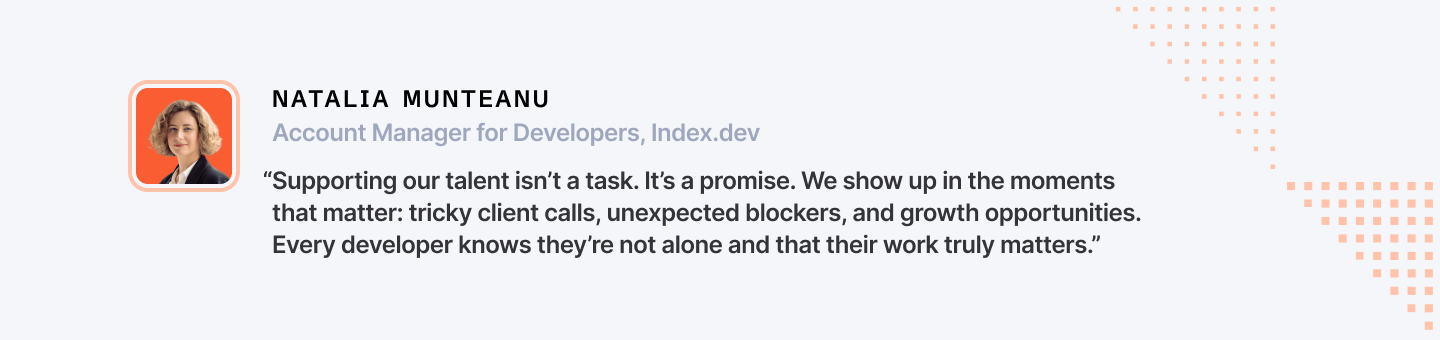
As Natalia Munteanu, Account Manager for Developers, explains:
“Supporting our talent isn’t a task. It’s a promise. We show up in the moments that matter: tricky client calls, unexpected blockers, and growth opportunities. Every developer knows they’re not alone and that their work truly matters.”
What We're Learning and Acting On
No survey is perfect. And no process is ever finished. That’s the whole point of running NPS this consistently. It shows us what’s working, but just as importantly, it shows us where we need to get better.
And when engineers take the time to give honest feedback, we take that seriously.
What we heard
The feedback this period pointed to a few recurring themes. Getting started felt harder than it should for some engineers. A handful of developers were moved across multiple projects more than they'd have liked, which disrupts focus and makes it difficult to build momentum. Payment timing, while reliable, wasn't always predictable enough for people to plan around.
What's already been fixed
We recorded step-by-step video walkthroughs covering how to fill in timesheets and submit invoices, shared them with all active talent, and built them into the onboarding flow going forward. We also rewrote the onboarding message itself to set clearer expectations from day one, covering project assignment, payment windows, and where to go for support.
Payment communication was another quick fix. After seeing feedback around uncertainty, we made the payment window clear and consistent across the network.
What we’re improving now
We're embedding all key onboarding resources directly on the workspace page, right where engineers need them. Project stability is another focus. We’re working on better planning and clearer visibility, so engineers know what to expect and can rely on more consistent project setups. Contracts are also being reviewed to make sure expectations are fair and balanced on both sides.
And our Account Management team is already booking 1:1 calls with every engineer who gave us constructive feedback. If someone isn't fully happy, we want to understand why and work toward fixing it. As Natalia puts it:
"We take the feedback personally. If a developer gives us a 7 or an 8, we're on a call with them the next day to find out how to make it a 10."
Some improvements are already live. Others will take more time or deeper analysis before we get them right. What matters is that we act on what we hear, and we make sure engineers know their input is taken seriously.
⭢ See how Index.dev connected top UX designers with Fishbrain to build a standout app and grow careers. Read the full case study next.
Retention Over Everything
At the end of the day, our goal is the highest possible retention of talent. A developer who's been on the same project for a year knows the codebase, knows the team, and ships better work than someone who just onboarded. Clients get continuity. Engineers get stability and room to grow. The whole Index.dev network gets stronger. That's the compounding effect of getting this right, and it's why we care so deeply about the experience behind the score.
That's the goal behind every survey, every action plan, every check-in call. Not a number, but a relationship that works for everyone in it. We listen. We act. We improve. And every time we do, we build a stronger, more resilient network. For our talent, our clients, and our mission.
Thank you to everyone who shared their thoughts this period. We're already working on making H1 2026 even better.
➡︎ Be part of a trusted engineering network where feedback is heard, projects are stable, and your career thrives.