Let’s get straight to it. Our Net Promoter Score this year is 85.45.
It comes directly from the tech professionals who build products for our clients every day. The people writing the code, fixing the hard problems, shipping real features, and seeing exactly how we work behind the scenes.
It’s a rare score in any industry. In offshore tech recruitment, where projects move fast, expectations shift, and experiences can differ from one placement to the next, it’s even rarer.
We run our NPS surveys twice a year because they keep us honest. They show us whether our communication helps or distracts, whether projects help people grow or burn them out, whether developers feel part of the team or left on the side, and where we still need to improve.
Last year, our NPS was 76. This year, it’s 85.45. But the number alone isn’t the story. What matters is why our contractors rated us this way:
- Why they feel supported.
- Why they trust us.
- Why they recommend us.
- And what this means for anyone thinking about joining Index.dev or hiring through us.
This is their story.
Let’s break it down.
Join Index.dev and work remotely on exciting projects that help you grow and get paid fairly.
1. Project Satisfaction and Team Integration
What this category really measures
- Are developers happy with the project they’re working on
- Do they feel part of the client’s team
- Are they learning, growing, and doing meaningful work
Here's something most talent networks and tech recruitment platforms won't tell you: they'll place you anywhere that pays. The project could be mind numbing, the team could be a disaster, and as long as the invoice clears, they're happy.
We're not built that way.
Project quality is the foundation. A developer spending 40+ hours a week on work that doesn't challenge them or teach them anything isn't just unhappy. They're stagnating. Their skills plateau. Their motivation tanks. And eventually, they leave, either physically or mentally.
When we asked developers about the projects they're working on and how integrated they feel with client teams, the responses showed something clear. They're not just clocking in. They're challenged. They're growing. They're actually part of the teams they work with.
And this year’s feedback reminded us exactly why we care so much about the match.
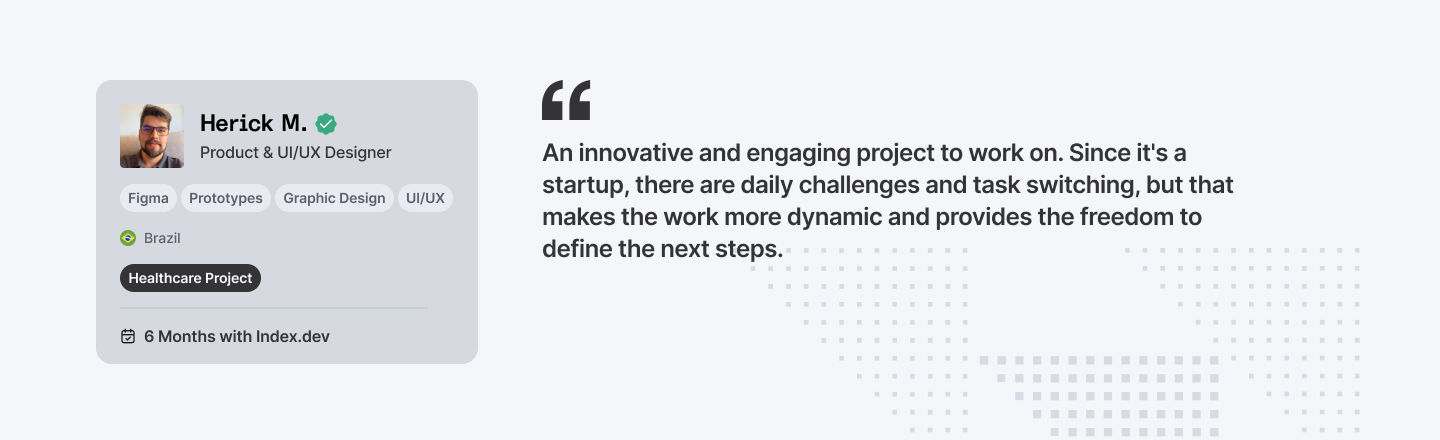
Herick is building inside a fast-moving AI healthcare project where nothing stands still. That kind of environment forces you to think, stretch, create, adapt. The right project doesn’t just use your skills. It improves them.
The integration piece matters just as much. Remote work can be surprisingly lonely when it’s done wrong. You’re present in the tools but absent in the team. You’re in meetings but not included. You ship code but don’t share ownership.
When that happens, you stop feeling like a teammate and start feeling like a service provider. A line item.
That’s exactly what we work hard to avoid.
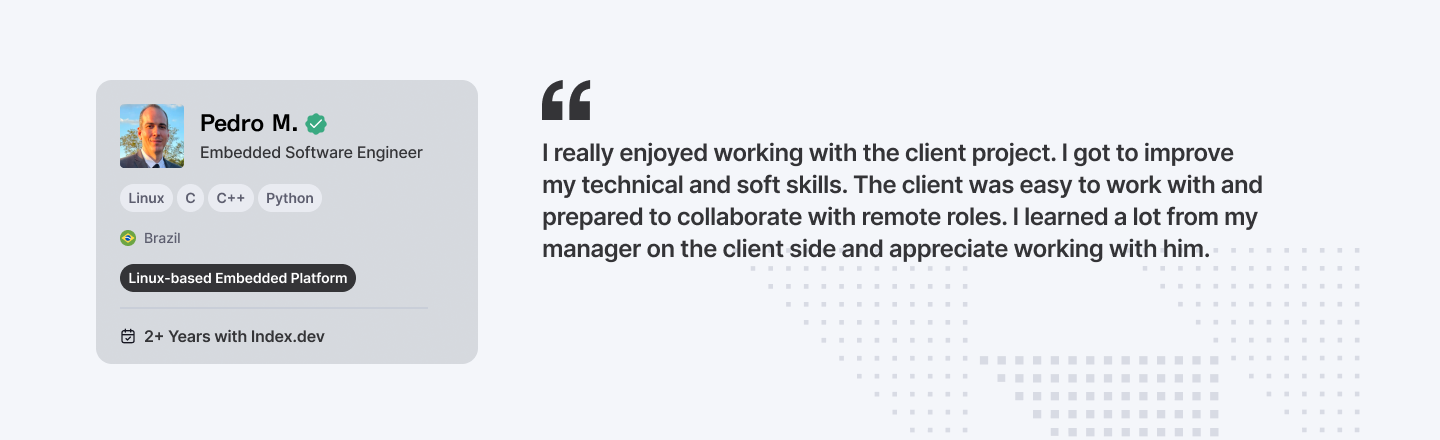
Pedro's experience shows what happens when the match is right. The client wasn't just tolerating remote work. They were set up for it. The manager wasn't just delegating tasks. He was teaching. Giving feedback. Treating Pedro like a team member.
That's not luck. That's what happens when placements are intentional. When we're matching people based on more than just "Do the skills on the resume match the job description?" we're looking at work style, team culture, growth trajectory, project complexity. The things that determine whether someone thrives or just survives.
“The team is very supportive and I'm learning new technologies.” - Vitor O., DevOps Engineer assigned to an EdTech Platform
Why does this category matter for a talent network? Because if the projects are bad or you're treated like an outsider, no amount of "support" or "benefits" will fix that. The work itself has to be worth doing. The team has to treat you like you belong.
When a developer feels challenged and integrated, everything else clicks. The project moves faster. The client gets better output. The developer grows. Everyone wins. And this year's feedback reminded us exactly why we obsess over getting placements right.
As our Account Manager for Developers, Natalia Munteanu, puts it:
“We don't measure success by how many placements we make. We measure it by how talent is still thriving six months, a year, two years later. That only happens when they know someone's genuinely looking out for them, not just when things are easy, but especially when they're not.”
2. Communication and Developer Assistance
What this category really measures
- How connected developers feel to Index.dev
- How well we support them once they start
- Whether they feel heard, backed up, and taken seriously
Most contractors know this scenario too well. You get placed on a project, and that’s the last time you hear from the agency. You become a ghost they only summon when it’s time to send an invoice or extend a contract. If anything goes wrong, you’re basically on your own.
This is exactly the experience we refuse to recreate.
Our Account Managers for Developers exist for one reason. To make sure our contractors never feel abandoned. They check in regularly. Not to breathe down your neck or hover over your work. They check in to catch problems early. To help you handle team dynamics. To make sure you’re not silently struggling or dealing with something that could be fixed with one conversation.
This category scored highest in our survey. Engineers feel heard and supported, which shouldn't be remarkable but apparently is.
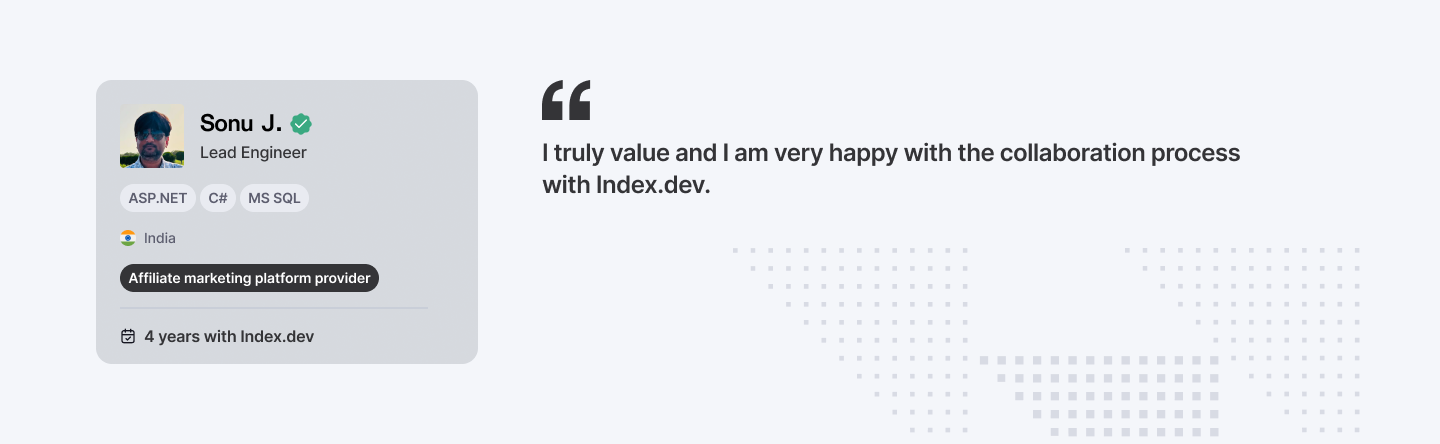
Sonu has been with Index.dev for four years and recently stepped into a tech leadership role at NetRefer. You don’t stay somewhere that long unless the relationship works both ways.
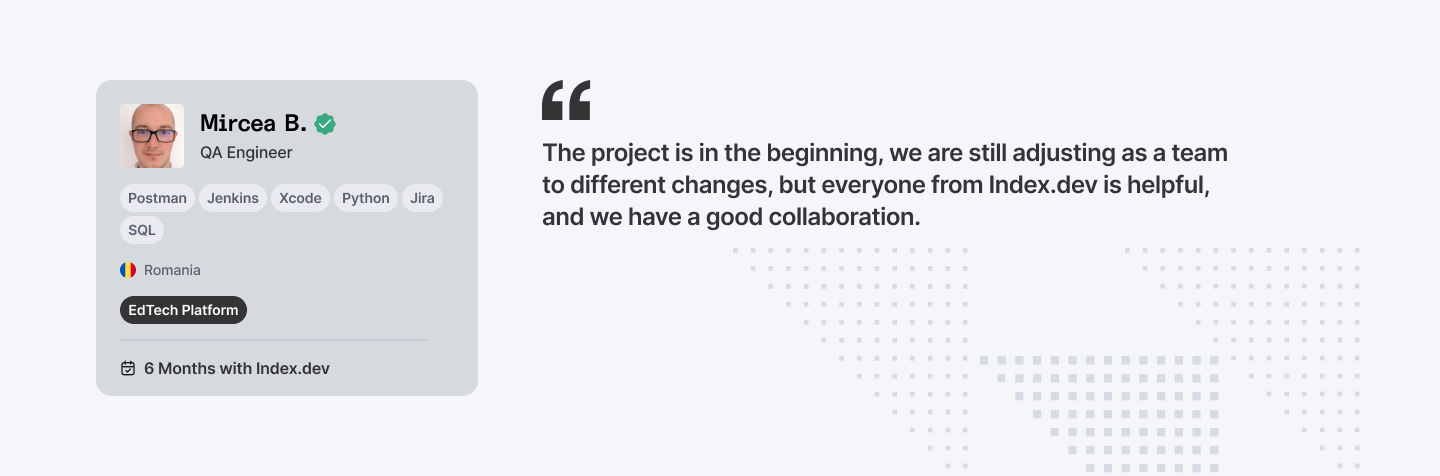
Even in the early, messy stages of a project, Mircea felt supported. That matters. That’s usually the stage where things fall apart without someone watching your back.
We also got honest feedback about what to improve. And we appreciate that more than anything. Andrei P. (Test Automation Engineer / EdTech Platform in the U.S.) joked that fewer questionnaires would help (fair point), and Rafael F. (Engineering Tech Lead / Healthcare Platform in the U.S.) asked for the option to choose his payment date so he could organize his bills better. Also fair.
We’re already looking into how to make both of these happen. This is why consistent communication matters so much. Contract work is unpredictable by nature. Clients change scope midstream. Projects hit technical walls no one saw coming. Budgets get slashed. Priorities shift. Teams reorganize. When that happens and you have no one checking in, you carry all of the uncertainty alone.
But when someone understands your situation and stays close to your reality, you don’t just survive these changes. You adapt. You grow. You make smarter decisions. And you avoid a lot of unnecessary pain.
3. Invoicing and Payments
Why this category matters:
- Payment issues break trust instantly
- Speed builds trust instantly
- There is no in-between
Getting paid shouldn't be hard. It definitely shouldn't be stressful. But for contractors working internationally, it usually is both. You finish the work. You send the invoice. Then you wait. And wait. The money shows up eventually, maybe two weeks later, maybe three. Banks take their cut. Fees stack up. Currency conversion becomes a puzzle.
This is why we launched Index.wallet this year. It’s our digital wallet powered by Cadana’s payment infrastructure and it lets us pay talent in more than a hundred countries from one system. No more scattered tools. No more “waiting a few more days.” No more mystery fees.
And tech talent feel the difference.
"On payment I have absolutely no issues. Payments are processed very fast." - Latchezar N., Backend Developer assigned to an AI Platform for Investors
Latchezar’s experience is exactly the point. Payments should feel boring. Reliable. Something you don’t have to think about.
“I'm enjoying the current payment system. Especially since I'm now paying fewer fees.” - Marcelo K., PowerBI Developer assigned to a Managed Service Provider
Lower fees matter. A lot. Not just because it’s money saved but because it signals respect. You shouldn’t lose income simply for living in a different country.
So why does invoicing matter so much in our NPS? Because getting paid reliably and quickly isn’t a perk. It’s basic respect. It tells people their work is valued. It removes stress from the job. It lets them focus on building great products instead of tracking down when their money will arrive.
People don't need complicated payment processes or innovative financial products. They need their money to arrive fast, safe, and predictable. Every single time. No surprises. No excuses. No waiting around wondering if this month will be different.
4. What Developers Appreciate Most About Working With Index.dev
This is where everything comes together. Quality of projects. Support. Payments. Transparency. Communication. All of it.
It's the ultimate test because people don't recommend things that waste their time or let them down. When you tell someone else to work with a company, you're putting your reputation on the line. You're saying "I trust this enough to attach my name to it." So when we ask developers if they'd recommend Index.dev, we're not just collecting a score. We're asking if we've earned that level of trust.
Their answers showed what matters most to them.
“Longer term projects, diverse team, and a lot of room available for growth in a specific role.” - Saim A., UI/UX designer assigned to an Affiliate Marketing Platform Provider
Saim highlights something crucial. Contract work often means hopping from gig to gig, never going deep, never feeling secure. Longer-term projects allow developers to focus, grow their skills, and leave a mark.
And then there's this answer from Ger, which captures the whole spirit of what we're trying to build:
"The main things I appreciate about Index.dev:
- Clear Communication – expectations and feedback are shared openly.
- Strong Project Direction – there's always a clear vision for each project while still allowing flexibility for creative input.
- Professionalism & Reliability – timelines, deliverables, and processes are respected.
- Collaborative Spirit – the team is approachable, responsive, and solutions oriented.
- Diverse & Exciting Projects – working on high profile projects keeps the work motivating."
Ger D., Shopify Developer assigned to an Archiving and Technology Company
When contractors feel supported, challenged, and respected, they produce better work. They collaborate more effectively. They stay longer. And they tell their peers. That’s the ripple effect behind our NPS score.
At the end of the day, trust isn’t built in a single project or a single paycheck. It’s built over time, through experiences that make people feel valued, included, and empowered. And that’s exactly what our developers told us they appreciate most.
Explore more: 2024 NPS survey – how Index.dev keeps developers thriving.
Final Thoughts
An NPS of 85.45 tells us we're on the right path. But the real achievement isn't the number. It's the proof behind it. Proof that we're doing the things we said we'd do. It’s proof that trust can be built, even in an industry where projects change overnight, teams are remote, and the work is constantly shifting.
As Natalia Munteanu, our Account Manager for Developers, reminds us:
"Supporting our talent isn’t a task. It’s a promise. We’re here in the moments that matter: the tricky client calls, the unexpected blockers, the growth opportunities. Our job is to make sure every developer knows they’re not alone and that their work, and their voice, truly matters."
This score reflects confidence. Confidence that our engineers feel seen, supported, and valued. Confidence that the projects they’re on matter. Confidence that their voices are heard and acted on. Confidence that when they get paid, it’s fair, fast, and predictable. Confidence that working with Index.dev is worth recommending to a friend, a colleague, or a peer.
And this isn’t the finish line. It’s the baseline. We’ll keep listening. We’ll keep refining. We’ll keep making Index.dev a place where talent doesn’t just work, they thrive. Where careers grow. Where teams perform. Where clients succeed.
➡︎ Ready to work on projects that actually matter? Index.dev places developers on longer-term projects with teams that treat you like you belong, not like a contractor. See what projects are available and why developers recommend us.
➡︎ Curious how to evaluate and hire the right developers? Explore our guides on tech talent vetting, coding assessments, AI/ML expertise, and success stories like how our developers helped build the #1 fishing app. Browse more insights from Index.dev experts.