According to Business Insider, labor costs account for more than 60% of corporate expenses and engineering talent is often the biggest operating expense. To avoid the high cost of a mis-hire, thoroughly vetting candidates is crucial as it can help you make an informed choice and directly impact your project success.
Vetting part is an integral part of the hiring process, as it helps you pre-screen the candidate’s skills and decide if you can proceed further. The process should primarily focus on whether a candidate is or not the right fit for your company. And managing the process from the first to the last stage will help you make an informed choice in finding skilled professionals for your specific requirements.
Our article offers the best practices, including methods, tools, and techniques that can help you screen and vet software developers effectively. It also deep dives into the best practices Index.dev platform used throughout its 5 year vetting process of thousands of software developers.
Here are some key steps to help you hire the best developers for your startup and enterprise.
Hire a senior developer from Index.dev vetted talent network! Post a job description and we’ll find you candidate in 48 hours.
1. Review Portfolios and Past Projects
Thoroughly pre-screen developers and look at what they have already built. A portfolio is often the first clue to help you grasp the quality of work developers can put out into your project. It includes examples of code, open-source projects contribution, and GitHub or StackOverflow activity. Plus, it allows you to start weeding out candidates early and decide who will make the first round of interview.
Here’s what makes a well-curated portfolio:
Past Projects
Look for projects that have similar scope and complexity to yours. Examine the quality of their work and the overall quality of the application they have developed. Also spot the candidate's standout accomplishments and how adeptly they showcase their certifications, tech skills (programming languages, frameworks, algorithms, data structures) and soft skills (problem-solving, communication, critical thinking).
Open Source Contributions
Evaluate whether the candidate actively shares industry insights through blogs or contributes to open-source projects. This demonstrates their commitment to learning and community involvement.
GitHub Activity
Assess simple GitHub metrics, such as the number of followers (indicative of reputation), join date (reflecting experience), and keywords aligned with languages and technologies. Examine the number of repositories the candidate possesses to gain an understanding of their project diversity. Examining these repositories offers valuable insight into how developers handle code organization, documentation, and problem-solving, revealing their potential impact to the project and collaborative skills.
Read More: Effective Remote Recruitment Strategies for Engineering Managers
2. Thoroughly Evaluate Technical Skills
Technical skills are crucial for determining the developers’ suitability for your project. Consider integrating live coding sessions, coding tests, or take-home assignments into your interviews so you meticulously evaluate their knowledge, problem-solving, and critical thinking. Ask technical questions related to the tech stack and tools that you use for your project. The following methods will help you evaluate the developer’s tech proficiency in a technical interview:
Live Coding Sessions
Live coding sessions are a dynamic way to assess a developer’s coding prowess, problem-solving, critical thinking, and ability to work within a project with tight deadlines. In these sessions candidates will write code in real-time, often using programming languages like Python, Java, JavaScript, C++, or PHP.
This setup will help you understand how candidates think as they challenge themselves through coding tasks and they handle work under pressure. Check how they use their body language, how well they communicate, and, most importantly, their passion for what they do. Assess comprehensively the candidate’s technical skills, values, and cultural fit within your organization. According to Conflict International, which provides a staff pre-screening service, "rigorous vetting isn't optional when a bad hire can cost six figures and damage team performance.
You can undertake one of these sessions by using screen-sharing tools like CodeSignal, CodePen, and CoderPad. You can then provide them with a coding challenge relevant to your project and assess their suitability.
Coding Challenges
One of the most powerful tools in a tech recruiter’s arsenal for screening developers are coding challenges. These sessions can effectively evaluate a candidate’s ability to debug and write code in real-world scenarios and can benefit you in the following ways:
- Testing Skill Set: Evaluating developers’ technical skills in a specific programming language or role, such as mobile app development and knowledge of multiple technologies like Java, React, Python, and more.
- Automated Code Analysis: This helps evaluate language proficiency, code design, code readability, and overall approach to coding.
Some examples of coding challenges might include:
- Debugging exercises aiming to identify and fix bugs in a given code, assessing developer’s attention to detail and problem-solving.
- Algorithm optimization that challenges developers to refine existing algorithms for a better performance.
- Feature development which involves adding new features to an existing code base, testing developer’s approaches to innovation.
- System design where developers should design a system or architecture, providing insight into their grasp of complex software systems.
Platforms like HackerRank, Codility, and iMocha offer a variety of coding assessment tests and allow the creation of custom assignments according to your project’s tech stack.
Take-Home Coding Assignment
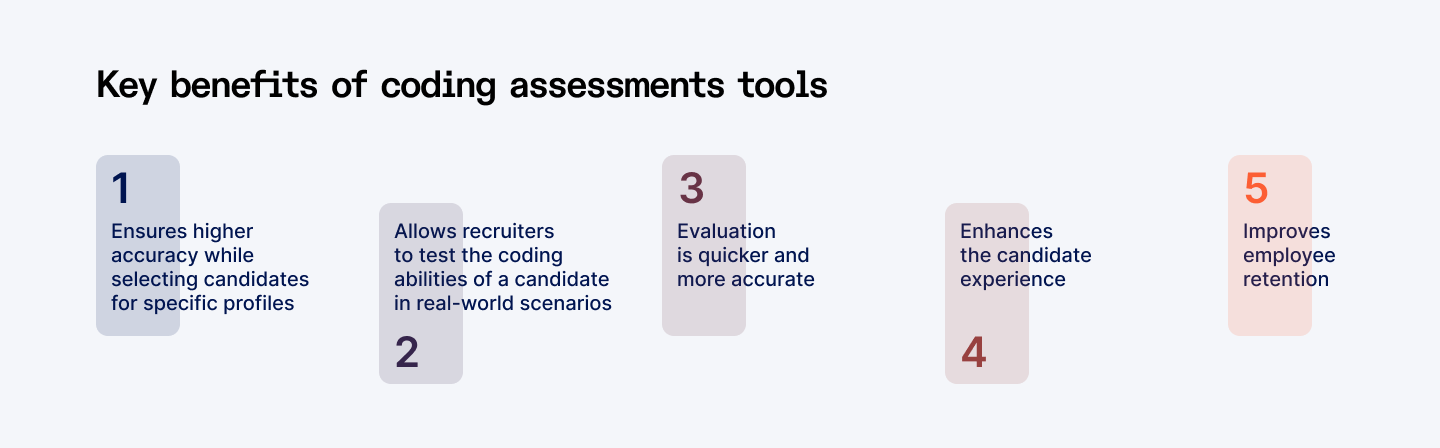
Another trick on how to vet developers effectively is a take-home coding assignment. It is a more comprehensive coding test that developers complete at home and at their own pace, usually over a longer period. Take-home assignments offer insights into developer’s dedication to execute a more extensive project to completion. Plus, this method provides candidates with the opportunity to showcase their skills in a more relaxed environment. The benefits of take-home coding assignment are clear:
- You reach a bigger pool of developers, including senior professionals who love take-home assignments and hate live coding sessions.
- You reduce the risk of a biased hiring as you assess the actual work and not the candidate.
- You can simulate real-world scenarios better than with coding challenges and assignments.
- You vet developers in a candidate-friendly environment, leaving a positive overall impression of the interview.
At the same time, the biggest concern of tech recruiters is that take-home assignments are easy to plagiarize. To avoid this trap, use the right online tools that ensure that candidates can’t plagiarize the given tasks, such as CodeSignal, LeetCode, and HackerRank.
Pair Programming
Another approach to vet developers effectively is pair-programming. Developers are team players and there’s no better way to assess a candidate's suitability within a project than pairing them with another software developer. Pair programming involves two programmers working together at one workstation. The “driver” types code, while the other, the “observer”, reviews each line of code. Then they switch roles frequently. This method provides insight into a developer’s technical proficiency and ability to communicate and collaborate with peers, which is crucial especially in a remote environment. Plus, it ensures the interview process includes a preliminary simulation of how well the candidate will interact with the teammates. But be aware, you shouldn’t pair two candidates together. Instead, pair a candidate with a programmer from your company. Useful tools for this include Visual Studio Code Live Share and Codeanywhere.
Work Sample Test
This is often used in a remote work setup and involves offering candidates a small real-world project to complete at their own pace. You can create a work sample test that mirrors the kind of work you’re expected for them to do at your startup. There are websites that will host the process via screen recording to ensure that the test was legitimately conducted. This allows you to evaluate their code quality, approach to problem-solving, and attention to detail. Some useful tools for this include GitHub, Bitbucket, and GitLab.
In-person Coding Assignment
An in-person coding assignment is a problem-solving test given to a candidate during an on-site interview, where they are required to write code in real-time, usually on a whiteboard, while being observed by interviewers. This assignment is usually done face-to-face, either in a company's office or via a virtual call and is often used alongside other interview methods like technical discussions, behavioral interviews, or system design tasks. The main problem with this type of assessment is that it is limited to tech talent available locally. Plus, it can be stressful for the candidates and don't necessarily show how skilled someone is in real-world situations. And the worst part? According to Dice, 42% of applicants claimed that the thing they hate the most about the interview process are whiteboard interviews.
Automated Online Coding Assessment Tools
Automated coding assessment tools are a scalable method for vetting technical proficiency across a wide range of programming languages and frameworks. These tools provide standardized tests and exercises, helping you conduct an unbiased evaluation of each candidate. Here are some popular examples:
- HackerRank: Among their customers are PayPal, Atlassian, and LinkedIn. The platform allows clients to evaluate developers skills, problem solving and communication skills through real-time online pair programming, and project-based skills.
- CodeSignal: Trusted by Uber, Affinity, and Quora. This assessment platform provides coding assessments, custom coding tests tailored to specific open positions, and live video interviews.
- CoderPad: Used by AirBnB, Dropbox, and Quora. This tool supports over 30 languages and technologies and helps clients open a video call with the candidate and review their code in real-time.
These tools can be customized to match the specific technical requirements of the role, making them an integral part of the hiring process.
Also read: How to Hire Skilled Developers for Startups
3. Assess Soft Skills
Evaluating soft skills is just as important as assessing technical proficiency. Soft skills facilitate productive collaboration among engineers and contribute to team cohesion. Here are top soft skills expected from a high-performing developer:
.png)
Communication
Outstanding developers know how to communicate concisely and effectively in different situations with leadership, project managers and other team members. This becomes essential in a remote work environment, as they need to be able to convey their ideas to people in different locations and with different tech-savviness. Questions you can ask to ensure your next developer has great communication skills are:
- How do you handle conflict or disagreements within a team to ensure a positive outcome?
- How do you maintain clear and effective communication with team members across different time zones?
- Describe a time when you had to explain a technical concept to someone without a technical background. How did you ensure they understood it?
At Index.dev we also make sure that developers are able to freely communicate in English, have a certain mindset, or so-called cultural fit, to easily communicate with clients from all countries and backgrounds.
Problem-Solving
Problem-solving capabilities are essential for all aspects of software development, ranging from a simple task, like troubleshooting faulty code, to a complex challenge such as designing the architecture of a new software application. This soft skill reflects whether a candidate can adopt an agile approach to software development, enabling them to find ‘out-of-the-box’ solutions for challenging tasks, while anticipating potential issues and addressing them before they arise. Ask the following questions to effectively assess the problem-solving skills of a potential hire:
- Share an example of a particularly challenging setback you faced and how you resolved it.
- How do you approach debugging when dealing with a complex issue that has multiple potential causes?
- When encountering two development issues while coding, how do you prioritize which one to address first?
Read More: Effective Ways to Assess Developer's Problem-Solving Skills in Tech Hiring
Cognitive Ability
This is an essential developer trait especially for a remote work environment as it reflects developer’s ability to assess hurdles in the development process, break them down into smaller components, and come up with efficient methods to tackle them efficiently. Here are key questions you should ask to vet the cognitive skills of your candidates:
- Describe a challenge you encountered during the development process and the steps you took to resolve it.
- How do you manage your workload when facing tight deadlines?
- Can you share an example of a project where you had to identify and fix a bug, error, or inconsistency?
Creative Thinking
To build innovative solutions developers need creativity. This comes with the ability to improvise quickly and think proactively. With this skill developers can find innovative ways to solve challenging problems, adapt quickly to changing project requirements, and create impressive products that meet the customers needs. Ask these questions to ascertain the candidate’s creativity:
- Share an example of a time you faced a challenge during development and had to change your approach to overcome it.
- How do you go about brainstorming and developing a new product or feature?
- Can you describe a situation where you had to devise a creative solution to a difficult technical problem? How did you approach it?
Critical Thinking
This goes hand in hand with problem-solving. It’s no longer enough to write code or develop a product feature. Developers have to think critically of the issues they are dealing with and be aware of the numerous solutions they can use to solve them. Plus, they should collect feedback from product releases and use it to identify areas for improvement, refine features, and address any issues or bugs. Ask these questions during the vetting process to evaluate candidate’s critical thinking:
- Can you provide an example of a time when you had to critically assess and challenge a proposed technical solution?
- How do you go about weighing the pros and cons of various solutions to a coding problem?
- Share a situation where you used an unconventional approach to solve a problem in your job role.
Team Player
In software development, team player skills ensure that all the team members work cohesively and collaboratively towards the product. Regular inputs are required from coworkers to bring the project to completion. Ask these questions to ensure the candidate can successfully collaborate with team members:
- How do you ensure you effectively contribute and collaborate in a team setting?
- Have you ever encountered challenges while working with team members from different cultural backgrounds? How did you handle them?
- In your opinion, what are the biggest obstacles to effective collaboration in the development process, and how would you recommend overcoming them?
Read More: 5 Challenges of Hiring Remote Developers and How to Overcome Them
Vetting Practices at Index.dev
A vetting procedure can take a lot of time and money if you’re using only your internal resources. Consider partnering a talent network like Index.dev to hire expertly-vetted talent on demand. Since 2019 we’ve vetted thousands of developers from different regions around the world, including Central Eastern Europe, Latin America, and Asia. This helped us develop a robust vetting process that identifies high-performing developers who can bring significant value to our clients’ projects, requiring minimal oversight.
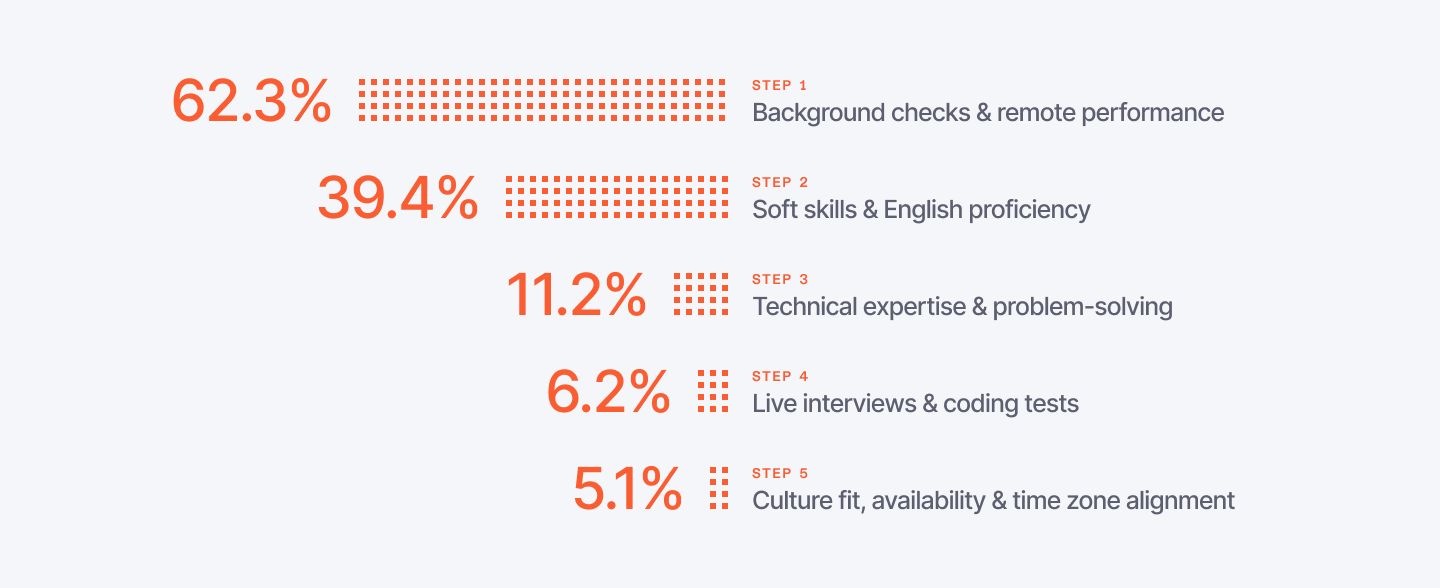
From thousands of monthly applications, less than 5% are accepted on Index.dev talent network. Each applicant is thoroughly screened for tech/soft skills, English proficiency, and remote performance. The complete vetting process takes two weeks, after which the top 5% of candidates are selected and listed on the platform.
So, how do we identify an outstanding developer? Here’s the process:
Background Checks and Remote Performance
A pass rate of 62.3% from all applicants.
Our screening process starts with comprehensive background checks, such as a criminal records search, to verify a candidate’s history and background. We evaluate a candidate's resume, portfolio, and certifications, ensuring they have a robust knowledge of different programming languages, frameworks, algorithms, system designs, and other relevant workplace skills.
Beside this, we emphasize the quality of the work they can put in on platforms like GitHub and how well they are able to manage projects, use AI tools, collaborate in a remote environment, and handle collaboration tools.
Soft skills and English proficiency
A pass rate of 39.4% from all applicants.
During the interviews, our talent recruiters evaluate developers on soft skills like communication, work ethics, broader project implications, agile approaches to software development, and emotional intelligence in handling stress and taking accountability. Additionally, we check their education and English proficiency, to make sure they become valuable team members in any tech team.
Technical Skills and Problem-Solving
A pass rate of 11.2% from all applicants.
We thoroughly check developer’s technical skills through checking their previous work, GitHub repositories, Stack Overflow participation, or open-source projects contributions. We delve deeper into their coding style and problem-solving mindset to figure out the complexity of the projects they can handle. Rather than seeking proficiency in multiple languages, we prioritize candidates excelling in one or two key tech skills. Additionally, our talent recruiters may conduct technical interviews to double check the developer’s expertise, particularly in areas like data structures, algorithms, and system design. This vetting phase is intense and involves a lot of interactions. We don’t give second chances to those who don’t have the necessary technical proficiency and can’t effectively solve technical problems.
Live Interviews & Coding tests
A pass rate of 6.2% from all applicants.
As per client’s requests, candidates can undergo rigorous live interviews and real-world coding scenarios to showcase their competence, thoroughness, and professionalism. We also assess their abilities to deconstruct complex problems into smaller chunks, troubleshoot faulty code, and handle legacy code. Only those with exceptional results go through.
Culture Fit, Availability, and Time Zone Alignment
A pass rate of 5.1% from all applicants.
Typically conducted at the end of the vetting process, this phase is vital for determining whether the developer is a team player and can fit well into our client’s company culture.
We assess personality traits, full-time availability, and time zone alignment, opting for candidates who are fully engaged in their work. This principle helps us screen developers who can lead to an increased team dynamics and performance and higher retention per project.
The Bottom Line
When it comes to developers, quality counts. There are several ways to vet candidates besides scrolling through their resumes or GitHub profile. You can build internal tests and invite candidates to solve test tasks on-premises. You can also pair program the best-qualified candidates with a senior developer from your team and evaluate their collaboration skills.
Another way to vet candidates is using online assessment tools like HackerRank, Codility, or CodeSignal as they can generate tests based on your project’s tech stack and other requirements. But this can be quite expensive as you have to pay an entire package of tests, which include more assignments that you might need.
The vetting process is time-consuming especially if you want to develop it from scratch without the extra help.
Find Vetted Developers on Index.dev
We at Index.dev provide a vetted talent network of senior developers who are ready to take on your projects. Whether you need a software developer, AI engineer, project manager, or UI/UX designer, you can trust you'll hire professionals with strong technical skills, high work ethics, and global experience. Our talent recruiters have conducted hundreds of interviews and know exactly what works. They understand client expectations and can accurately assess whether candidates meet those standards.
Here's more what we offer:
- The elite 5% of developers, QA specialists, designers, and project managers.
- Hard-to-find experts to fill your most in-demand roles.
- No hidden hiring fees and a 30-day risk-free trial to evaluate your new hire's performance.
Partner with Index.dev and access a network of expertly vetted developers for your process.