
If you are leading an engineering team today, you are already feeling it. Delivery is harder to predict. Hiring feels riskier. And the gap between a strong engineer and an average one keeps getting wider. What changed is not just the market. It is the nature of the work itself. The engineers who were considered ‘strong’ in 2023 are not automatically strong today.
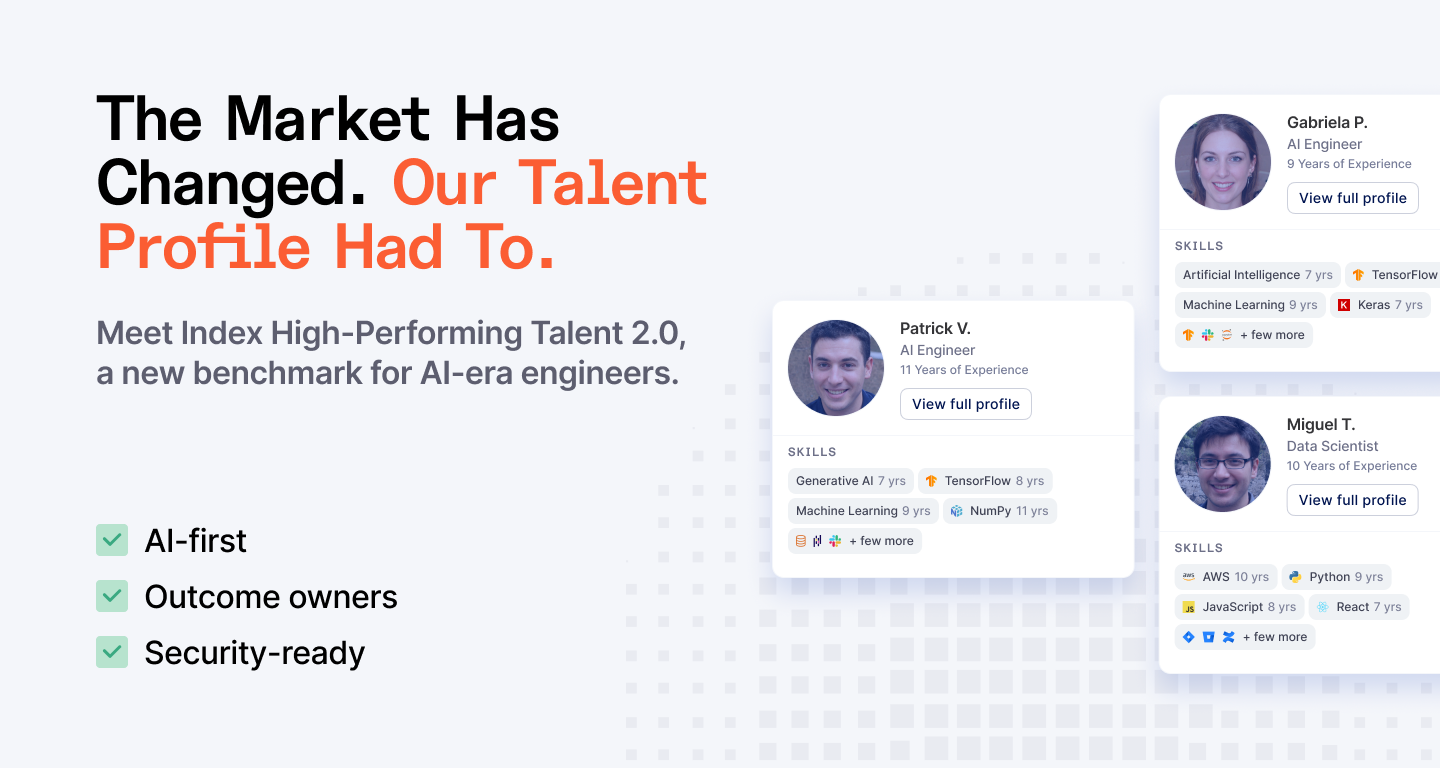
At Index.dev, we have been building a verified network of senior remote tech talent since 2019. In early 2023, we published our first High-Performing Tech Talent Profile. It set a clear bar: technical depth, remote reliability, strong communication, and the ownership mindset to ship production-grade software. That profile served us, and our clients, well.
But the world did not stay still.
AI changed how engineers work. Security threats scaled. Product complexity increased. And the talent market became harder to read, because the surface-level signals — GitHub profiles, years of experience, impressive-looking CVs — became easier than ever to fake or inflate.
So we rebuilt the profile from the ground up. This is Index.dev High-Performing Tech Talent Profile 2.0.
Get access to high-performing engineers from Index.dev and scale your team with confidence.
Why We Had to Rebuild, Not Just Refresh
The original profile was about depth: technical skill, remote discipline, clear communication. Those things still matter. But depth alone does not differentiate a high-performing professional in 2026.
Three things changed everything.
AI became a daily work tool.
In 2023, using AI tools was a bonus. Today, not using them is a red flag. Engineers who do not start their tasks with AI, who cannot name the tools they use, who have no proven habit of AI-first work over at least six to twelve months, are running slower than the engineers around them. They are also thinking smaller. AI didn’t make engineers more equal. It made the gap more visible.
AI did not reduce the value of senior engineering talent. It made weak talent easier to spot.
— Eugene Garla, VP of Talent at Index.dev
Risk increased in remote hiring.
The volume of fake identities, inflated profiles, AI-generated CVs, and outright impersonation in the remote talent market has grown significantly. We see it regularly. Profiles that look flawless on paper, candidates who say the right things, but something is off. A different person answers technical questions. Credentials that do not check out. Employment history that falls apart under scrutiny. This is the current reality of remote hiring, and it demands a different level of diligence.
Accountability expectations grew.
Founders and engineering leaders no longer want someone who executes tasks. They want someone who owns outcomes. That means breaking work into milestones, flagging risks early, handling production issues, and being able to say: here is what changed because of what I built. Not just what I built.
“We built HPP 2.0 because the world changed and our standard had to change with it. We put serious work into making the verification process harder to game, the criteria harder to fake, and the evidence requirements harder to inflate.” — Mihai Golovatenco, Talent Director at Index.dev
What High Performing Talent Profile 2.0 Means
An Index.dev High-Performing Tech Talent Profile 2.0 in 2026 is defined this way:
An AI-first builder. A senior, reliable remote professional who starts every task with AI, ships production-grade software with measurable business impact, and operates safely with sensitive information. They have a product mindset and business acumen to take an idea and make it fly using technology.
That sounds obvious. In practice, it is very specific.
1. Builder mindset
We stopped prioritizing people who “complete tickets well.” We prioritize people who build things that work in the real world.
That means:
- they understand why something matters
- they can break down unclear problems
- they move forward without waiting for perfect input
- they ship, measure, and iterate
Being good at Python or React is useful. Being able to turn an idea into a working system is what creates value.
2. AI-first, not AI-curious
Our HPP 2.0 profile requires proven AI-First execution. This doesn't mean they "use ChatGPT sometimes." It means they start every task—research, refactoring, testing, documentation—with AI tools. We verify a consistent 6–12 month track record of this habit. Why? Because an AI-First builder is more thorough. They use AI to pressure-test their own logic and catch edge cases that humans miss. But they do it safely. They know exactly what stays local and what can be shared with a model. They respect your intellectual property as much as your codebase.
3. Outcome owner
Most engineers can tell you what they built. Fewer can tell you what changed because of it. That gap is exactly what we look for. When we talk to HPP 2.0 candidates, we do not ask "what did you work on?" We ask "what moved because of your work?" Measurable impact. Specific results. Real accountability. Something concrete. The person we are looking for does not hand off a PR and move on. They follow the outcome. They care whether it worked.
4. Security-aware
Secure software development is not a specialty anymore. Every HPP 2.0 professional understands secret management, access control basics, OWASP fundamentals, and data handling. They never commit credentials. They think about least privilege. They can work inside regulated client environments, which increasingly means understanding KYC workflows and digital identity verification requirements.
5. Orchestrator, not just contributor
Strong engineers today think in systems. They can coordinate multiple parallel workstreams simultaneously, including both human teammates and AI agents. They understand:
- trade-offs between speed, cost, and reliability
- how architecture decisions impact future work
- where things break under load
- how to debug with real data, not assumptions
If they cannot do this, they do not meet the profile.
“The market no longer rewards engineers who only execute tasks. It rewards builders who can turn ambiguity into outcomes.” — Sergiu Matei, Co-founder at Index.dev
How We Measure High Performance Now
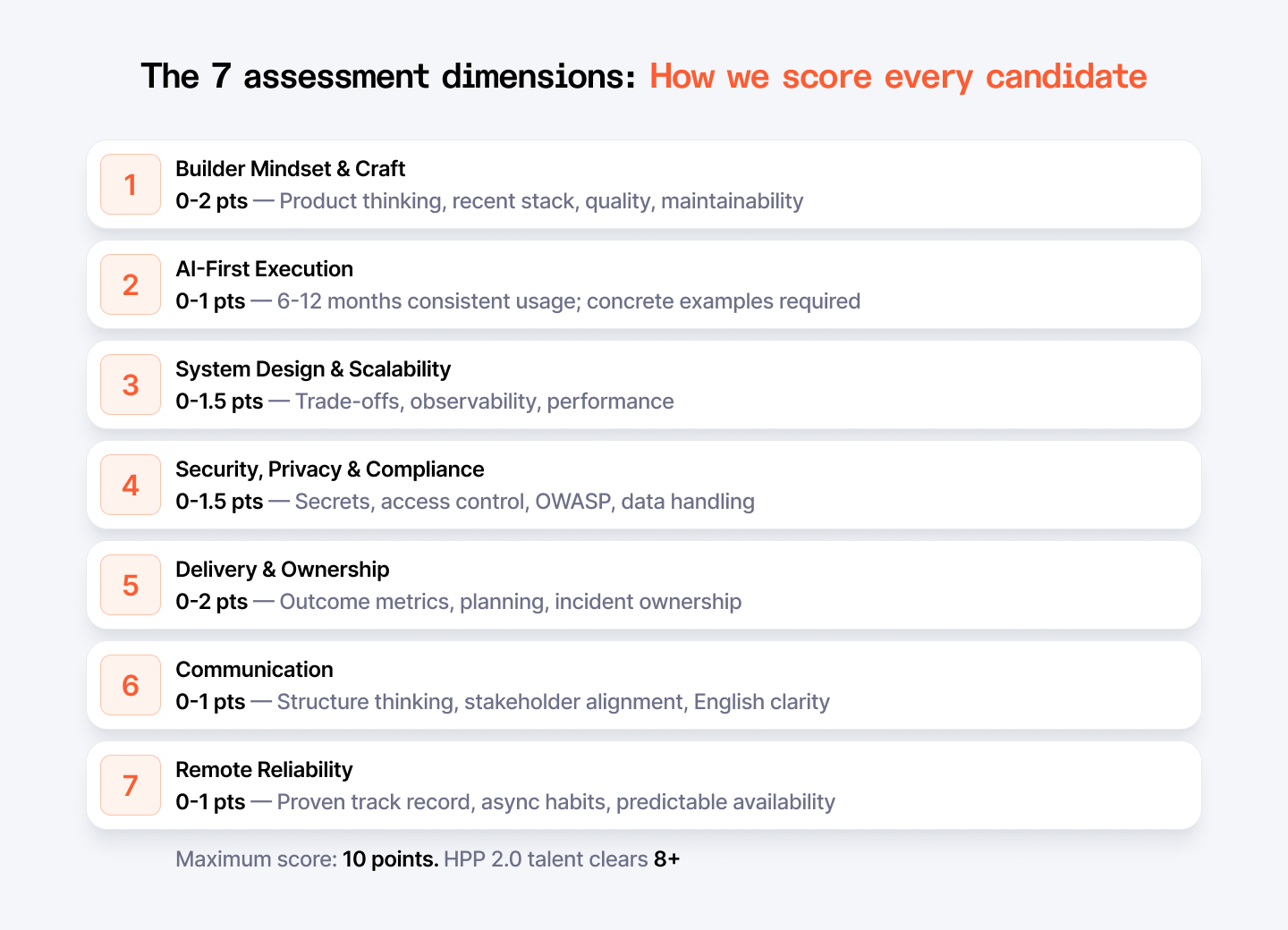
We do not just describe the profile. We score it. Every candidate is evaluated against seven weighted categories, each backed by concrete evidence, not self-reported claims.
Category | Score | What it means in practice |
| Builder mindset & craft | 0-2 pts | Product-minded, ships fast with AI, strong craft in core stack, production examples with metrics. |
| AI-first execution | 0-1 pts | Starts every task with AI, 6-12 months of proven usage, names tools, respects safety guardrails. |
| System design & scalability | 0-1.5 pts | Can reason about trade-offs, performance, observability, and reliability. |
| Security, privacy & compliance | 0-1.5 pts | Secure SDLC, secret handling, OWASP basics, KYC, comfortable under NDA. |
| Delivery & ownership | 0-2 pts | Breaks work into milestones, flags risk, owns incidents, shows measurable outcomes. |
| Orchestrator & communicator | 0-1 pts | Coordinates people and AI agents, writes clear async updates, camera-on, professional presence. |
| Remote reliability & collaboration | 0-1 pts | Proven remote routines, stable setup, predictable availability. |
Maximum score: 10 points. HPP 2.0 talent clears 8 or above.
Each category is backed by concrete evidence: project stories with metrics, code walkthroughs, incident‑handling stories, and clear examples of how they handle security and AI tools.
Why Verification Standards Had to Become Stricter
Here is something that does not get said plainly enough in this industry: a lot of the talent you see on the market right now is not what it claims to be.
Fake identities are a real and growing issue. Sanctioned-country candidates using VPNs and borrowed credentials to appear elsewhere. Deepfake interviews. AI-generated profiles that read like top-tier talent but fall apart the moment you ask a live technical question. Inflated CVs with employment history that cannot be verified. And the classic bait-and-switch, where a strong candidate does the interview and a different person shows up on day one.
We have seen all of it. And we built our verification process specifically to close these gaps.
"We verify identity twice on purpose. Once at the interview, and again at the start of every engagement. Candidate switching is one of the most common and hardest-to-detect risks in remote hiring. We do not give it room to happen.” — Pavel Melnicov, Talent Recruiter at Index.dev
How we verify our high-performing tech talent
Every expert in our 27,000-plus network has passed five steps:
Step 1: Real identity, confirmed live.
Government-issued ID verification before any client interaction. During the interview, we match their face to their ID on a live camera. This removes fake identities and AI-generated profiles at the door.
Step 2: Every credential is checked.
Degrees confirmed directly with universities. Employment history validated with past employers. Certifications authenticated with the issuing bodies. If it is on their profile, we have checked it.
Step 3: Cheat-proof technical assessments.
Traditional technical interviews are easy to game. A second screen, someone off-camera, AI running in another tab. We have seen every version of it. Our assessments are live-proctored, camera-on, with screen monitoring throughout. Real-time problem solving, no take-home tests, domain-specific challenges designed by subject matter experts, with multiple evaluation layers. If they passed our assessment, they earned it. Not their friend. Not ChatGPT. Them.
Step 4: A live interview, every time.
Every professional is personally interviewed by our sourcing and talent verification teams. We assess how they communicate, how they reason through problems, how deep their knowledge goes. Then clients interview them too, live, on camera, before they make any decision. You see who they are before you commit to anything.
Step 5: Domain mapping.
Verification is just the start. We map every expert to specific domains, workflows, and task types so they are placed where they are strongest. When you need engineers with specific security or compliance experience, or evaluators with specialized domain backgrounds, we know exactly who fits.
Our principle here is simple:
The person you interview must be the person who does the work. Every time.
What This Means for Your Business
If you are a founder, CTO, or head of engineering at a Series A or B company, a scaleup, or an established business that is hiring remotely, here is what the HPP 2.0 standard means in practice:
- You reduce the risk of a bad hire. The verification process does not just confirm someone can code. It confirms who they are, that their history is real, that their skills hold up under live scrutiny, and that they will show up professionally in a remote environment. That is a very different thing from a CV review and a couple of technical rounds.
- You get someone who ships, not just someone who works. HPP 2.0 talent is measured against outcomes. They break work into milestones. They flag risks early. They handle production incidents. They do not need handholding to move from an idea to a shipped feature.
- You get someone who is genuinely AI-capable. Not someone who says they use AI and means they opened ChatGPT once. Someone with six to twelve months of demonstrated AI-first habits, who can work faster, produce better output, and adapt to the tooling your team already uses. The productivity difference is real.
- You get remote-first reliability. Async communication, written clarity, proactive risk flags, stable setup, predictable availability, timezone overlap that works for your team. Remote performance is built into the profile.
The Shift That Matters Most
The move from Profile 1.0 to Profile 2.0 is not about raising the bar on technical skills alone, though it does that. It is about redefining who a high-performing tech professional is.
In 2023, the profile was built around depth: technical excellence, remote discipline, good communication.
In 2026, the profile adds something different. The ability to take a problem, use all available tools including AI, coordinate people and systems simultaneously, and produce an outcome that is measurable in terms of business impact.
That is a meaningful difference. And it is the difference that matters to companies that need talent to accelerate growth.
➡︎ Want to see how HPP 2.0 talent could fit your team? Reach out to the Index.dev team and we will be straight with you about what is realistic for your role, your timeline, and your market.


