Offshore isn't just an option, it's an imperative. You get access to global expertise, flexibility, and cost efficiency. But it also comes with risks. One wrong step and you're dealing with mismatched expectations, wasted budgets, or worse, state-sponsored fraudsters, identity thieves, or "ghost" developers who vanish the moment they gain access to your GitHub repository.
The threat landscape has shifted from "bad resumes" to sophisticated cyber-criminality. According to a 2024 Deloitte Global Outsourcing Survey, 59% of businesses cite quality concerns as their primary barrier to offshore hiring. Another study by Clutch found that 25% of companies who hired remote developers experienced significant issues with commitment and availability. Worse yet, specialized security reports show that "identity-as-a-service" fraud—where candidates rent a real person's identity to pass an interview—is at an all-time high.
The key isn't to shy away from offshore talent, but to approach it with a strategic, robust framework.
At Index.dev, we’ve spent years building systems, processes, and safety nets that let companies hire offshore developers with confidence. In this article, we’ll share practical tips for mitigating risks and show why partnering with a full software development and delivery expert like Index.dev can transform these risks into manageable opportunities.
Hire confidently. Access the top 5% of vetted offshore developers — risk-free, insured, and trial-backed with Index.dev.
What Mitigates Risk (And What Doesn't)
Here's what most companies get wrong: they think a good interview process is enough. It's not. You can have the most rigorous technical assessment in the world, but if you're not verifying identity, checking consistency across platforms, and monitoring for red flags post-hire, you're leaving yourself exposed. A "Senior Developer" on Zoom might actually be a junior in a different country using a real-time voice modulator and a hidden prompter.
Real risk mitigation happens in layers. Think of it like cybersecurity. You don't just have a firewall and call it a day. You have multiple defenses working together: authentication, monitoring, response protocols, and insurance for when things still go wrong.
Read next: 7 strategies to identify deepfake remote candidates.
Why Risk Management Matters in Offshore Hiring
Before we get into solutions, let’s address the elephant in the room: bad hires and frauds.
Studies show that 74% of companies report an average loss of $14,900 when a hire doesn’t work out. However, if that "hire" is a proxy for a malicious actor from a sanctioned nation like North Korea or Iran, the cost isn't just $14k—it’s a total compromise of your Intellectual Property and potential federal fines.
Worse, deepfake and AI-generated fake candidates are no longer sci-fi, they’re emerging threats that can derail projects and expose companies to fraud and data breaches. In 2023, the FBI reported a surge in what they call "deepfake interviews" where scammers use AI-generated video and audio to impersonate qualified developers. These fraudsters pass technical interviews using real-time assistance from hidden accomplices or AI tools, land the job, and then either disappear with advance payments or deliver subpar work from someone else entirely.
The scale of this problem is staggering. Deepfake incidents have risen over 2,000% since 2022. In May 2024, the U.S. Justice Department revealed that over 300 companies had unknowingly hired impostors linked to North Korea for remote IT roles, causing at least $6.8 million in losses. These weren't amateur scams. They were coordinated operations using stolen identities, AI-generated video, and proxy networks to pass interviews and get inside company systems.
Then there's the multi-job juggler problem. A recent report indicated that approximately 37% of remote tech workers admitted to working multiple full-time jobs simultaneously without disclosure. That means the developer you think is 100% focused on your product may be splitting their time — and attention — across two or three other companies at once.
These aren't isolated incidents. They're symptoms of a market that's moving faster than its verification systems.
"Most companies treat offshore hiring as a cost-saving exercise. That's backwards. The real value is accessing talent you literally can't find locally. But only if you're willing to invest in the infrastructure to make it work." – Andi Stan, CSO at Index.dev
Common Risks in Offshore Hiring
So, here are some of the most common "icebergs" companies often encounter in offshore hiring:
1. The "Phantom" Developer
Misrepresented skills, inflated experience, or even outright fake profiles are a growing concern. The rise of sophisticated AI tools means a resume might be flawless, and a video interview might feature a convincing deepfake, leaving you with a team member who simply isn't who they claim to be. Creating a convincing fake candidate now takes less than 70 minutes. Gartner predicts that by 2028, 1 in 4 job applicants could be fake. The pipeline you trust is already being gamed.
2. The "Proxy" Problem
Some candidates pass the interview themselves, then delegate the actual work to someone else entirely — often a less experienced developer. You hired a senior engineer. A junior is writing your code. You won't know until the damage is done.
3. The Communication Chasm
Time zones, language barriers, and cultural nuances can create significant friction. What's clear in one culture might be ambiguous in another, leading to misunderstandings, missed deadlines, and a sense of disconnection.
4. The "Ghosting" Phenomenon & Turnover Troubles
High attrition rates among offshore talent can be incredibly disruptive. If a developer isn't properly engaged or supported, they might "ghost" you for another opportunity, leaving your project in limbo.
5. The "Set It and Forget It" Trap
Some platforms simply connect you with a freelancer and then disappear. This leaves you solely responsible for performance management, conflict resolution, and ensuring project alignment.
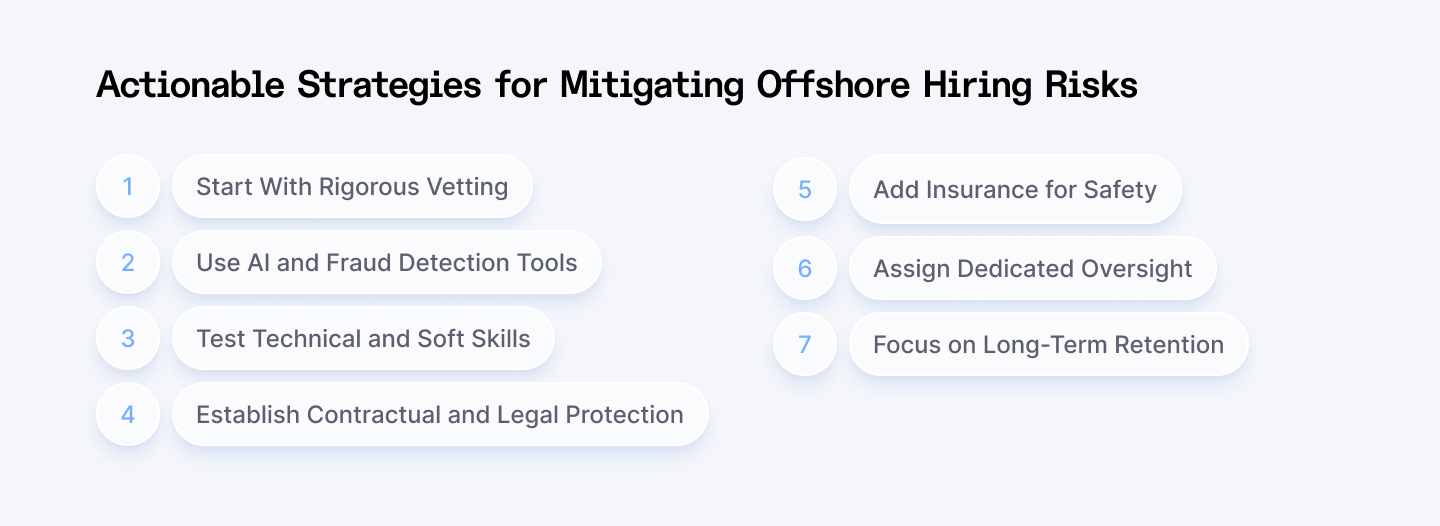
Actionable Strategies for Mitigating Offshore Hiring Risks
1. Start With Rigorous Vetting
The single biggest risk in offshore hiring is simple: hiring the wrong person. Bad hires cost companies more than just salary. According to the U.S. Department of Labor, the cost of a mis-hire can reach 30% of the employee’s first-year earnings. In offshore contexts, that figure can skyrocket because of time zone gaps, cultural misalignment, and remote work challenges.
How to Mitigate
- Background checks: Is this person who they say they are? Cross-reference their CV against LinkedIn, GitHub, Stack Overflow, and any other professional profiles they maintain. Look for consistency in employment timelines, project descriptions, recommendations, etc.
- Multi-layered technical vetting: Test developers on the exact skills you need, using real coding tests, project simulations, and portfolio evaluations.
- Soft skills and communication checks: Remote work demands high communication discipline. Evaluate collaboration, adaptability, and responsiveness.
- Cultural fit assessment: Culture clashes reduce efficiency and retention. Interviewers should evaluate mindset, values, and approach to problem-solving.
Index.dev Approach
Every engineer goes through a multi-layered screening process including technical tests, soft-skills evaluation, cultural fit, reference checks, and trial engagements. By the time a candidate reaches you, risks of mismatch, delays, or underperformance are minimized.
The real value lies in uncompromising verification and human-centric support. We've learned that technology must augment, not replace, the diligent human eye in vetting talent.
Our vetting is built on three pillars that most hiring platforms skip entirely:
- Identity Verification: We use fraud detection tools and human cross-checking to catch deepfakes, proxies, and inconsistencies before they ever reach your screen. The person you interview is the person who shows up on day one — verified, accountable, and real.
- Technical Capability Integrity: We don't just test if someone can write code. We test for real capability in their core stack and in AI systems — LLMs, RAG pipelines, production environments.
- Operational Maturity: We only vet engineers who have shipped in high-stakes environments. We look for clear thinking under pressure, ownership of outcomes, and a "ship-first" accountability mindset.
The real value lies in uncompromising verification and human-centric support. We've learned that technology must augment, not replace, the diligent human eye in vetting talent.
Also read: Essential strategies for evaluating developers' problem-solving skills.
2. Use AI and Fraud Detection Tools
Fraud in freelance and remote hiring is real. Fake profiles, overstated seniority, bot-assisted applications, and even AI deepfake video interviews are emerging threats. If you’re hiring at scale through an ATS, identifying automated job applicants early helps cut application spam without filtering out qualified candidates.
In a recent report by Checkr, 18% of hiring managers reported encountering fraudulent applications in the last 12 months. That number is climbing fast. With deepfake incidents up 2,000% since 2022, what was once an edge case is now a standard threat every hiring team needs to prepare for. Deploy tools that analyze interview behavior for signs of AI assistance or deepfakes.
How to Mitigate
- Identity verification: Use tools like Checkr and LinkedIn Talent Insights to confirm identity and employment history.
- Portfolio verification: Validate GitHub, Stack Overflow, and project contributions.
- Deepfake detection: Ensure video or audio interviews are genuine. Tools like Intel FakeCatcher or Human Security can flag AI-generated content.
- Behavioral analytics: Evaluate consistency in answers, coding patterns, and problem-solving approaches to detect anomalies.
Index.dev Approach
We solve the identity crisis with industrial-grade Identity Verification. We use advanced fraud detection to catch deepfakes, proxies, and profile inconsistencies before they ever reach your screen. We combine AI-assisted tools—like Intel FakeCatcher and Sift—with human intelligence to ensure the "Senior Dev" on your screen isn't a synthetic mask.
3. Test Technical and Soft Skills
Here's where companies often cut corners. They nail the technical evaluation but skip the soft skills assessment, assuming any developer who can code will fit into a remote team. Wrong. Remote work demands a different skill set entirely. You need developers who can communicate asynchronously, document their work clearly, and proactively raise blockers without constant hand-holding.
How to Mitigate
- Role-specific technical tests: Assess skills directly relevant to your stack or project.
- Remote collaboration simulation: Check ability to work asynchronously, use project management tools, and handle distributed communication.
- Soft skills assessment: Measure initiative, adaptability, and communication.
- Industry-specific knowledge: For specialized projects, ensure familiarity with domain standards or compliance requirements.
Index.dev Approach
Only few candidates pass all our checks. They come highly skilled, motivated, and ready to integrate into your team seamlessly. We check if they can own the outcomes. There's a big difference between a developer who waits to be told what to do and one who proactively identifies problems, communicates blockers early, and delivers without hand-holding. That's what we screen for.
4. Establish Contractual and Legal Protection
Many offshore hiring issues come from ambiguous contracts, unclear expectations, and unprotected IP. Without the right model, companies face legal exposure, misclassification risks, and administrative headaches.
How to Mitigate
- Local labor laws: If you're directly hiring, familiarize yourself with the labor laws in the developer's country. This includes everything from working hours to termination procedures.
- Defined contracts and NDAs: Ensure intellectual property and confidentiality are legally protected. Work with contracts that clearly define scope of work, intellectual property ownership (all code belongs to you, period), and confidentiality.
- Flexible engagement terms: Scale teams up or down without long-term penalties. Work with contracts that clearly define termination clauses, notice periods, payment terms, dispute resolution mechanism, and compliance.
- Data security protocols: Implement strict data security and privacy measures, especially if developers will be handling sensitive company or customer data. Ensure compliance with regulations like GDPR or CCPA.
Consider using a contract engagement model rather than hiring individuals directly. This shifts legal and compliance burden to a third party while giving you flexibility to scale teams up or down without HR overhead.
Index.dev Approach
Clients engage developers through Index.dev contracts. We handle compliance, payments, legal exposure, and HR overhead. This allows companies to scale flexibly, mitigate risk, and focus on building software.
“Building a global development team is about building trust brick by brick, with every vetted profile, every transparent contract, and every conversation managed with care.” – Michelle Radu, Director of LeadGen & New Business Sales at Index.dev

5. Add Insurance for Safety
And seriously, get insurance. Errors, delays, or disputes can quickly become costly. Professional liability coverage isn't just for big companies. Even mid-sized teams should carry policies that protect against errors, omissions, or breaches related to outsourced work.
How to Mitigate
- Professional liability insurance: Protects against developer errors or project mishaps.
- Corporate insurance coverage: Adds an extra safety net for cyber incidents, operational disruptions, or legal claims.
Index.dev Approach
Index.dev backs collaborations with a $5M corporate insurance policy, protecting clients financially and ensuring continuity in case of unexpected events.
This means:
- Protection against financial losses from disputes or errors
- Strengthened trust and extra layer of protection for your business
- Ensured continuity despite unforeseen incidents
Legal safeguards also encompass NDAs and IP protections, vital for safeguarding your know-how.
6. Assign Dedicated Oversight
Remote developers can sometimes feel disconnected from clients’ operations. Without constant oversight, small red flags like missed deadlines, quality degradation, or availability issues can become big problems. And in a world where some developers are quietly juggling three other jobs, "availability issues" can be the polite way of saying you're getting 20% of someone you're paying 100% for.
How to Mitigate
- Dedicated project managers: Assign someone to track performance, address concerns, and ensure alignment.
- Proactive engagement: Monitor developer satisfaction and engagement to prevent attrition.
- Rapid issue resolution: Replace or supplement developers if problems arise without delaying the project.
Index.dev Approach
Each engagement comes with a dedicated Account Manager for both the client and the developer. This ensures communication flows smoothly, performance stays on track, and issues are resolved before they escalate.
7. Focus on Long-Term Retention
Short-term engagements increase the risk of turnover, knowledge gaps, and reduced productivity. Never commit to a long-term contract without a trial period. Typically two to four weeks is enough to evaluate code quality, communication responsiveness, culture fit, and ability to work independently.
How to Mitigate
- Trial periods: Even with vetting, sometimes the fit isn’t perfect. A trial period reduces risk and allows clients to test compatibility before committing. Before full engagement, test developers on a small but meaningful project or bug-fix challenge.
- Full-time engagements: Work with platforms, agencies that ensure their assigned developers commit to your project rather than juggling multiple clients.
- Career growth and engagement: Offer learning opportunities, mentorship, and meaningful work to retain talent.
- Structured onboarding: Integrate offshore developers into your company culture and workflows from day one. Introduce critical tasks gradually, allowing early detection of misalignment.
- Success metrics: Define success metrics upfront. What does good look like after week one? Week two? Be specific. "Completes assigned tickets" is vague. "Delivers two features with test coverage above 80% and no production bugs" is measurable.
And here's the crucial part: be willing to walk away if it's not working. Continuing with a bad fit will always cost more than cutting ties early.
Index.dev Approach
Our talent averages over 14 months on projects, fully embedded in client teams. This reduces attrition, ensures continuity, and builds trust.
Clients can trial our developers risk-free. If expectations aren’t met, we offer a money-back guarantee and will replace talent without extra cost.
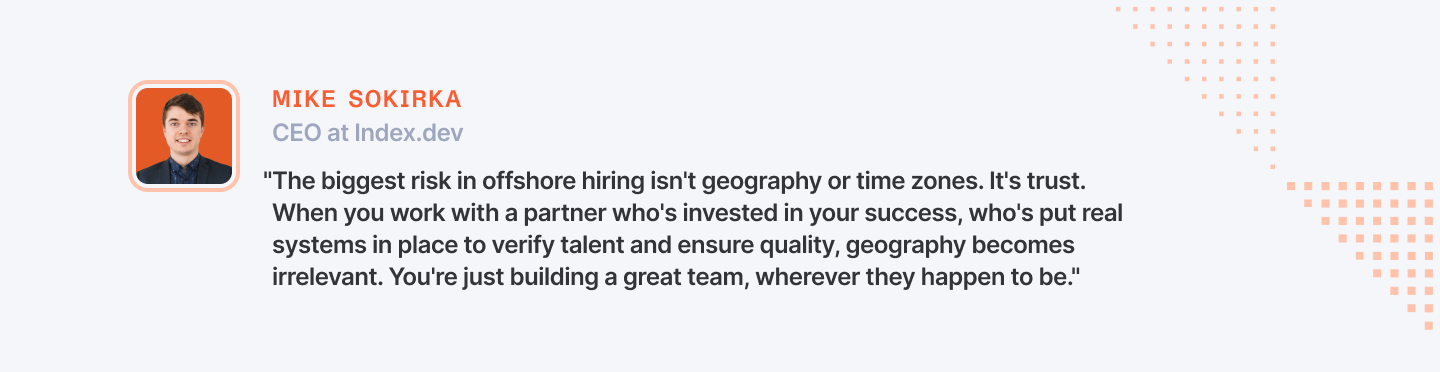
Why Lean on Index.dev for Hiring Offshore Talent
Offshore hiring isn’t simple. It’s an entire ecosystem of moving parts: global compliance, fraud detection, remote team management, international payroll, and more.
Most companies aren’t built to handle all that. You’re already focused on building great products, serving customers, and keeping teams aligned. You shouldn’t also have to become an expert in international HR and fraud prevention.
That’s where Index.dev comes in, not just as a hiring platform, but as a full risk-mitigation partner. We don’t simply “connect” you with developers. We own the process end-to-end, so every step between discovery and delivery is covered, protected, and transparent.
At Index.dev, everything we do is designed around one simple goal: de-risking offshore hiring. Every system we’ve built, every check we perform, every guarantee we give exists to make sure you can hire with total confidence.
Here’s what that looks like in action:
- Consistency Matching:
- Our talent experts verify every developer profile across multiple channels — LinkedIn, GitHub, Upwork, and beyond — to ensure what you see is real. We call it Consistency Matching: a process that cross-checks each data point against public and private records, followed by in-depth vetting calls. This is how we catch the red flags others miss: inflated seniority, side projects that compete with yours, or even developers planning to send a proxy to interviews.
- Our talent experts verify every developer profile across multiple channels — LinkedIn, GitHub, Upwork, and beyond — to ensure what you see is real. We call it Consistency Matching: a process that cross-checks each data point against public and private records, followed by in-depth vetting calls. This is how we catch the red flags others miss: inflated seniority, side projects that compete with yours, or even developers planning to send a proxy to interviews.
- AI-Powered Fraud Prevention:
- We combine AI-driven tools with human intelligence to detect fake profiles, deepfakes, and fraudulent interviews before they ever reach you. Our tech stack includes: LinkedIn Talent Insights and Checkr for background and identity verification, HackerRank and Codility for technical skill validation, Human Security and Intel FakeCatcher to flag deepfakes and synthetic media, Sift and Socure for fraud and behavioral anomaly detection.
- We combine AI-driven tools with human intelligence to detect fake profiles, deepfakes, and fraudulent interviews before they ever reach you. Our tech stack includes: LinkedIn Talent Insights and Checkr for background and identity verification, HackerRank and Codility for technical skill validation, Human Security and Intel FakeCatcher to flag deepfakes and synthetic media, Sift and Socure for fraud and behavioral anomaly detection.
- Rigorous Technical and Cultural Screening:
- Only 5% of developers make it through our complete vetting process. This selectivity means you're not wading through dozens of mediocre candidates hoping to find one good one.
- Only 5% of developers make it through our complete vetting process. This selectivity means you're not wading through dozens of mediocre candidates hoping to find one good one.
- Dedicated Account Managers for Ongoing Success:
- We don’t vanish once a match is made. Every Index.dev collaboration comes with a dedicated Account Manager who supports both sides – client and developer. They track progress, resolve issues early, and keep engagement healthy. You don’t have to micromanage. You get proactive oversight that keeps your project on course.
- We don’t vanish once a match is made. Every Index.dev collaboration comes with a dedicated Account Manager who supports both sides – client and developer. They track progress, resolve issues early, and keep engagement healthy. You don’t have to micromanage. You get proactive oversight that keeps your project on course.
- Risk-Free Trial Period with Money-Back Guarantee:
- You can test our talent completely risk-free. If expectations aren’t met during the trial period, we’ll refund your money and replace the developer at no additional cost. Zero risk to you.
- You can test our talent completely risk-free. If expectations aren’t met during the trial period, we’ll refund your money and replace the developer at no additional cost. Zero risk to you.
- Full Legal, Compliance, and Insurance Coverage:
- We handle all contracts, NDAs, payments, and global compliance. Your intellectual property is fully protected. Developers are legally bound by professional standards. And with a $5 million corporate insurance policy, we add an extra layer of financial security that few in the industry can match.
- We handle all contracts, NDAs, payments, and global compliance. Your intellectual property is fully protected. Developers are legally bound by professional standards. And with a $5 million corporate insurance policy, we add an extra layer of financial security that few in the industry can match.
- Long-Term Engagement and Retention Focus:
- We don’t work with freelancers chasing the next gig. Our engineers join long-term, full-time projects where they can grow with your team. On average, Index.dev developers stay for more than 14 months, integrating into your culture, understanding your roadmap, and contributing like in-house teammates.
- We don’t work with freelancers chasing the next gig. Our engineers join long-term, full-time projects where they can grow with your team. On average, Index.dev developers stay for more than 14 months, integrating into your culture, understanding your roadmap, and contributing like in-house teammates.
Final Thoughts
The offshore talent market isn't going away. It's accelerating. The companies that figure this out early, who build proper vetting systems, legal frameworks, and oversight mechanisms, will have a massive competitive advantage in accessing the best developers regardless of location.
The question isn't whether to tap into global talent. It's how to do it without exposing yourself to unnecessary risk. By leaning on a partner who has already built the systems, processes, and protections, companies can focus on innovation, growth, and impact rather than firefighting hiring mistakes.
“Every company wants to hire fast, but fast without process is a liability. With the right partner, offshore teams become a source of predictable, high-impact results.” – Mike Sokirka, CEO at Index.dev
Hire top offshore developers without the risk.
Access the top 5% of vetted talent, matched in 48 hours, with full legal, compliance, and insurance coverage. Test candidates with a risk-free trial and get dedicated Account Managers to ensure alignment, performance, and long-term retention, all while scaling your team seamlessly.