Almost every company you know is ‘using’ AI. But if you look under the hood, most are just spinning their wheels in the experimentation phase. We’ve moved past the ‘wow’ factor of chatbots, yet many organizations still haven't stitched AI into the actual fabric of their business.
In a recent survey by Oliver Wyman Forum and the NYSE, only about 17% of $1B+ companies reported meaningful impact from AI, like a 10% lift in revenue or cost savings.
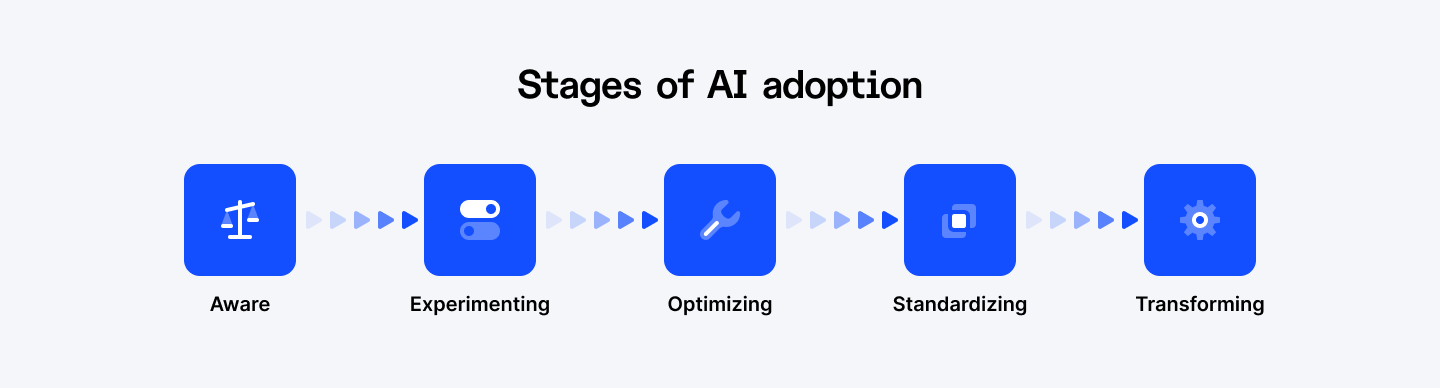
Winning the first lap of the AI race is easy. Staying ahead is the hard part. The leaders pulling ahead are already wiring AI into how decisions are made, how teams operate, and how products evolve.
Here are five core elements to nail AI adoption and equip your team to crush your company goals.
Ready to accelerate AI adoption? Index.dev scales your engineering capacity with verified remote talent, fast software delivery, and AI-ready teams →
What the data tells you
- Nearly two thirds of companies in a McKinsey survey say they haven’t started scaling AI across the business. It’s still stuck in pilots, side projects, or innovation labs.
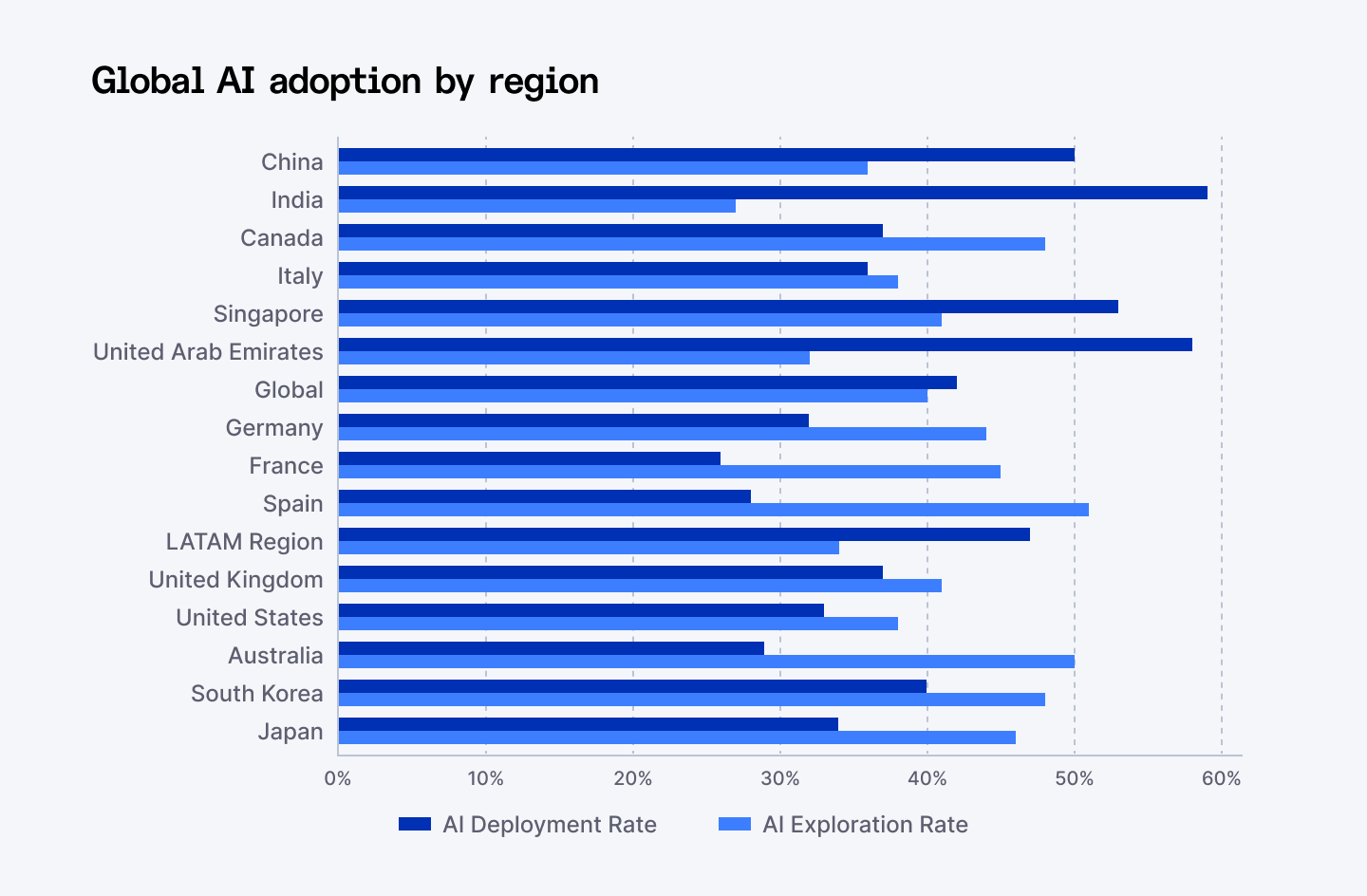
- Adoption is uneven. Roughly 1 in 6 companies are actively using AI today. The rest are either watching or waiting.
- Even among companies already using AI, only about half feel ready to scale it. Among those planning to adopt it, that number drops to a third.
- Only a tiny cohort—roughly 6% of companies—are what we call “AI High Performers.” These are the ones seeing an EBIT impact of 5% or more.
- While 93% of leaders call AI a top priority, over 50% admit they simply don't have the internal skills to pull it off.
⭢ Up next: See the latest AI assistant statistics and what they say about adoption and real ROI in 2026.
Five core elements of successful AI adoption
1. Expand skills fast
50% of businesses say the lack of skilled professionals is their single biggest barrier to AI adoption. You can have the best models, the best infrastructure, and the best intentions, and still go nowhere without the right people.
Right now, the demand is clear. Roles like software engineers, data scientists, and cybersecurity experts are still leading. But the shift is happening fast. You’re now competing for AI engineers, ML engineers, data engineers, and cloud specialists. They are core to AI execution.
What’s interesting is how uneven this demand is. There’s no single “AI skill set.” It depends on how AI shows up in your business. In some sectors, it’s deep technical expertise. In others, it’s things like data storytelling, prompt design, or risk modeling.
What most leaders still underestimate though is the soft skill layer. Cisco CHRO Kelly Jones put it plainly: Soft skills are the new hard skills.
The WEF's Future of Jobs 2025 report backs this up, ranking analytical thinking, resilience, empathetic leadership, creative thinking, and self-awareness as the five most critical skills going forward. As AI handles more execution, your competitive edge shifts to judgment, adaptability, and the ability to lead through uncertainty.
The leaders getting this right are building cultures of continuous learning. Upskilling is a strategic priority. Build it like one.
2. Allocate capital wisely
AI is expensive. It’s not just another line item in your IT budget; it’s a fundamental shift in how you deploy capital. Big Tech capex reached $427 billion in 2025, with projections pointing to a further 30% increase in 2026.
But where does the money come from? 50% of organizations are funding AI through internal capital reallocation, while 39% are tapping cost savings from AI-driven efficiencies. In plain terms: AI is cannibalizing existing budgets. R&D, marketing, headcount, M&A pipelines.
Deloitte found that more than half of companies now allocate between 21% and 50% of their entire digital budget to AI, averaging 36% of spend. That's a massive concentration. And as Deloitte cautions, unchecked AI spending can starve the rest of your technology portfolio if you're not intentional about it.
The ROI picture is equally complicated. Companies that moved early into AI report $3.70 in value for every dollar invested, with top performers achieving $10.30 returns. But most organizations don't see meaningful ROI for two to four years, far longer than the typical seven to twelve month technology payback expectation. Despite tens of billions in enterprise GenAI investment, a recent MIT study found that 95% of companies have seen little to no P&L impact so far. The 5% that are winning share one thing: they're embedding it into core workflows with clear ownership and feedback loops.
Effective leaders treat AI investment like any serious capital decision: with expected returns, timelines, and accountability. The question is how to fund AI without starving the rest of the business, and how to stay patient enough to see it through.
Short-term ROI and long-term growth aren't opposites. But you have to be deliberate about holding both at the same time.
3. Reimagine processes boldly
Most AI efforts fail for a simple reason. They try to plug AI into broken processes. That doesn’t work.
A 2025 MIT study found that 95% of generative AI pilots had no measurable bottom-line impact, with most failures attributed to brittle workflows and misalignment with day-to-day operations.
The AI vs. humans debate is a distraction. The real question is how work gets redesigned so both can do what they're good at. AI excels at automating routine processes, pattern recognition at scale, data analytics and prediction, and complex calculations done at speed and consistency. Humans excel at contextual judgment, creativity, emotional intelligence, ethical decision making, and navigating situations no one has seen before. The most effective implementations don't pick one or the other. They architect workflows that leverage both.
McKinsey's 2025 State of AI report found that high performers are nearly three times more likely to have fundamentally redesigned their workflows, and that intentional workflow redesign has one of the strongest contributions to achieving meaningful business impact of all factors tested.
The other thing effective leaders get right: they don't try to boil the ocean. Start with point solutions where the AI-human split is clear. Get those working. Then weave them together into a broader redesigned process as capability matures. Bain's research shows that companies taking a human-centric approach to workflow modernization, where technology and workforce changes happen in parallel rather than sequentially, deliver more than double the total shareholder returns.
The frame that works:
- Automation where AI is clearly superior
- Augmentation where human judgment adds irreplaceable value
- Net-new capabilities where neither humans nor AI could have gotten there alone
4. Prioritize data ruthlessly
Your AI is only as smart as the data you feed it. You can have the most expensive LLM on the planet, but if you’re feeding it fragmented, low-quality data, you’re just automating bad decisions.
A 2025 Harvard Business Review and Cloudera survey found that only 7% of enterprises say their data is completely ready for AI adoption, and more than a quarter say their data is not very, or not at all, ready. Think about that. Nearly nine in ten companies are charging full speed into AI on a foundation they know is shaky.
A PEX Report 2025/26 found that over half of organizations cite data quality and availability as the main barrier to AI adoption, ahead of skills gaps, regulatory concerns, and resistance to change.
There's a governance gap too. Less than half of businesses currently have an AI governance policy in place. That creates real exposure: regulatory, legal, and reputational. The companies getting this right treat data infrastructure the same way they treat any critical business system: with dedicated ownership, clear standards, ongoing maintenance, and executive accountability. Build the pipelines to acquire, clean, and govern your data before you scale your models, not after.
5. Align leadership and culture properly
Every other element on this list, skills, capital, process, data, can be addressed with the right investment and the right plan. Culture is different. You can't buy it, and you can't mandate it. It either gets built deliberately, or it doesn't get built at all.
According to DataIQ's 2025 executive benchmark survey of Fortune 1000 companies, cultural challenges remain the single greatest obstacle to AI transformation, driven by process change resistance, organizational misalignment, and failure to manage change effectively.
The evidence on leadership is unambiguous. McKinsey's 2025 State of AI report found that high-performing companies are three times more likely to have senior leaders who visibly demonstrate ownership of and commitment to AI initiatives, and who actively model AI use themselves. What leaders do matters far more than what they say.
Chief AI Officer roles are now present in 61% of enterprises, a signal that leadership structures are evolving to keep pace. But titles alone don't change culture. What changes culture is behavior at every level of management, from the C-suite down to team leads. When a manager actively uses AI and builds it into how the team works, adoption follows. When they don't, it stalls, regardless of what tools are available.
The cultural shift also means addressing fear honestly. Employees aren't resistant to AI because they're complacent. They're anxious because no one has told them clearly where they stand. Leaders who communicate openly about what AI will and won't change, who create safe environments to experiment and fail, and who treat upskilling as a genuine investment rather than a checkbox exercise, those are the ones whose teams actually adopt AI at scale.
⭢ Explore more: Learn the key global enterprise AI adoption trends and where companies are heading next.
Conclusion
Successful AI adoption is the result of a deliberate, multi-front strategy. You have to move beyond the technical what and master the organizational how.
Leaders who pull ahead will be the ones who treat AI fluency as a non-negotiable requirement for every role, move capital away toward scalable infrastructure, refuse to settle for faster versions of old, broken processes, and recognize that data is their primary competitive advantage.
Some companies will keep AI at the edge of the organization. Others will embed it into how decisions are made, how work flows, and how value is created.
The difference will show up in ROI, speed, and long-term competitiveness.
How Index.dev accelerates AI adoption
Most AI companies today struggle with capacity. Finding the right AI engineers. Verifying their skills. Building teams that can deliver, not just experiment.
That’s where Index.dev fits in.
Instead of relying on unverified talent or slow hiring cycles, you get access to a vetted global network of AI and STEM engineers who are already tested for real world execution.
- Verified network: You don't need more resumes; you need fewer, better choices. Index.dev offers access to a verified network of over 27,000 senior engineers, where only a few make the cut. Every specialist undergoes a rigorous 5-step human-led verification process, covering everything from complex LLM fine-tuning to real-world MLOps.
- Instant AI engineering capacity: Whether you are building a proprietary model, integrating agentic workflows into legacy systems, or launching new AI driven products, Index.dev provides the flexibility you need.
- STEM talent for AI labs: For companies building the next generation of intelligence, Index.dev bridges the gap to high-trust STEM talent. Whether you need PhD-level researchers for RAG (Retrieval-Augmented Generation) or domain experts for complex data labeling and model evaluation, you get specialized talent that understands the science behind the software.
You get the speed of a global platform with the high-touch security of a closed-loop system. You stay in control of your codebase and your IP, while Index.dev handles the global payroll, compliance, and talent management across 160+ countries.