75% of venture-backed startups fail. A significant chunk of those that don't fail, stumble badly during growth — not because of the product, not because of the market, but because of how they scaled the team.
Scaling an engineering organization is one of the hardest things a founder or CTO will do. It's not just about headcount. It's about building systems, culture, and leadership structures that don't collapse under their own weight at 10 people, at 30, at 80.
At 1 engineer, you build the product. At 10, you build velocity. At 50, you build systems. At 100, you build an organization. The habits that helped you survive at 5 engineers will quietly break you at 50.
Many founders delay change. They wait for pain before they act. A missed deadline. A production outage. A senior engineer quitting. Then they patch the issue and move on. But scaling engineering with band aid fixes is how you accumulate invisible debt. Organizational debt. Cultural debt. Decision making debt.
You feel it later. In slow execution. In endless meetings. In unclear ownership. In leaders who are busy but not effective. The decisions you make early set the conditions for everything that follows.
At Index.dev, we've worked with funded startups, fast-growing scaleups, and enterprise teams across the globe, helping them expand their engineering organizations with remote talent. We've seen firsthand what works, what doesn't, and more importantly, why. From scaling a team from 1 to 50 engineers or from 50 to 100 and beyond, we know the decisions that make growth smooth and the pitfalls that can slow it down.
Building your engineering team? Index.dev connects you with verified, remote engineering talent and handles the entire software delivery. Scale faster, smarter →
The Challenges of Fast Growth
Fast growth feels like winning. It is, until the cracks appear. More engineers means more complexity, more coordination overhead, and more ways for things to quietly break down.
Here are the challenges you'll almost certainly face, and how to get ahead of them.
Challenge #1: Hiring Fast
The pressure to fill seats is real. Investors want velocity. The product wants more features. And you've got three roles open with five more on the way. That pressure is exactly when hiring mistakes happen.
Speed and quality require discipline. Lower your bar by even 10% to hire faster, and you’re adding technical and cultural debt that can take years to fix. A single bad hire can cost you 30% of their first-year salary, and slow your entire team in the process.
Be precise about what you need technically, and stay curious about where a candidate's strengths naturally fall. In interviews, go deep on past projects rather than relying purely on assessments. And don't underestimate soft skills either. Ownership, communication, the ability to mentor and be mentored — these qualities multiply a team's effectiveness in ways that pure technical ability doesn't.
Challenge #2: Knowledge Transfer
In a five-person team, knowledge moves through conversation. By the time you're at thirty, that stops working. Silos form, onboarding slows down, and new engineers spend weeks piecing together context that should have been written down months ago.
We have seen this pattern repeat across remote and hybrid teams. Growth exposes documentation gaps. It exposes unclear ownership. It exposes how dependent the company was on a few early employees.
The fix is making knowledge-building a team habit. Each onboarding wave should leave the system better than they found it. Every new hire improves docs. Every team clarifies ownership. Pair new hires with each other to build peer relationships, and connect them with experienced engineers who can fill the gaps. This infrastructure supports async and remote work naturally. Someone joining from a different timezone doesn't need to be in the room to get up to speed.
Challenge #3: Maintaining Engineering Culture
Culture isn't a values document on the wall. It's the sum of everyday behaviors: how decisions get made, how feedback is given, how failure is handled, how work gets recognized. When your team doubles in six months, that culture gets stress-tested, much like the community trust that drives peer to peer fundraising campaigns, where the strength of an organization's culture and values directly determines how willing supporters are to rally others around a shared cause.
New hires absorb culture through whatever norms they observe first. If those norms aren't intentional, they'll be inconsistent. McKinsey research has found that companies with strong, clearly defined cultures during scaling periods see significantly higher employee engagement and lower attrition.
Growth changes everything. Make sure it doesn't change who you are. Name your culture explicitly and early, make senior engineers culture carriers, and revisit your norms as the team grows.
Leadership Looks Different at Every Stage
Research shows that when organizations undertake a large-scale transformation, their efforts fail about 70% of the time.
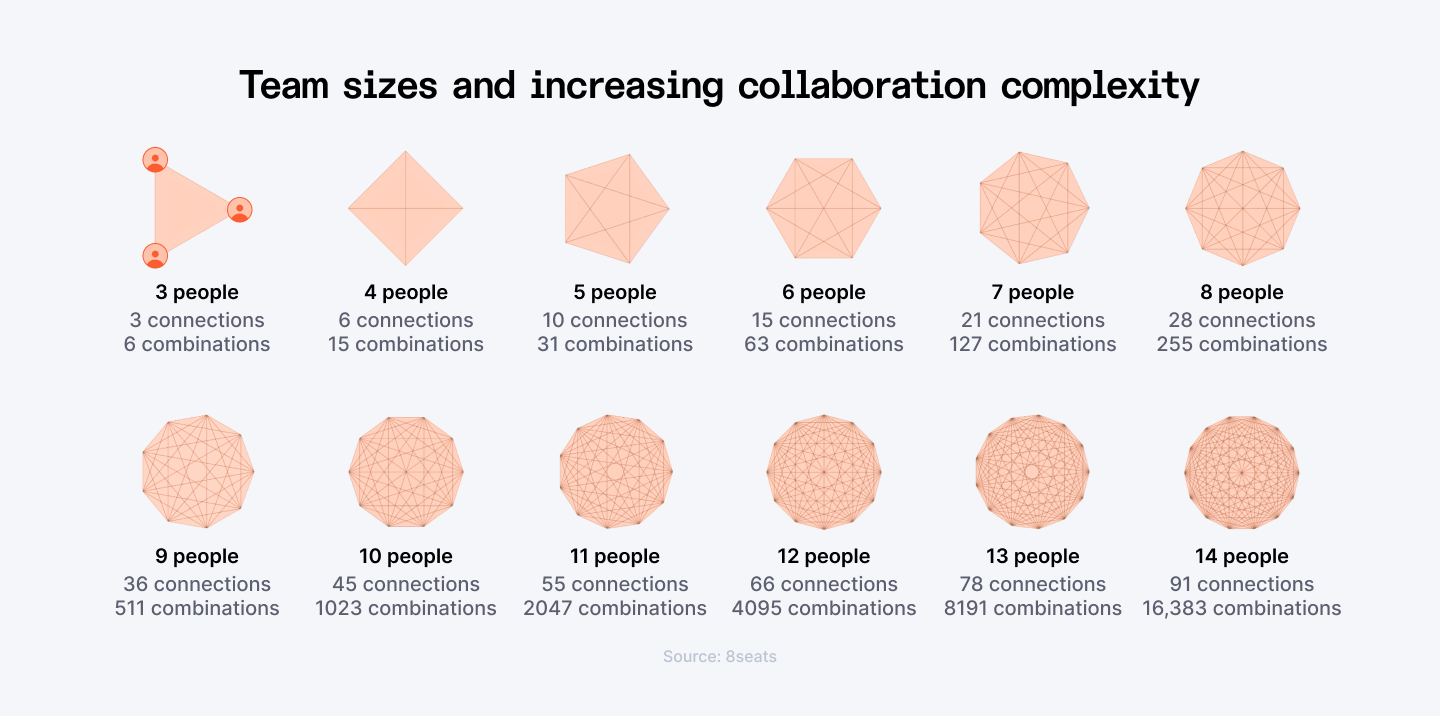
The leader who got you here won't always be the leader who gets you there. This is a hard truth most founders learn late. The CTO who thrived in the zero-to-twenty phase, shipping fast, wearing every hat, making calls on instinct, is operating in a fundamentally different role at fifty engineers. The skills that made them exceptional early on (speed, scrappiness, personal ownership) can become liabilities when what the organization needs is structure, delegation, and systems thinking. Assessing someone you've built something with, someone who's been in the trenches with you from day one, is tough. When someone is talented, it's natural to overestimate how far that talent stretches. So most founders wait. They wait for a loud, undeniable signal that something is broken before they're willing to act.
By then, the damage is usually compounding. People have left. Teams have fragmented. Technical debt has built up. The better move is to anticipate these inflection points before you hit them.
Here's what leadership looks like across the four stages most engineering organizations go through.
Four Stages of Scaling
Stage #1: 1 to 10 Engineers
At this stage, you're building a product. Everything else is secondary. Most startups begin with a technical co-founder leading engineering through the seed phase and often all the way to around 20 people. That's the right call.
What this stage demands above all else is someone who can write code, make fast architectural decisions, and still keep the bigger picture in view. If you don't have a technical co-founder, your first engineering hire is one of the most consequential decisions you'll make. You need someone who has done this before at a similar stage with limited resources, shifting priorities, and a small, scrappy team.
A few things to keep in mind at this stage:
- Don't over-engineer. The temptation to build for scale before you've found product-market fit is real, especially with strong technical founders.
- Hire for range. With a team this small, look for people who are curious, adaptable, and comfortable with ambiguity.
- Set architectural foundations intentionally. The decisions you make about your data model, your service structure, and your deployment approach will compound over time.
- Culture starts now. With fewer than 10 people, every person shapes the culture by default. The behaviors you tolerate, the norms you model, the way you handle failure and feedback — all of it becomes the blueprint.
You won't have all the answers at this stage. Nobody does. Speed and judgment. That's the job.
Stage #2: 10 to 20 Engineers
According to a Stripe developer report, engineering teams lose an average of 17 hours per week to technical debt and bad infrastructure decisions. At 15 engineers, that's a significant drag on output.
Something shifts around the 10-engineer mark. What worked before starts to feel strained. Decisions take longer. Miscommunication becomes more frequent. Engineers start stepping on each other's work. This means you've hit the natural limit of a fully flat, everyone-reports-to-one-person structure.
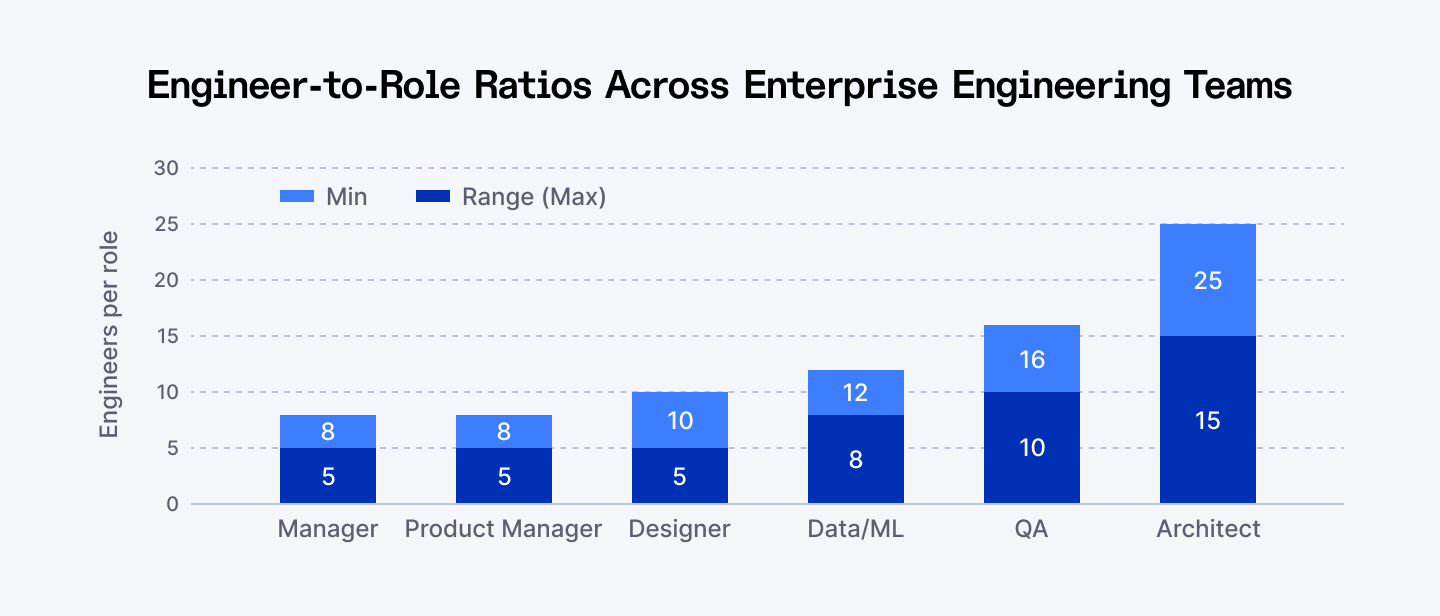
This is the stage where you introduce your first layer of management, and how you do it matters. You don't need a complex org chart. You need one strong engineering manager who can own project prioritization, manage workloads, and create enough operational clarity that engineers can focus on building rather than coordinating.
A few principles to anchor this stage:
- Don't overcomplicate it. Career ladders, formal performance frameworks, elaborate sprint rituals — none of that is urgent yet. What matters is that someone is accountable for keeping the team aligned.
- Choose your first engineering manager. Promote too early and you lose a strong individual contributor while gaining a struggling manager. Hire externally without enough context and you risk a cultural mismatch.
- Document decisions. You're small enough that institutional knowledge still lives in people's heads. Start externalizing it now. Decision logs, architecture notes, brief onboarding docs.
- Protect your senior engineers' time. As the team grows, senior engineers get pulled into more coordination and context-sharing. Be intentional about this. Their highest-value contribution is still technical, not administrative.
- Watch for early cultural drift. New hires at this stage arrive with their own habits and expectations from past companies. Without an intentional onboarding process, the culture you built in Stage 1 starts diluting.
The 10 to 20 range is a transition stage in every sense. You're not a scrappy startup anymore, but you're not a scaled team either.
Stage #3: 20 to 50 Engineers
This is where the real test begins. You've found product-market fit, you're growing fast, and suddenly the way you've been running engineering stops working. The organization feels harder to steer. Decisions take longer. Tension builds between teams. Productivity plateaus even as headcount grows.
At this point, one question becomes unavoidable: is the person leading your engineering organization the right person to take it through the next phase? This isn't a question about loyalty or past performance. It's a question about fit for what's coming.
The answer usually falls into one of three scenarios:
Scenario 1: Your biggest challenge is people and org health
You've got productivity issues, turnover creeping up, unclear career paths, and a culture that's starting to fragment under growth pressure. Engineers are frustrated. Managers are overwhelmed. Output doesn't match headcount. This calls for a people-first engineering leader. Someone who has managed managers before, built performance frameworks that work, and knows how to create the kind of operational structure that lets engineers do their best work. Critically, this person needs breadth. Not just experience managing application engineers, but DevOps, security, platform — the full engineering surface.
Scenario 2: Your biggest challenge is product and technical complexity
You're not struggling with people management. You're struggling with the product itself. Scaling it, rearchitecting parts of it, or staying technically competitive in a market that demands deep specialization.
Here, you need a technically authoritative leader who can make hard architectural calls, engage credibly with customers on technical decisions, and set a clear technology vision.
A setup that works well: the CTO owns architecture and technology vision with a small, senior team. An SVP or VP of Engineering owns org execution, people, and delivery. Two distinct roles, clear ownership.
Scenario 3: Your biggest challenge is scaling across multiple teams simultaneously
This one is less talked about, but common. You've grown fast enough that you now have multiple product lines, multiple engineering teams, or both — and coordination between them is starting to break down. Teams are duplicating work, making conflicting technical decisions, and pulling in different directions. The org has scaled horizontally without a structure to support it.
What you need here is a leader with experience designing team topology at scale. Someone who understands concepts like stream-aligned teams, platform engineering, and internal developer experience as practical tools for reducing inter-team friction.
Whichever scenario fits your situation, the principle is the same: diagnose first, then decide.
Stage #4: 50 to 100+ Engineers
Welcome to the big league. If you've made it here, something is working. You have a product people want, a team that can build it, and enough momentum to have scaled to 50-plus engineers. That's genuinely hard to do. But 50 to 100 is where a lot of companies quietly plateau. Not because growth stops, but because the organizational infrastructure can't support the scale. The symptoms are familiar: slower delivery, rising attrition, duplicated work across teams, engineering managers burning out, and a growing sense that nobody quite knows what everyone else is doing.
At this stage, the job of engineering leadership fundamentally changes. You're no longer building a team. You're building an organization.
A few things to keep in mind at this stage:
- Leadership becomes organizational design. By 50 engineers, you have multiple layers of management, multiple product streams, and enough complexity that no single person can hold it all in their head. That means investing seriously in org design. How teams are structured, where ownership boundaries sit, how decisions get made and by whom.
- Engineering managers need real support. Managing people is hard. Managing engineers, who are often skeptical of management and protective of their autonomy, is harder. And managing teams while also handling cross-functional pressure, delivery expectations, and org change is a full-time job that most managers weren't formally trained for. At this scale, investing in management development is mandatory. Whether that's structured coaching, peer learning groups, or bringing in experienced external mentors, the return is significant.
- Build the platform your engineers deserve. Internal developer experience becomes a serious competitive advantage. How fast can a new engineer get productive? How much cognitive overhead does your tooling create? According to recent surveys, developers spend nearly 30% of their time on tasks that don't directly contribute to shipping products. At 80 engineers, that's the equivalent of 24 people not contributing. Investing in internal tooling, developer platforms, and streamlined CI/CD pipelines pays back immediately and compounds over time.
- Retention is now a strategy. At 50-plus engineers, losing key people is expensive in ways that go beyond the cost of replacement. You lose institutional knowledge, technical context, and team stability. And attrition is contagious. When strong engineers leave, others start questioning whether they should too.
50 to 100 engineers is the stage where small mistakes in leadership or structure become expensive. Every missing manager, unclear process, or leadership bottleneck multiplies across the organization.
Nail Remote, Global, and AI Hiring
Once your engineering team grows past 50, talent strategy becomes just as important as technical strategy. Where your engineers live, how they work, and what skills they bring shapes everything, from velocity to product quality to culture.
1. Choose Your Hiring Locations and Remote Work Policy
According to a recent survey, 69% of US companies now offer work location flexibility. The majority of startups with 100 or fewer employees now offer remote-first work policies. Among larger tech companies, 65% allow some form of remote work with selective in-office requirements. For most engineering organizations, remote is the default.
And it's opening up global hiring in a real way. The path to global teams often starts with one good remote hire. In a recent survey, 72% of employers reported a positive remote experience directly influenced their decision to hire globally.
Whatever policy you adopt, base it on a real business case, not preference, not fear, and not what other companies are doing. Then identify the constraints of that policy honestly and build your systems around them.
2. Build a Globally Distributed Engineering Team
The strongest argument for hiring globally is the access to talent. If you've saturated the local market, if a specific skill set is scarce or prohibitively expensive in your region, or if you need to scale faster than local hiring allows, building a global team is a rational, strategic move.
At Index.dev, we've helped funded startups, scaleups, and enterprise teams expand their engineering teams with remote talent from across Europe, Latin America, Asia, and beyond. A good example is Fishbrain, the fishing app with millions of users worldwide. When they needed to scale their engineering team in Sweden, they worked with Index.dev to bring in skilled contractors who integrated directly into their team and product culture. The result wasn't a remote vendor relationship. It was an extension of their core team, working on real product priorities alongside their in-house engineers. They even invited the Index.dev contractors to a team-building event in Sweden and took them on a fishing trip to one of the country’s well-known fishing spots.
Yes, distributed teams can fail for predictable reasons. The key is to address those risks early:
- Keep teams with dependencies in overlapping time zones. Collaboration across a 9-hour gap is painful. Scrum teams or tightly coupled components perform better when the team shares a core working day.
- Distribute meaningful work across every location. When engineers outside headquarters are handed lower-priority tasks, two things happen: they become bottlenecks waiting on decisions made elsewhere, and they disengage. Ownership needs to exist in every location. Engineers perform better when they know their work matters.
- Invest in in-person connection. Even once a year. Shared meals and face-to-face time build trust faster than months of video calls. The "us vs. them" mentality is one of the most corrosive forces in distributed teams, and one of the most preventable.
3. Assess Your Need for AI Talent
AI hiring is one of the most expensive and overhyped areas in engineering recruitment right now. Salaries for senior ML engineers and AI researchers have reached levels that only make sense if AI is genuinely central to your product.
So ask the honest question first: do you actually need to build and train models yourself, or do you need engineers who can work effectively with existing AI tools and APIs? For most companies, it's the latter.
If AI is truly core to your product and you need proprietary model development, hire one exceptional senior scientist. Make that your significant investment. Support them with one strong engineer, and use trusted contractors to flex capacity until further full-time hires are clearly justified. Don't build an AI team because it looks good in a pitch deck. Build one because your product genuinely can't exist without it.
At Index.dev, we're seeing strong demand for AI-adjacent engineering talent across our network, particularly engineers who can integrate, fine-tune, and deploy models. The market for this profile is competitive, but more accessible than pure research talent, and often more relevant to what growth-stage companies need to build.
Final Thoughts
Scaling an engineering team from 1 to 100 is not a straight line. It's a series of inflection points, each one demanding a different version of you as a leader.
Every stage has its own challenges. Early on, it’s speed and execution. From 10 to 50, it’s structure, clarity, and leadership. Beyond 50, it’s systems, autonomy, and scaling culture across people, locations, and technical complexity.
The choices you make—who you hire, how you organize, where your engineers work, and what skills you prioritize—compound over time. If you focus on leadership, processes, and culture as much as code, your team won’t just grow in numbers. It will grow in strength, resilience, and impact.
➡︎ Still building engineering teams the hard way? Index.dev gives you instant access to senior, verified engineers — no long hiring cycles, no onboarding drag. Whether you're building AI-enabled products, scaling your engineering capacity, or finally moving a stalled initiative into production, we provide the technical depth and managed delivery support to keep you on track.