Startups achieve success or failure based on their selection of suitable remote developers for their development team. The success rate for startup survival during their initial years stands at 90%. This makes selecting employees wisely an essential business priority. Remote development teams have become an essential game-changer because they provide cost reduction benefits along with improved productivity enhancements.
Studies indicate remote developers achieve 35-40% higher productivity output levels when compared to office-based developers which leads to startup savings of $11,000 annually per remote employee. Remote work adoption allows businesses to increase productivity while simultaneously decreasing operational costs which results in yearly savings of up to $600 million.
Remote hiring establishes a worldwide talent market which provides startups with two essential advantages including increased hiring diversity and improved operational agility. The technology sector demands startup success along with growth through purposeful remote worker recruitment practices because of intense market competition.
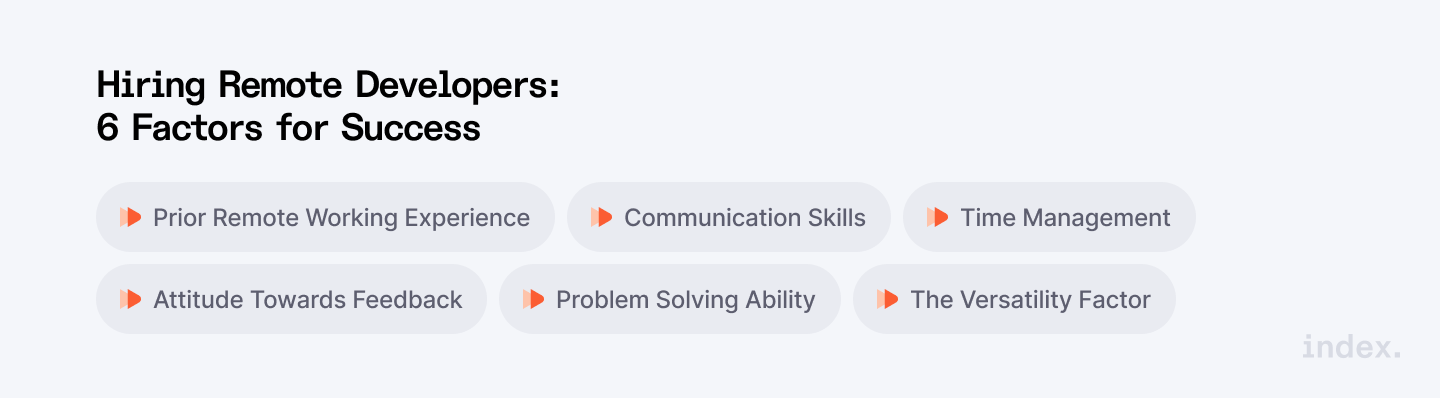
Hiring Remote Developers: Factors for Success
Before talking about the perfect plan to hire remote developers, it’s important to consider the qualities you need to look for. If your developers have a certain set of qualities, it will simplify your task of managing the team.
Let’s have a look at these factors that will set you for success if you find them in your remote developers.
1. Prior Remote Working Experience
Developers with remote work experience will be familiar with remote project management platforms like Trello, Basecamp, and Asana, so you'll spend less time providing instruction to them.
However, the situation becomes vague for applicants who have never worked remotely before. You'll need to check if these potential applicants can manage their own workloads and meet project deadlines without a manager peering over their shoulders.
So, make a point of asking if they've ever utilised project management software, and if not, how they now manage their workload.
You may assign applicants a job in your team's selected project management client to check if they'll be comfortable using these programs. You may then talk about their experience during your virtual discussion.
2. Communication Skills
If a candidate shares their views and writes well in their cover letter and CV, they are likely to have strong communication skills, which are essential while working remotely.
However, besides great writing communication skills, you should also assess their verbal abilities. These are equally vital for your team dynamics and will be employed on a daily basis to communicate project specifics and changes.
So, while interviewing remote developers, assess how effectively they practise active listening. Look out for interruptions and see if they have any follow up questions. Your team will stay in touch via email, apps and video calls. If the communication skills aren’t up to the mark, it will definitely cause a problem.
3. Time Management
A common challenge that almost all the remote workers come across is procrastination. ‘I have time, I will do it later’ mentality often stresses out the employee which eventually impacts productivity. Many startups also rely on remote employee monitoring tools to understand how developers manage their time, identify bottlenecks, and ensure accountability without micromanaging.
It’s tough to predict the exact duration a task might take because developers invest time in coding and attempting to solve problems. However, an experienced developer will have a better grasp and will be able to provide a tentative timeline.
While interviewing, ask questions around the developer’s time management skills and ask about their previous projects’ timelines. This will paint you a picture of the developer’s working style and you can judge if that will work for you or not.
4. Attitude Towards Feedback
Another significant factor in the remote recruiting process is how open the developers are to feedback from their managers, customers, or other team members. As software development is primarily a collaborative endeavour, developers must actively solicit feedback from team members or clients and respond to it.
It has been noticed that effective developers are more receptive to receiving and incorporating feedback into their work. Being sensitive to feedback is critical for producing high-quality results since it constantly helps people improve their jobs.
If the developer fails to incorporate the feedback or doesn't understand your point of view, you will be on different pages, and there will be a lack of alignment, which will be reflected in the final output.
5. Problem Solving Ability
Successful remote developers can quickly understand the situation at hand. They are also capable of creating innovative solutions to problems with ease. As remote developers may have to wait before contacting the team, they must trust their own problem-solving instincts.
When employing a remote team, it is usually a good idea to assess their problem-solving talents and proficiency with some easy questions about actual user cases for the project they have recently completed.
You may also use popular aptitude tests to learn how people approach problems and try to solve them. The idea is to see how they handle problematic situations under pressure without any guidance because not everyone is readily available in a remote setup.
6. The Versatility Factor
Major companies already have set systems and procedures that are integrated into their operations. However, most companies flourish in a far less organised setting. What works for a team of 20 assigned to 50 projects will not work for a team of 5 assigned to 2 projects.
That is why determining if the developer can survive in a changing environment is imperative. It is best not to recruit professionals who value the predictability and consistency of frameworks such as annual performance evaluations and budget approval mechanisms.
As a startup, you need to hire someone who can go with the flow and adjust themselves to various situations rather than being monotonous.
Also Read: Effective Remote Recruitment Strategies for Engineering Managers
Need to scale your engineering team quickly? Tap into Index.dev’s global talent network for proficient developers and simplified hiring processes.
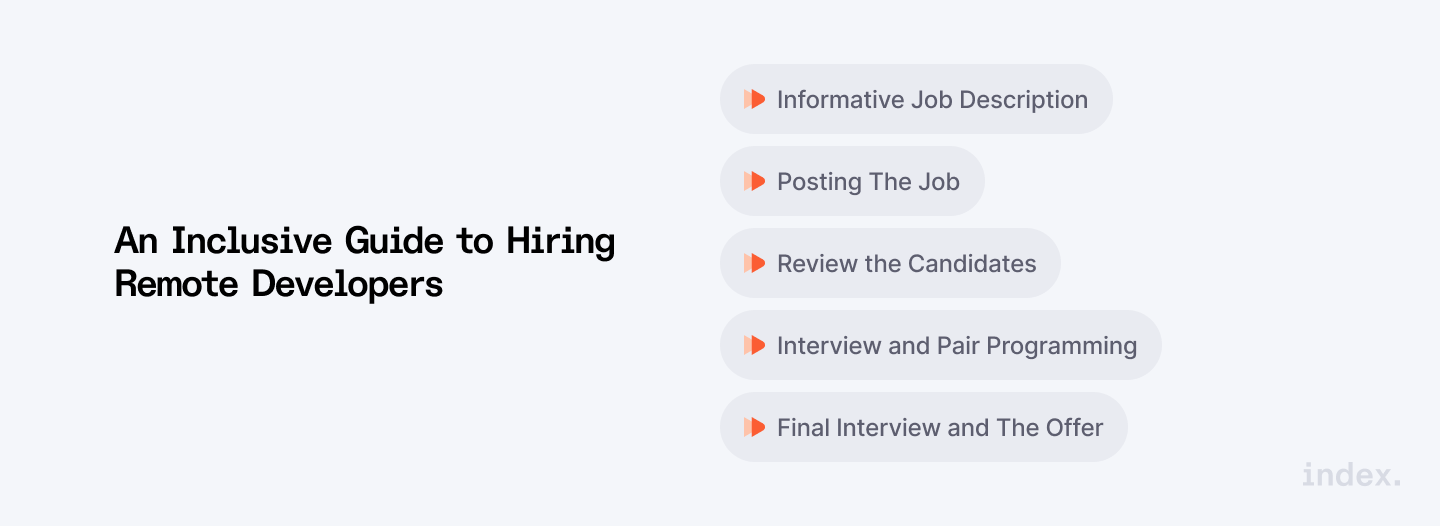
An Inclusive Guide to Hiring Remote Developers
Hiring the right remote developers is an initial step of the ladder, and if you fumble, you’ll never make it to the top. To save you from the trouble, we have compiled an all-inclusive guide to hiring skilled remote developers.
The Mindset Matters
Make sure you understand precisely why distributed teams are necessary. Naturally, in the job description, you should specify the professionals required to build a remote team of developers from the beginning. It serves as the foundation upon which your HR department or a third-party marketplace will search for qualified individuals. You're ready to hire a new employee once you've established exact objectives and expectations.
The screening procedure is one of the most challenging aspects of recruiting remote developers. People who are expected to work remotely may be unable to attend your workplace, thus your interview possibilities are limited. Nonetheless, there is a process you may use to establish whether the possible applicant is a suitable fit.
Informative Job Description
Once you've decided what you want, write a job description. You must decide on the precise skills, expertise, and qualities required for the position.
As a result, include all relevant information, such as the candidate's experience and specialised technical talents, as well as the web developer's tasks and responsibilities. Also, include some information about what your organisation performs so that applicants have a better understanding before applying for the position.
Specify the project scope and produce a description that aligns with your company objectives. Furthermore, be clear about the type of project, the required technology stack, and the number of remote employees.
Here are the components you must include in the job description:
- About the company
- Roles and responsibilities
- Perks and benefits
- Expectations from the developers
- Working hours
- Salary range
Posting The Job
Once you've completed the description, you'll need to post it on several remote employment sites to make it visible to candidates. When you submit the advertisement, make sure to provide any relevant details to clarify the description and attract the proper remote talent.
Here are three methods for effectively posting a position on job boards:
- Create a clear and precise job description: The job description should be straightforward to read and understand. To attract potential recruits, you must convey the company's goal and culture in addition to job descriptions.
- Use relevant keywords: Use relevant keywords to guarantee that your job description shows in search results. To do this, you must consider the perspective of the job seeker. Adding keywords will increase exposure, encouraging skilled developers to apply.
- Add a competitive salary range: All job candidates demand competitive compensation. Set a range that is acceptable for the role and industry. Then, research market rates and propose the most appropriate pay for the role.
Also Read: How to Vet Software Developers
Review the Candidates
When you finish sharing a job release on websites, you may receive hundreds of applications. You do not have time to interview every one of them. At that point, you will need to go ahead and review their resumes in order to determine which one has been chosen for an interview.
This stage requires you to match the qualifications, experience, and talents to the requirements of your project. If they match effectively, you can proceed with their applications.
You can also send a technical exam to applicants before spending time interviewing them. To assess their technical talents, use coding exams, technical interviews, and real-world problem-solving assignments.
You may use tools like HackerRank, Codility, and LeetCode to develop successful evaluations. Make sure the duties are related to the work they will be doing at your organisation. Once they pass the technical test, you can proceed to the next phase.
Interview and Pair Programming
When someone applies for a remote position at your firm and passes your initial evaluation, it does not imply that they are a good match as a remote employee. In the majority of cases, a 30-minute face-to-face discussion with a recruiting manager or team lead will assist in comprehending how this new hire will benefit your current team.
To see candidates in action, a technical manager (such as a lead developer from your in-house team) can develop a test programming project and work with the applicant. These pair programming sessions are typically conducted using popular applications such as Slack and GitHub. Pair programming allows you to effectively evaluate a candidate's abilities and competency using various tools.
Technical abilities aren't the only thing to consider; assessing soft talents is also crucial. Arrange behavioural interviews to assess their problem-solving, teamwork, adaptability, and communication skills. Ask pertinent questions to see how they deal with remote work problems, including managing time zones, remaining motivated, and communicating with a distant team.
Final Interview and The Offer
If you are satisfied that you have discovered the best candidate to continue forward, the next stage is the final interview. It should outline the candidate's pay expectations, work schedule, and all of the advantages that come with working for your organisation.
Make sure they have an opportunity to ask questions. Also, remember to ask yourself the last questions to confirm that a candidate is a good fit for your distributed team.
After the final interview with the candidate, send along the official employment offer along with an overview of the benefits you provide. To recruit a remote software developer, negotiate a contract with the appropriate supervisors and your legal department.
Wait for your candidate's approval, and then welcome a new team member. Once the contract is signed, you may begin onboarding your new remote employee.
Struggling to fill key engineering roles? Index.dev offers a network of 15,000+ vetted software engineers, ready to join your team. Find your right fit in under 48 hours!
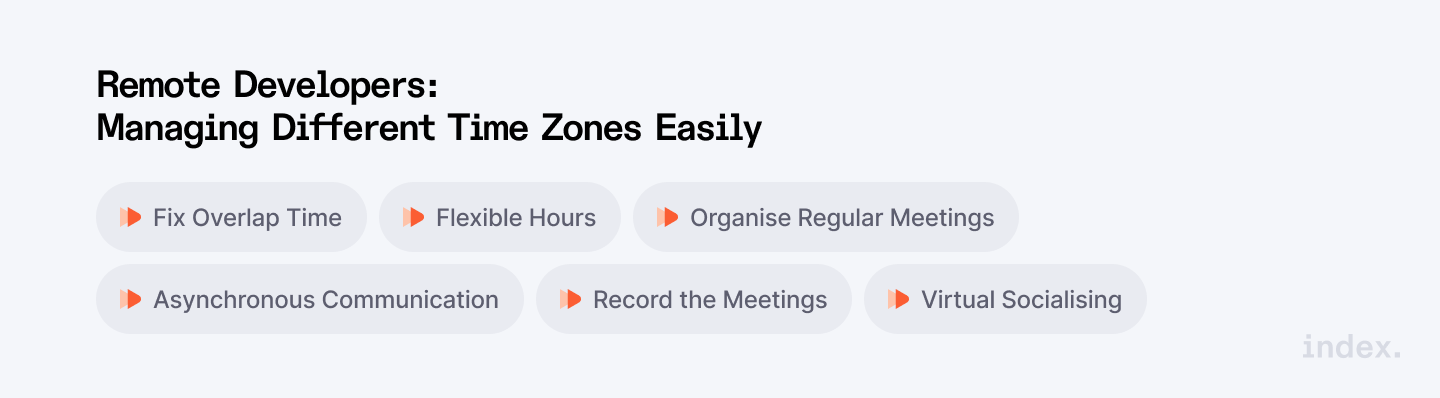
Remote Developers: Managing Different Time Zones Easily
Remote work allows us access to the global pool which results in cross-border collaborative teams. It might make communication tough due to different time zones, but there’s nothing planning can’t solve. Let’s have a look at various techniques that can help manage different time zones without a hassle.
Fix Overlap Time
If you have a diverse team, it’s obvious that everyone has a different schedule. However, it’s not impossible to find a common ground to connect with the whole team. You can set up a particular time when all the team members are expected to be accessible for meetings and collaboration.
This is what we call the designated overlap time. While this window may not cover the entire workday for everyone, having it in place avoids decision-making obstacles and assures prompt interaction.
Flexible Hours
Flexible working hours is a luxury and if you provide it to your team, it will directly result in better productivity. When companies allow employees to work at their convenience, they provide a better work-life balance and better well-being.
Flexible hours won’t only result in work getting done in a timely manner but it will also ensure the quality is intact. Not only this, employers who enable their employees to work on a flexible schedule can find themselves a more profitable and desirable firm to work for.
Organise Regular Meetings
In a remote setup, meetings are one of the best ways to connect with teammates and know that you’re actually working with humans. Remote meetings are versatile and cost-effective for engaging employees, communicating across locations and departments, and other potential interactions.
Sort out a time that works best for the majority of the employees to organise meetings with them from different zones. You can also switch the times on a monthly basis so that it’s not biased towards a specific time zone.
Asynchronous Communication
Asynchronous communication is one of the best hacks for overcoming the hurdle of different time zones. It allows remote employees to respond at their convenience. They are neither pressed for time nor concerned about keeping someone waiting for an answer.
Asynchronous communication gives remote workers a higher chance of being productive and focused. Instead of constantly monitoring and responding to communications, people can focus on working and completing their tasks.
This increased productivity implies that you will receive higher-quality work. A team with fewer distractions and more mental capacity improves efficiency, keeps deadlines on track, and reduces mistakes.
Record the Meetings
Even if you have a designated overlap time and regular meetings, it might be a possibility that not every member is able to attend the call. To overcome this, you can simply record the meetings and take down action times to share with the members.
Keeping a record of meetings will help with efficiency and consistency. It will also help to provide additional resources and access to information. It will keep everyone on the same page even if they are unable to attend the meeting.
As a host, reviewing a recorded meeting will give you a better chance to review your performance as well. You will be able to study your shortcomings and work on the areas where you need improvement.
Virtual Socialising
Meeting in person is not the only way to socialise and get to know your teammates better. In a remote setup, you can always opt for activities to socialise virtually. According to research by Gallup, ‘Virtual team building activities lead to an increase in employee performance rate, claiming 41% lower absenteeism and 21% higher profitability.’
Consider a range of activities, including Zoom calls, online games, book/movie groups, and more. This is an essential aspect of acknowledging that we are all human and that we can connect in a variety of ways to make our work relationships more valuable and delightful.
Also Read: 33 Best Places for Hiring Software Engineers in 2024
Conclusion
If you are clear about your expectations from the developers you are going to hire, you are already on the right path to success. Hire a developer that has prior remote working experience so you won’t have to explain everything from the scratch. Ensure that they have sound time management, communication, and problem solving skills apart from the technical skills.
Review the profiles diligently before moving to the interview round to ensure that you don’t end up wasting your time. If you find a skilled remote developer, you will eventually be able to manage the different time zones with no negative impact on productivity.
For Clients:
Sign up on Index.dev to access a global network of skilled remote developers:
- Choose from 15,000 high-performing developers, designers, PMs, and QAs
- Vetted and ready to interview in 48 hours
- Long-term, full-time work
Features of Index.dev
- Talent pool: The elite 5% of tech talent
- Platform: Full-time, 100% vetted remote contractors
- Highlights: Rigorous 4-stage vetting and dedicated account management
- Risk Free Trial: 30-day trial, only pay if you are happy
- Hiring costs: No platform or hiring fees
For Developers:
If you’re a skilled software developer looking for high-end projects in the US, UK, and EU join Index.dev for a beneficial remote career.