Remote engineering hiring is growing fast as companies shift to global talent and flexible work models. Teams now hire across different regions, focus on specialized roles, and build distributed teams to improve speed, scale, and access to skilled engineers.
This article highlights key statistics that explain hiring trends, role demand, productivity, and workforce changes in the engineering sector.
In this statistical roundup, we break down the key insights shaping remote engineering hiring today.
Note: All statistics and data are collected from trusted online sources and carefully verified for accuracy.
TL;DR
- An overwhelming 82% of companies have officially pivoted to remote work as their primary hiring model for new engineering talent.
- Remote Data Analyst positions have experienced a staggering 458% year-on-year surge, marking the highest growth in the technical sector.
- The demand for remote Tech Leads has skyrocketed by 404%, highlighting a massive shift toward distributed management.
- Companies adopting a remote-first strategy effectively expand their available talent pool by up to 400%.
- Indonesia has emerged as the world leader in remote hiring growth, boasting a 266% annual increase.
- While 77% of engineers report being more productive at home, only 37% of their supervisors agree with that assessment.
- A significant 65% of remote vacancies are gated for senior professionals, leaving less than 6% of roles available for junior engineers.
- Engineers value their autonomy so highly that 37% would willingly accept a 10% pay cut to guarantee permanent remote status.
- Over half of all engineers (56%) know someone who has already quit or would quit if forced back to a physical office.
- Remote job postings in emerging economies have nearly doubled, rising from 16% in 2020 to 28% today.
The New Engineering Standard: Adoption and Workplace Models
The landscape of technical work has undergone a permanent structural shift. What began as a mandatory reaction to global lockdowns has matured into a calculated, remote-first operational strategy.
For most engineering organizations, the debate over "if" remote work is viable has been replaced by "how" to best optimize a distributed workforce for long-term technical debt reduction and sustainable product velocity.
- 82% of companies now utilize remote work as their default hiring model for new engineering roles.
- 78% of remote-capable technical roles are currently performed in either a fully remote (26%) or hybrid (52%) capacity.
- Only 21% of engineering positions remain strictly on-site, a figure that continues to shrink as talent competition intensifies.
- 56% of hiring managers now explicitly state that remote arrangements have had a net positive impact on their overall team operations.
The Specialization Surge: Niche Roles and the AI Boom
As the generalist software engineering market stabilizes, a hyper-growth phase has emerged within high-complexity technical niches. Companies are no longer just looking for "coders"; they are competing for specialized architects capable of managing the massive infrastructure shifts required for artificial intelligence and advanced data modeling on a global scale.
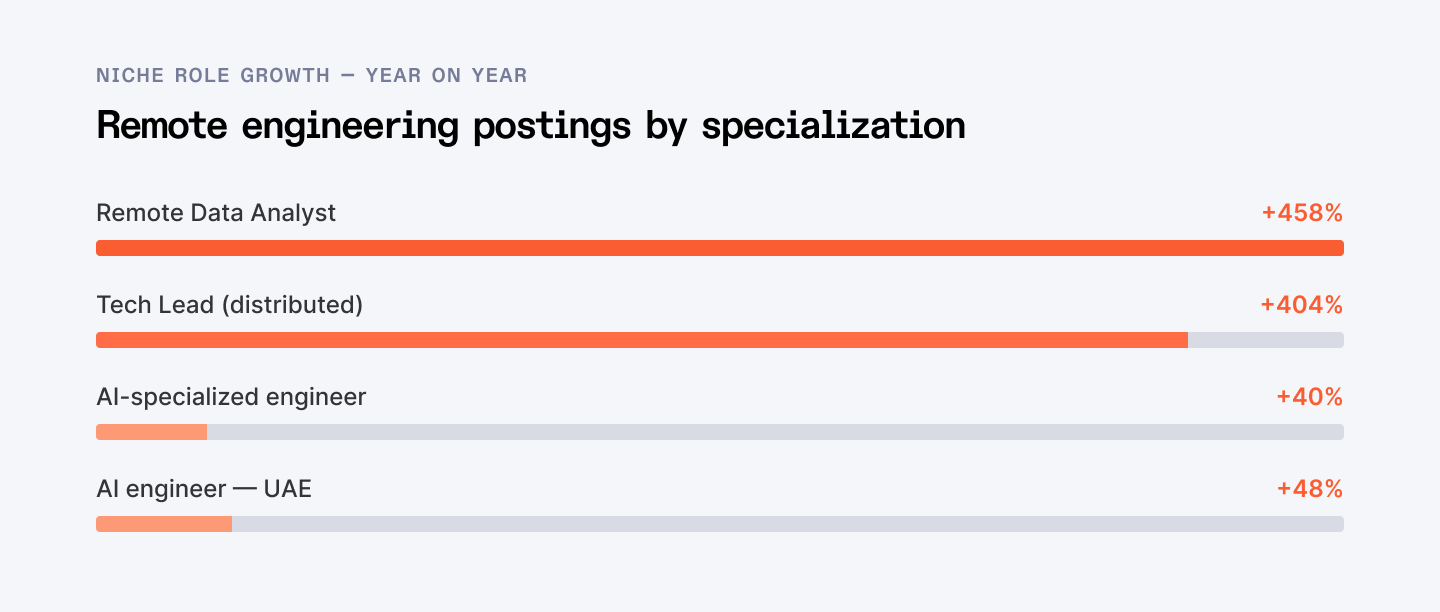
- Remote Data Analyst postings have seen a staggering 458% year-on-year growth, the highest in the sector.
- Tech Lead roles in remote environments grew by 404%, signaling a massive need for distributed leadership.
- Demand for AI-specialized engineers is growing at 40% annually, more than double the rate of the available talent pool growth (15–20%).
- AI-specific hiring volume in emerging tech hubs like the UAE surged by 48% in the last twelve months alone.
Explore more: Discover the emerging AI roles companies will be hiring for in 2026 and what skills will be in highest demand.
The Experience Gap: Seniority and the Access Divide
A definitive "Trust Gap" has emerged in the remote engineering sector, creating two very different realities for junior and senior talent. While seasoned engineers enjoy unprecedented freedom and leverage, entry-level candidates face a tightening market where physical proximity is often seen as a prerequisite for effective mentorship and cultural integration.
- 65% of all remote engineering vacancies are strictly reserved for "experienced-level" professionals with five or more years of tenure.
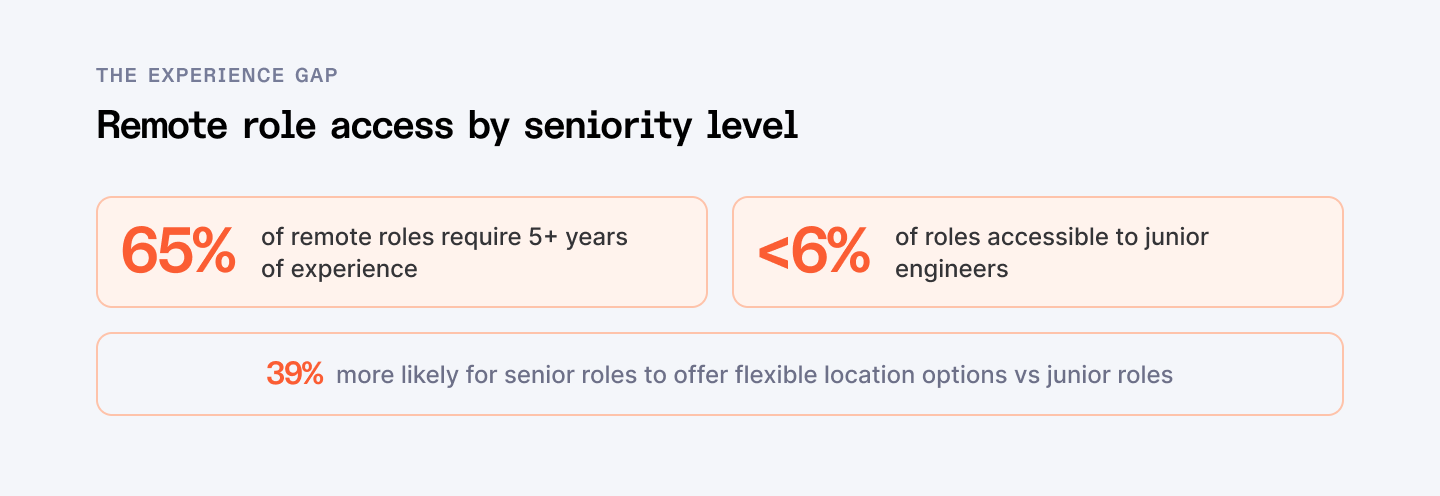
- Less than 6% of fully remote engineering roles are accessible to entry-level or junior candidates.
- Senior-level openings are 39% more likely to offer flexible location options compared to junior roles.
- Managers report that onboarding and mentorship are the top two hurdles, contributing to the preference for on-site junior training.
Global Expansion: The Rise of Emerging Talent Hubs
The decoupling of "work" from "location" has triggered a massive expansion of the global talent pool. Western firms are increasingly looking past traditional tech hubs like Silicon Valley and London, instead tapping into burgeoning engineering ecosystems in Eastern Europe, Southeast Asia, and Latin America to find specialized skills and optimize labor costs.
- Adopting a remote-first hiring strategy increases a company’s available talent pool by up to 400%.
- Indonesia leads the world in remote hiring growth with a 266% year-on-year increase.
- Poland (+183%) and Brazil (+164%) have solidified their positions as the top two secondary hubs for engineering talent.
- The share of global tech postings located in emerging economies has jumped from 16% in 2020 to 28% today.
Learn more: Explore the latest remote developer jobs and hiring trends shaping the global tech market.
The Compensation Matrix: Salaries and the "Flexibility Premium"
Engineering compensation is no longer a simple calculation of local cost-of-living. A new "shadow salary" has emerged, where the value of time and autonomy is factored directly into total reward packages. This has forced companies to balance high-demand salary benchmarks with the non-monetary value of work-life integration.
- 37% of engineers state they would accept a 10% pay cut if it meant guaranteeing a permanent remote status.
- Remote engineers currently earn an average of 12% to 35% more than on-site peers, largely due to the seniority bias of remote roles.
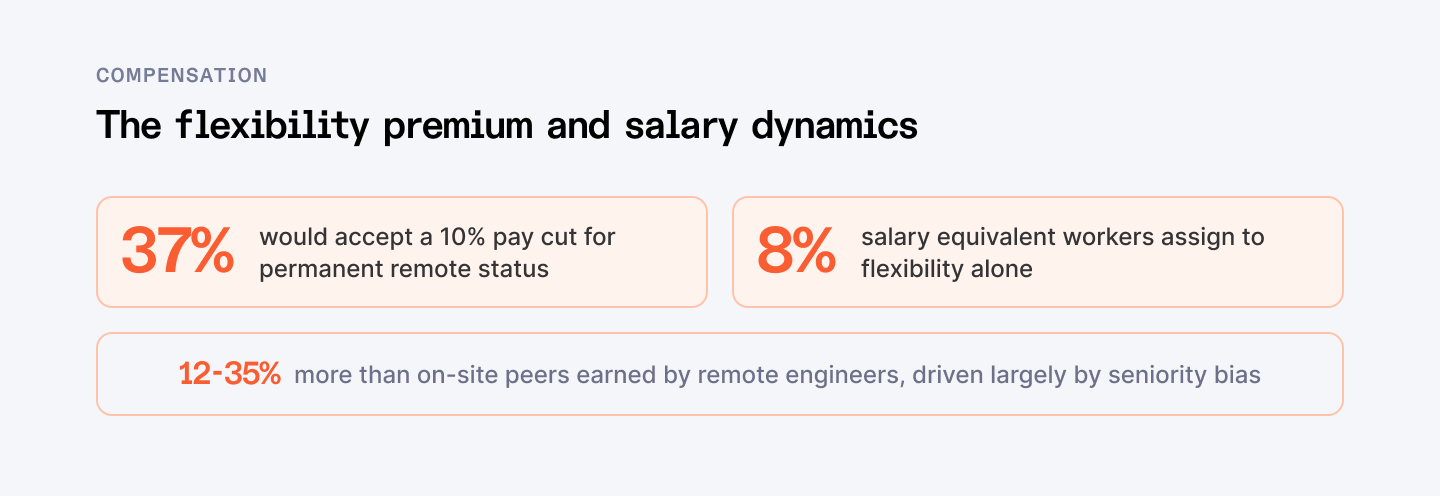
- Employees value the "flexibility premium" as being equivalent to a direct 8% salary increase.
- In the US, remote salaries in secondary hubs like Boston and Seattle have now begun to outpace the traditional San Francisco "Bay Area premium."
Performance and Retention: The Productivity Paradox
There remains a significant disconnect between how engineers view their own output and how executives perceive the health of their organizations. While individual contributors report higher levels of focus and job satisfaction, leadership teams are increasingly concerned about the erosion of corporate culture and the long-term effects of social isolation.
- 77% of workers feel more productive at home, while only 37% of supervisors agree that productivity has increased.
- 56% of engineers know someone who has quit—or would quit—if their employer mandated a full-time return to the office.
- 47% of professionals who are not currently looking for new work cite their "current flexibility" as the number one reason they stay.
- Despite high satisfaction, 83% of engineers report struggling with overwork and "meeting fatigue" due to the blurring of lines between home and office hours.
Up next: Learn why high retention of engineering talent at Index.dev leads to faster delivery, better output, and lower engineering costs.
Final Thoughts
Remote engineering hiring is no longer a trend. It is now the standard way companies build and scale teams. The data clearly shows strong growth in remote roles, higher demand for specialized talent, and a shift toward global hiring.
At the same time, companies must solve challenges like senior talent gaps, onboarding issues, and productivity alignment. Businesses that adapt to these changes early will gain access to better talent and long term growth opportunities.
FAQs
1. What are remote engineering hiring trends in 2026?
Remote engineering hiring trends show a strong shift toward remote-first and hybrid models. Companies are expanding global hiring, focusing on specialized roles like data analysts and AI engineers, and building distributed teams to improve productivity and access to talent.
2. Why are companies choosing remote engineering hiring?
Companies choose remote hiring to access a larger global talent pool, reduce hiring costs, and scale faster. As a result, remote-first strategies can increase available talent by up to 400 percent and help businesses hire skilled engineers from multiple regions.
3. Is remote engineering hiring good for junior developers?
Remote hiring is more focused on senior professionals. Around 65 percent of roles require experienced engineers, and less than 6 percent are open to junior candidates. This creates a gap where entry level engineers may find fewer remote opportunities.
4. How does remote work impact engineering productivity?
Most engineers report higher productivity when working remotely. However, there is a gap in perception, as many managers do not fully agree. Remote work improves focus and flexibility but can also lead to challenges like overwork and communication gaps.
Data Sources
- https://dev.to/__be2942592/the-complete-remote-job-search-strategy-for-developers-in-2026-211c
- https://www.flexjobs.com/blog/post/flexjobs-remote-work-economy-index
- https://www.itransition.com/software-development/statistics
- https://owllabs.com/state-of-hybrid-work/2024
- https://www.researchgate.net/publication/403474959_The_State_of_Remote_Software_Engineering_Labor_Market_Shifts_Tooling_Evolution_and_Hiring_Patterns_2020-2026
- https://www.yomly.com/remote-work-statistics/