
Hiring today is no longer just about filling open roles. Companies face growing pressure to find the right talent faster while managing rising costs and skill gaps. Many struggle to match candidates with real business needs, especially as roles require a mix of technical and practical skills. This makes hiring strategy a key factor in business performance.
In this statistical guide, we compare talent platforms and traditional recruiting using real data. You will see insights on hiring speed, cost, efficiency, retention, and adoption of AI and digital tools. All data is sourced from verified reports and is listed at the end of the article for transparency.
Unlock faster access to verified engineers through Index.dev’s global talent network and delivery-ready teams →
Talent Platforms vs Traditional Recruiting at a glance
- 24% global hiring outlook shows steady demand, but only 40% plan to increase hiring, while 34% face economic uncertainty.
- Hiring demand is uneven, with Asia Pacific at 29%, while countries like the UAE (48%) and India (42%) lead, and Argentina (3%) lags.
- Talent shortage is severe, as 48% of hiring managers cannot find qualified candidates, and 80% struggle with skill gaps.
- Traditional recruiting is weakening, with 52% saying passive recruiting is ineffective and 32% saying job ads no longer work.
- Hiring funnels are inefficient, with 73 applicants, 3 interviews, 1 hire, and a median time-to-hire of 38 days.
- ATS adoption is widespread, with 75% of recruiters using it and 99% of enterprises relying on it, driven by a market growing to USD 34.83B by 2034.
- AI adoption is rising fast, reaching 25.9% (up from 4.9% in 2023) and enabling 26% faster hiring.
- Talent marketplaces improve speed, reducing hiring time by up to 20 days and improving cycles by 30% to 40%.
- Talent platforms cut costs, with internal hiring being 3 to 5 times cheaper, and improve retention to 62% vs 45% for external hires.
- Despite benefits, adoption faces barriers, with 42% facing compliance issues and nearly 60% facing internal resistance.
1. What do the global hiring outlook and workforce shifts show?
Hiring demand remains positive but mixed. Expansion, new roles, and skill needs drive hiring, while economic uncertainty and automation slow it down. Workforce restructuring and long-term planning are on the rise, with many companies shifting toward strategic hiring models rather than reactive recruitment.
- The global net employment outlook stands at 24%, which reflects steady hiring demand, with 40% of employers planning to increase hiring, 16% expecting workforce reduction, and 42% planning no change, showing a balanced but cautious hiring environment.
- Hiring demand is mainly driven by business expansion, as 37% of employers are hiring due to company growth, while 27% are creating new roles for new ventures, indicating active business scaling.
- Skill and technology needs are shaping hiring decisions, with 25% of employers hiring to meet new skill requirements and 24% hiring due to technological advancements, showing a shift toward capability-based hiring.
- External risks continue to influence hiring, as 34% of employers say economic uncertainty impacts hiring decisions, while 27% report reduced job demand due to market changes, highlighting cautious workforce planning.
- Workforce restructuring is ongoing, with 22% of companies restructuring or downsizing and 21% reporting that automation is reducing certain roles, indicating a shift toward leaner, more automated operations.
- Long-term workforce planning is on the rise, with 57% of organizations future-proofing their HR strategies, indicating a shift toward strategic hiring rather than reactive recruitment.
2. How does hiring demand vary across regions and countries?
Hiring demand is uneven across regions. Asia Pacific and emerging markets show strong growth, while some regions and countries face weak hiring outlooks. This variation highlights how economic conditions and market maturity directly impact hiring strategies and the adoption of modern recruiting methods.
- Regional hiring demand varies significantly, with Asia Pacific leading at 29% hiring outlook, followed by the Americas at 27%, while Europe and the Middle East remain lower at 19%, showing stronger growth momentum in emerging markets.
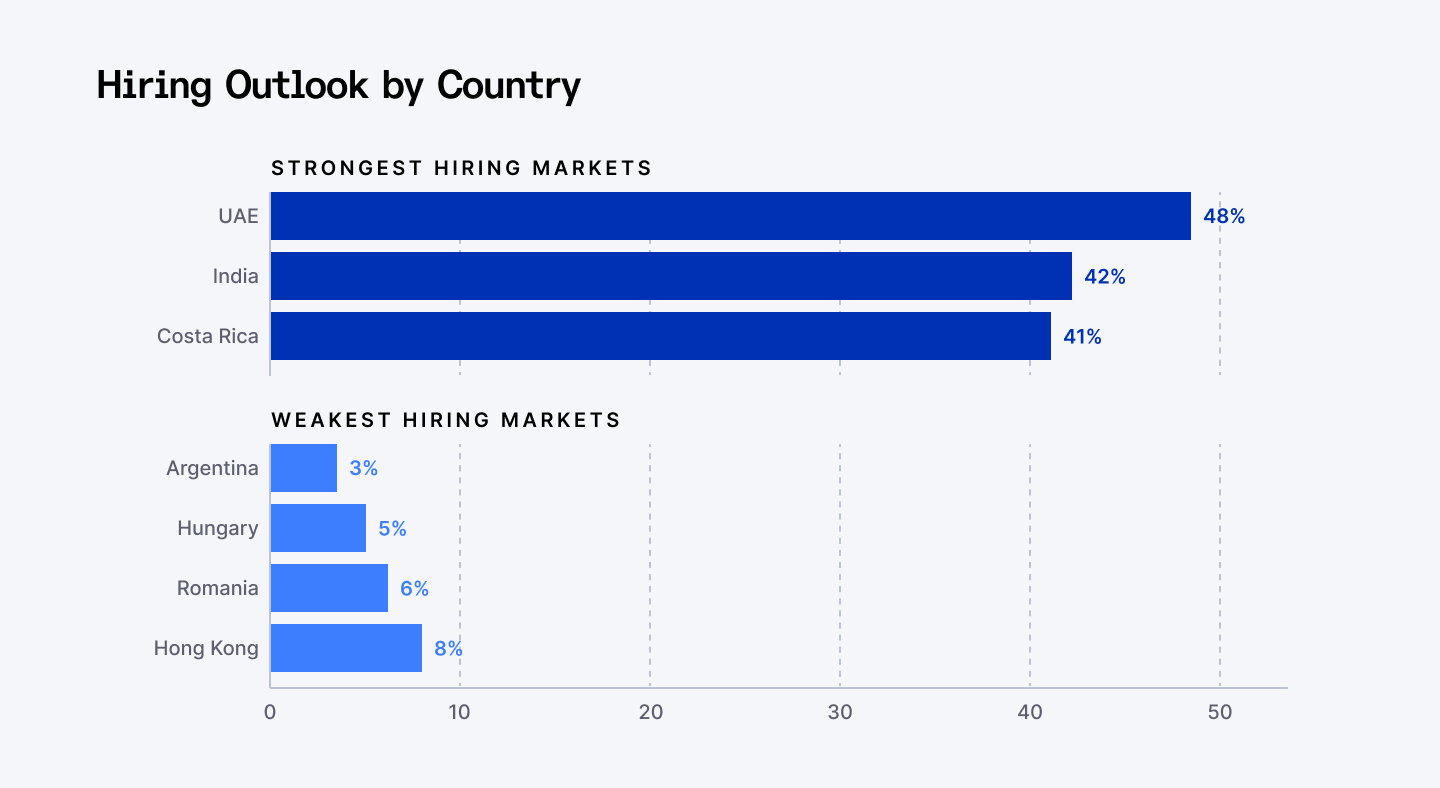
- Among countries, the UAE shows the strongest hiring outlook at 48%, followed by India at 42% and Costa Rica at 41%, reflecting high demand in rapidly growing economies.
- In contrast, weaker hiring markets include Argentina at 3%, Hungary at 5%, Romania at 6%, and Hong Kong at 8%, indicating slower economic activity or hiring constraints in these regions.
3. What do labor market and hiring flow data reveal?
Labor market data shows high job demand but uneven hiring outcomes. Job openings exceed hires, and voluntary exits dominate separations. Stable unemployment and strong participation rates indicate an active workforce, but gaps between openings and hires suggest inefficiencies in matching talent to roles.
- Job openings reached 6.9 million in February 2026, compared to 4.8 million hires and 5.0 million separations, showing ongoing workforce movement and hiring gaps.
- Employee exits are driven mainly by voluntary movement, with 3.0 million quits compared to 1.7 million layoffs and discharges, which indicates employee-driven job changes rather than employer-led reductions.
- The labor market remains stable, with unemployment between 4.1% and 4.2%, while the prime-age employment-population ratio stands at 80.5% and labor force participation at 83.4%, showing strong workforce engagement.
Up next: See how traditional recruiting compares with AI hiring and what works better for tech roles today.
4. How severe is the talent shortage and hiring difficulty?
Talent shortage remains one of the biggest hiring challenges. Companies struggle to find qualified candidates, face growing skill gaps, and deal with low applicant interest. Hiring difficulty is increasing year over year, indicating a clear mismatch between job requirements and the available talent supply.
- Talent shortages remain a major issue, as 48% of hiring managers cannot find enough qualified candidates, while 29% report not receiving enough applicants, highlighting supply gaps in talent.
- Hiring difficulty is increasing, with 68% to 69% of HR professionals struggling to hire full-time employees, and 53% reporting hiring has become harder compared to the previous year, showing worsening hiring conditions.
- Skill shortages are widespread, with 80% of employers struggling to find candidates with key skills, and 77% facing challenges filling roles that require new or updated skills, indicating a strong skills mismatch.
- Local talent limitations also affect hiring, as 31% of employers say their market lacks qualified candidates, while 23% report low candidate interest in available roles, further reducing hiring efficiency
5. How effective are traditional recruiting channels based on data?
Traditional recruiting channels still dominate but show declining effectiveness. Job boards remain widely used but face issues with cost and candidate quality. Passive recruiting and job advertising are becoming less reliable, especially in larger companies, highlighting the need for more efficient hiring approaches.
- Job boards remain the primary hiring channel, with 68.6% of employers conducting most or all hiring through them, showing continued reliance despite challenges.
- Cost pressure is increasing, as 50.3% of employers report job board costs as a major issue, making traditional hiring more expensive.
- Candidate quality remains a concern, with 59.7% of employers receiving too many unqualified applicants, slightly lower than 63.3% in 2024 and 62.6% in 2023, indicating a marginal improvement.
- Traditional job advertising is losing effectiveness, with 32% of hiring managers stating it no longer works, indicating declining ROI.
- Passive recruiting is becoming less reliable, as 52% of decision-makers find it ineffective, and 51% report lower response rates, reducing outreach success.
- Larger organizations feel this more strongly, with 69% of large companies and 70% of mid-sized companies reporting reduced effectiveness of passive recruiting strategies.
- 31.9% of employers expect job board usage to increase, showing continued reliance despite inefficiencies.
- 54.1% expect usage to stay the same, which indicates stable dependency on job boards.
- Only 6.5% expect job board usage to decrease, which shows slow movement away from traditional channels.
6. How are hiring channels and candidate behavior evolving?
Hiring is becoming multi-channel and digital-first. Candidates use multiple platforms, while employers diversify sourcing strategies. However, gaps still exist in mobile and social adoption, which creates friction in the hiring process and limits access to potential talent pools.
- Candidate behavior is platform-driven, with 79.5% using job boards, 54.9% using professional networks, and 45% using company websites, indicating multi-channel job-search patterns.
- Hiring strategies are also multi-channel, with 71.3% using employee referrals, 49.5% using career pages, and 46.1% using professional networks, indicating diversified sourcing strategies.
- Alternative channels are growing, with 43.5% using social media and 34.4% using alumni networks, up from 28.3% in 2024, showing expansion beyond traditional methods.
- Despite this, 24% of companies do not actively use social media for recruiting, which limits access to a broader candidate pool.
- Mobile behavior is rising, with 26% of job applications coming from mobile devices, yet 17% of companies do not support mobile applications, creating friction in the candidate experience.
7. How efficient is the traditional hiring funnel?
The traditional hiring funnel is inefficient. High application volume leads to very few hires, while long hiring timelines and recruiters' workloads slow the process. Candidate concerns about automated screening also affect trust and experience in the hiring journey.
- The hiring funnel shows heavy drop-offs, with 73 applicants per job, only 3 candidates interviewed, and just 1 candidate hired, indicating low conversion efficiency.
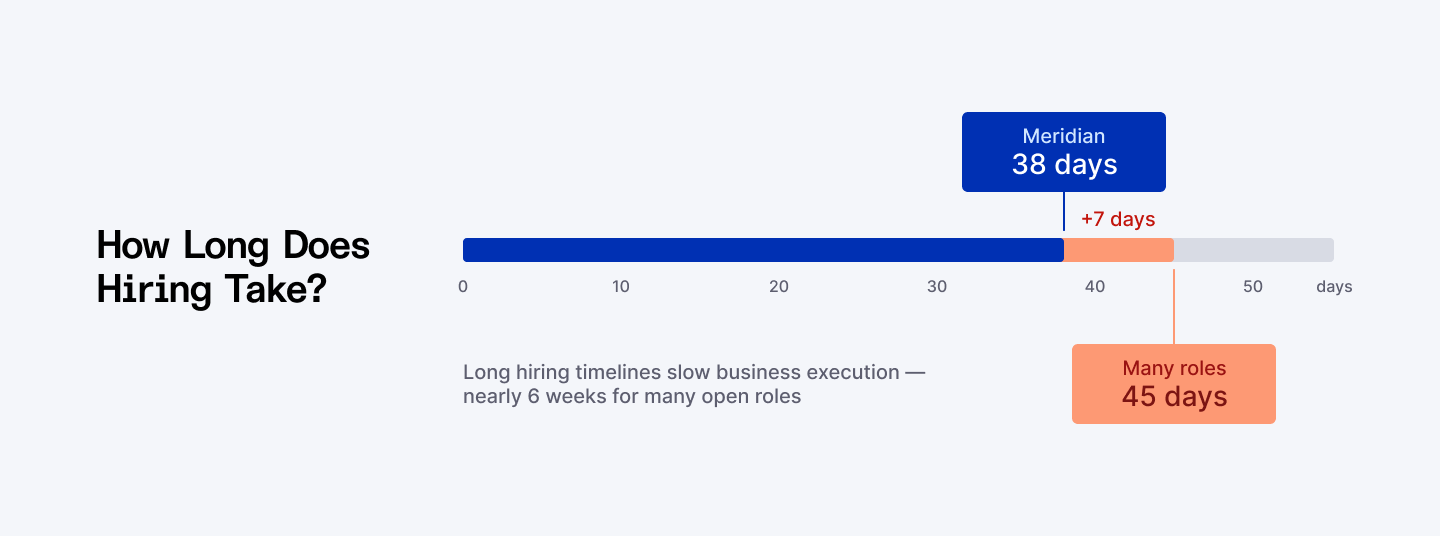
- Hiring timelines remain long, with a median of 38 days and many roles taking about 45 days, which slows business execution.
- Recruiter workload is high, with each recruiter handling about 20 requisitions, which can reduce hiring quality and speed.
- Offer acceptance rates are relatively strong at 87%, but delays and poor experiences can still lead to drop-offs.
- Candidate concerns are increasing, as 77% worry their resumes will be filtered out before reaching a human reviewer, showing trust issues with automated systems.
8. What does ATS adoption and market growth indicate?
ATS growth shows a strong shift toward digital hiring systems. Rapid market expansion and high adoption across enterprises and SMBs indicate that companies are moving away from manual recruiting. Regional distribution highlights global adoption, with large enterprises leading while smaller businesses continue to catch up.
- The ATS market is expanding from USD 17.22 billion in 2025 to USD 34.83 billion by 2034, growing at an 8.20% CAGR, reflecting strong long-term demand for automated hiring solutions.
- Regional distribution shows Asia Pacific at 29%, North America at 26.60%, Europe at 21.60%, the Middle East & Africa at 13.20%, and Latin America at 9.60%, indicating global adoption.
- North America’s market grows from USD 4.75 billion in 2025 to USD 4.95 billion in 2026, driven by strong adoption of digital hiring.
- Asia Pacific increases from USD 4.81 billion to USD 5.38 billion, reflecting rapid digitalization and talent demand.
- Europe grows from USD 3.78 billion to USD 4 billion, supported by improved candidate experience and transparency.
- Middle East & Africa expands from USD 2.22 billion to USD 2.46 billion, driven by digital transformation initiatives.
- Latin America rises from USD 1.66 billion to USD 1.78 billion, supported by cost efficiency and automation needs.
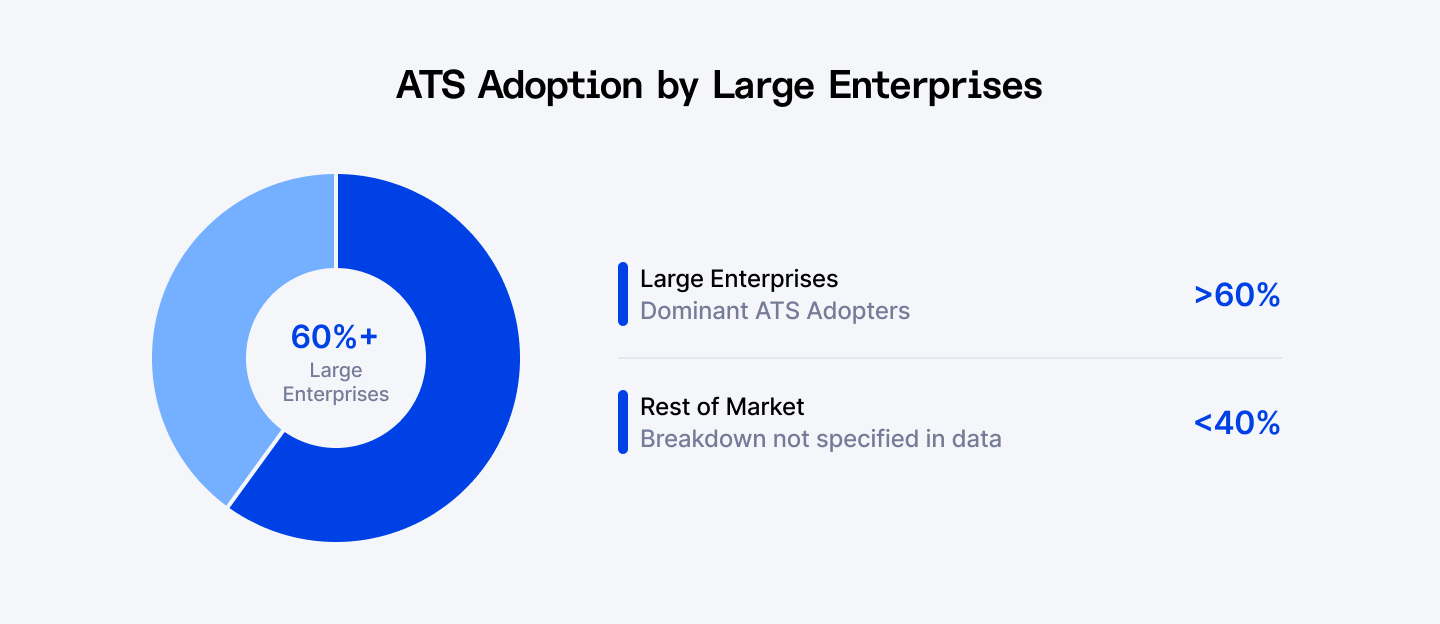
- Large enterprises are expected to hold over 60% of the market share by 2026, indicating dominance in ATS adoption.
- Adoption is widespread, with 75% of recruiters using ATS tools and 99% of enterprises relying on them for hiring processes.
- Small businesses are also adopting ATS, with 60% planning to invest in these tools to improve efficiency and reduce hiring costs.
Learn more: Understand how ATS, CRM, and HRIS tools work together in a modern HR tech stack for faster hiring.
9. How is AI adoption changing hiring processes?
AI adoption is accelerating rapidly in recruitment. Companies are using AI for job creation, candidate communication, and matching. This improves speed and efficiency while enabling personalization. The rise of generative AI further enhances engagement, making hiring more automated and data-driven.
- AI usage in hiring has reached 25.9%, up from 4.9% in 2023, showing rapid adoption across organizations.
- Recruiters use AI widely, with 73% using it to write job ads and 68.6% using it to message candidates, improving communication efficiency.
- More than 68% of organizations are adopting AI-based recruitment tools to improve talent matching and hiring accuracy.
- Generative AI is already used by 59% of platforms, helping deliver personalized job recommendations and better candidate engagement.
- Companies using AI in recruiting processes achieve 26% faster hiring, which significantly reduces time-to-hire.
Up next: Learn which AI adoption strategies help the best teams scale smarter and deliver real business impact.
10. How do talent marketplaces improve hiring speed and efficiency?
Talent marketplaces deliver faster hiring outcomes compared to traditional recruiting. They reduce time-to-fill, improve staffing cycle efficiency, and enable quicker project deployment. These improvements directly impact business performance by reducing delays and improving workforce responsiveness.
- Talent marketplaces reduce time to fill roles by up to 20 days, which significantly shortens hiring cycles.
- Staffing cycle times improve by 30% to 40%, enabling faster workforce deployment across projects.
- Companies using talent marketplace platforms achieve 30% faster project staffing, improving execution speed compared to traditional hiring methods.
11. How do talent platforms reduce hiring costs and improve productivity?
Talent platforms reduce reliance on external hiring and improve internal workforce utilization. Lower hiring costs and better use of existing employees help companies optimize resources. This shift makes hiring more efficient while improving productivity across teams.
- Internal hiring through talent marketplaces is 3 to 5 times cheaper than external hiring, significantly reducing recruitment expenses.
- Talent marketplace platforms enable companies to reallocate up to 25% of internal workforce capacity, improving utilization and reducing hiring needs.
- Internal and referral hires account for 15% of total hires, underscoring the growing importance of internal talent pools.
12. How do talent platforms impact retention and hiring outcomes?
Retention outcomes improve significantly with internal hiring. Employees placed internally stay longer than external hires, reducing turnover and hiring costs. This highlights the long-term value of talent platforms in workforce stability.
Internal hires have a 62% retention rate, compared to 45% for external hires, showing stronger long-term employee retention.
13. What challenges affect the adoption of talent platforms?
Despite benefits, the adoption of talent platforms faces challenges. Data privacy concerns, organizational resistance, and compliance issues slow implementation. However, new technologies like blockchain are emerging to address trust and verification challenges in hiring systems.
- Data privacy and compliance issues affect 42% of companies, slowing the adoption of talent marketplace platforms.
- Organizational resistance is high, with nearly 60% of companies facing pushback from employees and managers when shifting from traditional hiring.
- Technology is evolving, with 36% of platforms using blockchain-based credential verification to improve candidate authenticity and reduce fraud.
14. How are companies shifting toward internal and alternative hiring models?
Companies are actively exploring internal and alternative hiring strategies to reduce dependency on traditional recruiting. Internal hiring, talent pipelines, and rehiring former employees are increasing, while upskilling is becoming a key approach to meet workforce needs.
- Internal hiring is rising, with 42.3% of employers hiring or promoting internally, compared to 16.9% in 2024, showing a significant shift.
- Alternative recruiting sources include 36.9% hiring from talent pipelines and 30.8% rehiring former employees, thereby expanding hiring options.
- Upskilling is prioritized by 27.8% of employers, with a focus on developing existing employees to fill roles.
- Despite this shift, only 26% of companies use internal talent marketplaces, indicating early-stage adoption.
- 41% of companies train existing employees for hard-to-fill roles, which shows a strong shift toward internal skill development as a hiring solution.
15. How are hiring strategies evolving beyond traditional methods?
Hiring strategies are shifting toward value-driven approaches. Companies focus more on compensation, flexibility, and employee development rather than relying solely on traditional channels like social media, which are less effective.
- Social media is used by 59% of companies, but ranks lower in effectiveness than other hiring strategies.
- Candidate expectations are rising, with 41% declining offers due to competing offers and 24% expecting faster hiring decisions, which puts pressure on companies to improve their approach.
- More effective approaches include 58% improving compensation, 57% offering flexible work, and 53% training internal employees, showing a shift toward employee-focused strategies.
16. What does cost pressure in hiring indicate?
Rising hiring costs, especially for executive roles, highlight inefficiencies in traditional recruiting. Increasing cost-per-hire underscores the need for more cost-effective solutions, such as talent platforms and internal hiring strategies.
Cost-per-hire for executives has increased by 113% since 2017 and by 21% since 2022, indicating a sharp rise in hiring costs for senior roles.
Final words
Hiring today is slow, expensive, and often inefficient. Companies struggle to find the right talent, deal with long hiring cycles, and face increasing risk with poor matches. Traditional recruiting methods are no longer enough to meet modern business needs.
Platforms like Index.dev offer a better approach.
Index.dev connects companies with AI-vetted engineers and ready-to-deploy teams, matched to exact skill requirements. Businesses can secure interview-ready talent within 48 hours and start immediately, reducing delays and accelerating hiring.
The platform combines AI-driven assessments with human matching, running over 12,000+ evaluations each month to ensure quality and fit. This helps reduce hiring risk while improving performance.
Real-world results highlight the impact. For example, Inveniem needed a trusted IT Systems expert for critical infrastructure and security work. Through Index.dev, they hired a senior engineer in days who quickly became a core team member and handled complex systems without disruption.
This shift allows companies to move from slow, reactive hiring to faster, skill-based team building.
If you want to build stronger teams without hiring delays, hire human-verified talents on Index.dev today.
FAQs
How hard is it to hire qualified candidates today?
About 48% of hiring managers report not finding enough qualified candidates, underscoring how difficult hiring is today. In addition, 29% do not get enough applicants, while 68% to 69% of HR professionals report hiring difficulty, and 53% say it has become harder than last year.
Are traditional recruiting methods losing effectiveness?
Around 52% of hiring decision-makers say passive recruiting is no longer effective, which shows traditional methods are losing impact. Also, 32% of hiring managers say job advertising no longer works, and 51% report lower response rates from candidates.
How long does it take to hire a candidate?
The global median time to hire is 38 days, which means hiring typically takes over a month. Many roles take around 45 days, while talent marketplaces can reduce this time by up to 20 days and significantly improve hiring speed.
Do talent platforms reduce hiring costs?
Internal hiring through talent platforms can be 3 to 5 times cheaper than external hiring, resulting in significant cost savings. At the same time, executive hiring costs have increased by 113% since 2017, making cost-efficient hiring methods more important.
Do talent platforms improve employee retention?
Internal hires have a 62% retention rate compared to 45% for external hires, which shows better retention outcomes. This indicates that talent platforms help companies retain employees longer through internal mobility.
How widely are AI and ATS used in hiring today?
Nearly 75% of recruiters use ATS tools, and 99% of enterprises rely on them, which shows widespread adoption. AI usage has also grown to 25.9%, up from 4.9% in 2023, with companies using it for job ads and candidate communication.
How are hiring channels changing today?
About 79.5% of candidates use job boards, which shows hiring is now platform-driven. At the same time, 54.9% use professional networks and 45% use company websites, while 71.3% of companies rely on referrals and 26% of applications come from mobile devices.
Data sources
- https://go.manpowergroup.com/hubfs/MEOS%20Q3%202025/MPG-MEOS-Q3-2025-Global-Report.pdf
- https://www.fortunebusinessinsights.com/applicant-tracking-system-market-108826
- https://www.grandviewresearch.com/industry-analysis/applicant-tracking-system-market-report
- https://www.glassdoor.com/blog/talent-wars-heat-48-hiring-managers-struggle-enough-quality-candidates/
- https://www.jobspikr.com/blog/talent-marketplace-adoption-and-roi-2025/#:~:text=An%20internal%20talent%20marketplace%20not,retention%20by%20up%20to%2086%25.
- https://www.businessresearchinsights.com/market-reports/talent-market-116423
- https://ta.smartrecruiters.com/rs/664-NIC-529/images/Recruitment-Benchmarks-2025-Report.pdf
- https://www.bls.gov/news.release/jolts.nr0.htm
- https://www.shrm.org/topics-tools/research/2026-talent-trends/tt26-full-report
- https://www.shrm.org/topics-tools/news/talent-acquisition/bls-hr-jobs-unemployment-jan-2025
- https://www.shrm.org/topics-tools/research/2025-recruiting-benchmarking
- https://www.hrdive.com/news/cost-per-hire-application-increase-2025-recruitment-appcast/812612/?ref=pin-com.ghost.io
- https://www.ihire.com/resourcecenter/employer/pages/the-state-of-online-recruiting-2025
