Your company's talent acquisition process might be bleeding money right now. When you're doing recruiting software comparison research, you'll discover that most organisations run their ATS, CRM, and HRIS systems like separate islands. This produces costly issues that damage your bottom line and scare off top talent.
Research indicates that 40% of applicants are overlooked in hiring because systems don't communicate with one another. This hurts your employer brand and wastes your top talent. Companies that connect their HR tech ecosystem properly see amazing results:
- 30% faster hiring
- 25% less cost per hire
- 20% better retention rates
To help you understand which HR tech stack suits your business needs, we have put together this comprehensive guide that explores integration strategies for a talent-first world.
Hire the top 5% of vetted developers fast. Index.dev matches you in 48 hours and helps you build teams efficiently with integrated HR tech.
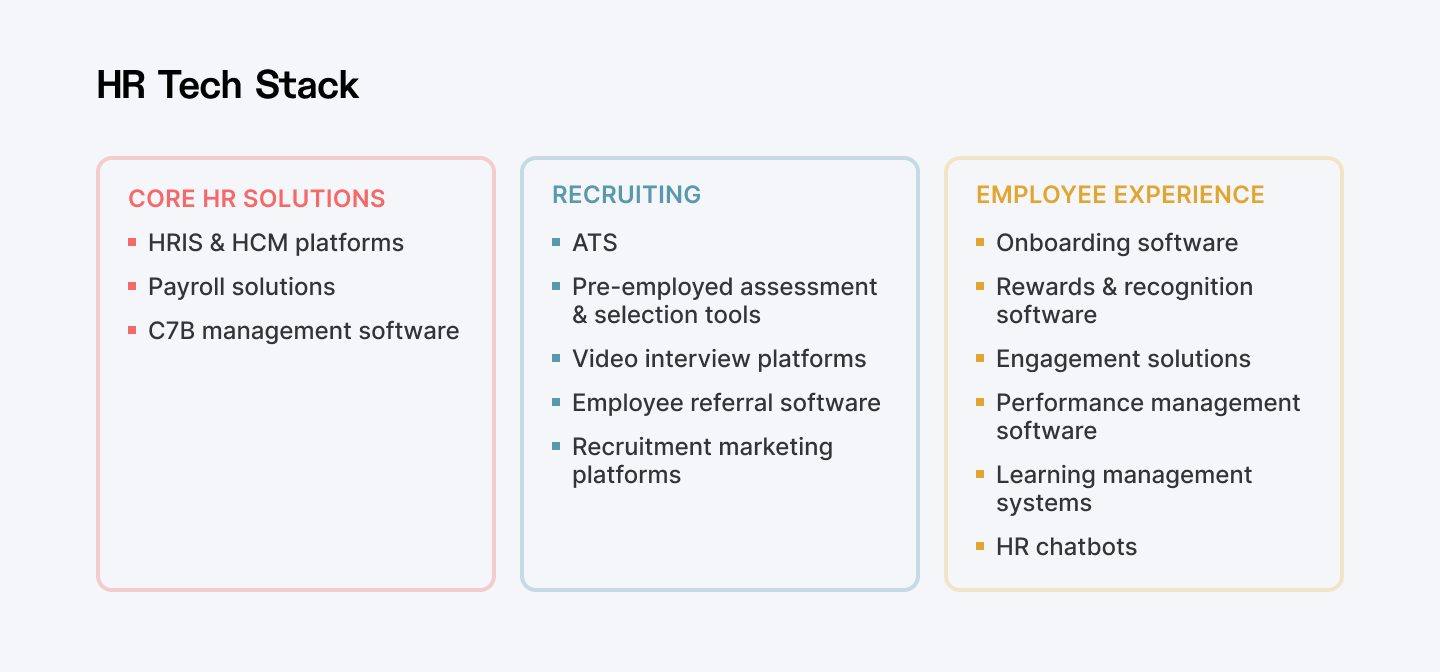
Why Your Current Setup Is Costing You
Let's talk about what's happening when your HR systems don't work together. It's not only an IT issue; it's a business emergency that is impacting each and every hire you make.
- Data Chaos Everywhere:
- Your team spends hours entering the same candidate info into multiple systems. 62% of HR teams waste time on this repetitive, error-prone task instead of building real connections with top talent. When you look at the cost of skilled pros doing copy-paste work, it adds up fast.
- Your team spends hours entering the same candidate info into multiple systems. 62% of HR teams waste time on this repetitive, error-prone task instead of building real connections with top talent. When you look at the cost of skilled pros doing copy-paste work, it adds up fast.
- Candidates Notice Bad Experiences:
- 72% of job seekers with a poor experience talk about it online. From harsh Glassdoor reviews to social media rants, each frustrated candidate becomes a loud warning sign for others to avoid your company.
- 72% of job seekers with a poor experience talk about it online. From harsh Glassdoor reviews to social media rants, each frustrated candidate becomes a loud warning sign for others to avoid your company.
- Your Competition is Moving Quicker:
- While you're stuck juggling disconnected systems, smart competitors are using integrated platforms to move faster, respond better, and build stronger relationships across the hiring journey.
- While you're stuck juggling disconnected systems, smart competitors are using integrated platforms to move faster, respond better, and build stronger relationships across the hiring journey.
What Really Works
When you conduct a proper recruiting software comparison, you'll discover that integration isn't nice to have; it's crucial to success. Businesses with integrated systems continually outperform those with fragmented methodologies.
- The Numbers Don't Lie:
- Organisations that use their talent technology effectively experience improvements right away. Recruiters save 15+ hours per week that they can spend on strategic work instead of administrative tasks. More importantly, they get a complete view of every candidate and employee from first contact to retirement.
- Organisations that use their talent technology effectively experience improvements right away. Recruiters save 15+ hours per week that they can spend on strategic work instead of administrative tasks. More importantly, they get a complete view of every candidate and employee from first contact to retirement.
- AI Makes Everything Better:
- When your systems work together, artificial intelligence becomes incredibly powerful. Predictive algorithms cut hiring bias significantly. You create more effective matches between candidates and jobs, resulting in happier employees who linger.
- When your systems work together, artificial intelligence becomes incredibly powerful. Predictive algorithms cut hiring bias significantly. You create more effective matches between candidates and jobs, resulting in happier employees who linger.
- Single Source of Truth:
- With integration, there is only one location where your talent data resides. You can see which job boards give you your top performers over time, patterns of successful hires, and even recognise retention risk before individuals leave. It is impossible to have this strategic understanding when your data resides in multiple systems.
- With integration, there is only one location where your talent data resides. You can see which job boards give you your top performers over time, patterns of successful hires, and even recognise retention risk before individuals leave. It is impossible to have this strategic understanding when your data resides in multiple systems.
Learn more about AI recruitment platforms in our definitive guide.
Where HR Technology Is Going
The world of talent acquisition is evolving fast. Skills-based hiring is replacing degree requirements. Remote working is here to stay for most positions. Your HR tech ecosystem needs to be prepared for this.
New platforms leverage AI to recognise transferable skills that resume parsing can't catch. Your hiring tools must integrate with teamwork platforms such as Slack and Microsoft Teams. Credential authentication is becoming real-time with blockchain technology, shortening background check time.
Understanding Your Options
When you're assessing systems, you must realise how every component fits into your strategy. Let's divide the three key components and exactly how they need to work together.
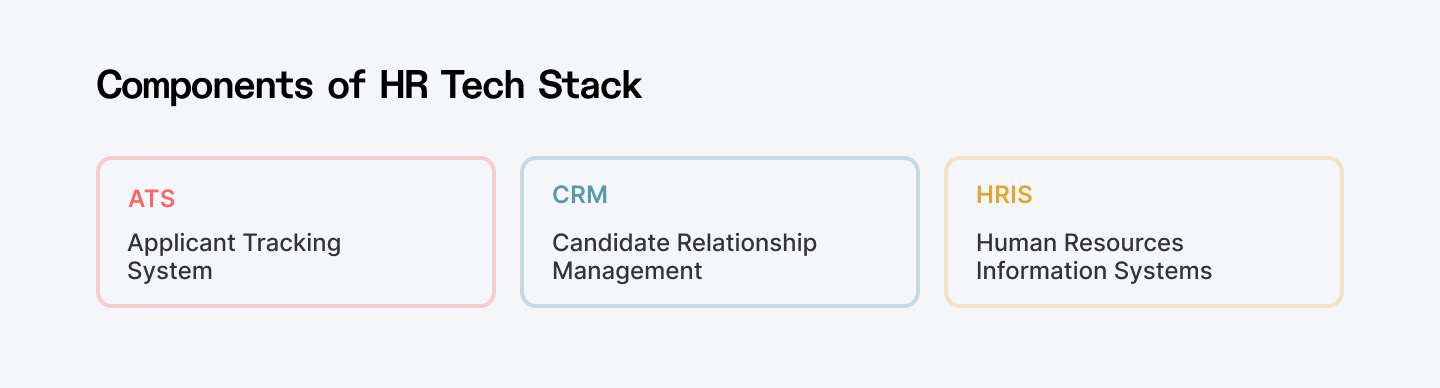
ATS (Applicant Tracking Systems)
This is where your ATS and CRM integration begins. Contemporary ATS systems, such as Greenhouse integrations, seamlessly sync candidate status changes to your relationship management database. That allows promising candidates who are not suitable for existing openings to remain in your nurturing pipeline for future jobs.
Key ATS platforms include:
- Greenhouse (excellent API connections)
- Lever (strong recruiting software comparison features)
- Workday Recruiting (enterprise-scale integration)
CRM (Candidate Relationship Management)
Your CRM acts like the central nervous system of your talent strategy. Platforms like Beamery, Phenom, and Avature pull engaged candidates into your ATS when relevant positions open. They also pull employee performance information from your HRIS to enhance future sourcing initiatives.
HRIS (Human Resource Information Systems)
Your HRIS tracks and automatically generates employee records as candidates are hired via the ATS. It then continuously sends performance information, career progression activity, and engagement statistics back to your CRM. This builds a full picture of effective hiring trends.
Some of the popular HRIS solutions are:
- Workday (full-fledged enterprise solution)
- BambooHR (ideal for scale-up businesses)
- ADP (reliable payroll integration)
Your Integration Roadmap for HR Tech Stack
Now let's get down to business about how to actually do this. Integration success entails technical planning as well as strategic planning around data flow.
Technical Implementation Paths
Approach | Best For | Pros | Cons |
| API-First Tools | Companies buying new systems | Fast setup, reliable connections | Limited to supported integrations |
| Middleware Solutions | Mixed old/new systems | Flexible, custom workflows | Requires technical expertise |
| All-in-One Suites | Simple setups | Everything works together | Less specialised features |
Choose API-First When Possible
Platforms like Index.dev prioritise integration capabilities with pre-built connectors that reduce setup time and ongoing maintenance. Search for systems providing REST APIs, webhooks, and real-time data synchronisation.
Data Flow Strategy
Your integrated talent experience must have this sensical sequence:
- CRM finds and develops potential talent
- ATS processes formal applications and interviews
- HRIS processes onboarding and the employee lifecycle
- CRM reclaims leaving employees as alumni for future openings
Compliance and Security
Integration should be privacy-respecting. GDPR and CCPA mandates require the use of data masking on sensitive data, maintaining comprehensive audit trails, and requiring all vendors to pass the SOC 2 certification.
AI's Strategic Advantage in Connected Systems
Artificial intelligence transforms integrated HR systems from reactive tools into predictive platforms. When you're doing recruiting software comparison research, AI capabilities should be a major factor.
AI-powered resume screening focuses on skills rather than demographic indicators that introduce bias. This reduces screening time by 50% while improving candidate quality. Machine learning analyses communication patterns to identify passive candidates most likely to respond to outreach. Advanced algorithms analyse performance data to identify flight-risk employees with 85% accuracy, enabling proactive retention efforts.
Your Step-by-Step Playbook for Deployment
Phased deployment minimises risk while providing value early on. Here is the way to roll out integration effectively.
Phase 1: Begin Small with High Impact
Begin by synchronising ATS-CRM for your recruitment team first. This disciplined initial step allows you to solve integration issues on a bounded scale while providing value in short order. Track metrics like time-to-fill and candidate satisfaction to measure improvement and build momentum for larger-scale integration.
Index.dev's robust API makes this process extremely smooth, with the already existing connectors that reduce the technical overhead.
Phase 2: Scale Systematically
After the ATS-CRM integration is running smoothly, include HRIS connections for automating offboarding and onboarding. This phase requires more focus on change management, particularly training recruiters on CRM nurturing activities.
Change Management Success:
User acceptance determines the success of integration. Provide comprehensive training on new processes, correctly describe integration benefits, and address job security or complexity issues. Regular feedback sessions help in finding and overcoming adoption challenges in no time.
KPIs That Matter
Success at integration must be quantifiable and tied to business outcomes. Below are the metrics that matter:
Metric | Before Integration | After Integration | Improvement |
| Time-to-Hire | 45 days | 32 days | 29% faster |
| Cost-per-Hire | £4,000 | £3,000 | 25% reduction |
| Candidate Experience Score | 6.2/10 | 8.1/10 | 31% better |
| Recruiter Productivity | 3 hires/month | 4.5 hires/month | 50% increase |
These benefits compound over time. A 13-day decrease in time-to-hire may not seem like a lot, but on dozens of hires per year, it adds up to significant productivity savings and less business disruption from unfilled posts.
Choosing Your Technology Partners
Choosing the appropriate platforms is essential for a successful integration. In your recruiting software comparison, integration capabilities should be your top concern.
Best Small-Medium Business Options
- ATS/CRM: Zoho Recruit seamlessly integrates with Zoho CRM, with powerful features at reasonable prices
- HRIS: BambooHR has low-code integration capabilities that require no dedicated IT staff
Enterprise Options
- Full Suite: SAP SuccessFactors provides enterprise-grade HRIS capabilities
- AI-Powered: Eightfold combines ATS and CRM capabilities with advanced machine learning
- Integration Hub: Index.dev excels at combining diverse systems with a flexible API architecture
Most Critical Evaluation Factors
Keep an eye out for suppliers offering:
- Complete API documentation and support
- Pre-configured connectors to popular platforms
- Real-time data synchronisation capabilities
- Sound security and compliance features
- Proactive customer support in deployment
Explore how to integrate AI tools into your hiring workflow.
Your Next Steps
Integration isn't optional anymore; it's a competitive necessity. Your talent strategy is only as strong as the technology supporting it. Integration enables the data-driven, candidate-focused approach that modern recruiting software comparison demands.
Immediate Action Plan
- Review your existing systems' API capabilities within 30 days
- Pinpoint integration shortcomings that bring daily frustration
- Prioritise linkages that will bring the quickest ROI
- Join forces with integration experts like Index.dev to make it happen faster.
Those firms that move quickly to harmonise their HR tech ecosystem will create lasting competitive differentiators. The question isn't if you should integrate, it's how fast you can do it while your competition is wrestling with isolated systems.
Your integrated HR tech stack is just one conversation away. Explore our vetted developer network specialising in seamless HR system integrations today.