I have spent the last few days pulling apart Toptal and Upwork pricing pages, fee documentation, and a stack of 2026 comparison posts, because every "vs" article I found either read like a Toptal ad or an Upwork ad, and buyers deserve better than that. So this is my attempt at the version I wish I had found when I started looking.
Quick Picks: Who Wins for What
If you only have thirty seconds, here is the short version before the detail.
- Best for one premium specialist hire: Toptal
- Best for budget flexibility and a large talent pool: Upwork
- Best for long term remote squads with vetted matching: Index.dev
None of these labels are "best overall." Each platform wins a specific kind of hiring problem, and the table below dives deeper into this.
Comparison Table: Toptal vs Upwork
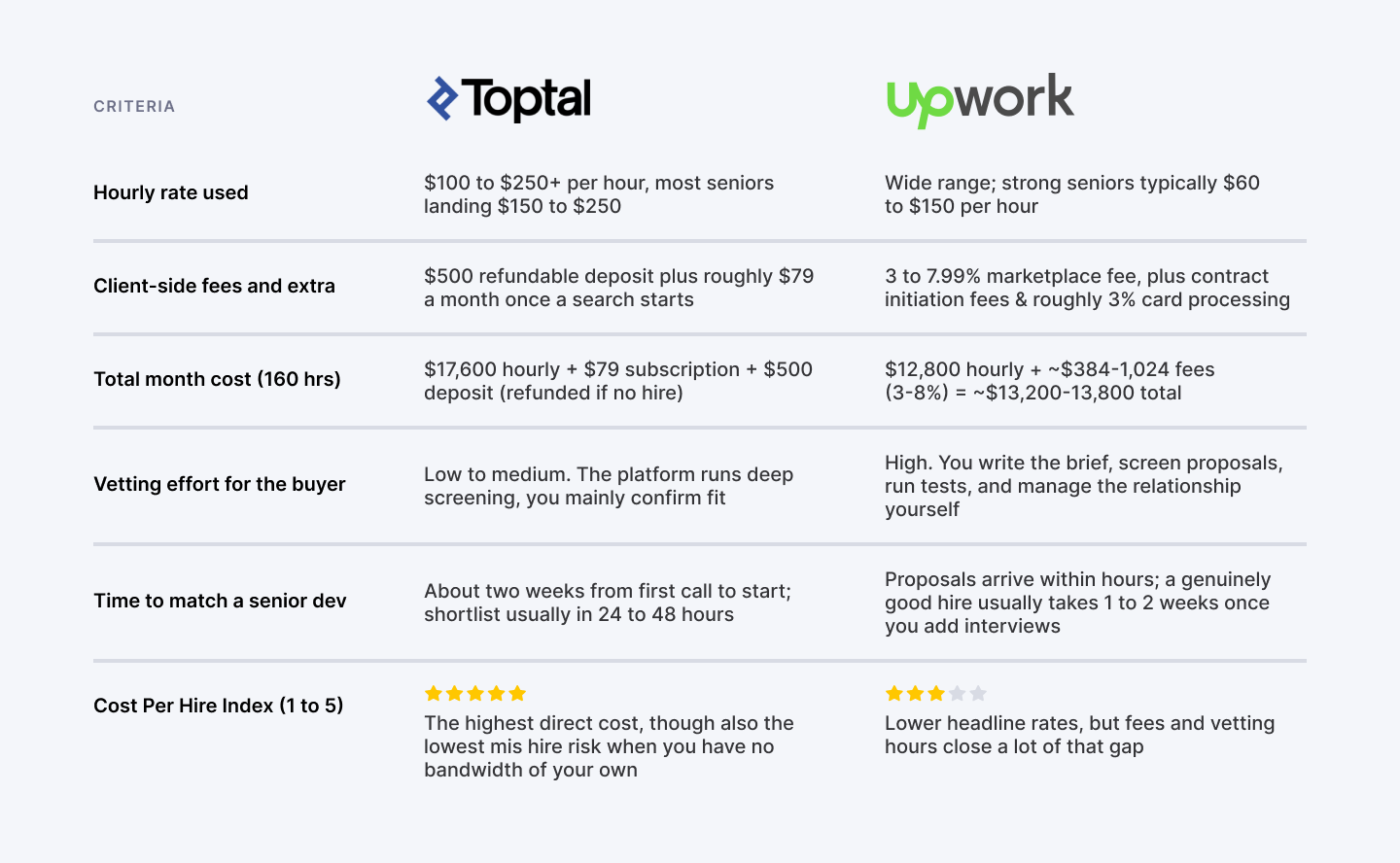
I took published 2026 hourly bands, added the client side fees each platform actually charges, and weighed that against how much vetting work lands on the buyer's plate. Here’s the breakdown:
| Platform | Hourly rate used | Client-side fees and extra | Total month cost (160 hrs) | Vetting effort for the buyer | Time to match a senior dev | Cost Per Hire Index (1 to 5) |
| Toptal | $100 to $250+ per hour, most seniors landing $150 to $250 | $500 refundable deposit plus roughly $79 a month once a search starts | $17,600 hourly + $79 subscription + $500 deposit (refunded if no hire) | Low to medium. The platform runs deep screening, you mainly confirm fit | About two weeks from first call to start; shortlist usually in 24 to 48 hours | ⭐⭐⭐⭐⭐ The highest direct cost, though also the lowest mis hire risk when you have no bandwidth of your own |
| Upwork | Wide range; strong seniors typically $60 to $150 per hour | 3 to 7.99% marketplace fee, plus contract initiation fees and roughly 3% card processing | $12,800 hourly + ~$384-1,024 fees (3-8%) = ~$13,200-13,800 total | High. You write the brief, screen proposals, run tests, and manage the relationship yourself | Proposals arrive within hours; a genuinely good hire usually takes 1 to 2 weeks once you add interviews | ⭐⭐⭐ Lower headline rates, but fees and vetting hours close a lot of that gap |
How I Chose and What I Looked at
I did not run a controlled test where the same brief went through Toptal and Upwork at the same time, and I want to be upfront about that rather than imply otherwise. What I did was read Toptal's client facing pricing pages and several independent 2026 cost breakdowns, then cross check those against Upwork's own fee documentation and a handful of freelancer side explainers on how the newer variable fee model works.
I also went through a Reddit thread where a founder documented six months of technical recruiting across multiple platforms (because founder side accounts tend to surface the vetting workload that a pricing page never mentions). So if your team ends up running an actual side by side trial with a real brief, I would genuinely want that data. For now, the scoring above is built from public pricing plus a rubric for Toptal vs Upwork, not a lab test.
Toptal: Best When You Need One Premium Specialist
Verdict. Toptal earns its price when the hire is one senior engineer or architect and getting it wrong would cost you more than the rate does. Multiple 2026 reviews put its acceptance rate under 3%, built on language checks, technical interviews, live coding rounds, and a longer test project before anyone reaches a client.
You are paying for that filter. The catch is that the filter is expensive and slower than the marketing copy suggests: expect around two weeks between your first call and someone actually starting work.
Best for: One high stakes hire where you do not have the internal capacity to vet candidates yourself.
Pros for buyers
- Deep vetting with a genuinely low pass rate for senior talent
- A dedicated account manager who scopes the role with you before sending profiles
- Useful beyond engineering if you also need design or product talent from the same pool
Cons
- Rates typically run 30 to 40% above comparable Upwork talent for the same seniority
- The $500 deposit plus monthly subscription adds friction if you are only testing the waters
- A two week matching window can feel slow against a fast moving roadmap
Who should pick it
If the problem is finding one excellent person for a messy, high stakes codebase and time is scarcer than budget, Toptal is still the sensible starting point.
Upwork: Best for Flexibility and a Large Talent Pool
Verdict. Upwork works well once you already have someone technical who can filter proposals and run a real test task, because the platform itself does very little filtering for you.
Upwork's pool spans everything from $20 an hour beginners to $150 an hour specialists, and that range is exactly why quality varies so much from one profile to the next. On the fee side, freelancers now pay a variable rate between 0 and 15%, most commonly landing near 10%, while clients pay a marketplace fee of roughly 3 to 7.99% plus a small initiation fee per contract.
The speed advantage is real: proposals show up within hours of posting a job. The tradeoff shows up later, in the hours you spend reading proposals and running trial tasks before you find someone reliable, a pattern several founders describe in detail on Reddit.
Best for: Buyers with in house technical leadership who want to stretch the budget across multiple hires.
Pros for buyers
- A huge pool across every budget, skill level, and time zone
- Fast first contact once a job is posted
- Works well for smaller or mixed seniority tasks, not just full time roles
Cons
- Fees on both sides of the transaction add up over a long engagement
- Vetting is entirely on you, with no platform side screening layer
- Real risk of a bad hire if you skip live testing and go on portfolios alone
Who should pick it
If you have the internal muscle to interview and test candidates properly, Upwork gives you more hires per dollar than Toptal, as long as you budget the vetting hours honestly.
How to Choose Between Toptal vs Upwork
The right question isn't which platform is best overall, it's which specific hiring problem you're solving this quarter. A single high-stakes hire, or several roles on a real budget. Match the problem to the platform's actual model rather than its marketing, and the decision gets much shorter.
- If you need one senior specialist and getting it wrong would cost you more than the price gap → start with Toptal.
Its multi-stage vetting and managed matching exist specifically to reduce that risk, at a real premium of roughly $60 to $250+ per hour plus a deposit and subscription. - If you need several hires on a real budget and someone on your team can properly vet candidates → start with Upwork.
You'll pay less per hour on average, but you're taking on the screening work Toptal would otherwise do for you, plus a 3 to 10% client fee depending on plan.
Whichever path you pick, the brief you write before you start matters more than the platform, not a synthetic test.
What to Do This Week
Tonight
Write a tight brief. Stack, seniority, time zone, communication expectations, and a small paid trial task pulled from your actual backlog, not a made up sample project.
This week
Pick one platform based on the guide above and run a single trial instead of spreading the same brief across both. On Toptal, book the intro call and review the first shortlist closely. On Upwork, cap yourself at around five serious candidates and give every one of them the same paid test.
This month
Log more than the hourly rate. Track how many hours you personally spent screening, how many revisions the brief needed, and what the all in cost looked like once fees and your own time were added up. That log becomes useful data for the next hire.
Limitations and Precautions
Toptal's vetting reduces but doesn't eliminate mis-hire risk. You still need clear scope and realistic expectations. Upwork's flexibility comes with real quality variance that under-vetted clients report repeatedly. Rates and fees change; confirm current terms before committing budget for Toptal vs Upwork. This is not legal, tax, or HR advice.
FAQs
Is Toptal or Upwork cheaper for hiring a senior developer?
Upwork, on paper at least. You're looking at $60 to $150 an hour for seniors where Toptal runs $100 to $250. But Upwork adds client fees on top, and somebody has to read all those proposals. That somebody is you. The gap shrinks fast over a long engagement.
Which platform vets developers more strictly, Toptal or Upwork?
Not close. Toptal accepts about 3% of applicants after language checks, interviews, and trial projects. Upwork lets anyone in, so screening is your problem.
How fast can I hire through Toptal or Upwork?
Faster than either platform advertises. Upwork proposals show up within hours of posting, and Toptal sends a shortlist in a day or two. Neither is the real timeline though. Add interviews and a trial task on either one, and you're both starting around two weeks anyway.
Can I test both platforms before committing to a full hire?
Yes, but differently. Toptal offers a no-risk trial period upfront, so you can swap the developer if the fit is off. Upwork has no formal trial, but a small paid task or short contract first gets you the same thing without the policy behind it.
What does a senior developer cost on Toptal per month?
Using a $110/hour example inside Toptal's published 150+ senior band, a 160-hour month runs about $17,600 plus a $79 subscription and a refundable $500 deposit.
Bottom Line
The Toptal vs Upwork decision comes down to what you're actually paying for: a tighter filter, or a lower rate. If the hire is one senior specialist and getting it wrong is expensive, Toptal's premium still buys something real. It helps you spend less of your own time spent screening with a much tighter filter before a candidate ever reaches you.
If you're staffing several roles on a defined budget and have someone who can vet properly, Upwork wins the Toptal vs Upwork comparison on pure hires-per-dollar, provided you count the client fees and your own screening hours honestly rather than just the headline rate.
Key Takeaways
- Toptal suits one high stakes senior hire where vetting time matters more than hourly rate.
- Upwork works when you have internal capacity to screen and test, and want to stretch the budget across more hires.
- Index.dev is the practical middle option for long term AI, backend, or data roles that need vetted matching without full marketplace exposure.
- The Cost Per Hire Index in the table above is an original scoring rubric built from public 2026 pricing and fee data, built specifically for this comparison.
- None of the published timelines are guaranteed. A small real trial with your own brief remains the most reliable way to choose.