Everyone wants a simple answer to this debate of LATAM vs Eastern Europe developers, and I get why. But after digging through rate guides and nearshore reports from people who've actually hired in both regions, I can tell you the simple answer is a trap.
Here's a confession: I used to think this decision came down to price. It doesn't, not anymore. LATAM and Eastern Europe have closed the gap on rates, and once you see that, the whole question changes shape.
At a glance: quick recommendation for buyers
Here is how I personally frame this choice after digging through current rate guides, nearshore cost reports and Reddit threads from founders who have hired in both regions.
- If you are a US based team that cares most about live collaboration, start in LATAM and treat Eastern Europe as a secondary pool for specific skills.
- If you are a European company with mixed on-site and remote teams, Eastern Europe is usually the best first bet, with LATAM as a way to extend hours into the Americas.
- If your top priority is the absolute lowest rate, neither region will beat Asia; both are now mid priced but far cheaper than US or Western Europe.
- If you want vetted, long term remote engineers, platforms like Index.dev sit in the sweet spot: Eastern Europe around $40 to $70 per hour and LATAM around $35 to $65 per hour for mid level roles.
2026 LATAM vs Eastern Europe developers rate and hiring snapshot
Something nobody tells you upfront. In this race of LATAM vs Eastern Europe developers, neither of them are "cheap regions" anymore.
Juniors in both places run $25 to $40/hr. Mid-level folks sit around $40 to $65/hr in LATAM and $45 to $70/hr in Eastern Europe. Seniors are basically neck and neck, $65 to $95/hr in LATAM, $70 to $100/hr in Eastern Europe, with Poland and Czechia now pricing closer to Western Europe than anyone expected.
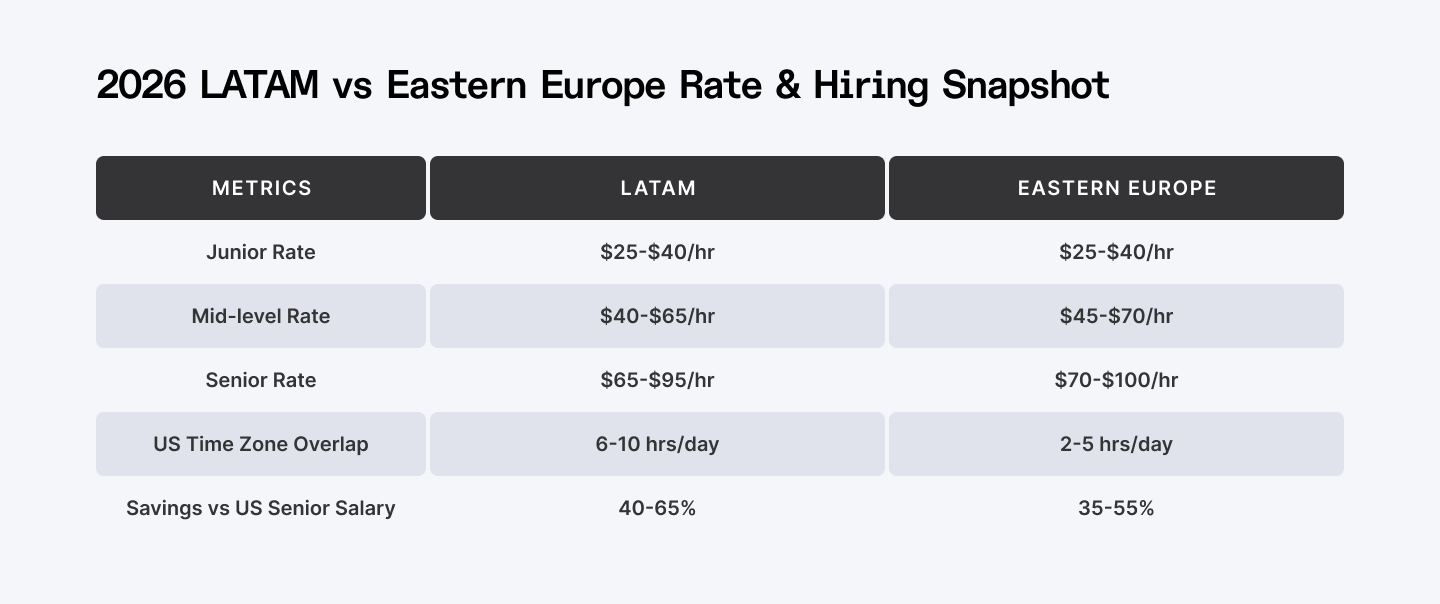
I wanted a single, decision ready view that merges what buyers actually see in proposals rather than quoting one cherry picked range. So I blended Index.dev’s public rate content with independent nearshore reports and country level salary data. I am not using internal payroll logs here, just published rate bands normalized for a US or EU buyer hiring through vetted platforms, not marketplaces.
How I built this comparison and where Index.dev fits
When I write rate content, I distrust any single “average salary” number, so I forced myself to triangulate across vendor rate guides, country salary benchmarks and nearshore cost reports before landing on bands that feel realistic for 2026.
I also pulled Reddit threads where founders describe how their LATAM vs Eastern Europe developers experiments actually went, because the pain points they talk about are often missing from polished agency blogs.
For quality, I used Index.dev’s public “How we verify” framework as the default bar: multi step identity checks, credential verification, technical assessments and live interviews, with only about 7% of applicants surviving the full pipeline. That matters because an Eastern European engineer found through a random freelance marketplace is not directly comparable to a LATAM engineer who has already passed a five stage vetting process and remote readiness checks.
Is one region cheaper, or is that a myth now
Honestly? Barely.
LATAM edges out Eastern Europe by maybe $5 to $10/hr at the junior and mid level, mostly because Argentina and Colombia are still relatively affordable. But once you hit senior talent, that gap basically disappears, especially against Poland, Czechia and Romania, where EU competition has pushed rates up fast.
I'll be blunt: chasing a $5/hr difference is not where your energy should go. Retention and fit matter way more, and I've seen buyers on Reddit say the exact same thing after actually hiring in both regions.
What about time zones, does that actually matter this much
Yes, more than people expect. If you're US based, LATAM gives you 6 to 10 hours of real overlap with Eastern Time. That's basically a normal workday with your team just a country away. Eastern Europe gives you maybe 2 to 5 hours of overlap with the US, which is fine if you're async-first but rough if you need live standups .
Flip that around for European buyers. If your HQ is in Berlin or Amsterdam, Eastern Europe overlaps almost the entire workday, while LATAM becomes the "extend our hours into the Americas" play instead of your core team.
Which region actually has better developers
I'll save you the suspense: there's no clean winner here.
Eastern Europe has decades of outsourcing history and deep CS traditions in Poland, Ukraine and Romania. LATAM has grown insanely fast, with senior remote engineers now pulling $55K to $70K a year working for US companies, which tells you the market is serious.
What I found more interesting than any rate chart, though, was reading through Reddit threads where founders had actually hired in both places. The consistent theme wasn't "Eastern Europe writes better code" or "LATAM communicates better." It was that once you filter properly, the skill gap between the two regions basically vanishes, and the real differentiator becomes responsiveness and how well someone fits your process.
What goes wrong when people pick the wrong region
So I kept seeing the same three mistakes pop up again and again during my research:
- US teams grab Eastern Europe purely for a lower sticker price, then realize every standup lands in someone's evening and they weren't ready to go fully async.
- European teams hire LATAM without planning handovers, and end up running two teams that barely talk to each other.
- Everyone skips real vetting, blames "the region" when a hire flops, when the actual problem was a weak hiring funnel.
None of these are region problems. They're planning problems wearing a region's name.
How I'd decide if I were you
Skip the 10-agency email blast. Instead, run this in a week:
- Write down where your decision makers sit and how synchronous you need to be. That alone points you toward LATAM or Eastern Europe before rates even enter the conversation.
- Get a real shortlist from both regions using the same brief, and ask each partner how they vet for English and remote readiness.
- Interview one candidate from each region back-to-back, same rubric, same day. You'll feel the difference in communication style faster than any spec sheet can tell you.
- Only compare rates after the interviews. Quality signal first, price second.
That's genuinely the process I'd want to run before signing anything, and it's the same one I'd point a buyer toward if they came to Index.dev asking this exact question.
A quick reality check before you decide
These rate bands will shift. Inflation in Argentina alone can move contractor expectations faster than any annual survey updates. A lot of published "average salary" numbers also mix full-time payroll costs with freelance rates, so double check which one you're actually looking at before you budget.
And to be clear, this isn't legal or tax advice. Loop in your finance or HR team before you commit to a country for compliance reasons.
Quick answers to what people actually ask
Is LATAM cheaper than Eastern Europe in 2026?
Slightly, at the junior and mid level, by around $5 to $10/hr. At senior level the two regions are close to identical in price, so don't let a small rate gap be your deciding factor.
Do LATAM developers really work better with US hours?
Yes. Most LATAM countries give you 6 to 10 hours of real overlap with US Eastern Time, versus 2 to 5 hours from Eastern Europe. If your team runs live standups, that gap is the whole story.
Is Eastern Europe better for backend and AI work?
It has a longer track record there, especially Poland, Romania and Czechia, but LATAM is closing that gap fast. At a consistent vetting bar, you'll find strong engineers doing both kinds of work in either region.
What hidden costs should I plan for beyond the hourly rate?
Platform fees, payroll compliance, and the management overhead of running teams across time zones. Multiple cost guides point out that a bad hire or high attrition costs way more than any small rate difference ever will.
Where I land on this
Both regions are strong bets in 2026, and honestly the rate gap between them is small enough that I wouldn't build my whole decision around it. What actually separates a good hire from a painful one is time zone fit and how seriously the platform vets talent, not which flag is on the passport.
If you want to test this yourself instead of taking my word for it in this LATAM vs Eastern Europe developers debate, that's exactly the kind of side-by-side Index.dev can set up, one shortlist from each region, so you compare people instead of guessing at regions.
➡︎ Index.dev gives you instant access to pre-vetted engineering capacity across both regions, handling everything from talent matching and software delivery to remote onboarding. Whether you need nearshore real-time overlap or deep Eastern European technical execution, we deliver project-ready talent in under 48 hours.