Twice a year, we run an NPS survey with our engineers working across our clients’ projects. Contractors don't work in our office. They don't see us every day. The survey is essentially the only structured way we get to hear, in their own words, what's working and what isn't. So we read every response, track the trends period over period, and when something keeps coming up, we build something to fix it.
For the first half of 2026, we recorded an all time high talent NPS of +87.2, up 10.4 points from the second half of 2025. For the first time since we started tracking contractor sentiment, we also recorded zero detractors. Of all the senior engineers surveyed, not a single person rated their experience in the 0 to 6 range. In fact, the lowest score across the entire survey was a 7.
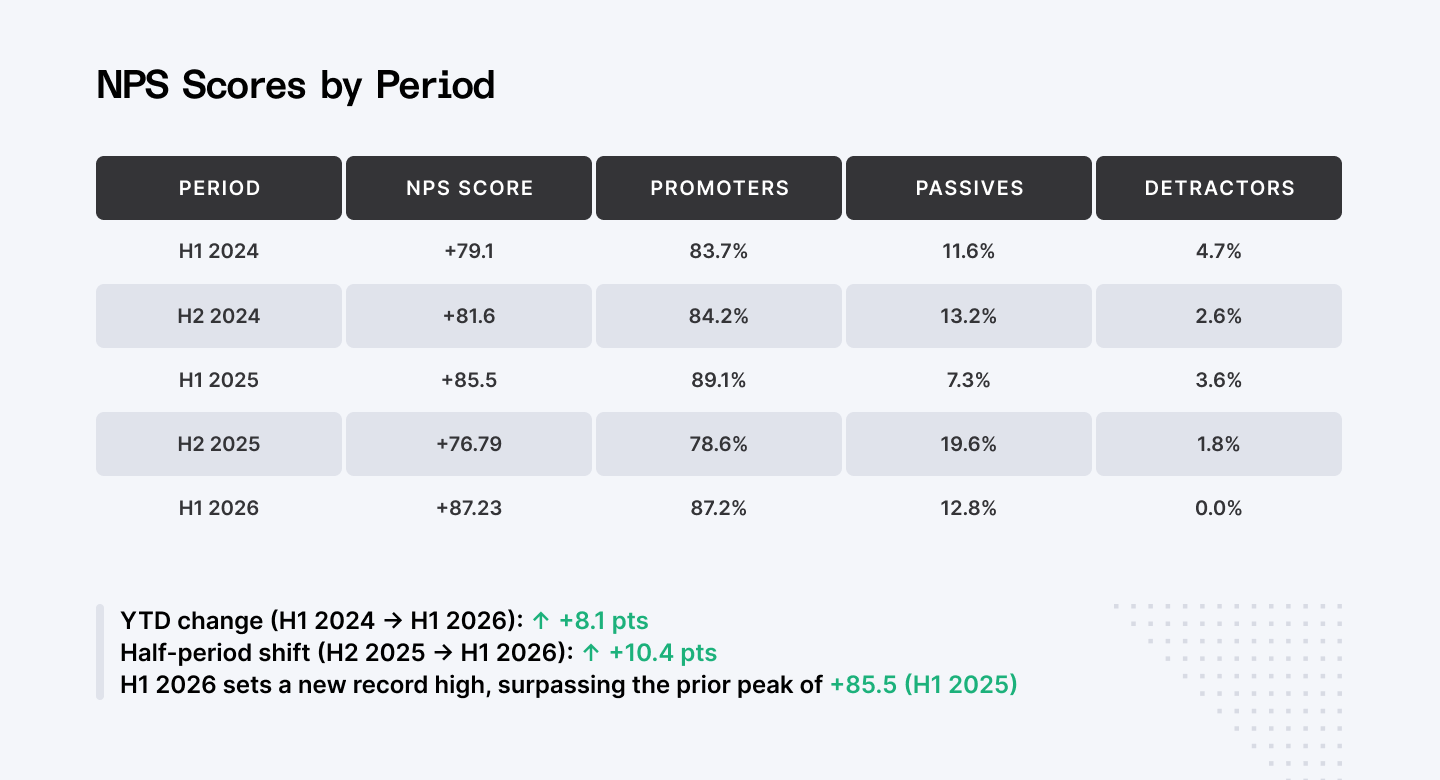
That is a particularly strong result in a talent and contracting market where the day to day experience can depend on many moving parts: the client team, communication, project stability, payments, processes and the level of support available when something goes wrong.
"Zero detractors isn't a nice stat to put on a slide. It's proof that when our talent tells us something's broken, we go fix it, fast enough and well enough that they notice," said Mike Sokirka, Interim CEO at Index.dev.
Here is an honest breakdown of what drove these numbers, where things improved, and the friction points we still need to tackle.
One Click That Fixed a Recurring Complaint
If you look at the question by question breakdown, one metric jumps out immediately. Satisfaction with invoicing and payments shot up from 8.80 to 9.53 out of 10. That's the largest single gain anywhere in the survey.
It didn't come out of nowhere. In the prior period, contractors told us that generating invoices and handling billing paperwork was taking too much effort. A classic administrative headache, the kind that doesn't sound urgent on its own but wears people down survey after survey. So we built something to fix it: a feature letting talent generate and send an invoice straight from their timesheet, in a single click.
The payoff was immediate. Natalija J., an engineer working with Poq, put it simply: "I really like the timesheet system where I can export the invoice with one click of a button. Previously it took way more time." Denis C. described the payment experience in three words: "Perfect. No delays."
It is a great reminder for anyone managing global teams. You don't always need massive platform overhauls to boost developer satisfaction; sometimes, simply wiping out minor operational friction makes all the difference.
Nothing Slipped. Everything Went Up
It wasn't just invoicing that got better. Project satisfaction, integration with client teams, communication from Index, timesheet convenience, likelihood to recommend, every single one of those moved up compared to the previous period. Usually when you fix one thing, something else quietly slips. That didn't happen here.
Here is how the key dimensions scored this cycle:
- Invoicing & Payments: 9.53 / 10 (up from 8.80)
- Communication & Support: 9.53 / 10 (up from 9.32)
- Client Team Integration: 9.06 / 10 (up from 8.88)
- Project Satisfaction: 8.70 / 10 (up from 8.55)
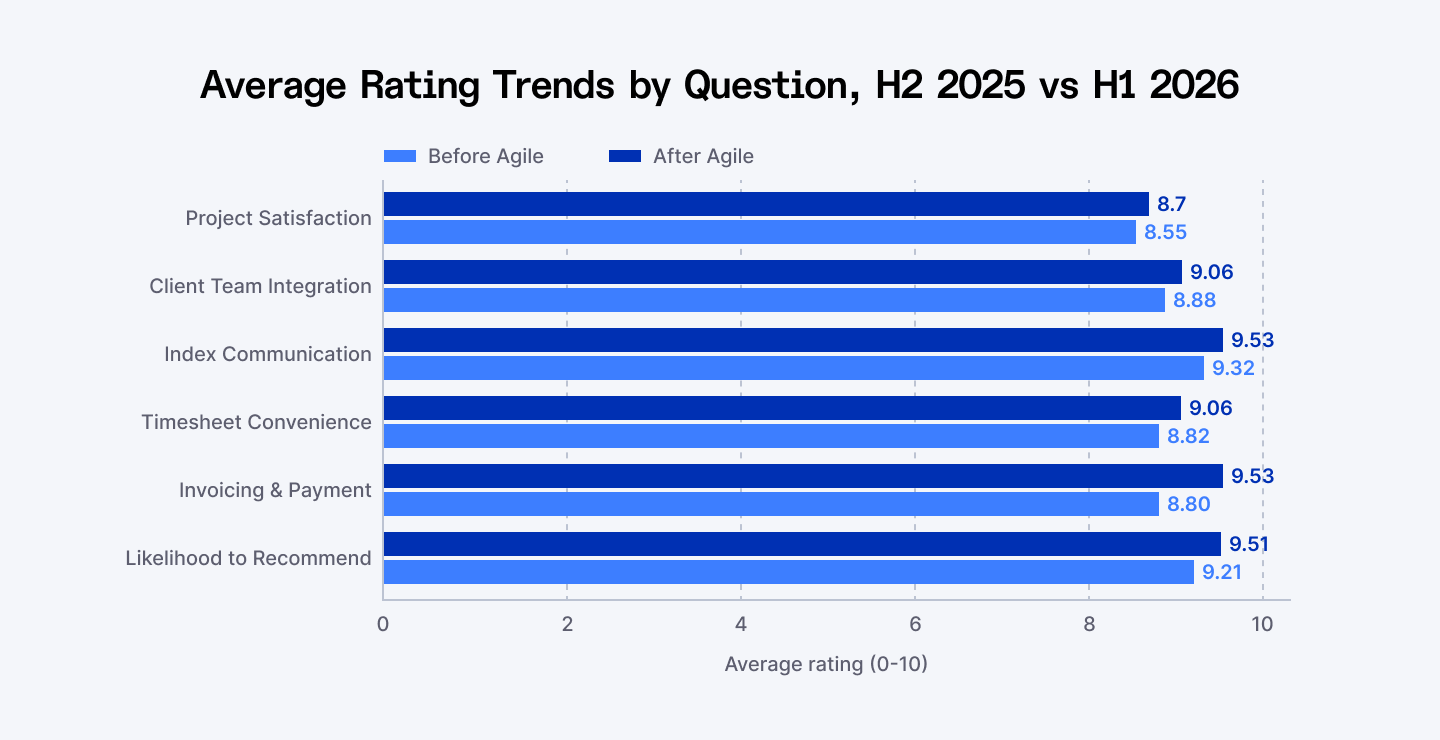
The score we watched closest, though, was project stability. Late last year, contractors flagged concerns about being shifted between client accounts too quickly. This cycle, that friction virtually disappeared. Instead, contractors highlighted deep integration and team culture.
Raphael F., working with MyBackHub, highlighted the collaborative drive on his assignment, noting that "the team is highly engaged, always looking for creative ways to deliver more value and care to consumers." Meanwhile, Italo P., working with Daloopa, pointed to the balance between tech stack and autonomy: "It’s a modern project that leverages everything currently trending in the industry... The team is friendly and well-balanced; I have the autonomy to add value while feeling secure."
Seeing stability return alongside high autonomy confirms that getting engineers matched to mature, well-structured client environments pays off for everyone involved.
Communication Remains One of the Strongest Parts of the Experience
Communication and account support tied with payments as our highest-rated dimension, scoring a 9.53 out of 10. In a tech landscape rushing to automate every single touchpoint, engineers overwhelmingly told us that having direct access to real people remains critical.
Contractors repeatedly pointed to fast response times, approachable account managers, and transparent problem-solving when things get tricky on a project. Vuk V. highlighted the "ability to talk to a human on demand on very short notice," while Kateryna B. noted how much she values the company's "human-centric and personal approach," adding that "they treat contractors as individuals rather than numbers."
Remote contracting can easily turn transactional. An engineer gets matched, ships code, submits a timesheet, and receives a payout, with zero genuine human interaction in between. But as teams become more distributed, keeping a direct, personal line of support open is the glue that holds long-term remote partnerships together.
A Record Score, But Not Just Because of New Talent
Whenever satisfaction metrics spike, it is fair to wonder if the numbers are riding on a wave of honeymoon-phase enthusiasm. New sign-ups are often thrilled just to land a great role, and that initial optimism can easily distort overall survey data.
Our latest breakdown showed the exact opposite trend. First-time survey takers dropped to 31.9% of respondents, down from 46.4% in the previous cycle. Over two-thirds of the engineers who filled out this survey have been contracting through Index.dev for a prolonged stretch.
Tenured contractors are naturally harder to impress. They have seen how platform policies play out over months, lived through client transitions, and know where the operational frictions lie. Having our highest score to date driven by experienced engineers with a long baseline for comparison proves these improvements represent genuine, lasting progress.
What We Are Taking From the Results (And Where We Go From Here)
Looking at the full picture, a few things stand out.
First, listening only matters if something changes afterward. Automated invoicing proved that when engineers tell us where administrative friction lives, fixing it yields immediate, measurable trust.
Second, basic operational excellence will always outperform flashy promises. Fast responses, reliable payouts, daily autonomy, and dedicated account managers remain the bedrock of contractor satisfaction.
Third, long-term sentiment is what validates platform health. Knowing these scores were driven primarily by tenured contractors gives us confidence that these improvements reflect reality, not just first-day enthusiasm.
And finally, there's always something left to fix. Reaching zero detractors doesn't mean the work stops. A strong NPS isn't a trophy to put on a shelf. It's an operational roadmap.
The feedback highlighted clear areas where we can continue sharpening the platform experience:
- Compensation transparency: Creating clearer, more structured visibility into how rate reviews and adjustments are handled over time.
- Payout predictability: Exploring ways to provide even tighter, more consistent payout windows to help talent plan their finances with ease.
- Operational & KYC support: Working closely with our third-party payment and verification partners to eliminate lingering onboarding and withdrawal friction.
Building an elite platform for world-class engineers means accepting that product and service quality is an ongoing pursuit. We are proud of what these H1 numbers say about our progress, but we are even more motivated by the remaining friction points revealed in the comments. Listening, building, and continuously refining will always be how we operate.
Up next: see what eight NPS surveys in a row reveal about how Index.dev's talent experience has changed over time.