It's 2025, and three out of four HR leaders are leveraging AI hiring tools; while those on paper resumes and back-and-forth email threads are getting left behind.
Every hour you spend sifting through applications by hand or switching schedules is an hour you could miss a top talent. Now imagine cutting almost half the time off your typical time to hire, giving people constant updates in real-time, and releasing your team from administrative busywork to engage in high-value conversations.
In this article, we’ll show you exactly how to use AI to improve your hiring process, step by step. You’ll learn how to choose the right AI tools for sourcing and screening, set clear goals to track success, and build fair, compliant policies.
We’ve also included real examples, checklists, and tools to help you turn AI from a buzzword into a real advantage, for faster, smarter, and more inclusive hiring.
Stop losing top talent to slow hiring. Access Index.dev’s elite 5% of vetted developers with 48-hour matching, AI-powered screening, and a 30-day free trial.
Key Takeaways
- AI recruiting tools adoption jumped from 26% to 53% in one year, accelerating time-to-fill by up to 45%.
- Integrating AI into recruiting frees your team from tedious tasks like resume parsing, interview scheduling, and candidate outreach so they can focus on strategy.
- Startups, SMEs, and remote-first teams are using AI in HR workflows for everything from job ad generation to predictive analytics.
- Balance speed with fairness: combine AI resume screening with human review to mitigate bias and ensure compliance.
- Implement phased automating hiring using AI: test one tool, monitor metrics (time-to-fill, candidate satisfaction), scale.
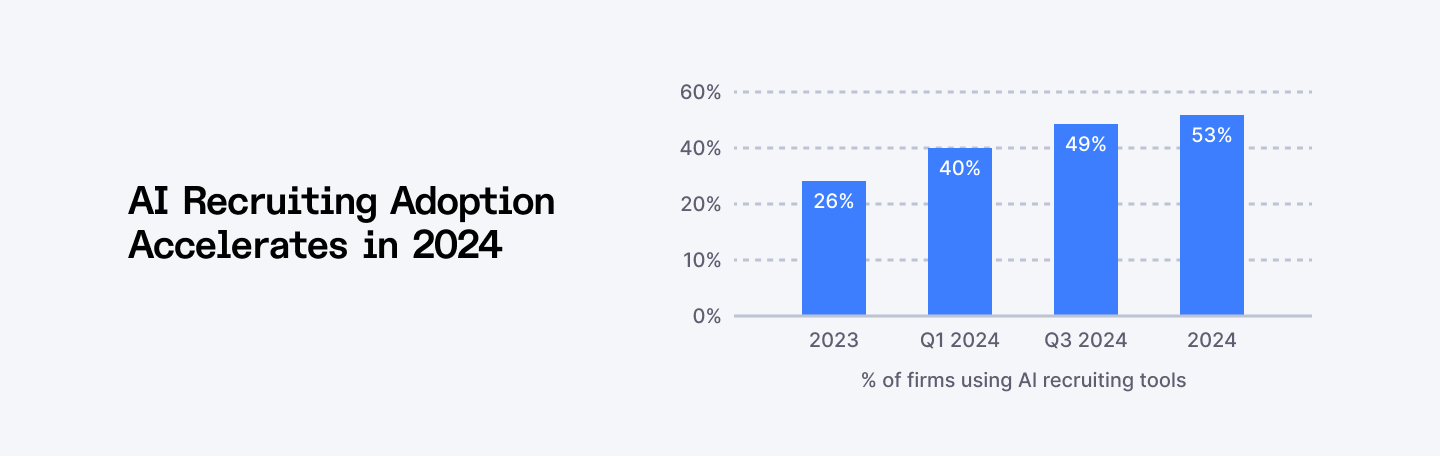
Who Is Driving Adoption of AI Recruiting Tools?
Usage rates doubled last year to 2024, with 53% of businesses now utilizing AI to hire (from 26% last year).
Gen Z and Millennial entrepreneurs are particularly keen: young entrepreneurs were 56% more likely to test generative AI than older ones. Remote and hybrid work also drives AI in HR workflows because by late 2024 nearly 40% of new U.S. job postings offered remote/hybrid roles, so firms need smarter tools to sift through a global candidate pool that spans across time zones.
Even government agencies and large organizations are hiring for AI skills and embedding AI into HR planning, according to this McKinsey report. For example, NASA created an AI‐powered virtual HR assistant (NOVA) and is using ML to match staff to projects.
In short, from Silicon Valley tech startups to Main Street shops and government units, organizations of all stripes are finding new ways to use AI in recruiting.
What AI Recruiting Tools Should You Consider?
AI is no longer a monolith. It’s a suite of specialized tools that each tackle different parts of your hiring process:
- Job Description Generators:
Tools like Textio and HireVue’s Insights optimize postings for clarity and inclusivity, boosting click-through rates by up to 20%.
- AI Resume Screening:
NLP-powered filters (e.g., in Greenhouse, Lever, Workable) rank applicants on skills and cultural fit. You’ll see up to a 45% reduction in screening time.
- Candidate Chatbots:
Platforms such as Paradox Olivia or Mya Systems field FAQs, pre-screen candidates, and schedule interviews; available 24/7.
- Video-Interview Analysis:
Emerging generative AI for recruitment tools analyze tone, word choice, and even facial expressions to provide initial candidate assessments.
- Predictive Talent Intelligence:
End-to-end suites (Eightfold.ai, Phenom People) forecast hiring needs and match applicants to roles based on historical success profiles. Recruiting teams can also integrate auto dialer software with their ATS or CRM platforms to automate candidate outreach and speed up interview coordination.
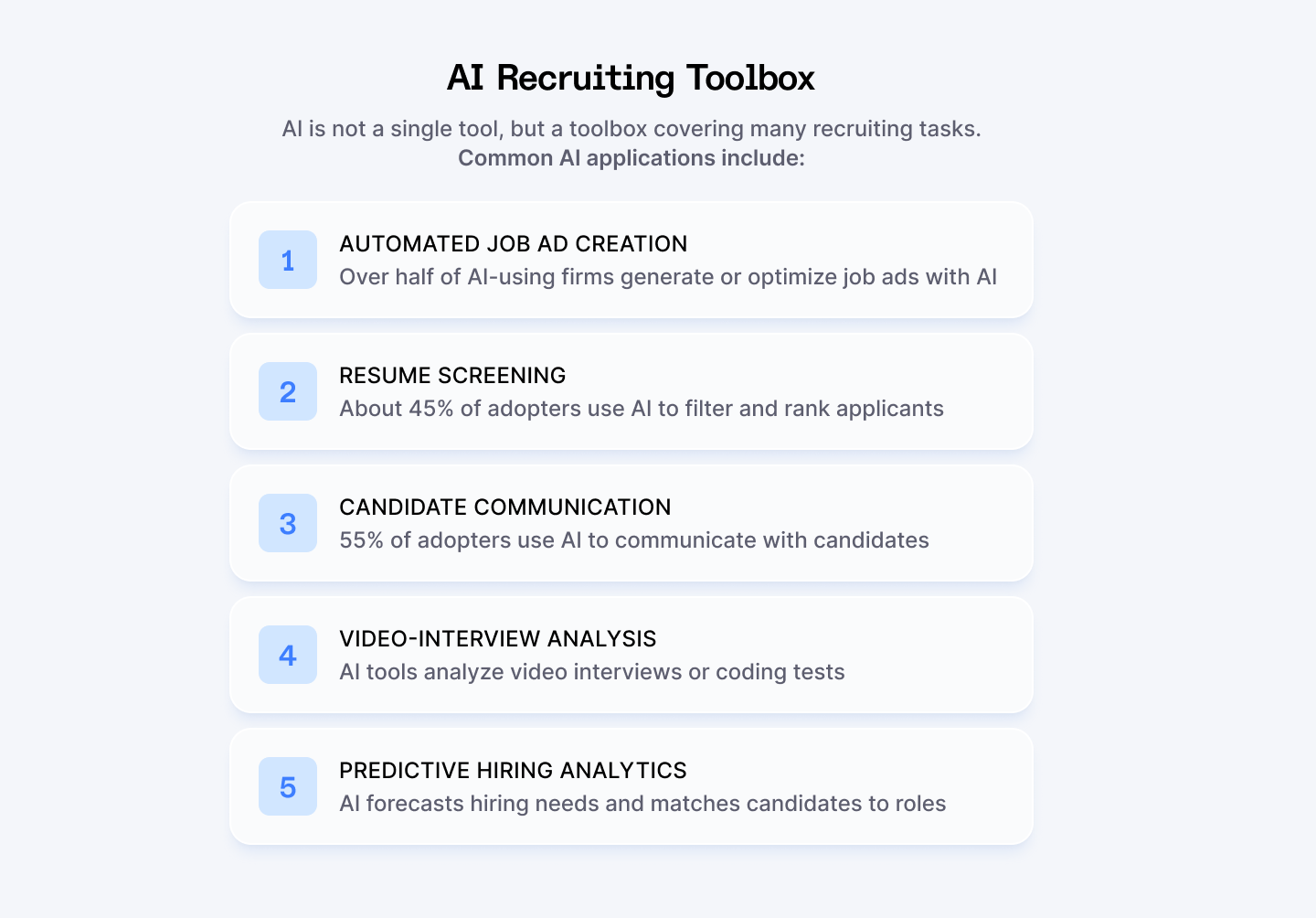
Research confirms that “recruitment technology leaders” (organizations with advanced hiring stacks) are dozens of times more likely to use AI for screening and analytics than laggards.
Each tool serves a purpose in your funnel: automating hiring with AI means starting small (e.g., resume parsing) and layering on communication bots or analytics as you prove ROI.
In short, AI is being embedded throughout the funnel: from posting jobs, to finding and engaging candidates, to selecting finalists and even onboarding. Free AI hiring tools are now offered by leading platforms like Recruit CRM, making recruitment more accessible and efficient for recruiters.
For a broader view across HR functions beyond engineering hiring, see Peoplebox's guide to AI tools for HR teams covering screening, engagement, performance, and analytics.
When and Where to Embed AI in Your Hiring Workflow
AI recruiting tools are going mainstream right now. According to global industry reports:
- Q1 2024: 55% of HR teams using at least one AI tool.
- Q4 2024: 78% adoption across recruiting functions.
By 2025: 75% of HR leaders plan to expand AI in hiring.
Even within single HR functions, use of generative AI is on the rise; 71% of firms were using generative AI regularly for at least one function through the end of 2024, up from 65% six months prior. The shift to remote work brought on by the pandemic has sped the process along.
Adoption spans North America, Europe, and Asia-Pacific. If your team operates remotely, AI-powered applicant tracking systems (ATS) and chatbots let you engage candidates around the clock, regardless of time zone. In a survey of 237 HR pros worldwide, over half said their firms use AI-enabled recruiting tools.
You'll frequently see early applications in high-volume recruitment (retail holiday highs or tech bootcamp alumni) before spreading AI further into more strategic areas such as leadership recruitment. Basically, AI recruitment is no longer testing the waters; by 2025 most hiring teams anticipate leveraging it.
Why You Need AI in Your Hiring Process
Struggling with a talent deficit? Here's why incorporate AI into recruiting:
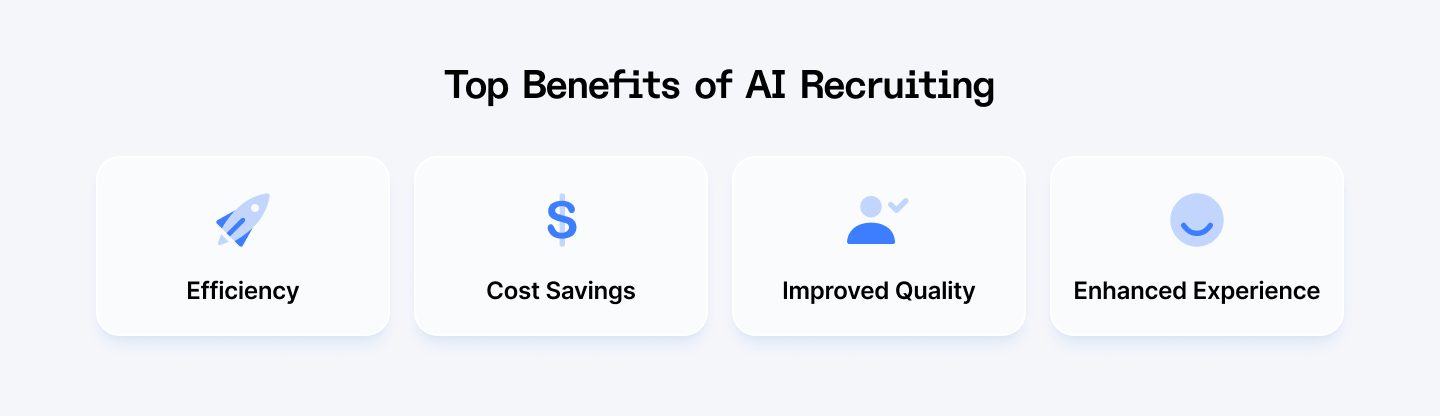
- Speed & Scale:
Generative AI has reduced time-to-fill by as much as 45%, based on industry studies.
- Quality Boost:
Data indicates AI-driven businesses stand a 45% chance of reaching their quality objectives.
- Efficiency Savings:
Teams save 60% of time spent on admin activities such as scheduling and first screening.
- Improved Candidate Experience:
Quicker response and simplified applications improve levels of satisfaction by 30%.
- Cost Savings:
Early-stage startups avoid hiring extra HR staff, reallocating budgets to strategic growth.
Startups can especially benefit: a case study of an early-stage tech firm showed that integrating AI into workflows eliminated the need to hire at least €100,000 worth of extra staff for scaling, allowing a small team to handle much more work.
AI also lets HR teams do more with less. For example, resume parsing and initial outreach enable recruiters to spend their time interviewing and scheduling instead of on mundane tasks.
By leveraging AI recruitment software to streamline mundane work, you free up your recruiters to make connections and have more levels of candidate engagement.
For remote-first companies, AI levels the playing field so you can address global talent without the added headcount. These tools can quickly search across global talent databases and even conduct asynchronous video interviews, so that time zones or locations are no barrier.
AI can also improve candidate experience and diversity, when done right. Smart job ad generators can tailor postings for clarity or inclusiveness, and efficient screening software can ensure a wider talent pool gets considered. In surveys, improved candidate experience and better pipeline access rank among top AI benefits.
How to Pilot and Scale AI in HR
If you’re at an early-stage company or mid-size firm, how do you start?
Identify Bottlenecks
Map your current workflow. The first step is identifying routine parts of your recruitment that drain time: sourcing candidates, scheduling interviews, screening qualifications, etc. What is the most time/effort-consuming roadblock? That’s your low-hanging fruit.
Select One Tool
There are turnkey AI tools to tackle each problem. Begin with a standalone AI feature, resume parsing or chatbot scheduling. Many ATSs offer free trials for these modules. You can refer to our previously mentioned ‘AI Recruiting Tools’ section for a deeper dive into specific tools.
Define Metrics
Track time-to-fill, candidate satisfaction, and recruiter workload before and after implementation.
Train Your Team
Equally important is training your team. Make sure recruiters know how the AI works and its limits. Offer role-based workshops so recruiters understand AI outputs and limitations. Designate an AI champion in HR to oversee vendor relationships and feedback loops.
Iterate & Expand
Once you see gains, introduce additional capabilities: video analysis, predictive analytics, or talent intelligence platforms.
Governance & Compliance
Don’t forget legal and ethical compliance. If your AI tool profiles candidates, ensure it does so in a way that doesn’t violate equal opportunity laws. Establish a review cadence; quarterly audits of bias metrics, data security checks, and candidate feedback.
By following these steps, you’ll integrate AI smoothly and build trust in automating hiring with AI across your organization. Early adopters find that when recruiters see relief from grunt work, they often become the biggest advocates.
Balancing AI Resume Screening with Fairness
No one wants a biased black box. To use AI resume screening responsibly:
- Human-in-the-Loop
Let AI handle volume (screen 1,000 resumes in minutes) then have recruiters validate shortlisted candidates, handle interviews, conduct final vetting, and other nuances.
- Regular Audits
Monitor demographic biases: are there disproportionately more groups making progress? Get your team to iteratively refine any AI filters or chat prompts based on actual outcomes.
- Transparency & Consent
Inform applicants when AI is involved and explain how you use their data. Clearly communicate that you’re using AI to assist, not replace, human decision-making.
- Ethical Guardrails
Data security is also key: ensure any cloud-based AI platform is certified for bias mitigation and data security. They must meet standards like SOC 2 or ISO/IEC 27001 for handling personal data.
When you combine AI speed with human judgment, you get the best of both worlds: fairness, compliance, and efficiency.
Two Industry Spotlights
Tech Startups & Developer Recruitment
In high-velocity software teams, Index.dev’s AI-driven matching engine connects you with pre-vetted remote engineers by assessing skills, culture fit, and time-zone alignment.
One Berlin-based SaaS startup cut its time-to-hire from 35 days to 11 days and sustained a 96% retention rate over 12 months by combining Index.dev’s talent intelligence with human expert vetting.
E-Commerce & Seasonal Hiring
Retailers experience highs and lows. AI job ad optimizers and chatbots manage bursts of customer-service job applicants, allowing HR to concentrate on leadership and technical positions.
A web retailer reduced seasonal hire turnaround time by 35% after implementing AI-assisted screening
Concerns: Bias, Privacy and the Human Touch
Even though there are clear advantages, introducing AI into the recruitment process raises real concerns.
Studies consistently refer to trust concerns among applicants: almost 49% of working American job applicants report AI hiring tools are more biased than human recruiters.
Actually, a poll found 56% of TA practitioners are worried AI will depersonalize the hiring process, and 53% worry about being exposed to bias. These fears are not unfounded because if an AI model is trained on past hiring data, it can inadvertently replicate historical biases.
For example, researchers noted that an AI resume screener could produce skewed results if not audited, causing teams to distrust its recommendations.
Privacy is another issue: AI tools often process sensitive candidate data, so firms must ensure compliance with labor and data regulations.
Ethical use also demands transparency (candidates should know if AI is involved in the process) and human oversight (final hiring decisions usually require a person’s judgment).
Despite these caveats, many organizations find that the right balance of AI and human review pays off. Best practices involve careful validation of tools and ongoing feedback loops.
FAQ
What is AI recruiting?
AI hiring applies NLP and machine learning to automate resume screening, job ad optimization, and interaction with candidates through the recruitment process.
How do AI hiring tools improve hiring quality?
By examining massive data sets, AI technologies find the best fit and forecast candidate performance, minimizing human error and bias.
Do data protection regulations in place adhere to AI hiring software?
Compliant vendors adhere to SOC 2, ISO 27001, and GDPR/CCPA standards. Compliance is maintained through periodic audits and open candidate disclosures.
Looking Ahead: The Future of AI in HR Workflows
As HR processes transform with AI, experience more sophisticated personal assistants that learn your recruitment preferences along the way, or computer vision evaluating soft skills from video answers; all with human approval.
Governments will push AI ethics and reskilling more aggressively, expanding the pipeline of AI-literate talent.
When you adopt generative AI for hiring responsibly (keeping pace, being fair, and adding human judgment) you'll turn hiring into a strength, not a weakness.
Our recommendation:
Pilot small, measure the effect, and scale with oversight.
Conclusion
You don't need to make hiring a never-ending loop of paperwork and busywork.
For startups, SMEs, and remote-first businesses with talent needs, AI can do it all; from resume screening to interview scheduling. Early adopters are seeing productivity gains and filling positions sooner, according to data.
By rolling out new tech in thoughtful stages, keeping an eye on the numbers that matter, and building in simple fairness checks, you’ll free up your recruiters to do what they do best: connect with candidates, nurture relationships, and build a culture that lasts.
For practical steps, consider tools like MIND.dev as an example of how to combine AI-backed vetting learning with real human screening for your next tech hire.
Ready to strengthen your hiring workflow? Let Index.dev match you with top AI-vetted developers in 48 hours. Faster, smarter, and risk-free.