
Hiring talented individuals has never been more challenging. In 2025, HR and talent acquisition directors will face a world characterized by remote-first workforces, high-volume recruiting needs, and increased pressure to eliminate bias and strengthen the applicant experience.
AI recruiting platforms are sophisticated technologies designed to automate various aspects of the recruitment process, including sourcing, screening, shortlisting, and scheduling.
These platforms are not only buzzwords. According to a McKinsey analysis, firms that use AI-powered recruiting tools have decreased hiring time by up to 40% while considerably boosting hiring quality indicators. With the battle for competent people hotter than ever, AI recruiting is increasingly becoming a must-have for forward-thinking businesses.
This guide explains what AI recruiting platforms are, how they vary from traditional ATS systems, what critical features to look for, and how to integrate them into your tech stack, so you can hire quicker, smarter, and more efficiently.
Access the top 5% of vetted developers: AI-matched in 48 hours with a 30-day free trial. Hire smarter with Index.dev.
What Is an AI Recruitment Platform?
An AI recruiting platform is a talent acquisition tool that employs artificial intelligence to automate and improve several phases of the hiring process, such as applicant sourcing, screening, evaluation, and shortlisting.
Unlike traditional Applicant Tracking Systems (ATS), which primarily store and organize candidate information, AI recruitment platforms actively engage with talent, assess compatibility, and identify the best-fit candidates, often before a human recruiter even reviews a resume.
These systems use machine learning, natural language processing, and predictive analytics to analyze job descriptions, scan resumes, and match candidates based on skills, experience, cultural fit, and even behavioral tendencies.
Some go even farther, anonymizing resumes to prevent unconscious prejudice or using AI chatbots to perform pre-screening interviews in real time.
How It Differs From An ATS
ATS = Organizer:
Traditional systems, such as Greenhouse or iCIMS, provide storage and workflow tools for recruiters to manage applications.
AI Platform = Smart Assistant:
Platforms such as Mind, Fetcher, and HireEZ actively scan databases, job boards, GitHub repositories, and social media to find and rate applicants, frequently with no human participation until the final selection stage.
For example, although an ATS may report that 200 people have applied, an AI recruiting platform will identify the 5 most likely to succeed based on real facts, not just keywords.
According to Deloitte's 2024 Global Human Capital Trends study, 57% of organizations have already included some sort of AI into their hiring procedures, with speed, applicant quality, and efficiency being the primary benefits.
In summary, an AI hiring platform does more than just manage applications; it transforms the recruitment process into a predictive, data-driven engine that saves time, reduces hiring expenses, and increases success rates.
Key Features of the Top AI Recruitment Platforms
AI recruiting platforms have varying capabilities, but the top ones have a common set of high-impact characteristics. These solutions improve recruiting with intelligence, speed, and justice, rather than simply automating it.
The following are the essential elements to look for in a top-tier AI recruiting platform in 2025:
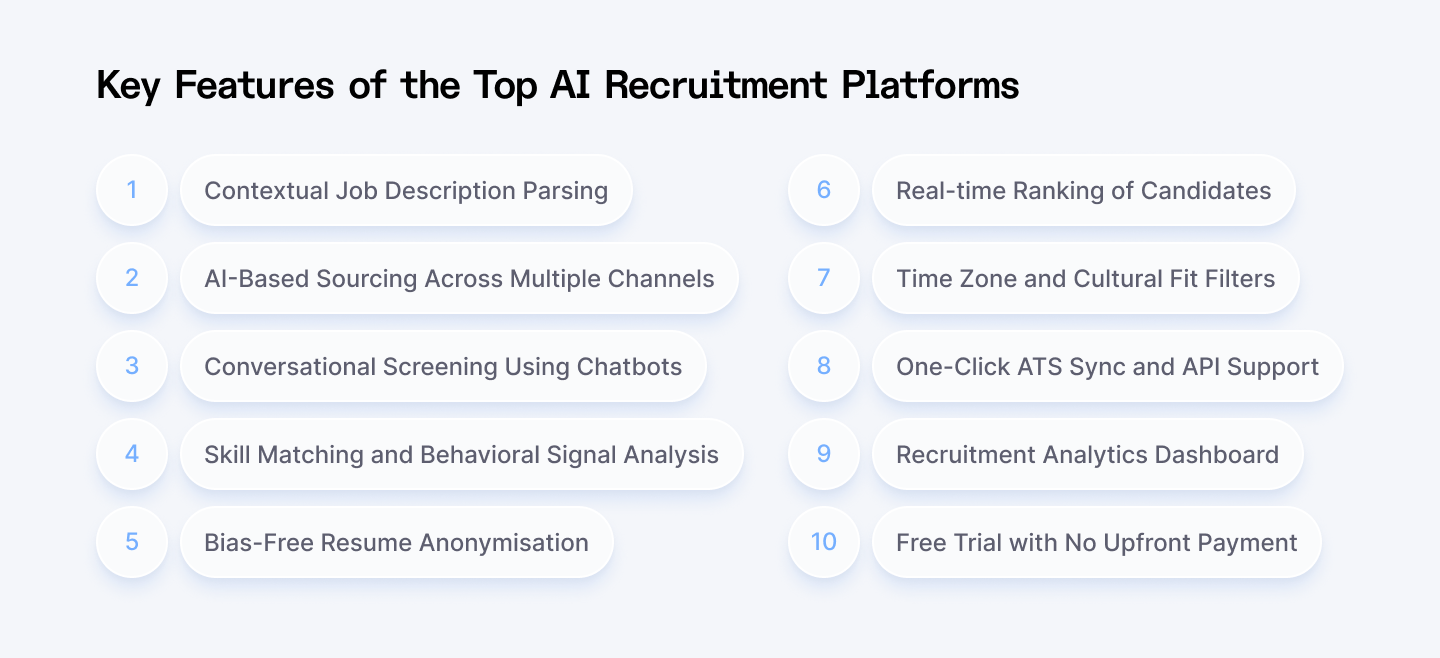
1. Contextual Job Description Parsing
The era of keyword-stuffed job postings is over. Leading systems employ natural language processing (NLP) to grasp a job description's intent, duties, and needed abilities. This results in improved alignment between positions and applicant profiles from the start.
2. AI-Based Sourcing Across Multiple Channels
A contemporary AI hiring platform searches many applicant sources, including LinkedIn, GitHub, Stack Overflow, job boards, and even corporate databases, to identify high-potential candidates. It constantly improves its sourcing approach to fit the job context and recruiting history. This is similar to how AI sourcing tools operate today.
3. Conversational Screening Using Chatbots
Conversational AI platforms, such as AI-powered chatbots, may perform initial applicant interviews, ask role-specific questions, evaluate communication skills, and gather availability 24/7. This saves recruiters' burden and engages applicants early in the process, resulting in better response rates.
4. Skill Matching and Behavioral Signal Analysis
Top platforms use both hard skills and behavioral clues (such as tone, reaction patterns, and prior job-switching tendencies) to estimate a candidate's chances of success. This results in a more comprehensive picture than typical resume filtering.
5. Bias-Free Resume Anonymisation
To facilitate equitable hiring, AI platforms may anonymize resumes by deleting identifying information such as name, gender, age, and photo. This helps to eliminate unconscious bias and increase diversity hiring results.
6. Real-time Ranking of Candidates
Instead of manual shortlisting, systems rate applications according to fit, availability, wage expectations, and employer preferences. Recruiters can quickly identify top prospects without having to comb through hundreds of profiles.
7. Time Zone and Cultural Fit Filters
Remote recruiting has made time zone compatibility critical. Mind, for example, filters applicants based on whether their working hours match and uses AI to determine cultural compatibility via communication cues and previous cooperation data.
8. One-Click ATS Sync and API Support
Seamless integration is critical. The finest AI hiring platforms provide native ATS connections (e.g., with Greenhouse, Lever, and Workday) as well as comprehensive APIs for seamless integration into current HR tech stacks. This eliminates data silos and manual duplication.
9. Recruitment Analytics Dashboard
Hiring is more than simply who gets the job; it's about knowing the funnel. A smart AI recruiting platform provides dashboards that provide metrics like time-to-fill, cost-per-hire, diversity ratios, and conversion rates, allowing teams to make data-driven decisions.
10. Free Trial with No Upfront Payment
Buyer-friendly pricing sends a strong sense of confidence. Platforms that provide risk-free trials and post-hire payment alternatives enable HR departments to test and implement AI recruiting without long-term commitments or financial risk.
In 2025, the finest AI recruiting tools will not only automate but also intelligently help. From recruiting talent across continents to guaranteeing bias-free screening, these capabilities help recruiters make quicker, smarter, and more equitable hiring choices. When comparing providers, consider this feature list as a baseline to distinguish between hype and true value.
AI Recruitment Platform Comparison
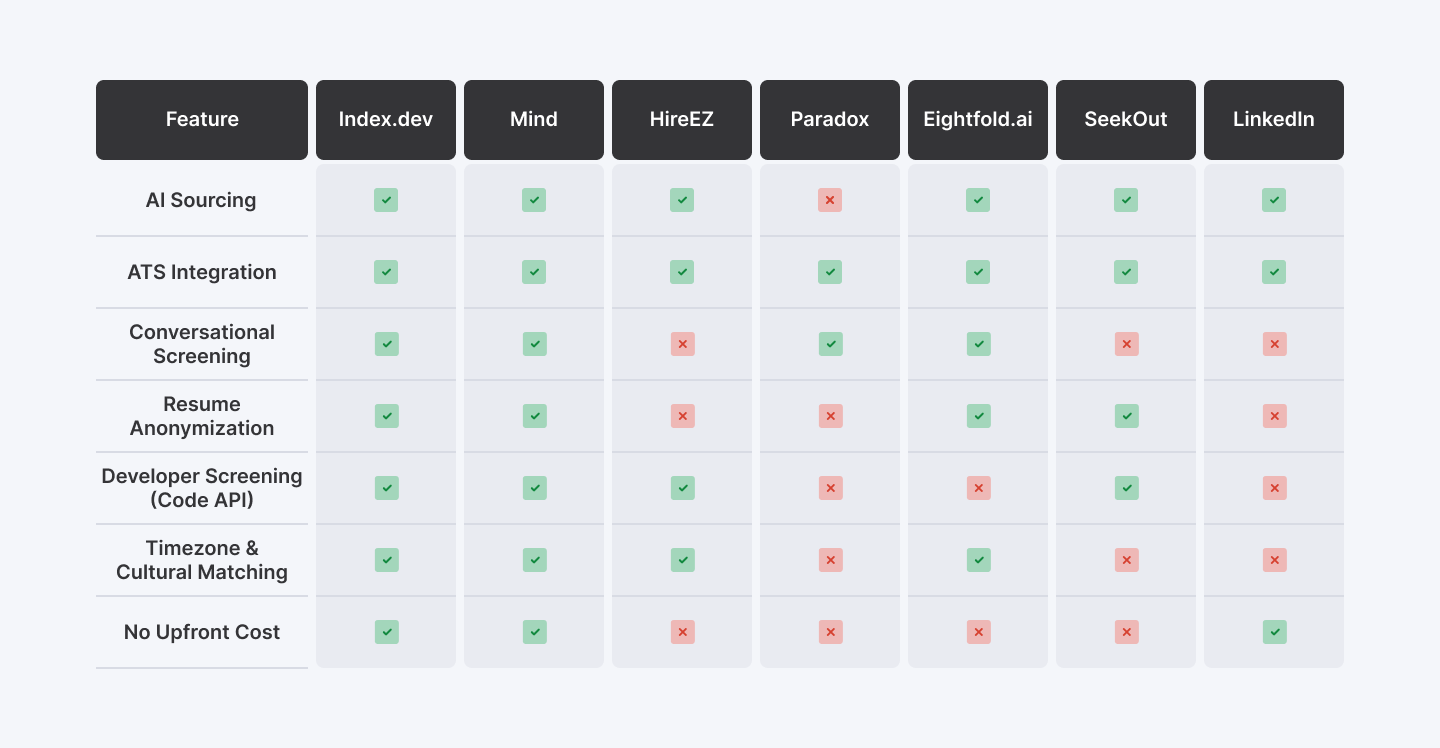
With thousands of AI recruiting tools offering quicker, smarter, and bias-free hiring, it's easy to feel overwhelmed. However, not all tools are made equal. Some are feature-rich, yet difficult to implement. Others move quickly but lack compliance or DEI capability. That's why we've broken down seven top AI recruiting platforms, plus one remarkable end-to-end hiring solution, Index.dev, to help you find the best match for your hiring needs.
Platform Overview: The Contenders
Platform | Best For |
AI + human-matched tech teams, full pods, remote hires | |
Mind | End-to-end AI hiring assistant for tech talent |
Fetcher | Automated sourcing with human-in-the-loop |
HireEZ | Talent sourcing for hard-to-find profiles |
Paradox | Conversational AI for high-volume hiring |
Eightfold.ai | Enterprise-grade talent intelligence platform |
SeekOut | DEI-focused sourcing and analytics |
LinkedIn Talent Insights | Market-wide hiring intelligence tools |
Feature-by-Feature Comparison
Feature | Index.dev | Mind | HireEZ | Paradox | Eightfold.ai | SeekOut | |
| AI Sourcing | ✅ | ✅ | ✅ | ❌ | ✅ | ✅ | ✅ |
| ATS Integration | ✅ | ✅ | ✅ | ✅ | ✅ | ✅ | ✅ |
| Conversational Screening | ✅ | ✅ | ❌ | ✅ | ✅ | ❌ | ❌ |
| Resume Anonymization | ✅ | ✅ | ❌ | ❌ | ✅ | ✅ | ❌ |
| Developer Screening (Code API) | ✅ | ✅ | ✅ | ❌ | ❌ | ✅ | ❌ |
| Timezone & Cultural Matching | ✅ | ✅ | ✅ | ❌ | ✅ | ❌ | ❌ |
| No Upfront Cost | ✅ | ✅ | ❌ | ❌ | ❌ | ❌ | ✅ |
What Makes a Modern AI Recruitment Platform Truly Scalable?
Most AI recruiting platforms offer quicker sourcing, automation, and intelligent screening, but only a handful are designed to grow with your team across countries, hiring models, and project requirements.
The finest platforms go beyond point solutions for sourcing and screening. They integrate AI efficiency with human-in-the-loop decision-making, cross-functional talent coverage, and operational flexibility to support:
- High-volume role fulfilment.
- Cross-border hiring in over 100 countries.
- Custom team assembly (pods or full-stack squads)
- Project-based or long-term engagement models
- Enterprise-level compliance and integration support
Key Components of a Scalable AI Hiring Solution
Component | Description |
| AI Vetting Engine | Runs automated assessments on coding, communication, and logic, ensuring only qualified talent moves forward. |
| Human Matching Layer | Expert advisors validate fit, not just skills—matching candidates to company culture, pace, and tech stack. |
| Global Compliance Suite | Offers payroll, contracts, and legal support across countries—essential for remote teams. |
| Flexible Hiring Models | Supports contract, full-time, and pod-based staffing under one roof. |
| DEI & Bias Control | Ensures diverse pipelines via anonymized sourcing and inclusion-aware filters. |
| High Talent Retention | Enables longer project continuity through full-time assignments, not just short gigs. |
Platforms like Index.dev are pioneering this new category by combining AI recruiting with managed delivery. They assess hundreds of individuals for various roles—developers, AI/ML engineers, designers, and marketers—and deploy fully-formed engineering pods as needed.
Success measures include the following:
- 97% match success rate
- 3x talent retention than industry average
- 60+ hours saved per hire
- Compliance in 160+ countries
Whether you need to fill a single tech post fast, grow a team for your next product sprint, or eliminate dependency on fragmented freelancing platforms, a genuinely scalable AI recruiting solution should function as a strategic partner rather than merely a software tool.
Explore 17 AI recruiting tools that make finding software engineers easier.
How to Integrate an AI Recruitment Platform with Your HR IT Stack?
Adopting an AI recruiting platform may improve your hiring process, but only if it works smoothly with your current HR tech stack. Whether you're utilizing an enterprise-grade ATS, a CRM to manage talent pipelines, or specialized onboarding tools, the true value of AI hiring platforms emerges when they're integrated into your overall recruitment workflow.
Here's a realistic step-by-step strategy for integrating a recruiting automation platform without affecting your HR processes:
Step 1: Evaluate Your Existing HR Technology Stack
Before implementing a new AI recruiting platform, undertake a complete analysis of your existing processes.
Most mid- to large-sized businesses already rely on a combination of the following:
- Applicant Tracking Systems (ATS): Greenhouse, Lever, Jobvite, and iCIMS
- Human Capital Management (HCM) systems: Workday, SAP SuccessFactors, Oracle HCM, and Mekari Talenta.
- CRM solutions for recruitment: Salesforce and Beamery.
- Background verification tools: Checkr, HireRight
- Interview tools include Codility, HackerRank, and Interview Mocha.
Ask yourself:
- Where are the gaps in automation?
- Which tools are underused or overlapping?
- Are the existing systems adaptable enough to support API integrations?
This audit shows where an AI hiring platform can have the largest effect, whether in sourcing, screening, or analytics.
Step 2: Identify Integration Points
Once you've defined your stack, identify where the AI recruiting platform should go in.
Most current systems support the following:
- Native interface with popular ATS and HCM systems
- APIs and Webhooks enable personalized processes and real-time data exchange
- Zapier supports bridging tools without direct integrations
- Chrome extensions enabling real-time candidate imports from LinkedIn and GitHub
For example, HireEZ has direct interfaces with Greenhouse, Lever, and SmartRecruiters, as well as platforms such as Mind and Index. Developers offer ATS-agnostic processes and open APIs.
When deciding on the finest AI recruiting platform for your company, always review their integration documentation and validate support for two-way sync, custom fields, and webhook triggers.
In more complex setups, teams sometimes document these integration requirements with input from a recruitment web development agency to ensure the platform aligns with existing systems and workflows.
Step 3: Conduct Data Privacy and Security Checks
Data security and compliance should never be overlooked, especially when managing sensitive applicant information.
Ensure that your selected AI recruiting platform is compliant with:
- GDPR (General Data Protection Regulation) is essential for EU recruiting.
- SOC 2 Type II Certification is for safe data management and privacy protections.
- CCPA (California Consumer Privacy Act) for businesses operating or targeting California.
- Consent-based sourcing: Platforms must log consent before engaging prospects, particularly when scraping public profiles or social data.
Some platforms, such as Eightfold.ai, include dedicated compliance dashboards and audit trails to ensure transparency and security throughout the employment process.
Always obtain security documents, a DPA (Data Processing Agreement), and third-party audit findings before selecting a provider.
Step 4: Pilot Using a Single Role or Pod
Before rolling out the AI recruitment platform throughout your organization, conduct a controlled pilot.
Choose:
- A high-volume position (e.g., support agent, inside sales)
- A crucial technological position (e.g., full-stack engineer).
- A cross-functional pod (for example, product, designer, QA, and development)
Use this pilot for:
- Validate AI-powered sourcing, screening, and AI interviewer workflows.
- Compare AI-generated shortlists against humanly found applicants.
- Obtain input from recruiting managers about applicant quality, fit, and engagement.
For example, Index.dev facilitates the quick deployment of engineering pods through AI and human validation. By running such a model through a product sprint or MVP build, you can evaluate not only the platform's efficiency but also its operational suitability for expanded hiring.
Step 5: Assess KPIs Before Scaling
Finally, monitor the key performance indicators (KPIs) that are most important to your firm. Without clear standards, it is difficult to justify acceptance or growth.
Track metrics such as:
- Time-to-hire: Measure days from job posting to offer acceptance.
- Quality-of-hire indicators include candidate success rates, early turnover, and management comments.
- Cost-per-hire: Total hiring costs divided by the number of hires.
- Candidate satisfaction: Surveys or Net Promoter Score (NPS) after hire.
- Recruiter productivity: Hours saved in sourcing and screening.
According to a Gartner poll, 69% of HR directors ranked enhancing recruitment efficiency through technology as their top goal for 2024.
AI systems that provide at least a 30-40% reduction in the time-to-hire and a 25-35% reduced cost-per-hire (as indicated by McKinsey) are increasingly becoming the standard for success.
Checklist for Smooth Integration
- Audit your current ATS, CRM, and HCM tools
- Identify where automation can improve sourcing, screening, or analytics
- Confirm API and webhook support for seamless integrations
- Perform due diligence on GDPR, SOC 2, and data privacy certifications
- Run a pilot with a high-priority role or pod
- Measure key hiring KPIs before expanding usage
- Use feedback to optimize workflows and improve ROI
Read how to use AI to hire developers effectively: what works and what doesn’t.
Questions You Should Ask Before Investing in an AI Hiring Platform
Before choosing an AI recruiting platform, it is critical to ask the proper questions, not just about capabilities, but also about scalability, compliance, transparency, and real-world performance.
If you're considering Mind.dev, Index.dev, HireEZ, or Eightfold.ai, the answers to these questions will decide if the solution meets your present and future hiring requirements.
Here are eight important considerations to examine when investing in a recruiting automation platform in 2025.
Q1: Is it adaptable to our hiring processes?
Every organization has its own set of procedures; some adhere to tight pipeline phases with various stakeholders, while others value speed and automation. The finest artificial intelligence recruitment systems should allow:
- Custom processes (e.g., assigning various interview phases or approval gates).
- Role-specific automation (e.g., distinct screening logic for technical and sales positions)
- Permission options for recruiter, manager, or HRBP access
For example, systems such as Index.dev allow businesses to create procedures for long-term hires vs contract-based pods, whereas Eightfold.ai allows for individualized applicant rating based on prior hiring trends.
A strict system might reduce production. Always ask: Can we shape the platform around our hiring strategy, or are we required to adhere to theirs?
Q2: Does it encourage diverse and global talent pools?
As remote recruiting becomes the norm, your AI hiring platform must support:
- Multi-region sourcing (e.g., LATAM, Europe, and Asia)
- Time zone filtering
- Multilingual Screening
- Diversity Analytics to Support DEI Goals
Platforms such as SeekOut and Mind provide bias-free sourcing, including anonymized resumes and DEI measurements. Meanwhile, Index.dev focuses on global hiring, finding people from over 160 countries with built-in compliance protocols.
Ask vendors if their platform can find, engage, and manage talent from underrepresented groups and emerging markets.
Q3: Can we integrate it with our ATS and communication tools?
Integration is not a bonus; it is a need.
The AI recruitment platform should connect easily with:
- Applicant Tracking Systems (ATS) such as Greenhouse, Lever, and Workday
- Calendaring applications, such as Google Calendar or Outlook
- Video interview systems such as Zoom or Microsoft Teams
- Email, Slack, and WhatsApp for real-time candidate communication.
HireEZ and Fetcher, for example, provide built-in interfaces with the majority of ATS platforms, whilst Mind and Index.dev enable API-based workflows and Zapier compatibility.
Check for two-way sync, webhook triggers, and custom fields/CRM-style tagging. Poor integration will lead to data silos and manual duplication.
Q4: What support, SLAs, and documentation does it provide?
Even the finest AI recruiting platform is only as effective as the support and documentation that accompany it.
Ask about:
- Dedicated account managers or support teams.
- Onboarding support and technical documents
- Service-level agreements (SLAs) that address uptime, response time, and escalation mechanisms
- Knowledge bases or community forums for self-service learning.
Enterprise-grade technologies like Eightfold.ai provide onboarding SLAs and priority support levels.
Ensure that your staff isn't left hanging when anything breaks, or when you need quick responses during high hiring periods.
Q5: How reliable are the AI-based recommendations (given the training data)?
The core of an AI recruiting platform is its recommendation engine, which is strongly reliant on training data quality and model architecture.
You should ask:
- What datasets are used to train the model (public profiles, previous hiring data, and employer input)?
- Does it improve over time in response to our success patterns?
- Can we modify the weighting based on factors such as talents, cultural fit, or location?
Mind.dev (Index.dev’s proprietary AI hiring tool), for example, leverages previous hiring data to increase rating accuracy, whereas Eightfold.ai analyzes billions of data points across job categories and career pathways.
Inquire about benchmark metrics: What is the platform's average match accuracy or time-to-fill improvement for clients in your industry?
Q6: Does it use anonymized candidate data for DEI?
Bias in hiring is a serious issue, and AI should be part of the solution, not the problem. The top AI recruiting tools anonymize candidate information at the initial phases to:
- Remove names, genders, pictures, and ages.
- Reduce prejudice in resume screening and shortlisting.
- Support blind interviews or DEI-specific workflows.
Tools such as SeekOut, Mind, and Index.dev include built-in anonymization to increase equality in sourcing and screening.
Also, can we enable or disable anonymization for certain jobs or teams? This flexibility is important when handling worldwide recruiting with varying compliance standards.
Q7: How is price determined: per hire, per seat, or flat?
Pricing approaches differ significantly between AI recruiting platforms.
You will encounter:
- Per-seat licenses (monthly recruiter access).
- Per-hire fees (percentage-based or flat)
- Annual contracts with use levels.
- No-upfront-cost platforms (such as Index.dev or Mind).
Ask vendors to clarify:
- Is there a free trial or a pilot phase?
- Are there any overage or success fees?
- What is included in the basic plan (for example, the number of roles, integrations, and support)?
Platforms that provide risk-free recruiting, such as Index.dev's "pay after hire" approach, are suitable for firms looking to scale quickly without committing to long-term, high-cost contracts.
Q8: Can it help us monitor and improve important hiring metrics?
A smart AI hiring platform should have a hiring analytics engine.
Look for built-in dashboards for measuring:
- Time-to-hire
- Cost-per-hire
- Offer acceptance rate
- Source-of-hire
- Candidate satisfaction (using NPS or questionnaires)
These insights not only help recruiters perform better, but they also assist executives in enhancing their hiring strategy. Platforms such as Eightfold.ai and Mind provide powerful analytics dashboards with industry-wide benchmarking tools.
Can we modify reports by department, recruiter, or location? Advanced analytics will save you precious hours in Excel while providing leadership with the information they demand.
Real-World Examples and Case Studies
The most effective approach to understand the effects of AI recruiting platforms is through real-world applications. Whether you're a startup trying to grow your staff or an organization looking to expand diverse recruiting processes, these anonymised case studies show how the appropriate recruitment automation software can bring benefits in terms of time, cost, and quality.
Case Study 1: A Tech Startup Hires 10 Engineers in Under 2 Weeks
Company Type: Early-stage SaaS company.
Location: Berlin, Germany.
Hiring Goal: Ten full-stack engineers for product launch.
Challenge:
No in-house recruiter, limited money, and an urgent three-week timetable.
Solution:
The firm integrated Mind's AI hiring platform with their current ATS. The application analyzed the job description, found candidates using the GitHub API, and started conversational screening with a GPT-4-powered chatbot. Candidates were ranked in real time, with just the top 20% selected for human evaluation.
Process Highlights:
- Custom skill matching and GitHub contribution analysis.
- AI chatbot screening for tech stack knowledge, timezone alignment, and compensation
- ATS sync allows for smooth candidate tracking.
Outcome:
- Ten hiring completed in 14 days.
- 80% time saved in sourcing and screening
- Cost per hiring decreased by 60% as compared to agency bids.
- The first-year retention of hires approached 95%.
Case Study 2: Enterprise Scales DEI Hiring with AI
Company Type: Fortune 100 Financial Services Firm
Location: North America.
Hiring Goal: Increase diversity in mid-level technical jobs.
Challenge:
The existing ATS lacked DEI. Focused filtering and screening
Solution:
The organization implemented a recruiting automation platform for bias-aware sourcing and resume anonymization. AI-powered procedures deleted identifiers such as name, age, and photo, ranking applicants only on their abilities and experience.
The Platform Enabled the DEI Team to:
- Establish goals for underrepresented groups.
- Apply custom filters for inclusion without lowering the qualifying criteria.
- Assess diversity across departments and jobs.
Tools Used:
- Resuming the anonymization module
- Customizable bias filters
- DEI dashboard: applicant breakdown by race and gender.
Outcome:
- In only one year, there was a twofold rise in the number of underrepresented candidates hired
- 35% more offers made to diverse candidates.
- 100% adoption across five technology business divisions.
Case Study 3: SaaS Company Lowers Cost-Per-Hire by 40%
Company Type: Growth-stage SaaS platform in the CRM area.
Location: US + LATAM.
Hiring Goal: Hire 30 people in customer success, engineering, and marketing.
Challenge:
Heavy reliance on third-party agencies, resulting in uneven quality and excessive costs
Solution:
The firm replaced traditional agencies with a scalable AI recruiting platform capable of managing whole workflows. They used Index.dev to implement AI vetting, human matching, and flexible recruiting models for both contract and full-time employment.
Key Features Used:
- AI matching for developers, marketers, and support personnel.
- Compliance Management in the LATAM Regions
- Centralized analytics for measuring source channel performance
Process Flow:
- JD uploaded to the platform.
- AI-sourced and ranked candidates within 48 hours.
- Hiring managers got a shortlist with match scores and availability.
- Final interviews are organized using integrated calendar sync.
Outcome:
- 40% decrease in cost-per-hire.
- Three times faster hiring cycle compared to agency timeframes.
- Offer acceptance rate: 90%
- 93% retention after 6 months.
These case studies demonstrate that AI hiring platforms are more than just theoretical tools; they are genuine, proven solutions that can handle key employment difficulties. The impact of developer staffing, diversity hiring, and cost efficiency is measurable and reproducible.
Discover how Index.dev can automate 80% of your recruiting process in only two weeks while ensuring quality, fairness, and full compliance.
Trends to Watch
As we approach 2026, AI-first recruiting is rapidly becoming the new norm. Companies that want to compete for top talent on a large scale, quickly, and affordably will increasingly rely on recruiting automation solutions to manage everything from sourcing and screening.
One significant change is the development of the recruiter's function. Human recruiters are shifting away from administrative jobs and toward strategic, high-touch roles. In this AI-assisted recruiting scenario, they're taking on the role of AI supervisors, fine-tuning prompts, assessing outcomes, and prioritizing applicant experience.
Looking ahead, numerous developing themes will redefine what makes the ideal AI recruitment platform:
- Emotion-aware AI will evaluate not just what applicants say, but also how they say it, evaluating confidence, clarity, and soft skills using voice and visual signals.
- Multilingual screening will become important for global recruiting, with AI chatbots and score algorithms capable of fluently communicating in various languages.
- Internal talent redeployment will increase as platforms utilize AI to match existing employees to available positions, boosting retention while lowering external hiring expenses.
Platforms that provide personalization, explainability, and transparency, rather than merely automation, will ultimately triumph.
Businesses will expect transparency into how algorithms make judgments, as well as the opportunity to customize procedures depending on culture, region, and company stage.
Conclusion
Choosing the appropriate AI recruiting platform is one of the most important decisions your hiring team will make. Traditional recruitment tools are no longer enough in a world where speed, precision, and fairness are essential.
The top AI recruiting tools combine intelligent automation with human understanding, allowing you to save money, shorten hiring timeframes, and uncover applicants who are actually a good match. Whether you're establishing a remote tech staff, enhancing DEI initiatives, or just growing quicker, AI recruiting provides you with a distinct advantage.
Take the step to update your talent strategy. Contact Index.dev now to see how AI-driven recruiting can transform your recruitment results—at scale, speed, and accuracy.


