Hiring top tech talent is difficult, especially when time, budget, and competition are all against you. The problem for tech recruiters, company owners, and hiring managers is real: should they remain with traditional recruitment approaches or convert to AI-powered solutions?
This article examines both approaches, including what they encompass, where they excel, and where they fall short. By the end, you'll know which technique (or hybrid plan) can help you employ top-tier developers and engineers faster, more efficiently, and without depleting resources.
Let's see which recruitment strategy produces better outcomes for current tech hiring challenges.
Still hiring the old way? Use Index.dev’s AI to match with top developers in 60 seconds. No recruiters, just results. Free trial included.
Quick Answer: Is AI Better Than Traditional Recruiting for Tech Hiring?
In many fast-paced technological situations, AI recruitment beats traditional techniques in terms of speed, scalability, and efficiency.
LinkedIn research found that AI systems can automate applicant sourcing, screening, and assessment, reducing recruiting time by up to 70%. For high-volume recruiting or startup scaling, AI provides unparalleled speed.
Traditional recruiting, on the other hand, continues to play an important role, particularly for senior, confidential, or culture-critical personnel. Human connection fosters trust and identifies intangible characteristics such as leadership potential or team fit.
In this article, we will evaluate both methodologies in several aspects, including performance, cost, candidate experience, bias, and scalability. Whether you're hiring five developers or your next CTO, you'll understand which technique is ideal for your scenario.
What Is Traditional Recruitment?
Traditional recruiting depends on human recruiters to manage the whole employment process. This involves sourcing people through job sites (such as LinkedIn and Indeed), working with HR consultancies, and using internal referrals. Manual resume reviews, screening calls, and in-person interviews are standard methods of candidate evaluation.
While this technique provides for more interpersonal interaction and personalized evaluation, it is frequently sluggish and resource-intensive. Filling a tech post through standard methods often takes 4 to 8 weeks.
Pros:
- Increases trust through personal engagement.
- Effective in executive, strategic, or relationship-based jobs.
- Allows recruiters to assess soft skills and cultural fit.
Cons:
- Recruiters have a high workload and time investment.
- prone to unconscious prejudice.
- Expensive to scale, especially for startups and worldwide teams.
In short, conventional recruitment is dependable but not necessarily adaptable. It is best suited for positions that need human judgment above speed or size.
What Is AI Recruitment?
AI recruitment uses artificial intelligence and automation to expedite crucial stages of the hiring process, frequently faster and more efficiently than human recruiters. It provides capabilities for resume processing, applicant sourcing, chatbot-based screening, code evaluations, and even automated interview scheduling.
HireEZ, for example, uses GitHub and LinkedIn to discover inactive prospects. Conversational pre-screens can be conducted by GPT-powered bots, while Codility or HackerRank automatically analyze and score candidates' coding skills.
Pros:
- Accelerates sourcing and shortlisting.
- Reduces bias (if algorithms are appropriately calibrated).
- Scales seamlessly across locations and responsibilities.
- Data-driven decisions. Improve candidate-job matching.
Cons:
- Needs organized data and stated job requirements.
- Lacks human sensitivity and sophisticated judgment.
- Can introduce algorithmic bias if not checked.
AI recruiting is particularly effective in tech hiring for high-volume or repetitive positions. It accelerates time-to-hire, reduces recruiter workload, and increases objectivity, making it an invaluable tool for businesses wishing to rapidly grow their engineering teams.
Explore 17 AI recruiting tools that make finding software engineers easier.
Key Comparison: Traditional Recruiting vs AI Recruiting
When comparing conventional recruitment to AI recruiting for tech hiring, it's critical to evaluate them in practical, high-impact areas such as:
- Speed
- Quality of hire
- Applicant experience
- Scalability
- Bias mitigation
- Price
Here's a structured comparison to help you pick the best approach for your organization's needs.
1. Speed and Time to Hire
Traditional recruitment is inherently sluggish. It can take 4 to 8 weeks to fill a single technical position using manual sourcing, many interview rounds, and decision cycles. Recruiters rely on job sites, email exchanges, and follow-ups, which can cause delays, especially when candidate availability does not coincide with the recruiting team timetable.
In contrast, AI recruiting simplifies the whole process. Tools like HireEZ, SeekOut, and GPT-powered screeners can save hiring time by up to 70%. AI automates sourcing, outreach, screening, and evaluation, typically producing a shortlist of suitable applicants in days.
For example, a Berlin-based SaaS business hired 5 full-stack devs using an AI-powered hiring pipeline (GitHub + GPT chatbots + Codility). Result? Three developers were hired in only 12 days, a process that would typically take six weeks or more.
- Verdict: AI excels in fast-paced contexts, particularly for startups and product launches.
2. Quality of Hiring
Traditional recruiting provides an in-depth, tailored insight of each prospect. Extended interviews and backchannel references allow experienced recruiters to assess soft skills, drive, and long-term fit. However, this might be inconsistent and influenced by individual recruiters' biases.
AI recruiting analyzes candidates based on hard facts like abilities, test scores, and behavioral patterns. Codility and HackerRank use real-world programming tasks to assess applicants, whereas resume parsers and ranking algorithms use objective criteria to filter them.
According to a 2023 LinkedIn Talent Report, firms that use AI for pre-screening minimize mismatched recruits by 30%, owing to improved alignment of job needs and candidate capabilities.
- Verdict: AI excels at matching technical roles, whereas conventional techniques are effective for culturally sensitive or leadership positions.
3. Candidate Experience
Traditional recruitment involves human engagement, such as phone calls, emails, and individualized comments. For senior jobs, this experience fosters trust and allows for discussions about remuneration, flexibility, and advancement. However, manual techniques frequently result in feedback delays and ghosting.
AI recruitment speeds up interactions:
- Chatbots do initial screening instantaneously.
- Candidates get automatic status updates.
- Assessments are conducted at the candidate’s convenience.
However, this strategy lacks personal warmth. Algorithmic rejection without feedback may leave some candidates feeling detached or bewildered.
- Verdict: A hybrid strategy, combining AI for speed and human empathy, provides the greatest applicant experience.
4. Scalability
Traditional recruitment is difficult to scale. A recruiter can only manage a certain number of positions, resumes, and interviews at one time. Scaling frequently entails employing additional recruiters, engaging agencies, or sacrificing quality.
AI recruitment thrives at volume. It can scan hundreds of applications in minutes, auto-rank prospects, and organize evaluations across time zones without requiring extra staff.
Use Case: A worldwide technology business utilized AI technologies to scale up hiring across ten areas at the same time, onboarding 50 engineers in six weeks, a feat that would have been impossible to achieve with human methods alone.
- Verdict: AI is the clear victor for worldwide or high-volume tech hiring.
5. Bias and Fairness
Traditional recruiting is susceptible to unconscious bias, based on gender, race, name, university, or personal networks. Subjective views can impact even the most well-intentioned recruiters' decisions.
AI recruiting promises to reduce prejudice by standardizing tests and eliminating identifiers during resume processing. For example, anonymous talent evaluations can help to level the playing field.
However, algorithmic prejudice is a growing worry. AI models might accentuate existing prejudices if they are trained on biased data (for example, employment choices from the past).
A Harvard Business Review research study demonstrates that AI hiring may eliminate bias, but only when regularly monitored and retrained using different datasets.
- Verdict: Supervised AI can effectively minimize bias. Otherwise, both strategies pose fairness problems.
6. Cost
Traditional hiring may be costly, especially when employing external agencies or headhunters.
- Agency costs range from 20-30% of yearly CTC (about $10,000-$25,000 each hiring).
- Internal HR: Salaries, LinkedIn recruiter licenses, job postings, and so forth.
- Delayed hiring might result in opportunity loss.
AI recruiting often entails initial setup or SaaS subscription charges, but the cost-per-hire drops dramatically as scale increases. Many solutions provide pricing depending on the number of hires or monthly use tiers.
For example, a mid-size product firm replaced agency recruiting with an AI-assisted pipeline, saving over $150,000 in one year and cutting time-to-hire by 40%.
- Verdict: AI is more cost-effective at scale, particularly for organizations that hire regularly.
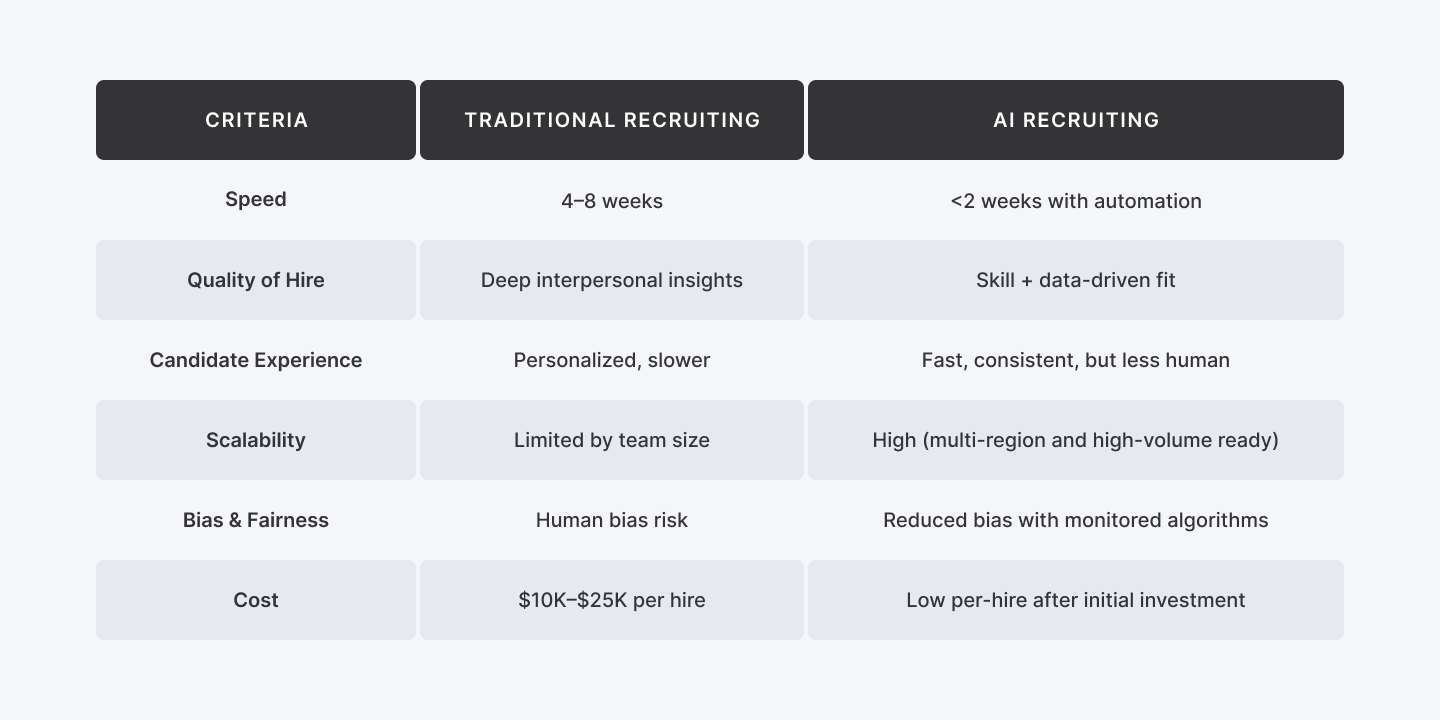
Summary Table: Traditional vs AI Recruiting
Criteria | Traditional Recruiting | AI Recruiting |
| Speed | 4–8 weeks | <2 weeks with automation |
| Quality of Hire | Deep interpersonal insights | Skill + data-driven fit |
| Candidate Experience | Personalized, slower | Fast, consistent, but less human |
| Scalability | Limited by team size | High—multi-region and high-volume ready |
| Bias & Fairness | Human bias risk | Reduced bias with monitored algorithms |
| Cost | $10K–$25K per hire | Low per-hire after initial investment |
By comparing the fundamental aspects outlined above, it is obvious that AI recruitment outperforms traditional techniques in the majority of operational KPIs, particularly for rapidly developing tech teams.
Traditional recruiting remains useful for positions that need emotional intelligence, negotiation, or long-term cultural alignment.
The best hiring strategy?
A mixed model, using AI where it excels and people where they are most important.
When Should You Use Traditional Recruitment?
Despite AI's increasing dominance in recruiting, conventional approaches continue to outperform in certain employment scenarios, notably those requiring human judgment, discretion, and connections.
Executive and senior leadership jobs frequently include complex evaluations (leadership style, strategic thinking, and stakeholder management) that computers cannot readily capture.
Similarly, culture-fit important jobs, such as early-stage team recruits or client-facing managers, benefit from human intuition gained through in-depth interactions and interpersonal assessments.
Confidential or stealth-mode searches (for example, replacing a VP without public awareness) need trust and discretion, which conventional recruiters and headhunters are trained to handle with care.
Relationship-based recruiting flourishes in referral networks and headhunting because the top applicants are rarely found on job boards or in public databases. Here, skilled recruiters may ignite passive talent pools, add context, and establish long-term rapport.
"Leadership responsibilities need more than simply abilities; they also require influence, vision, and teamwork. These traits are only revealed via human discourse."
— Laura Simmons, Director of Talent Acquisition at Insight Partners
Use conventional hiring for strategic, secret, or soft-skilled positions that cannot be evaluated by AI.
When AI Recruiting Works Best?
AI recruiting thrives in circumstances that require speed, scalability, and consistency, particularly in fast-paced tech teams or startup environments.
AI technologies provide unparalleled efficiency for firms seeking to recruit developers, engineers, and analysts on a large scale. Whether you're hiring for numerous comparable jobs or growing across areas, automation speeds up everything, from sourcing to evaluations.
In high-volume or repeated recruiting (e.g., frontend devs, QA testers, junior engineers), AI's filtering capabilities significantly decrease recruiter burden. Screening 500 resumes manually takes days; AI can do it in minutes using data-driven suggestions.
AI is also ideal for remote and internationally distributed recruiting. HireEZ and other tools enable sourcing from GitHub and LinkedIn across time zones, while GPT-powered chatbots may do asynchronous interviews.
When time-to-hire is crucial, such as during product launches or quick scaling periods, artificial intelligence provides a significant competitive advantage.
Top AI recruitment tools
- Sourcing: HireEZ, AmazingHiring
- Screening: GPT chatbots and Filtered.ai.
- Assessment: Codility, HackerRank.
According to a Gartner survey, firms that use AI recruitment solutions experienced an average 40% quicker time-to-fill and 30% lower cost per person.
Use AI recruiting for rapid, scalable, and objective hiring, especially for tech positions with clear requirements.
Explore 17 AI recruiting tools that make finding software engineers easier.
Does Hybrid Recruiting Offer the Best of Both Worlds?
The top firms today are combining the best of both recruitment approaches to build a hybrid strategy that uses AI for efficiency and people for empathy.
This is how it works.
- The first-pass filtering is handled by AI, which sources, parses resumes, and prescreens thousands of prospects.
- Humans conduct high-touch interviews to evaluate cultural fit, leadership potential, or soft skills.
- Assessment scores and rankings let human reviewers focus on the top 5-10% of candidates.
This combination lowers prejudice, speeds up the process, and guarantees that applicants receive a personal touch when it counts the most.
For example, employing an AI-powered shortlist, a mid-size product company cut its time-to-hire by 45%, while recruiters concentrated solely on final-round interviews. They grew without losing the quality of engagement.
Most organizations benefit from a hybrid model that balances speed and sensitivity, as well as scale and standards.
Final Takeaways
AI is transforming tech recruiting by providing speed, scalability, and efficiency, but it is not a one-size-fits-all answer. Traditional recruiting is important when hiring for senior positions, difficult responsibilities, or situations requiring discretion and relationship-building.
In most real-world settings, a hybrid approach triumphs. AI does the heavy lifting—resume sorting, filtering, and ranking—while human recruiters ensure that the applicant experience is real and consistent with the company's values.
The optimal strategy is based on your hiring goal:
- Need to scale quickly? Go AI-first.
- Need to use judgment and trust? Stay traditional.
- Need both? Go hybrid.
Make prudent decisions and use technology to enhance rather than replace your recruitment approach.
Stop wasting weeks on outdated hiring methods. Hire smarter with Index.dev: Our AI finds top tech talent in 60 seconds, and our expert team ensures every match is human-verified for quality and fit.