Nearly 76% of employers globally report difficulty finding skilled technical workers. The traditional model of posting a job, interviewing local candidates, and onboarding a full-time hire over three to six months no longer works for companies that need to ship fast.
The economics have shifted too. Labor costs account for more than 70% of corporate expenses. Engineering talent is often the single biggest line item. Committing to a permanent salary for a skill you might need for only 18 months is a risk most growth-stage companies can't afford.
That's why the smartest engineering organizations in 2026 treat development capacity as a fluid resource, not a fixed headcount. They don't buy talent through traditional employment. They access it through modern models that match the speed of their product roadmap.
Need senior engineers fast? Index.dev places verified developers into your team structure from day one. No lengthy hiring cycles.
This guide breaks down the five team-building models that are replacing the old playbook.
1. Staff Augmentation and Dedicated Remote Teams
Staff augmentation has moved beyond gap-filling. It's now a long-term strategy for building engineering capacity without the overhead of permanent hires. You partner with a provider who supplies pre-vetted engineers that work directly under your leadership. They join your standups, participate in sprint planning, and commit to your repositories.
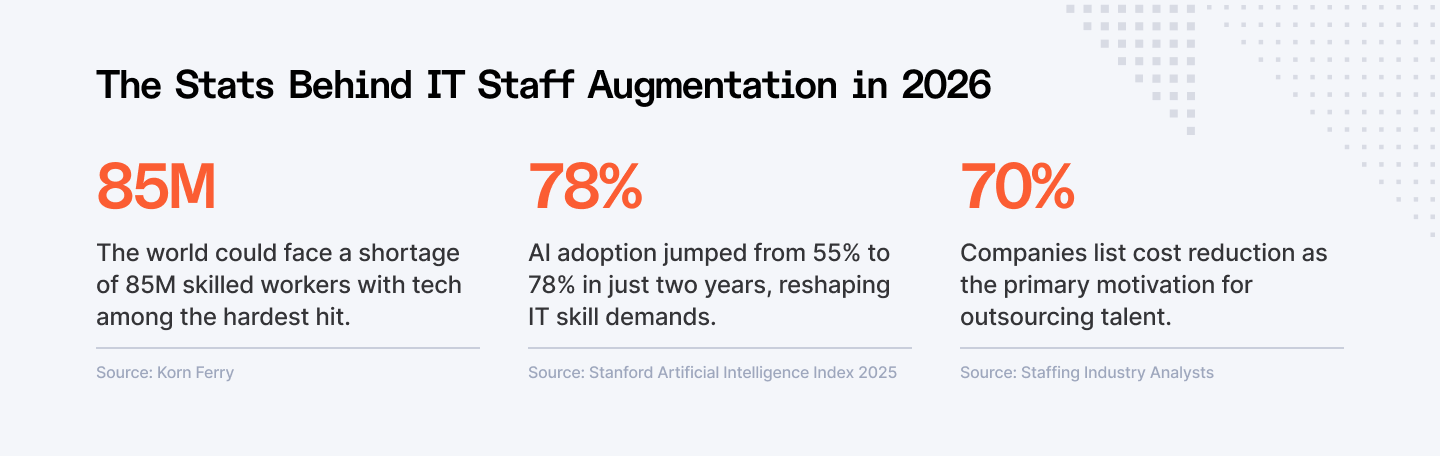
The difference from outsourcing is control. You manage the work. The provider manages sourcing, vetting, payroll, and compliance.
Why Speed Is the Main Advantage
A traditional hire takes three to six months from job posting to productive output. Staff augmentation can place a senior engineer into your project in under three weeks. When you hit a technical wall and need a specialized Rust developer or a Kubernetes migration expert, that speed matters.
Verified Market Reports estimates the IT staff augmentation market will reach over $200 billion by 2033, growing at 7.5% annually from 2026. This isn't a trend. It's a structural shift in how companies buy engineering capacity.
The cost savings are significant too. Companies using augmentation reduce overhead by approximately 40% compared to traditional hiring, cutting expenses on benefits, office space, and long-term training.
"The goal of modern engineering leadership is to orchestrate the talent," says Andrew Bates, COO of Bates Electric. "Staff augmentation allows teams to bring in senior expertise exactly where it's needed, without the operational burden of permanent hiring."
Read More: 5 Worrying Workplace Trends Managers Can't Ignore
2. Freelance and Contract-Based Developers
The gig economy for developers has matured. Today's contract engineers don't just complete tasks. They function as fractional leads and architects who plug into specific phases of your development lifecycle.
This model works best when project demands are cyclical. You might need a security auditor for a three-month compliance push or a UI/UX specialist for a front-end redesign. Instead of keeping these specialists on permanent payroll, you engage them for exactly the duration you need.
How Top Companies Use Contract Engineers
Spotify is a strong example. When their growth outpaced internal recruiting, they brought in external experts to integrate directly into their squad structure. This let them maintain their deployment velocity and ship features like AI-driven playlists without waiting months for traditional hires to ramp up.
The key is treating contractors as team members, not outsiders. Give them access to the same tools, documentation, and communication channels as your full-time engineers. The output gap disappears when the context gap does.
"Hiring is a permanent solution to what is often a temporary capacity problem," says Karina Simonovič, Marketing Manager at OptimalWarranty. "Contract-based engineering gives us the room to breathe during peak demand without bloating the organization."
Related: How to Hire Skilled Developers for Startups
3. Outsourcing to Development Agencies
Staff augmentation gives you individuals. Agency outsourcing gives you an entire team. This pod-based model works best for non-technical founders launching new products or enterprises spinning up skunkworks projects without distracting their core team. Much like COO executive search firms help organizations identify operational leaders to drive execution and scale, agency teams provide the coordinated expertise needed to keep complex initiatives moving efficiently.
The Agency Model Has Changed
Modern agencies in 2026 aren't feature factories. They act as strategic partners who provide product managers, QA testers, and DevOps engineers alongside developers. You hand over a high-level requirement. They return a finished, tested product.
The global software development outsourcing market is expected to surpass $618 billion by the end of 2026. The growth isn't coming from cost arbitrage alone. It's driven by a shift toward strategic co-creation, where the agency shares ownership of the product roadmap and builds software that scales with your long-term goals.
The best agencies bring structure and process that many startups lack internally. They've built hundreds of products and know which architectural decisions will save you from costly rewrites at scale.
"Agencies today are valued less for execution alone and more for their ability to bring structure, speed, and proven processes into complex builds," says Tim Cassidy, Co-Founder of Online CE Credits.
4. Global Talent and Offshore Teams
The local vs. remote debate is over. In 2026, the strongest engineering teams are geographically distributed by design. Companies build offshore and nearshore teams in Eastern Europe, Latin America, and South Asia to access deep talent pools that local recruiters miss entirely.
India and the US remain the largest developer markets, but regions like Eastern Europe and LATAM are seeing fast growth in their developer populations. The talent is there. The question is whether your hiring model can reach it.
The Economics and the Follow-the-Sun Advantage
Offshore development rates in 2026 run 40% to 70% lower than onshore rates. An offshore senior developer charges $30 to $55 per hour, compared to $100 to $180+ for similarly skilled talent in a US tech hub.
But cost isn't the only argument. The strategic benefit is the follow-the-sun model. With engineers distributed across time zones, your team achieves near-continuous productivity. A bug found by QA in London at 5:00 PM gets fixed by a development pod in Asia while London sleeps. The fix is ready for verification the next morning.
At Index.dev, we've built our talent network across Central/Eastern Europe, Latin America, and the US. We handle payroll, contracts, and compliance in 160+ countries, so you don't need to set up local entities or navigate foreign labor law.
5. AI-Assisted Development and Automation Tools
The most disruptive way to scale engineering output in 2026 isn't a hiring model at all. It's technology. A five-person team equipped with advanced AI coding assistants can match the output of a ten-person team working without them.
AI Is No Longer Optional
AI has moved beyond auto-completing code. It's now embedded in unit testing, code reviews, and architectural suggestions. Gartner predicts that 40% of enterprise applications will integrate task-specific AI agents by the end of 2026.
Teams using AI copilots ship code significantly faster than those relying on manual processes. Low-code and no-code tools are also expected to power over 75% of new application development this year, reducing delivery times by up to 90%.
The practical impact is clear. You don't need to hire ten more developers. You need to enable the five you have with the right tools. AI handles the repetitive work. Your engineers focus on architecture, product decisions, and the problems that actually require human judgment.
"AI is the ultimate force multiplier for a lean engineering team," says Sixin Zhou, Marketing Manager at LDShop. "The focus is shifting from adding more people to enabling existing teams to work more effectively with the right tools."
The Rise of Fractional Technical Leadership
These five models share a common requirement: strategic oversight. You can have the best augmented developers, offshore teams, and AI tools in the world. Without clear direction, they underperform.
That's why fractional CTOs are gaining traction. Many SMBs don't need a full-time CTO at a $300K salary. But they do need executive-level technical decision-making for 10-15 hours a week. A fractional CTO sets up the engineering infrastructure, chooses between augmentation and outsourcing, defines coding standards, and manages the roadmap.
This gives you big-company strategy on a lean-startup budget.
"Strategic oversight is often the missing link in remote teams," says Logan Peranavan, CEO of TapestoDigital AU. "A fractional leader ensures every external contributor is moving toward the same business objective."
Building Specialized Niche Teams
As software grows more complex, generalist developers become less effective for high-stakes projects. Companies are now sourcing teams around specific niches: Web3 architecture, generative AI integration, cybersecurity frameworks.
A fintech company might hire a dedicated cryptography team for six months to secure its ledger system, then transition that team out once the architecture is solid. The hardest parts of the product get built by the best specialists in that exact field.
"The era of the 'generalist' hire is fading in high-stakes development," says Jeffrey Zhou, CEO and Founder of Fig Loans. "Success in 2026 comes from assembling a dream team of niche experts for the specific problem at hand."
How to Choose the Right Model
Most elite engineering organizations don't pick one model. They use a core-and-flex strategy:
- Core team: A small, highly compensated in-house group focused on IP and product vision
- Staff augmentation: Senior specialists for specific technical needs
- Agency outsourcing: Non-core features and new product launches
- AI tools: Productivity multipliers for everyone involved
- Fractional leadership: Strategic oversight without full-time executive cost
This modular approach means you never pay for capacity you aren't using. You can burst development power when a market opportunity appears. And if a contractor leaves, the institutional knowledge stays with your core team and documented processes.
How Index.dev Fits Into This Model
At Index.dev, we specialize in the staff augmentation and dedicated team models described above. From thousands of monthly applications, less than 5% are accepted into our talent network.
Every engineer goes through a multi-stage vetting process:
- Background and remote performance (62.3% pass rate)
- Soft skills and English proficiency (39.4% pass rate)
- Technical skills and problem-solving (11.2% pass rate)
- Live interviews and coding tests (6.2% pass rate)
- Culture fit and availability (5.1% pass rate)
The entire process takes two weeks. Once a developer is in the network, we can match them to your project in 48 hours. We handle payroll, contracts, and compliance across 160+ countries, so you focus on building your product.
In a Nutshell
The traditional hiring model is a bottleneck for engineering teams that need to move fast. Staff augmentation, global talent pools, agency partnerships, AI-assisted development, and fractional leadership give you the flexibility to build the right team for the right problem at the right time.
The future belongs to the orchestrators. The companies that assemble the best talent from any source, in any region, and point it at the hardest problems.
Building an engineering team that scales? Get verified senior engineers from Index.dev who slot into your team from day one.
Want to go deeper? Explore how AI tools are driving real ROI, what it takes to scale after Series A, and the retention strategies that keep high-performing teams intact.