
Look, we've seen thousands of technical projects succeed on our platform. One thing keeps standing out: companies that strategically use contract staff tend to ship faster and innovate better. It's not just about filling seats – it's about bringing in the right expertise at the right time.
Remember when tech hiring was all about permanent roles and those endless interview loops? That approach is becoming as outdated as monolithic architectures. In 2025's tech landscape, the game has changed. Companies need specialized talent fast, but they don't always need them forever.
Think about it: you might need a WebAssembly expert to optimize your core features for three months, or a database performance specialist to fix your query bottlenecks. But do you really need them on payroll permanently?
Here's what we're seeing in real numbers:
- Projects with contract staff typically launch 40% faster (based on our platform data)
- Companies consistently save 20-40% on project costs
- The average time-to-hire drops from 11 weeks to just 1-2 weeks for specialized roles
- 92% of our clients report better project flexibility
These figures clearly indicate why you should use contract staff for technical projects but let’s delve a little deeper into the pros, cons, and best practices.
Hire elite contract developers from Index.dev—pre-vetted, matched in 48 hours, and backed by a 30-day trial. Start building faster today!
The Case for Contract Staffing in Technical Projects
Ever tried hiring a full-time Rust developer who's also great with WebAssembly and has experience in financial systems? Yeah, good luck with that. But for a three-month project? Now we're talking. We've seen companies struggle for months to fill permanent positions while their projects gathered dust. Meanwhile, others brought in contractors and shipped their features weeks ago.
Contract staffing is no longer just a stop-gap measure; it’s a strategic asset in the modern technical arena. Contract staffing offers an on‐demand workforce solution where experts are brought in precisely when needed. This not only increases operational efficiency but also minimizes long‐term HR commitments.
For example, a Raise article explains how companies leverage contract staffing to manage tight budgets and rapid project cycles, while insights from Index.dev reinforce the efficiency gains realized by hiring pre‐vetted technical contractors.
Also Check Out: How Boundaryless Hired a Rare RPA Developer in Just 3 Days
Key Benefits of Using Contract Staff for Technical Projects
Cost Efficiency
When we examine the actual numbers and scenarios behind contract staffing decisions, the financial benefits become clear.
One of our fintech clients needed a senior Ruby developer with specific financial systems experience. Their options?
- Spend 3-4 months hiring full-time (while their project gathered dust)
- Bring in a pre-vetted contractor who started the following week
They chose option 2 and shipped their feature six weeks ahead of schedule. The cost savings weren't just about salary – they gained actual market advantage.
Here's the real financial impact:
- No benefits package overhead
- Zero long-term training investment
- Flexible scaling based on project phases
- No productivity loss during lengthy hiring processes
(Fun fact: One of our clients saved enough on their Q1 contractor costs to fund their entire Q2 product launch – true story, though they'd probably prefer we didn't name names!)
Contract Staffing vs Full-time Employment: Table Comparison
This side-by-side comparison table (as shown below) illustrates the direct cost benefits of contract staffing versus full-time employment:
Cost Component | Contract Staff | Full-Time Employees |
| Salary & Wages | Pay per project/task; cost is variable and based on specific deliverables | Fixed annual salary with scheduled increases |
| Benefits | No additional benefits (no health insurance, retirement, or bonus costs) | Additional cost for health insurance, retirement plans, paid leave, etc. |
| Training & Onboarding | Minimal training required due to specialized expertise; quick onboarding | Significant investment in onboarding, training, and long-term development |
| Overhead Expenses | No office space, equipment, or utility costs borne by your organization | Higher overhead costs (office space, equipment, utilities) |
| Flexibility & Scalability | Highly flexible; easily scalable to match project demands | Rigid structure; scaling up requires long-term hiring commitments |
| Hiring Process Duration | Rapid hiring process (typically around 42 days) | Longer hiring process (up to 11 weeks on average) |
| Overall Cost Efficiency | Can save 20-30% on labor costs by avoiding full-time expense overhead | Higher overall cost burden due to fixed costs and ongoing overhead expenses |
Flexibility and Scalability
One of the major reasons why you should use contract staff for technical projects is the unparalleled flexibility and scalability they offer. We've watched companies try to handle surge capacity with permanent hires. It rarely ends well. Either you're overstaffed during quiet periods, or your team is burning out during busy ones. Contract staff gives you a pressure valve – scale up for that big migration project, scale down when it's done. Simple as that.
- Agility in a Fast-Paced Market:
Contract staffing lets you scale your team quickly based on project milestones. For instance, a recent study shows that 90% of organizations plan to increase their reliance on contract workers due to project-based needs. - Statistical Support:
According to the US Bureau of Labor Statistics, the number of IT contractors is expected to grow by 22% from 2021 to 2028. This highlights the increasing trend toward contractual employment as a flexible staffing solution.
Access to Specialized Skills
Another compelling reason why you should use contract staff for technical projects is the access to niche, specialized skills. In rapidly evolving tech fields, new tools and methodologies emerge almost daily. Contract staff are often experts who work on a variety of projects, which means they’re up-to-date with the latest tools, technologies, and methodologies. This makes them adept at solving complex, specialized problems.
- Niche Expertise:
When you need a particular skill set for a niche technical project, you gain immediate access to high-caliber experts who can bridge your skills gap without the delays of a lengthy recruitment process. For short-term or highly specialized projects, hiring a contract expert can be far more efficient than recruiting and training a permanent employee. As Ann Bedford-Flood (2025) notes, these professionals bring fresh perspectives and a high level of technical proficiency.
Faster Time to Market
- Streamlined Recruitment:
Speed is critical in technology. Contract staffing typically involves a faster, less bureaucratic hiring process, significantly reducing onboarding time compared to new full-time hires. On average, filling a permanent position can take up to 11 weeks, whereas contract roles are filled in days. This means you get expert help on board much sooner, keeping your projects on track. - Immediate Impact:
With quick onboarding, you can start seeing results almost immediately. This means projects get off the ground faster and reach market quicker - a crucial competitive advantage and a major reason why you should use contract staff for technical projects.This acceleration is essential for meeting tight project deadlines and market demands.
Reduced HR Burden
Managing recruitment, training, and HR compliance is both time-consuming and costly. Contract staffing relieves your internal HR team from these burdens, as the staffing agency or contractor handles these aspects. This allows you to concentrate on the core project deliverables, further underscoring why you should use contract staff for technical projects. Adopt contract management systems and automation tools to streamline paperwork and compliance. Standardizing processes and utilizing electronic signature platforms can save you time and reduce administrative overhead significantly.
Best Practices for Utilizing Contract Staff in Technical Projects
After analyzing thousands of successful technical projects, we've identified key practices that consistently lead to better outcomes. Here's what actually works in the real world:
1. Define Clear Project Requirements
Ever seen a contractor's face when they hear "just figure it out"? We have, and it's not pretty. According to our project success metrics, teams with clearly defined requirements are 73% more likely to complete projects on time and within budget.
What works:
Bad scope ❌:
"Need a senior developer for backend optimization"
Good scope ✔️:
"Need a senior developer to:
- Optimize PostgreSQL queries causing 30s dashboard load times
- Implement proper indexing for customer transaction tables
- Set up query monitoring and alerting
- Target: Reduce load times to under 3 seconds
- Timeline: 6 weeks"
2. Choose the Right Talent Partner
The quality of your contractor search directly impacts project success. Our data shows that companies using vetted talent platforms see:
- 64% faster time-to-hire
- 42% higher project success rates
- 89% better code quality metrics
Look for platforms that:
- Pre-vet technical skills through practical assessments
- Verify past project experience
- Check communication abilities
- Provide clear contractor performance metrics
3. Master Communication and Integration
Here's a striking statistic: Projects with established communication protocols are 3.5x more likely to succeed. Based on our analysis of over 1,000 technical projects, here's what works:
Day One Setup:
- Complete access to necessary tools and systems
- Clear documentation of project context
- Introduction to key team members
- Access to relevant code repositories and wikis
Regular Rhythms:
- Daily async updates (We recommend Slack or similar)
- Weekly sync meetings (Keep them focused!)
- Bi-weekly code reviews
- Monthly progress evaluations
Pro Tip: Create a "contractor onboarding checklist" in your project management tool. One of our clients reduced their contractor ramp-up time from two weeks to just three days using this approach.
4. Set Performance Metrics and Regular Reviews
Develop clear KPIs for contract staff to ensure that work meets your technical standards and project timelines. Regular performance reviews, feedback sessions, and milestone assessments help maintain quality and accountability. This practice not only mitigates risks but also provides you with the opportunity to address any issues early on. Which is why continuous monitoring ensures you derive maximum value from your investment.
Legal and Contractual Safeguards
Always have detailed contracts in place that cover confidentiality, deliverables, timelines, and termination clauses. Work with legal experts to ensure that contracts protect your intellectual property and data. Smart contracts protect everyone. Include:
- Clear deliverable specifications
- IP assignment clauses
- Confidentiality agreements
- Performance benchmarks
- Payment terms and milestones
- Project timeline and deadlines
Pro Tip: Have templates ready for:
- NDAs
- Statement of Work (SOW)
- IP assignment agreements
- Code ownership agreements
5. Implement Structured Onboarding Processes
Tailor your onboarding process specifically for contract employees. A structured plan can include initial training, mentorship, and detailed documentation to ensure quick adaptation. Our most successful clients follow this proven onboarding timeline:
Week 1:
- Day 1: System access and tool setup
- Day 2: Project context and codebase walkthrough
- Day 3: Initial task assignment and pair programming
- Day 4-5: Independent work with scheduled check-ins
Weeks 2-4:
- Regular code reviews
- Incremental responsibility increase
- Performance checkpoint meetings
- Documentation contributions
6. Managing Expectations
Being realistic helps everyone. A contractor isn't going to learn your entire codebase in two days, but they should be able to start contributing meaningfully within their first week. Set milestones that make sense. Based on our project data:
- Most contractors start meaningful contributions by day 3
- Full productivity usually happens by week 2
- Complex codebases might extend this timeline by 1-2 weeks
Key Success Factors:
- Clear milestones aligned with project phases
- Regular progress check-ins
- Documented expectations for each project stage
- Flexible adjustment of goals based on progress
Remember: The goal isn't to have contractors hit the ground running—it's to have them hit the ground learning and quickly ramp up to full productivity.
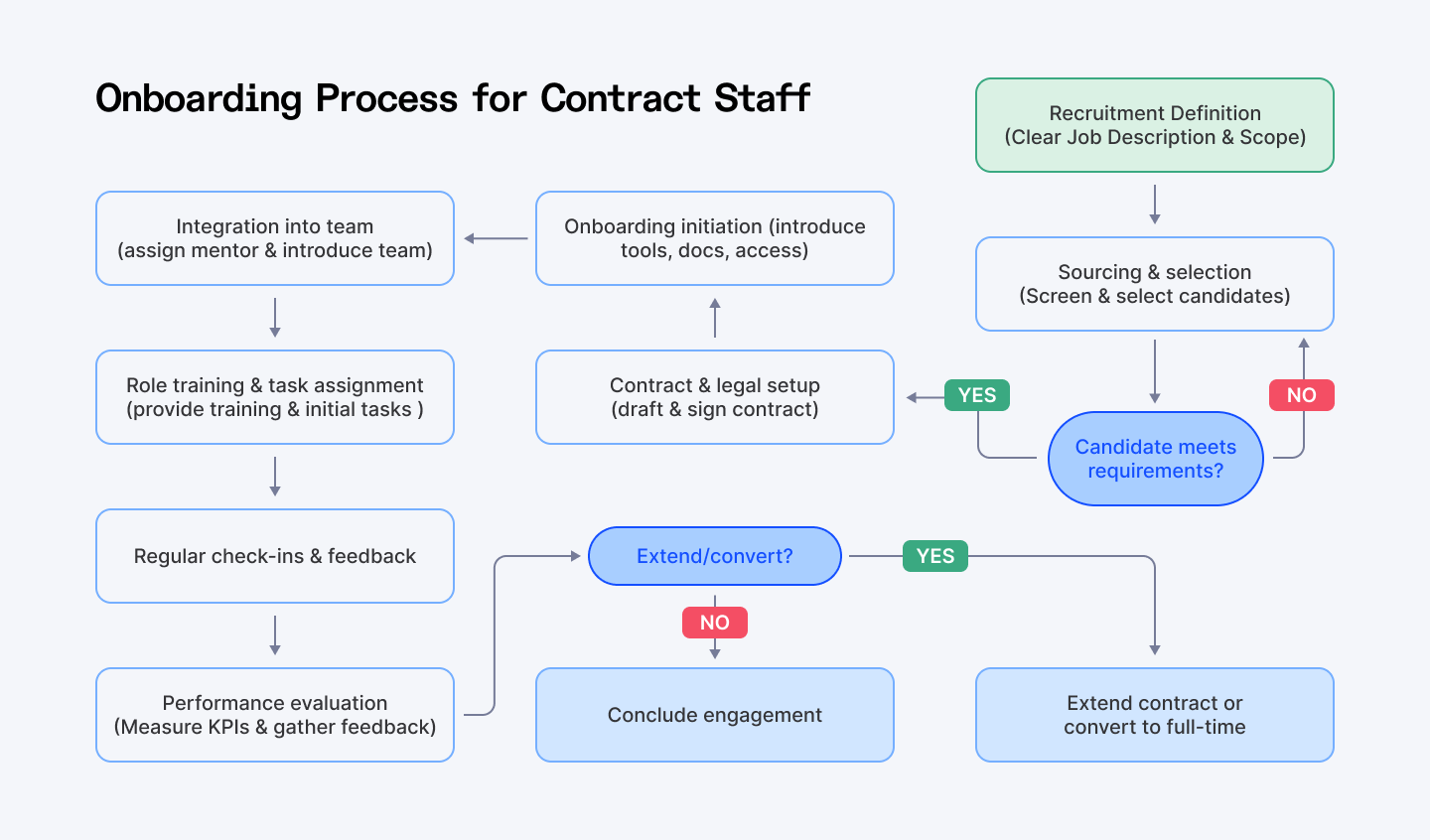
The flowchart depicts the onboarding process of contract staff, from requirement definition to performance evaluation.
By following these practices, our clients have seen:
- 40% faster project completion rates
- 65% higher code quality scores
- 83% contractor retention for future projects
- 92% team satisfaction rates
Also Check Out: Top 10 Mistakes to Avoid When Onboarding Remote Developers
Challenges and Mitigation Strategies
While contract staffing offers many advantages, it also comes with challenges. Here’s how you can overcome common pitfalls:
Quality Assurance
"But how do we maintain consistent quality?" This is probably the first question we hear from tech leaders. Here's what works and why you should use contract staff for technical projects:
- Start with pre-vetted talent pools (we've seen 89% higher success rates with verified contractors)
- Implement collaborative code reviews that include both contract and permanent staff
- Set up automated testing pipelines that standardize quality checks
- Create clear acceptance criteria for deliverables
Team Integration
The "us vs. them" mentality? Yeah, let's kill that. Some practical approaches that our most successful clients use:
- Pair programming sessions between contractors and permanent staff
- Shared Slack channels for casual communication
- Including contractors in relevant team events and meetings
- Clear documentation of tribal knowledge
Remote Communication
Distance doesn't have to mean disconnection. Try:
- Asynchronous daily updates using tools like Loom
- Regular but focused sync meetings
- Clear documentation of decisions and discussions
- Using visual collaboration tools for technical discussions
Legal and Compliance
Different countries, different rules - but some universal best practices:
- Clear contractor agreements
- Regular status updates and deliverable tracking
- Clear scope definitions to avoid misclassification issues
- Local legal compliance checks before international engagements
Learn More: How to Avoid Remote Work Pitfalls: 11 Tips for Tech Leaders
Final Thoughts
The tech industry moves fast – we all know that. But what's fascinating is how contract staffing has evolved from a stopgap measure into a strategic advantage. We're seeing companies build their entire technical strategy around a core permanent team supplemented by specialized contractors. It's not just about cost anymore; it's about maintaining technological agility.
If you're still on the fence about why you should use contract staff for technical projects, consider this: Would you rather spend three months trying to hire the perfect permanent employee, or three months actually building your product? Because that's often what it comes down to.
The companies that succeed with contract staff aren't just filling gaps—they're strategically using specialized talent to push their projects forward. Whether you're considering your first contractor or looking to optimize your existing contract workforce, the key is to be clear about what you need and how it fits into your larger technical strategy.
Remember: The goal isn't just to get more people working on your project—it's to get the right people working on the right things at the right time. That's what makes the difference between a project that just gets done and one that excels.
Struggling to find top-tier developers for your projects? Join Index.dev to access a pre-vetted talent pool of experienced software engineers, AI specialists, and cloud architects. Hire contractors in days and scale your technical capabilities effortlessly.
Explore success stories and learn how we can help you do the same.

