
Only 1 in 10 startups that raise a Series A will make it to a successful exit. The ones that don't? Many collapse not from a lack of funding or product vision but from hiring the wrong people at the wrong time. Hire too fast and you end up with a bloated team that can’t coordinate. Hire too slow and your competitors ship features while you’re still writing job descriptions.
At Index.dev, we work with Series A, B, and C startups every day, helping them staff engineering teams across a wide range of tech roles and locations. And we see the same scenario play out constantly. Founders have 12 to 18 months before serious Series B conversations begin. That window is shorter than it feels, and the pressure to show real product progress makes every hire critical.
This article will give you the real picture of the startup hiring market today, how many engineers you need, who to hire first, and the mistakes we see too often from smart founders.
Just closed your Series A? Index.dev helps funded startups hire vetted, senior engineers fast, across AI, backend, infrastructure and more. →
The New Rules of Series A Hiring
Money is flowing again. After two quiet years, venture funding rebounded in 2024 and stayed strong through 2025. Median Series A rounds climbed to about $15 million in 2025, up roughly 50% from the early 2020s according to venture data platforms, and AI‑focused companies often raise significantly more per employee than general tech startups. Data from Carta and Crunchbase shows that while median Series A rounds have climbed to roughly $15 million, the teams raising them are smaller than ever. AI and automation are pushing productivity higher, letting smaller teams do more.
Hiring today is nothing like the 2021 boom. Founders aren’t blitz‑scaling headcount. The era of hiring just for the sake of size is over. Measured growth is the new reality. Founders aren’t blitz‑scaling headcount. Boards are less tolerant of arbitrary hiring sprees, and every engineering hire needs to be clearly tied to product momentum, revenue growth, or technical defensibility.
There’s another trend under the surface worth calling out. According to the US Bureau of Labor Statistics, software developer roles are projected to grow 15% through 2033, nearly four times faster than the average occupation. Recruiting data and salary reports show that software engineering compensation remains competitive and stable, even as overall hiring slows. Early‑stage companies are still paying market rates for engineers and specialized roles, particularly in areas like AI, platform infrastructure, and security engineering.
In short, too many founders still mistake headcount growth for progress. It’s not. The current market demands balance:
Be deliberate in building your team, but aggressive about securing the right talent when it matters most.
How Big Should Your Engineering Team Be?
This is one of the most common questions founders ask, and the real answer isn’t a number — it’s strategy. What you should be thinking about is engineering output, product roadmap, and market velocity.
Across sectors, team sizes at Series A have shrunk compared to past cycles, even as funding per employee rose sharply. This tells you two things: startups are doing more with less, and you don’t need a huge team to compete.
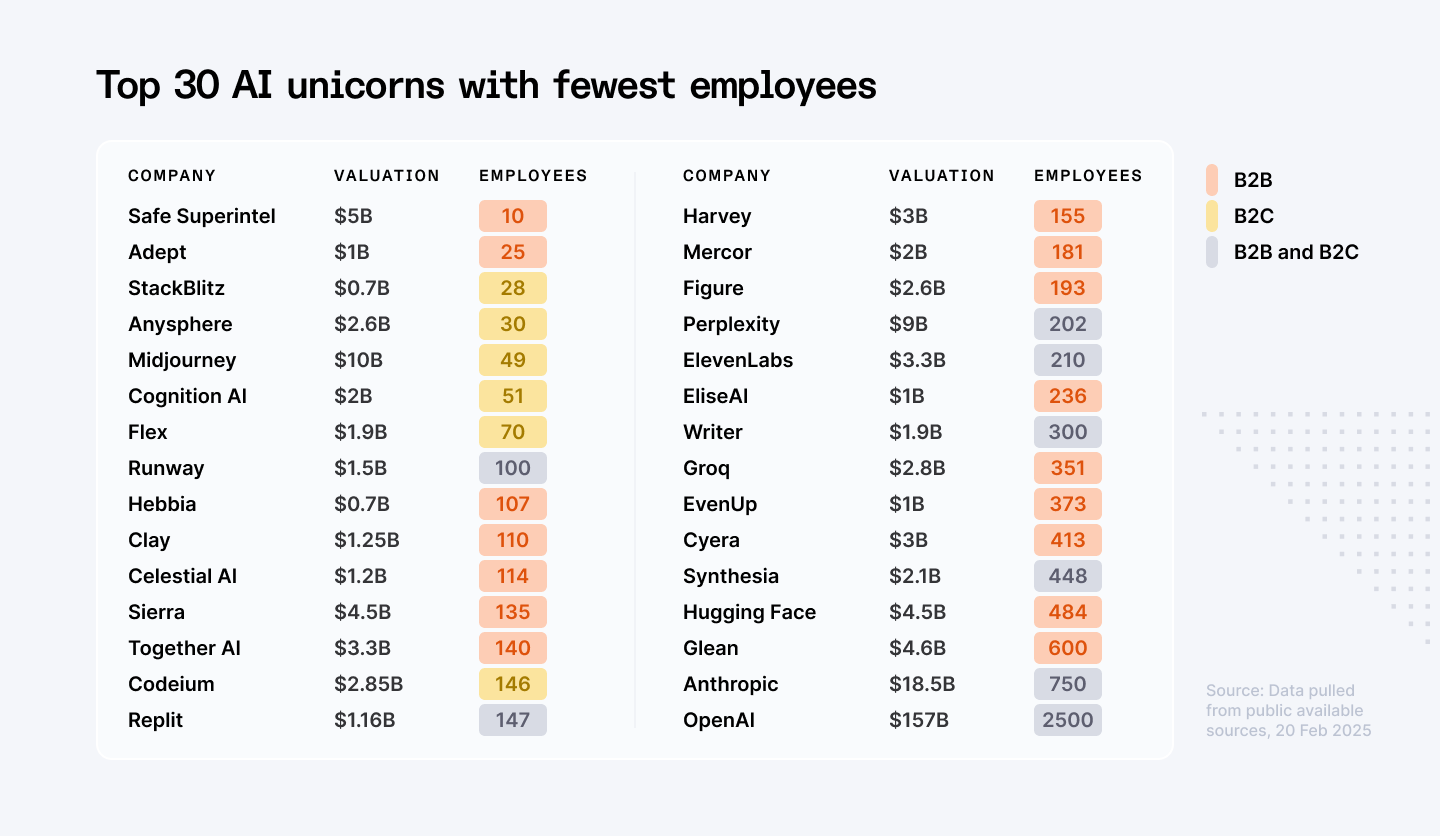
Source: Rule of Thumb | Data pulled from public available data resources
Our real‑world experience at Index.dev confirms this. Startups that tie hires to clear deliverables — milestones, quality, velocity — outperform teams that hire toward arbitrary headcount targets.
Here's what the data shows across sectors:
| Industry | Avg Total Headcount at Series A | Engineering % of Total | Optimal Engineering Team Size |
| Fintech / Payments | ~65-75 | 40% | 26 - 30 |
| AI / ML Infrastructure | ~35-45 | 65% | 22 - 29 |
| SaaS / Dev Tools | ~40-50 | 50% | 20 - 25 |
| Healthtech / Biotech | ~45-55 | 35% | 16 - 19 |
| Blockchain / Web3 | ~35-45 | 55% | 19 - 24 |
Sources: Storm2, Pitchbook, Dealroom, First Round Capital State of Startups
A few important patterns you should notice:
1. Industry shifts headcount significantly. Deeply regulated tech — Fintech, Insurtech — needs compliance, operations, and customer success roles early. That pushes total headcount up, but engineering still occupies a healthy share. SaaS and AI startups often skimp on non‑engineering roles early and let engineers carry product delivery.
2. Lean teams are a new normal. The reason headcounts are lower isn’t just market caution; founders are realizing quality beats quantity. AI and automation tools have reshaped how much work a small team can output, with some AI startups achieving meaningful ARR with surprisingly lean teams.
3. Engineering % doesn’t tell the whole story. Even if engineers are 50–60% of your team, your first hires should be tactical — those who unblock product delivery, build core infrastructure, or secure your product. Later, as you move toward revenue cadence and customer success, you’ll add GTM and ops hires.
From Index.dev’s work with Series A founders, a few things hold true:
- Founders who start with a roadmap breakdown (mapping features to disciplines and required throughput) end up hiring 15–30% fewer engineers but shipping faster.
- Most startups that hit product market fit with traction have 8–20 core engineers in the first 12–18 months. If you’re far above that without clear milestones, you’re probably adding overhead. Every ‘average’ hire you make is a debt you'll have to pay back with interest when you try to scale to Series B.
- Turnover matters. Carta data shows startup employee churn remains meaningful, so you need buffer capacity in hiring plans.
Ready to boost developer productivity with AI? Discover the full guide to AI-assisted development and smarter workflows.
Who to Hire First After Series A (And Why the Order Matters)
Sequence is everything here. Get it wrong and you'll either stall out or spend the next year untangling organizational debt.
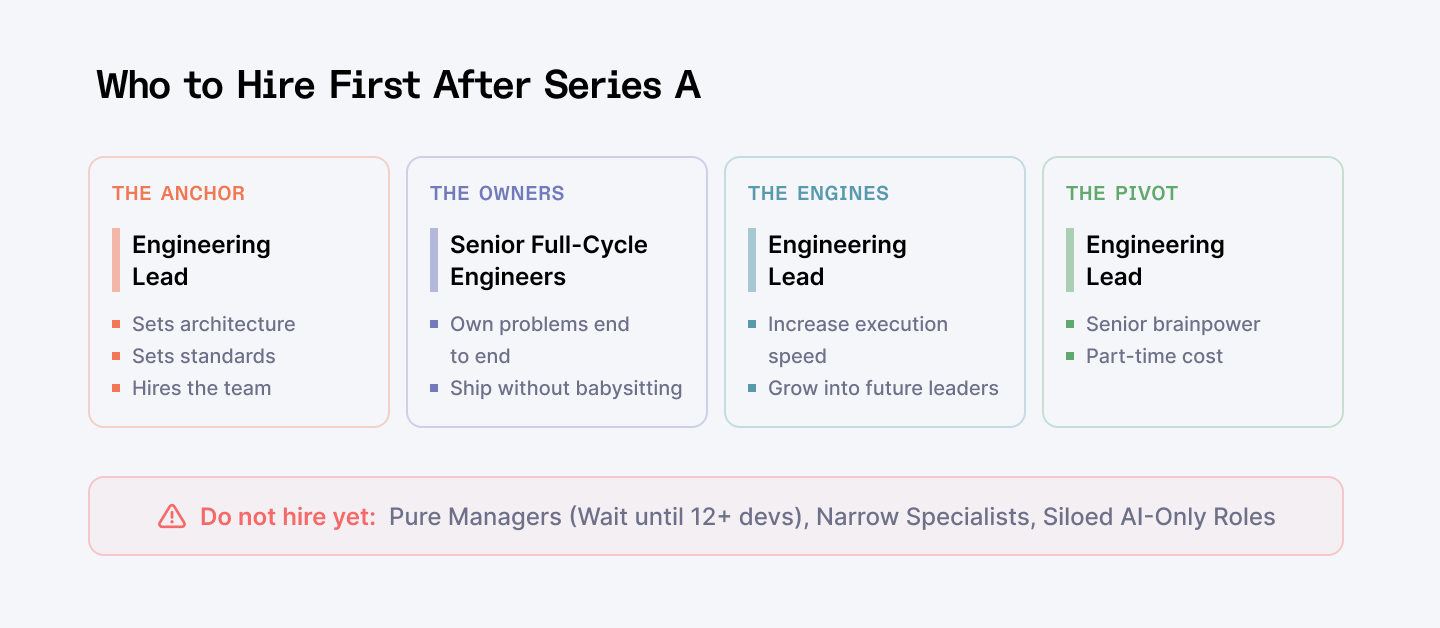
1. The Anchor: Your Engineering Lead (Hire #1)
If you don't have strong technical leadership in place, this is your most important hire, full stop. This person sets the architecture your product runs on for years. They define what good engineering looks like at your company. They interview every engineer you hire after them.
Look for someone who has operated inside a startup before. Someone who can write code and push back on the CEO's roadmap priorities. Comfort with ambiguity is non-negotiable. So is the ability to ship.
Take your time. A slow, right hire here is worth more than a fast, wrong one.
2. The Owners: Senior Full-Cycle Engineers (Hires #2–4)
Your next hires should be people who don't need to be managed closely. They look at a problem, figure out the right approach, and ship it. They've built what you need before. They know where the landmines are and which shortcuts will haunt you six months from now.
At this stage, strong generalists beat narrow specialists almost every time. You need people who can learn a new domain fast, not someone who only knows one framework really well. Ownership and accountability matter more than any specific technical skill set. AI and automation can help here too. Use tools for testing, CI/CD pipelines, and code reviews to let senior engineers focus on high-leverage work instead of repetitive tasks.
3. The Engines: Mid-Level Engineers for Execution (Hires #5+)
Once you have senior leadership and clear ownership in place, you can start adding mid-level engineers. They benefit from the structure your senior hires provide, they're more available in the market, and many will grow into senior roles as the company grows. Use these roles to build your internal talent pipeline. Today’s mid-level is your Series B Senior Lead.
4. The Pivot: Fractional Experts
One trend we’re seeing at Index.dev is the rise of Fractional Experts. Instead of hiring a $250k/year Security Lead, Series A founders are hiring elite experts for 5–10 hours a week to set the strategy, while their generalist team handles the execution. This keeps your burn low while your brainpower stays high. These people have already made expensive mistakes at other companies. Now you get their hard-won wisdom without the full-time price tag.
What Not to Hire Yet
- No dedicated engineering manager in the first 6 to 12 months post-Series A. Your CTO or technical co-founder handles that. Everyone writes code. Management becomes a full-time need around 12 to 15 engineers. Not before.
- Skip the narrow specialists too. You don't need a machine learning infrastructure engineer with Kafka experience when your team is seven people. You need sharp generalists who can figure things out across whatever problem is in front of them.
- And on the AI: don't hire someone specifically to "do AI" at this stage. That's a trap. What you want is engineers who already weave AI into how they work, not a dedicated AI person who becomes a bottleneck for everything ML-related.
The best early-stage teams are small, senior-heavy, and built around ownership. That combination is harder to assemble than it sounds, but it's what separates the teams that grow steadily from the ones that have to rebuild later.
⭢ Want to know how startups are scaling faster with flexible teams? Explore the rise of hybrid talent models and why they work.
Where Series A Scaling Usually Goes Wrong
We've worked with enough funded startups to know that most early-stage hiring mistakes aren't random. They follow a pattern. Here are the five that show up most consistently and do the most damage:
1. Lowering the Bar When the Pressure Builds
A-players know other A-players. B-players do too. The moment you bring in someone who isn't quite right, that person starts influencing your next hires, whether through referrals, interviews, or simply setting the cultural tone. One compromised hire can quietly lower the ceiling for everyone who comes after them.
Hold the standard. If a role has been open for 60 days and nothing's clicking, the answer is to rethink the role, not accept a weaker candidate.
2. Inflating Titles Too Early
Your first engineering hire becomes the CTO. It's tempting. It feels like a reward. But can someone who's managed a five-person team realistically scale to lead a 150-person org two rounds from now? Probably not. And now you have a title problem with no clean way out.
Give people real ownership and a clear path to grow into bigger titles. Let the role expand with the company. This becomes especially acute at Series B, when investors start asking hard questions about whether your leadership team can operate at the next level.
3. Hiring for Ego Instead of Stage
Hiring someone from Google or Meta feels like a signal. And sometimes those hires are exceptional. But large-company engineers are often built for a different environment: scaled systems, clear requirements, specialized teams, and room to go deep on one narrow problem.
At 15 people, you need someone who's comfortable with imperfect code, shifting priorities, and no one handing them a roadmap. That's a specific kind of person. The logo on their resume won't tell you if they're that person. Your interview process has to. The best Series A engineering hire you make might come from a company you've never heard of.
4. Underestimating How Much Culture Is Set in the First 10 Hires
Most founders think about culture in the abstract. Values on a wall. A line in the handbook. Something to figure out later. But culture isn't what you say. It's what you tolerate, reward, and model. And it gets hardwired into your team faster than you think.
The first 10 engineers you hire will define how decisions get made, how conflict gets handled, how much ownership people take, and what "good enough" looks like at your company. MIT Sloan research has shown that founding team culture persists and shapes organizational behavior long after the company scales. You don't get a reset button later. Someone who's technically brilliant but dismissive, territorial, or checked out will do more damage at 15 people than they would at 500. At scale, you can absorb one difficult person. At 10 people, that person is 10% of your company.
When to Bring in a Software Delivery Partner Like Index.dev
You do not need a staffing partner all the time. If you have a strong internal recruiter, a clear employer brand, and time to build slowly, you can hire in house. But after Series A, most founders do not have time. You have 12 to 18 months to prove velocity and your board is watching milestones, not your recruiting process. That is where a partner like Index.dev can make sense. And here is when it helps:
- You just closed and need to move fast.
- Building an internal recruiting function takes three to six months minimum. You don't have that runway. A specialized partner can run searches in parallel, across multiple roles at once, while your team stays focused on building.
- Why a partner works: At Index.dev, we have seen Series A startups lose six to eight weeks because their CTO was stuck screening candidates. When we step in, your team only meets pre qualified engineers who match your stack and stage.
- You need talent that isn't on job boards.
- Senior engineers with real AI/ML experience, infrastructure depth, or security expertise aren't browsing LinkedIn waiting for your posting. They're passive. Reaching them takes relationships.
- Why a partner works: Index.dev has a global network of verified engineers across these specialized domains. When a healthtech startup we partnered with needed to build out their ML pipeline quickly, they couldn't find the right profiles through traditional sourcing. We placed two senior ML engineers within two weeks, both from outside their local market, both with direct domain experience.
- You want flexibility before making permanent commitments.
- Contract and contract-to-hire models let you move fast without overcommitting. You can evaluate fit in a real working environment before locking in a full-time offer. For startups managing burn carefully, that flexibility is genuinely valuable.
- Why a partner works: At Index.dev, we have seen founders use this approach to accelerate roadmap delivery before Series B while keeping burn under control. Once traction was clear, they converted top performers to full time.
When to Reach Out
The best time to start the conversation is one to two weeks after your funding announcement. That's when strategic decisions are being made and budget is being allocated. Waiting three months means you've already lost time you can't recover, and you're now hiring reactively instead of deliberately.
⭢ See how a healthtech startup built and scaled a production-grade AI app without a single local hire.
Final Thoughts: Building the Foundation of Your Series B
Most founders treat the post-Series A hiring phase like a logistics problem. Headcount to fill. Roles to close. Runway to manage. It's not. The engineers you hire in the next 12 months will shape how your product thinks, how your culture behaves, and whether your Series B story is one of momentum or catch-up.
A few things worth sitting with:
- Slow down to speed up. The founders who take two extra weeks to find the right engineering lead almost always outperform the ones who filled the seat fast and moved on. False urgency is one of the most expensive things in early-stage hiring.
- Small and excellent beats large and average. A six-person team where everyone is exceptional will outship a fifteen-person team with three weak links. Don't let headcount become a vanity metric.
- Your team is your best recruiter. Your best hiring tool is the reputation your current engineers carry. The way your team operates, how you treat candidates who don't get the offer, how you onboard the ones who do. All of it travels. Build a team people want to join, and your next hire gets easier. Let standards slip, and it compounds the other way.
The company you are building is the result of the people you choose today. Make them count.


