
Over 70% of US employers now operate hybrid work models, according to Littler Mendelson PC. Nearly 60% of employees won't even consider roles without flexibility. Yet, a gap remains, a gap between what talent expects and what many leaders are willing to offer.
Think about your AI team. Your cybersecurity experts. Your data scientists. Do you really need all of them on payroll 40 hours a week, 52 weeks a year? Or do you need world-class expertise exactly when problems demand it, then the freedom to scale back when they don't?
The smartest companies have already answered this question. They're blending traditional employees with fractional specialists and contract experts, creating workforce structures that bend without breaking.
In this article, we explore what truly matters about hybrid talent models: the value they unlock, the challenges you must anticipate, how to intentionally combine full-time, contract, and fractional experts, and how to lead the transition without disrupting performance, culture, or momentum.
Building AI, data, or security teams? Index.dev helps you access vetted full-time, contract, and fractional experts globally so you can scale fast without long-term overhead.
Understanding Hybrid Talent Models
If you are still viewing your workforce as a static list of names on a payroll, you are missing the point. A hybrid staffing model isn't just a mix of "us" and "them." It is a strategic orchestration of talent designed to solve one specific problem: The speed of change.
The traditional ‘hire for life’ model is too slow for the current tech cycle. By the time you find, vet, and onboard a full-time data scientist, the technology they were hired to implement has probably already evolved.
The hybrid model is your workforce as a service. It’s the realization that you don’t need to own all the talent you use; you just need access to it at the right moment.
The hybrid talent model combines distinct workforce types: your full-time core team and part-time staff, project-based and contract specialists who join for defined projects, and fractional experts who contribute strategic hours over extended periods. Each serves a different purpose.
- Your full-time people? They own your culture, institutional knowledge, and long-term vision. They're the keepers of what makes your company yours.
- Your contract talent? They bring surge capacity and specialized skills for finite initiatives. Need to rebuild your API infrastructure? Hire a contract architect for six months, get it done, move on.
- Your fractional experts? These are senior practitioners, often people who've been VPs or Chief Officers elsewhere, working 10-15 hours a week across multiple companies. You get executive-level thinking without executive-level overhead. Your Series B startup suddenly has access to the same AI ethics expertise as a Fortune 500, for a fraction of the cost.
You're not choosing between stability and flexibility anymore. You're engineering both into your operating model.
Up next: Explore why every AI company needs a Forward Deployed Engineer.
The Main Obstacles and Considerations
Hybrid talent models sound clean in a strategy deck. In practice? They're messy. But not for the reasons you think. The actual obstacles run deeper.
1. You're managing humans, not headcount
Your full-time team sees a fractional expert charging $300/hour for 10 hours a week and wonders why they're grinding 50 hours for a fixed salary. Your contractors deliver brilliant work but never quite feel like they're "part of the team."
Communication, coordination, and project management become critical. If your teams aren’t aligned, deadlines slip, and silos form. Leaders must be deliberate about workflows, tools, and expectations.
2. Proximity bias will sabotage you silently
You know who gets promoted? The person in the room when decisions get made. You know who gets forgotten? The contractor who solved your authentication crisis but wasn't around for the celebration. If you're still measuring contribution by visibility instead of impact, your hybrid model will breed resentment faster than it creates value.
3. Legal and security concerns are table stakes
Yes, you need contracts that clearly define IP ownership. Yes, you need zero-trust security architecture when fractional experts access your systems. Yes, you need to know the difference between full-time employees and contractors before it becomes a costly mistake.
4. Culture doesn't need everyone in the same building
It needs everyone in the same conversation. Your fractional cybersecurity advisor should be in your Slack. Your contract data engineer should join sprint retrospectives. Your remote team should have context about why the work matters, not just what needs shipping. Culture is information flow and mutual respect.
The companies failing at hybrid models are failing because they're trying to force new workforce structures into old management habits.
Types of Hybrid Talent Models and How to Make Them Work
Most companies approach this backwards. They hire full-time by default, then scramble for contractors when they're overwhelmed, then maybe experiment with a fractional expert if someone on LinkedIn makes a compelling pitch.
That's not a strategy. The most resilient leaders I know are moving toward a tri-tiered talent model, each serving a different strategic purpose:
Hybrid Talent Models
Your full-time core
Best for: Long-term system ownership, model governance, and leadership.
These are your keepers of culture, continuity, and context. They understand your customers, your codebase, your politics, and your vision. They're here for the long game. In AI teams, this is your lead AI product manager and your core engineering team who maintain your models. In cybersecurity, it's your security operations lead and your incident response coordinator. In data teams, it's your head of analytics and the engineers who own your data infrastructure.
Your contract specialists
Best for: 3-to-6-month execution windows—building an ML pipeline, a security audit, or a cloud migration.
These are your surge capacity and your project executors. They come in with specific expertise to solve defined problems, then roll off when the work is done.
For your AI team, contract specialists might include the ML engineers building your recommendation engine, the data labeling team cleaning your training datasets, or the prompt engineers optimizing your LLM implementations.
In cybersecurity, contracts handle penetration testing, compliance audits, vulnerability assessments. In data, they build your dashboards, migrate your warehouses, implement your new analytics stack.
Your fractional experts
Best for: High-level strategy (Fractional CISO, Fractional Head of AI) where you need 20 years of experience but don't have the budget or the need for a $400k executive.
This is where most leaders have a blind spot. Fractional experts aren't consultants who show up, make PowerPoints, and leave. They're seasoned practitioners who work regular, predictable hours over extended periods. Think of them as part-time executives with full-time impact.
Your fractional Chief AI Officer works 12 hours a week setting strategy, reviewing architecture decisions, and keeping your team ahead of regulatory changes. Your fractional CISO establishes your security posture, reviews major initiatives, and ensures you're not making rookie mistakes. Your fractional Head of Data Science coaches your analytics team, pressure-tests your models, and spots the insights your junior team misses.
These people have already made the expensive mistakes at other companies. Now you get their hard-won wisdom without the full-time price tag.
How to Combine Them
A 2026 report on workforce fragmentation found that organizations using a blended leadership model (Fractional + FTE) reached product-market fit for new AI features faster than those relying solely on internal teams.
The key isn’t just hiring different types of talent, it’s designing how they work together. Here’s how to approach it boldly:
- Assign clear roles and expectations from day one. Everyone must know who owns what, and how decisions get made.
- Build communication systems that break silos. Tools and processes matter more than hierarchy in hybrid teams.
- Treat fractional and contract talent as strategic partners, not temporary labor. Their insights are often game-changing.
- Reimagine onboarding. Even a one-week contractor needs context and alignment. Invest in it upfront. It pays off tenfold.
- Measure performance by outcomes, not presence. Innovation, speed, and quality should drive evaluation, not hours logged.
What This Looks Like in Practice
Example: Building an AI-powered customer service system
Your full-time AI product manager defines requirements and owns the roadmap. A contract team of ML engineers builds the initial model over four months. Your fractional Chief AI Officer reviews architecture every other week, catches a bias issue in month two that would have been catastrophic in production, and advises on which foundation model makes sense for your scale and budget.
A Series B startup building AI tools might run with:
- 8 full-time engineers and product people (core team)
- 4-6 rotating contract specialists (implementation capacity)
- 2 fractional executives (strategic guidance)
Total team: 14-17 people.
Effective capacity: 25-30 full-time equivalents.
Cost: 40% less than hiring everyone full-time.
Example: Modernizing cybersecurity infrastructure
Your full-time security operations lead identifies gaps and priorities. You bring in contract specialists for a six-month zero-trust implementation project. Your fractional CISO meets with your exec team monthly, translates technical risks into business language, ensures your security investments align with actual threat models, and coaches your full-time lead on career growth.
You've just bought enterprise-grade security leadership for the price of a mid-level manager.
The Benefits of Hybrid Talent Models
Here's what hybrid talent models give you that traditional staffing can't:
1. Flexibility
You can scale your workforce up or down as business demands shift. Need extra hands for a critical AI project? Bring in specialists. Demand slows? Reduce costs without layoffs. For example, you need a machine learning engineer who specializes in natural language processing for financial services compliance. That person exists. But they're not looking for a full-time job in your city, and they're definitely not interested in relocating. With a hybrid model, you don't care. You hire their expertise for exactly as long as you need it.
2. Specialized skills
Your local talent pool has limits. Hybrid models give you access to experts anywhere in the world: cybersecurity professionals, data scientists, AI architects. You get the skills you need, when you need them. Also they give you access to people who won’t work for you full-time. For example, the best fractional experts aren't "between jobs." They've deliberately chosen a portfolio career because it gives them variety, autonomy, and often more income than any single employer would pay.
3. Cost efficiency
Pay for what you need. Full-time overhead disappears where it’s unnecessary. Contractors, fractional experts, and remote talent allow you to optimize spend while maintaining high-quality output. Let's do the math. A senior cybersecurity architect costs you $150K in salary, plus another $50K in benefits, equipment, and overhead. That's $200K annually. A fractional expert at $150/hour for 15 hours a week? You're paying $117K. And you can scale that up or down based on threat levels, audit cycles, and the ongoing needs.
4. Work-life balance
Flexible schedules and remote work are productivity multipliers. Teams that can structure their work around life are more engaged, more creative, and far less likely to burn out. Retention goes up, turnover goes down.
5. Geographic expansion
Want to enter new markets without building offices everywhere? Hybrid staffing lets you tap talent across the globe. You expand reach, diversify perspectives, and unlock new opportunities faster than competitors locked into traditional hiring. That changes everything about competitive positioning.
Up next: How to set up an Offshore Development Center in Eastern Europe.
Making the Business Case
I know what some of you are thinking: “This all sounds great, but I need numbers. I need ROI.”
Let’s break it down.
Talent pools expand exponentially
Hybrid and remote roles receive 7x more applications than strictly in-office roles. When you offer hybrid and fractional arrangements, you're not competing for the 500 qualified candidates in your city. You're competing for 50,000 globally. Your application volume increases. Your time-to-fill decreases. Your quality of hire improves.
Turnover drops
Flexibility is a retention strategy. Employees with control over how and where they work stay longer, complain less, and produce more. Calculate what a 20% reduction in regrettable attrition is worth to your organization. Now double it, because you're also avoiding the productivity crater that comes with constant team churn.
Real estate costs collapse
If people aren’t in the office five days a week, you need less space. Some companies are cutting office space by 40% and redirecting that budget toward talent. Office space is expensive—hybrid staffing turns it from a fixed cost into a flexible one.
A Framework for Deciding When to Hire Full-Time, Contract, or Fractional Talent
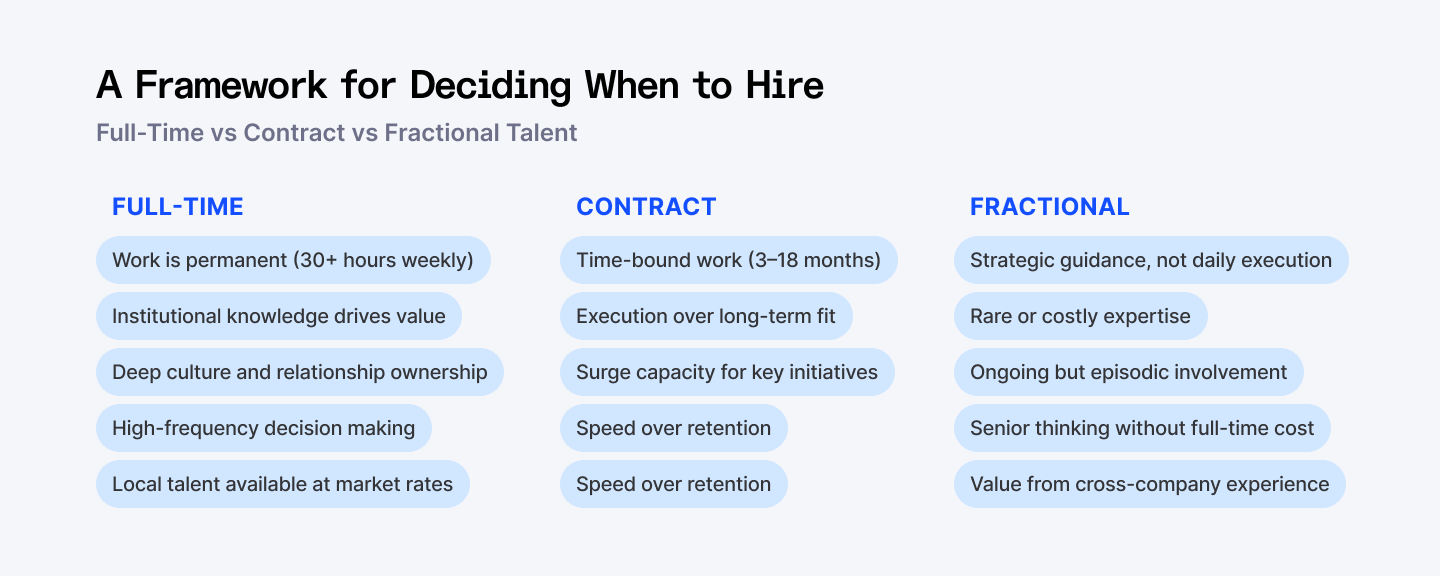
This is where most leaders get stuck. Not because they don’t believe in hybrid talent models, but because they don’t know how to decide. Full-time feels safe. Contractors feel fast. Fractional experts feel risky. And without a clear framework, decisions get driven by habit, fear, or internal politics.
Full-time when:
- The work is permanent and requires 30+ hours weekly
- Institutional knowledge is the primary value driver
- You need someone embedded in your culture and relationships
- The role involves high-frequency decision making
- You can find qualified candidates locally at market rates
Contract when:
- The work has a defined timeline (3-18 months typically)
- Technical execution matters more than cultural fit
- You need surge capacity for a specific initiative
- The deliverable is clearly defined and measurable
- Speed matters more than long-term retention
Fractional when:
- You need strategic expertise, not tactical execution
- The skill set is rare or expensive at full-time rates
- The work is episodic but ongoing (weekly or monthly touchpoints)
- You want senior-level thinking without senior-level overhead
- The value comes from experience across multiple companies
Wrapping Up
The rise of hybrid talent models is the new operating system for competitive organizations. Companies that embrace hybrid talent models are solving the retention crisis everyone else is drowning in. Employees with flexible work arrangements report 30% higher job satisfaction. Teams that blend full-time, contract, and fractional experts ship faster, pivot quicker, and scale more efficiently than traditional structures. Organizations that offer autonomy in how work gets done see turnover rates drop by nearly half.
So, stop defending the way you’ve always done things and start building the way things need to work.
- Start with the nature of the problem, not the role. Before you ask “who should I hire,” ask yourself a harder question: what kind of problem are we solving? If the work is continuous, core to your business, and evolves over time, that’s a signal for full-time ownership. If it’s time-bound, specialized, or exploratory, full-time hiring often slows you down. In AI, cybersecurity, and data, many problems are not permanent. They come in waves. New regulations. New models. Hiring full-time for temporary complexity is how costs quietly spiral.
- Use the permanence test. Ask yourself one simple question: Will this work still matter at the same intensity in 12 to 18 months? If the answer is yes, full-time makes sense. You’re building long-term capability. If the answer is no, you’re likely looking at contract or fractional talent. Leaders who ignore this test often end up with bloated teams and underutilized expertise.
- Use the complexity and risk lens. High-risk, high-impact decisions demand experience. But experience doesn’t always need to be full-time. When the stakes are high and mistakes are expensive, fractional experts are often the smartest move. They’ve seen the problem before. Think AI governance, data privacy, security architecture. You don’t need someone learning on the job. You need someone who’s already solved it elsewhere and can guide your team fast.
- Use the speed-to-value framework. How quickly do you need results? If speed matters more than continuity, contract talent wins. Contractors shorten time to execution. They don’t need months of ramp-up or internal alignment. They come in, deliver, and move on.
Hybrid talent models reward leaders who are honest about what they need, when they need it, and why. The goal isn’t to hire more people. It’s to make better decisions with the people you bring in.
➡︎ Ready to build your hybrid workforce? Index.dev gives you access to all three: vetted full-time engineers for your core team, contract specialists for specific projects, and fractional experts who bring senior-level thinking without senior-level costs. Scale up or down as needs change. →
➡︎ Want to learn more about global AI hiring and offshore developer markets? Explore these quick reads from Index.dev experts: Setting up an offshore team in Eastern Europe, safely hiring offshore developers, top AI talent countries, LATAM vs Eastern Europe comparisons, and LLM developer costs. Discover how to find, hire, and manage AI talent globally, and make smarter, data-driven hiring decisions.


