There’s a new buzzword flying around the AI world right now: Forward Deployed Engineer. If you haven't heard of it yet, you will soon. Andreessen Horowitz (a16z) even called it “the hottest job in tech.” Why? Because it sits right at the intersection of engineering and impact.
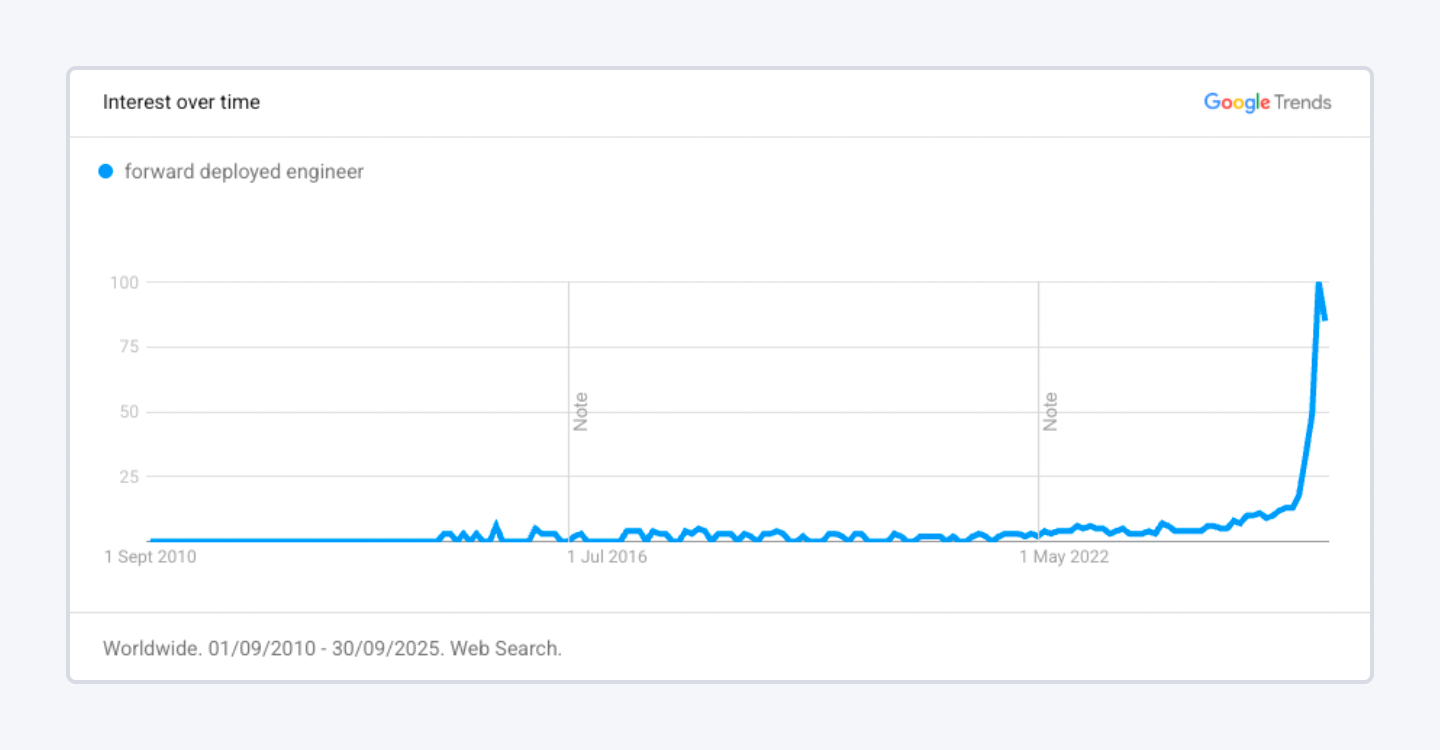
Forward Deployed Engineers (or FDEs) don’t just build software. They help companies use it, embedding themselves inside client teams, translating complex AI systems into real-world outcomes, and making the tech click for business.
OpenAI, Anthropic, Cohere, and Palantir are all racing to hire them. It’s not hard to see why. Businesses are desperate to adopt AI, but most don’t know where to start or how to make it pay off. FDEs bridge that gap. They code, consult, experiment, and deliver, all in one.
In this article, we’ll break down what this role really means, why demand is exploding, and what makes great FDEs stand out. We’ll also look at who can thrive in this job, and how founders can bring FDEs into their own teams to drive high-impact innovation from day one.
Let's dive in.
Ready to break into forward deployment? Index.dev connects developers with FDE opportunities at leading AI labs. Apply now!
What’s a Forward Deployed Engineer
A Forward Deployed Engineer, or FDE, is what happens when you mix a software engineer with a consultant and drop them straight into a customer’s world. They don’t just build features. They sit with clients, understand their messy realities, and make complex AI systems work in those environments.
Think of them as the bridge between code and impact. They write production-grade software, but they also talk to users, spot what’s broken, and fix it in real time. Their success isn’t measured in lines of code, it’s measured in outcomes.
The idea isn’t new. Palantir popularized it years ago when it embedded engineers inside customer organizations to configure its data platforms around real-world use cases.
Here’s what that looks like in practice:
- You're a technical implementer.
- You configure complex platforms, build workflows around real users, set up data integrations, and make sure everything stays healthy after launch.
- You configure complex platforms, build workflows around real users, set up data integrations, and make sure everything stays healthy after launch.
- You work alongside customers.
- Not from your desk, but onsite. Palantir FDEs spend about 25% of their time embedded with customers. You might find yourself on a factory floor at an industrial site, on the final assembly line at Airbus, or inside a Fortune 500 bank's operations center.
- Not from your desk, but onsite. Palantir FDEs spend about 25% of their time embedded with customers. You might find yourself on a factory floor at an industrial site, on the final assembly line at Airbus, or inside a Fortune 500 bank's operations center.
- You help close deals.
- When a prospect isn't sure they can use your product effectively, sales brings you in. You show them it's possible by doing it. You activate customers. You expand the value.
- When a prospect isn't sure they can use your product effectively, sales brings you in. You show them it's possible by doing it. You activate customers. You expand the value.
- You bridge technical and business worlds.
- One minute you're debugging data pipelines. The next you're explaining technical tradeoffs to a C-suite exec who's never written code. You need to speak both languages fluently.
- One minute you're debugging data pipelines. The next you're explaining technical tradeoffs to a C-suite exec who's never written code. You need to speak both languages fluently.
- You shape the core product.
- FDEs embed with core engineering teams, influence the product roadmap, and make calls on when to build custom solutions versus accelerating existing features.
- FDEs embed with core engineering teams, influence the product roadmap, and make calls on when to build custom solutions versus accelerating existing features.
In short, the role combines the technical depth of a software engineer, the business acumen of a product manager, and the relationship skills of a consultant. They search for the highest-impact problems, spend time with customers to understand their true nature, come up with new approaches, and don't quit until they reach the demanded impact.
Keep reading: Explore the top tech skills driving six-figure careers.
What FDEs Do Every Day
So what does a Forward Deployed Engineer do all day? You're juggling two jobs at once. You’re part engineer, part problem-solver, part translator between humans and machines. You live close to the customer, not behind a screen writing abstract code, but right next to the people using it.
Most days start with getting into the thick of a client’s world
You might be on-site at a bank, a factory floor, or a healthcare lab, wherever your company’s AI or data platform needs to come alive. You spend your morning digging into how the client’s systems work, mapping out workflows, spotting where things break, and figuring out how to make them better.
Then comes the build
You configure data models, write code, connect APIs, set up access controls, and make sure everything runs smoothly. You own what you ship. If something breaks in production, you’re the one who fixes it, fast. You monitor the stack, patch, debug, and push updates. It’s all about keeping things working.
You’ll also feed discoveries back into the main product team
Because what works for one client often sparks new features for everyone. In that sense, FDEs are a direct line between customer reality and product innovation.
It’s not all code, though
There’s plenty of human work. You lead short, focused meetings to align with stakeholders, cut through noise, and keep projects moving. You learn to say NO: to meetings that don’t matter, to features that don’t move the needle. Because if you try to do everything, you'll do nothing well. Protecting your build time becomes a skill in itself.
Expectations of a Forward Deployed Engineer (FDE)
Category | Expectations | Example Activities |
| Technical Expertise | Write production-quality code across the full stack. Handle data engineering, cloud infrastructure, APIs, and front-end integration. Optimize AI models for performance and latency. | Build custom pipelines, integrate APIs, tune model inference, configure cloud resources. |
| Customer Engagement | Embed with customer teams, often onsite, to understand workflows and domain-specific needs. Co-develop solutions with strategic stakeholders. | Conduct discovery sessions, sit alongside operators, gather feedback for prototypes. |
| Problem Solving | Prototype and iterate solutions using real-time feedback. Break down complex business challenges into implementable technical solutions. | Build proofs of concept, adjust workflows on the fly, troubleshoot operational issues. |
| Communication Skills | Translate between technical teams and non-technical stakeholders. Clearly communicate business value and technical choices. | Present demos, explain architecture decisions, align teams on deployment priorities. |
| Ownership & Autonomy | Own projects end-to-end, from scoping to deployment and maintenance. Make strategic decisions independently to drive outcomes. | Define project scope, prioritize features, resolve blockers without constant oversight. |
| Collaboration | Work closely with product, sales, and engineering teams. Provide feedback loops to improve the core product. | Share insights from customers, suggest product roadmap improvements, coordinate with internal teams. |
| Security & Compliance | Apply strict security, privacy, and compliance standards when deploying solutions with sensitive enterprise data. | Implement RBAC/ABAC models, secure data pipelines, ensure regulatory compliance. |
| Change Management | Act as a change agent within the customer organization, redesigning workflows and job functions for effective AI integration. | Guide adoption of new processes, train teams, help integrate AI into day-to-day operations. |
| Long-Term Engagement | Provide ongoing support and knowledge transfer to ensure sustained value and adoption. | Maintain dashboards, provide documentation, assist customers with updates and optimizations. |
| Business Impact Focus | Measure success through tangible business outcomes and customer satisfaction rather than just code or features. | Track adoption metrics, demonstrate ROI, ensure solutions create real-world impact. |
Every week is a mix of customer work, product improvement, and a bit of internal sync with your own team. You’re balancing two worlds at once: helping clients succeed while shaping the product itself.
It’s demanding. And it’s definitely not a typical engineering role. But if you thrive on direct impact and seeing your work make a visible difference in real time, it’s one of the most exciting jobs in tech right now.
What Strong FDEs Look Like
This role demands a lot. Salesforce's Senior FDE job description reads like a fever dream. Drive outcomes, build transformative AI, engineer bespoke solutions, own data lifecycles, remove blockers, drive innovation, become a trusted partner, debug production issues, lead prototyping, enforce best practices. Oh, and also close deals.
That's five jobs. You need to think and operate like a founder, just for someone else's company.
Competencies that are essential
1. Core technical strength
Every great FDE has solid engineering fundamentals. You can move comfortably through data wrangling and integration – SQL, APIs, connectors, a bit of Spark or ETL – and know how to make different systems talk to each other. You can script in Python or TypeScript, set up access controls, build dashboards that tell a story, and design workflows that actually fit how people work.
2. Delivery mindset
Delivery skills separate good from great. FDEs think in outcomes. You turn messy requirements into working workflows, manage change in real time, handle incidents in production, and keep systems running even when things break.
You spend time in the field, literally sitting next to the people who use the tools, learning how things really work.
3. Domain awareness and adaptability
Strong FDEs know their domain. Whether it’s finance, defense, healthcare, or industrial AI, you understand the environment you’re building for. You're a sharp communicator who can read a room, adapt to different problems, and always tie their work to commercial impact.
The FDE Skills Matrix
Dimension | Low | High |
| Technical Depth | Only configures existing features | Writes production-grade code across the stack; builds custom pipelines, integrates APIs, tunes AI models |
| Domain Knowledge | Generic understanding | Deep knowledge of the customer’s industry, workflows, and pain points |
| Communication | Reactive, only answers questions | Proactively translates between technical teams and business stakeholders; aligns priorities and drives clarity |
| Autonomy | Needs constant direction | Self-directed; drives roadmap, makes strategic decisions, and executes independently with the customer |
The goal is to find people in the top-right quadrant. They’re rare, highly skilled, and expensive, but they’re the ones who can transform deployments, accelerate adoption, and create real impact.
Who transitions well into FDE roles
The best FDEs don't usually come from traditional software engineering tracks. If you’re coming from one of these backgrounds, you might already have the foundation:
- Solutions or Sales Engineers who want deeper, post-sale ownership and impact.
- Data or Platform Engineers who crave more direct user interaction and outcome-driven work.
- Backend or Full-Stack Developers with strong systems thinking and curiosity about how their code performs in the wild.
- Product Engineers or Technical PMs who already design with end-users in mind and want to work closer to the field.
Notice a pattern? All these people were already doing part of the FDE job. They just needed the title to catch up.
How to position yourself
If you want to become an FDE, you don’t need the title to prove you’ve got the chops. What matters is showing that you can take a platform, adapt it to real-world users, and make it deliver value every day.
Highlight projects where you got close to users, solved real problems, and kept systems running. Tell stories about the outcomes you achieved, not just the tools you used. And when you’re updating your profile, use the right signals: forward-deployed, embedded with customers, adoption, incident response, time-to-value, field work, and hands-on delivery.
If you’ve got clearance or experience working on-site, call it out. Those are big differentiators.
Every company shapes the role differently
The truth is, FDEs look a little different everywhere. Some companies treat them like technical consultants, others as product engineers or embedded AI specialists. At Lindy, they act as technical partners helping customers build and maintain no-code workflows. At Salesforce, Senior FDEs are expected to deliver end-to-end AI solutions, from debugging and rapid prototyping to leading innovation across teams.
You might also see similar titles:
- Agent Engineer
- Solutions Architect
- Sales Engineer
- Technical Delivery Engineer
They all orbit the same space. What makes an FDE distinct is the dual mandate: work with customers and improve the core product.
How FDEs differ from traditional roles
Role | Focus | Time Horizon | Deliverable |
| Traditional Software Engineer | Builds generic features for a broad user base | Roadmap cycles | Product releases |
| Solutions Architect | Designs pre-sale solutions and proofs of concept | Weeks to months | Diagrams, specs |
| Sales Engineer | Supports sales with demos and technical validation; does not implement or maintain solutions | Pre-sale | Configured demos |
| Consultant | Advises or builds custom solutions outside your organization | Hourly or per project | Slide decks plus code handoff |
| Solutions Engineer | Hands-on integration and development for clients; ensures scalable deployment and customer success but typically not embedded long-term | Months to years | Integrated solutions and technical support |
| Forward Deployed Engineer (FDE) | Fully embedded build and deployment for one customer; deep technical implementation and long-term engagement | Months to years | Working software integrated into customer systems |
FDEs Compensation and Career Path
AI deployment isn't just about dropping software into an organization and hoping it works. It requires redesigning business processes that have existed for decades. Redefining job functions. Getting people to trust and adopt new ways of working. That's fundamentally a human problem and FDEs bridge that gap.
Let's talk money and where this takes you.
- The pay is solid.
- FDE salaries typically range from $120k to $180k base, plus equity and bonuses. That's comparable to senior software engineers, but with travel and direct client exposure baked in. You're not taking a pay cut to do more interesting work. You're getting paid market rate for senior-level engineering talent.
- Companies are realizing they can't just throw AI over the wall. They need people who can execute technically and understand the business impact. That's why demand for Forward Deployed Engineers keeps climbing.
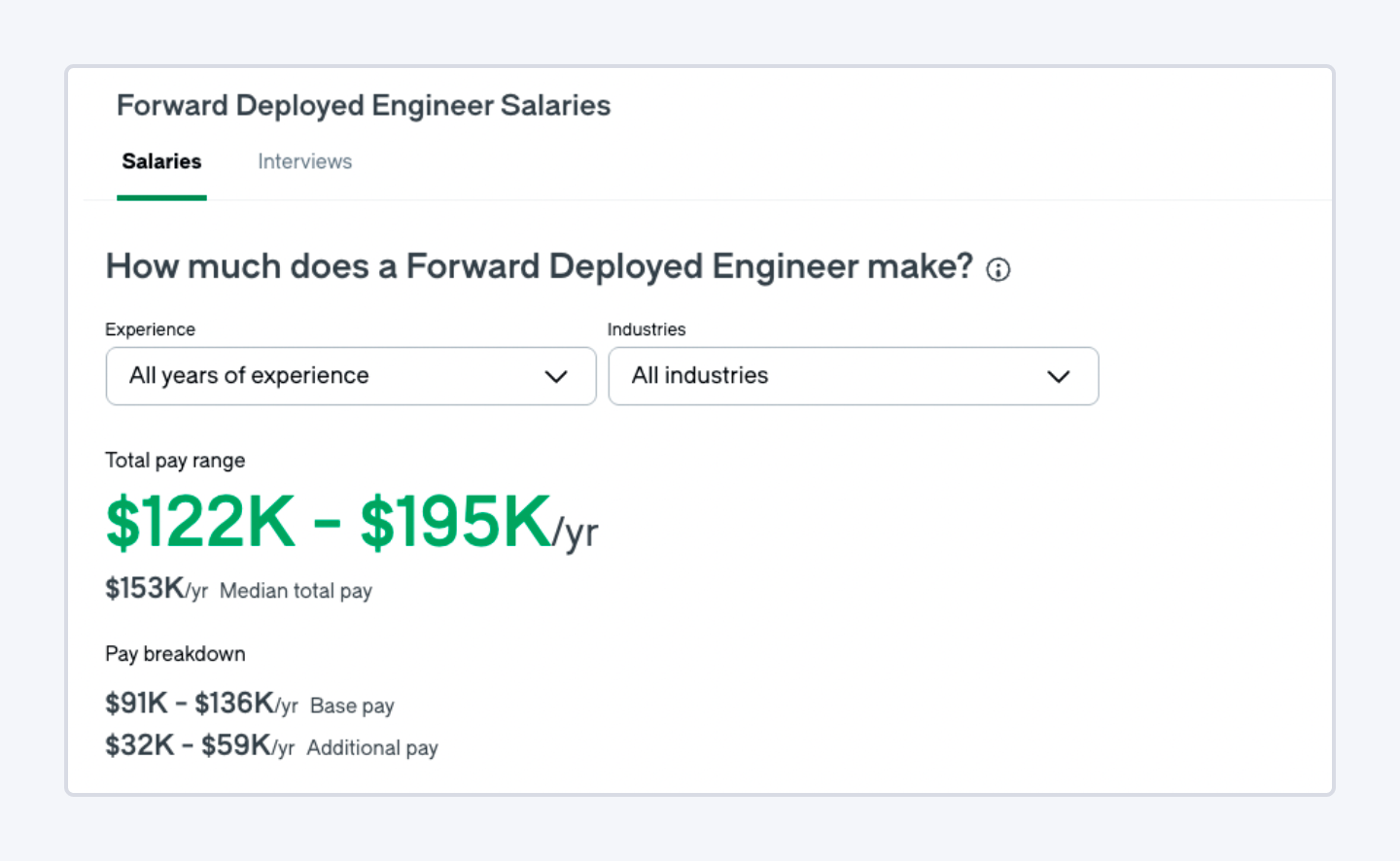
Source: Glassdoor
- The career trajectory is wide open.
- FDEs sit at the intersection of product, sales, and engineering. That puts you in a rare position to move in multiple directions.
- Want to go into product management? You've already been working closely with PMs, understanding user needs, and making product decisions. You know what customers want.
- Interested in solutions leadership or business development? You've been in the room where deals happen. You understand the commercial side. You've proven you can translate technical capabilities into business value.
- Prefer staying technical but want more scope? Customer engineering director or technical delivery leadership roles are natural progressions.
Who's Hiring FDEs (and Why Now)
Job listings for FDEs have skyrocketed by over 800% just between January and September of this year. OpenAI is leading the charge. They launched their FDE team at the start of this year and plan to grow it to about 50 engineers by the end of 2025. They're hiring across the US, UK, Germany, France, and Japan. Arnaud Fournier, who heads their European and Middle East FDE operations, says demand has exceeded expectations.
Companies like Anthropic, ElevenLabs, Databricks, Salesforce, and Google DeepMind are all actively hiring for these positions. Every major AI company is building FDE teams.
Why the sudden urgency? Because every AI company hit the same wall: AI is moving fast, but adoption at scale is messy. Customers love the demos. They get excited about the possibilities. They sign contracts. Then... nothing happens. The AI sits unused. The ROI never materializes. Renewals don't come through.
The problem is implementation. Businesses don't know how to integrate AI into their workflows. They don't understand how to configure it for their specific use cases. They can't navigate the change management required to get their teams to adopt it.
FDEs solve this. They turn pilots into production. Companies are willing to pay senior engineer salaries for this skillset because the alternative is watching expensive AI contracts fail to deliver value. Enterprise software companies, data platforms, even traditional tech giants are adopting the model. Anywhere you have complex technology that needs deep customer integration, FDEs make sense.
Inside the FDE Lifecycle
If you're considering this role, here's what your engagement actually looks like. Three phases, each with different demands on your skills.
Phase 1: Scoping
The first days or weeks are all about understanding the terrain. Your job is to map everything: systems, stakeholders, workflows, and the pain points nobody wants to admit exist. This feels like consulting, but with a crucial difference. You're not building a slide deck for someone else to implement. You're discovering what needs to be built so you can build it.
You run discovery sessions. Shadow users doing their jobs. Ask uncomfortable questions about why things work the way they do. Find the gaps between what they say they need and what they actually need. Document technical dependencies. Identify who owns what data and who's territorial about their processes.
You’re building a mental model of the business while experimenting with small, immediate wins. Rapid feedback is your secret weapon: every tweak, every prototype, every conversation moves the solution closer to something that works for the customer.
Phase 2: Prototyping
Now you’re in hackathon mode but inside an enterprise firewall with real stakes. Rapid iterations, quick demos, proofs of concept. You're building custom solutions in real time with the customer watching. Creating new data models to address their specific needs. Showing them what's possible, getting immediate feedback, adjusting course.
You're writing code, solving problems, seeing instant reactions. The feedback loop is tight. You demo something in the morning, get feedback over lunch, ship an iteration by the end of day. But you're also managing expectations constantly. Not every idea is feasible. Not every request makes sense. You need to balance customer demands with technical reality and project scope.
Phase 3: Production
Now you harden everything. Take those rough prototypes and turn them into production-ready deployments integrated into their systems.
You're delivering real software artifacts: custom pipelines, web applications, tools that need to run reliably every day. You're refining data models, setting up monitoring, handling error cases you glossed over during prototyping.
This phase also includes knowledge transfer. Teaching their team how to maintain what you built. Documenting the decisions you made and why. Making sure they can operate this after you leave.
Then comes operationalization. Coordinating with their IT and security teams. Getting approvals through their change management process. Making sure your solution fits their compliance requirements.
The challenge here is knowing when you're done. You could polish forever. You could add more features. But at some point, you need clear exit criteria: the system works, their team can maintain it, and it's solving the intended problem.
Next up: See how Genemod boosted its R&D cloud solutions with full-stack talent.
Why This Matters If You're Building Something
Maybe you're not looking to become an FDE. Maybe you're building a product and wondering if you need these people on your team. Here's the honest case for why you might:
You ship faster and kill risk early
FDEs live in the customer environment, hands-on with their systems. This means no more "customer told sales, sales told product, product told engineering, engineering built the wrong thing."
Having them on your team helps find blockers before they become disasters, validate assumptions in real time, and reduce integration risk because they're doing the integration themselves, whether that's on premise or in the cloud.
Time to value shrinks dramatically. Instead of months of back and forth, you're iterating daily with the people who'll use your product. You learn what matters and what doesn't. Fast.
You build a strong competitive moat
A good Forward Deployed Engineer doesn’t just implement your product, they make it part of the customer’s DNA.
They build custom connectors between your platform and the customer's systems. They create workflows tailored to that specific organization's processes. They tune AI models on the customer's proprietary data. They wire your solution into the customer's core business logic.
Traditional consultants implement and leave. FDEs implement and stay, continuously improving and maintaining. They understand the customer's internal dynamics, their politics, their technical debt. That knowledge becomes part of your competitive advantage.
You deploy complex technology
AI models are powerful, but raw models don’t solve problems on their own. They need low latency inference. They need custom data pipelines. They need domain-specific tuning. They need to connect securely to sensitive enterprise databases and legacy systems.
Customers can't do this themselves. They don't have the expertise. They don't have the time. They're scared of breaking things.
FDEs do the heavy lifting. They implement request batching to optimize inference. They use tools like TensorRT for performance. They set up multi-cloud deployments. They debug the weird edge cases that come up when you connect cutting-edge AI to decade-old enterprise systems.
They also handle the ongoing maintenance. Stability improvements. Configuration updates. The work that keeps AI systems running reliably in production.
AI applications are only valuable when they're deeply and correctly integrated with a company's operations. A brilliant model that sits disconnected from real workflows is worthless. FDEs make that connection happen.
The trade-offs you need to know
FDEs are expensive. You're paying senior engineer salaries plus travel costs plus the overhead of managing people who are physically scattered across customer sites. You also need to think carefully about when to use them. Not every customer needs an embedded engineer. Not every product requires this level of hand-holding.
But if you're selling complex technology into enterprises, if you're in AI where adoption is the bottleneck, if your competitive advantage depends on deep integration rather than features alone? FDEs might be the difference.
Closing Thoughts
Most "hot new jobs" are just old jobs with new names. Growth hacker. Prompt engineer. Blockchain developer. They spike, they fade, they become footnotes.
Forward Deployed Engineers are different. They're solving a fundamental problem that won't go away: the gap between building powerful technology and deploying it in the real world.
If you’re a developer, an FDE role is your chance to see your work live in the world, to iterate at the speed of business, and to make technology matter in ways that go far beyond a GitHub commit.
For founders and tech leaders, FDEs are a secret weapon. They accelerate deployment, reduce risk, embed your product into the customer’s core, and ensure AI works in the wild.
The rise of FDEs reflects a larger truth: success in AI isn’t just about models or algorithms. It’s about execution, adoption, and human connection. You can have the most advanced model in the world, but if no one can use it effectively, it’s just a tech demo.
Where to go from here
If you're an AI lab looking to scale your FDE team, or a developer looking to break into this space, the challenge is always the same: finding people who can do this work.
- Building your FDE team? Index.dev helps AI companies find and place forward deployed engineers who can handle the full lifecycle, from customer scoping to production deployment. We understand the technical nuances because we live in this world.
- Ready to break into forward deployment? Index.dev connects developers with FDE opportunities at leading AI labs. Through our acquisition of Codemotion, we've built Europe's strongest technical community. Whether you're transitioning from solutions engineering, backend development, or product roles, we help you position yourself for these high-impact positions.
Visit index.dev to learn more about how we're supporting AI labs and developers in this space.
➡︎ Curious about AI tools and developer performance? Explore our latest insights on how Perplexity compares to Google AI, how Mistral performed in coding tests, and how AI is transforming SQL generation, database optimization, and cloud cost management. Explore more from Index.dev and stay ahead in the AI engineering world.