Enterprise engineering teams do not grow randomly. They follow clear patterns in leadership, team size, and role distribution. These patterns help companies scale, ship faster, and manage complex systems.
Companies that allocate at least one-third of R&D to long-term innovation see up to 1.8 times higher returns. This shows how structure and investment decisions directly impact business outcomes.
In this data analysis, we examine how leading companies structure their engineering teams. We look at leadership roles, team composition, and team size benchmarks. We also study how large companies organize thousands of engineers into smaller teams.
This listicle roundup will help you understand what a well-structured enterprise engineering team looks like and how it works in practice.
Struggling to scale engineering? Index.dev helps you build high-performing, structured teams with verified engineers and AI specialists—ready to plug into your workflows fast.
Key Statistics on Enterprise Engineering Teams at a Glance
- Around 90% of CTOs report directly to the CEO, which gives them strong influence on business decisions.
- Companies that include the CTO in executive leadership approve major technology investments 27% faster.
- About 68% of CTOs plan technology roadmaps that extend 4 to 6 years, focusing on long term growth.
- Engineering can make up to 80% of total R&D headcount in large organizations, showing its role in driving scale.
- Software engineers account for about 40% of total R&D teams across companies.
- The most effective engineering teams have around 9 members, which supports better collaboration and speed.
- Small teams show 20% higher pull request velocity, allowing faster development cycles.
- Small teams also achieve 25% faster lead time, which improves delivery speed.
- Large teams show 15% lower productivity per engineer due to higher coordination overhead.
How Are Enterprise Engineering Teams Structured at the Top?
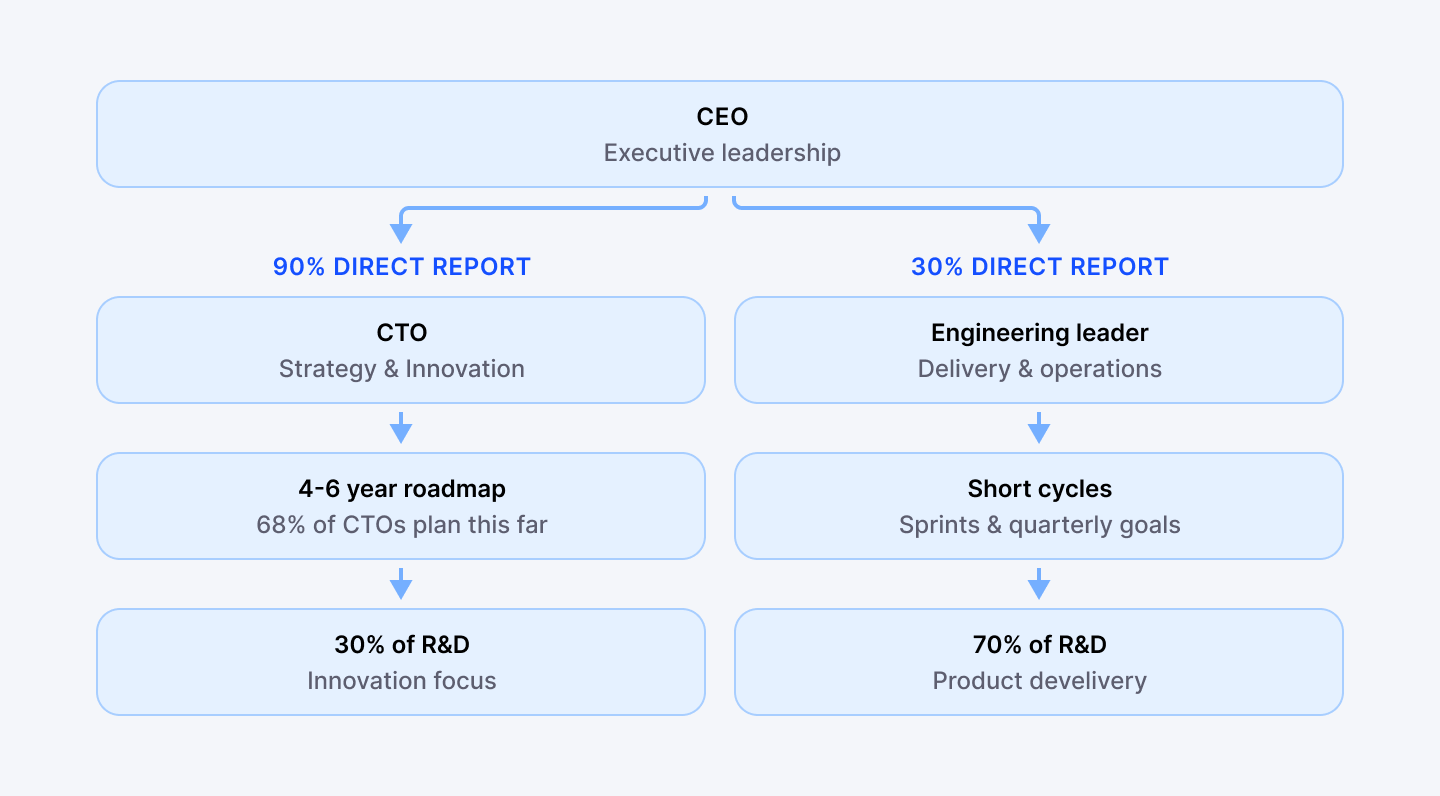
Enterprise engineering teams follow a dual leadership structure that separates strategy from execution. About 90% of CTOs report directly to the CEO, which gives them strong influence on business decisions. In comparison, only 30% of engineering leaders report to the CEO, as they focus on delivery and operations.
Around 68% of CTOs plan technology roadmaps for four to six years, while engineering teams work in short cycles such as sprints and quarterly goals.
How are enterprise engineering teams structured at the top
Work is also split by priority. About 30% of R&D focuses on innovation under the CTO, while 70% supports product delivery and execution. Companies that include the CTO in executive leadership approve major technology investments 27% faster.
This structure creates a clear balance. The CTO focuses on long term growth, innovation, and system direction, while engineering leaders ensure on time delivery, team performance, and scalable execution.
What Does a Typical Enterprise Engineering Team Look Like?
Enterprise engineering teams follow a clear structure based on company size, product complexity, and delivery goals. Across most organizations, software engineers form the core of the team, making up about 40% of total R&D headcount. This includes backend, frontend, full stack, and platform engineers who build and maintain core systems.
Engineering leadership roles such as engineering managers, tech leads, and directors account for nearly 20% of the engineering organization. These roles focus on delivery, architecture decisions, and team performance.
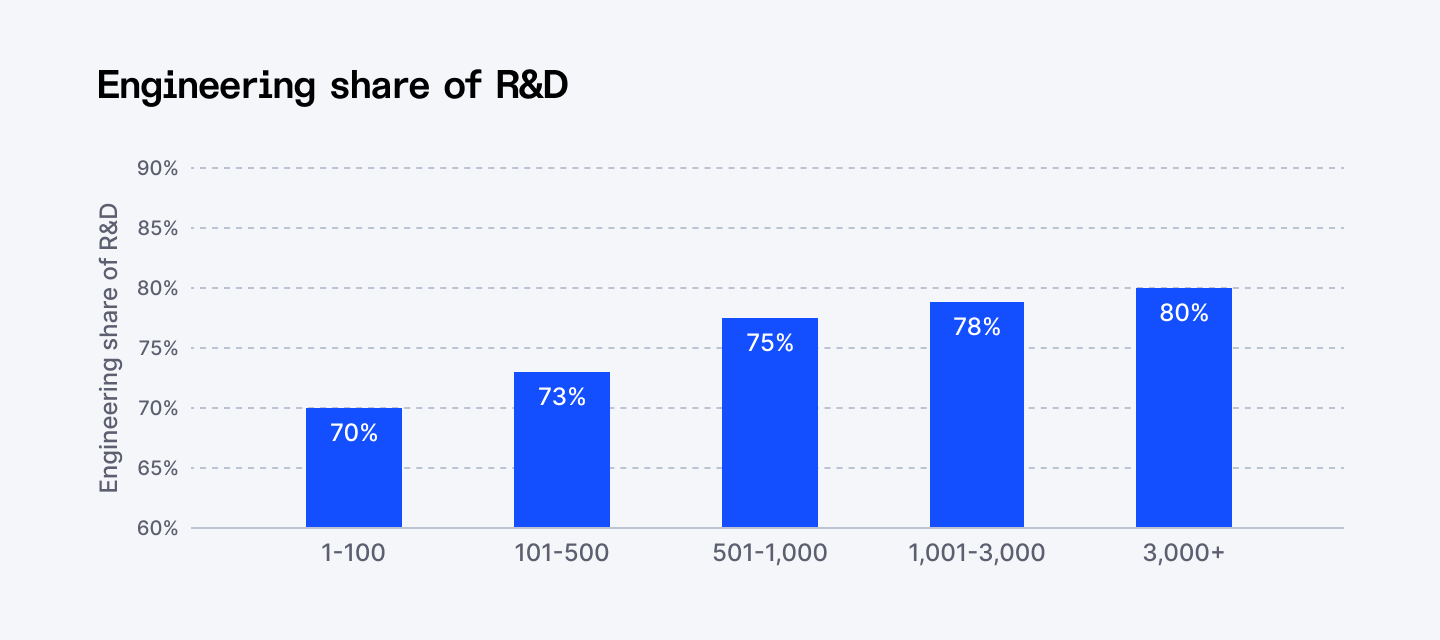
As companies grow, engineering becomes the dominant function within R&D. In smaller companies, engineering teams make up around 70% of R&D, while in large enterprises, this rises to 80% or more. This shift shows that product development, system reliability, and scalability drive business growth at scale.
Company Size | Engineering Share of R&D |
1–100 employees | 70% |
101–500 employees | 73% |
501–1000 employees | 75% |
1001–3000 employees | 78% |
3000+ employees | 80% |
Engineering share of R&D per company size
In mature enterprises, teams also expand to include DevOps, QA, data engineers, and security engineers, creating a more specialized and structured engineering organization.
⭢ Discover why startups keep losing top talent—and what subtle mistakes might be costing you your best engineers.
What Are the Typical Engineer-to-Role Ratios in Enterprise Teams?
In enterprise engineering teams, each role supports a fixed number of engineers to keep teams efficient and scalable. Most companies follow consistent ratios that balance delivery speed, decision making, and system quality.
Role | Engineers per Role |
Manager | 5–8 |
Product Manager | 5–8 |
Designer | 5–10 |
Data / ML | 8–12 |
QA | 10–16 |
Architect | 15–25 |
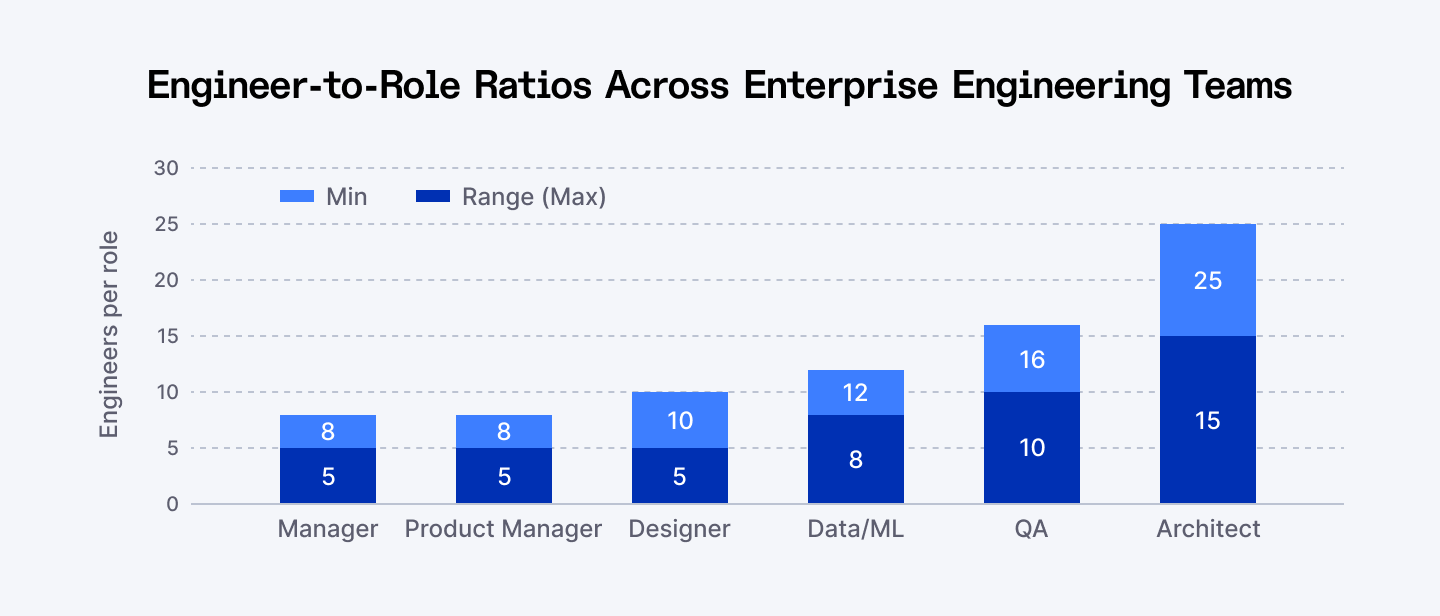
These ratios help teams stay efficient and balanced. Managers handle a small group so they can guide work without slowing progress. Product managers and designers stay close to engineers to support fast decisions.
Specialized roles like QA and data teams support larger groups because their work spreads across teams. Architects are fewer since they focus on system level design. This setup keeps teams lean and reduces delays in communication.
What Is the Ideal Team Size in Enterprise Engineering?
The ideal team size in enterprise engineering is around 6 to 10 members, with research showing a median of 9 people as the most effective. Teams larger than this often see a drop in productivity due to higher coordination effort.
Leading companies follow this model in practice. Amazon uses the two pizza rule, where teams stay small enough to be fed with two pizzas, usually under 10 people. Spotify organizes teams into squads of 6 to 12 members, allowing them to work like small, independent units.
Research from Google shows that smaller teams collaborate better, communicate faster, and make decisions more quickly. Each team member has clear ownership, which reduces confusion and improves accountability.
As team size grows beyond 10, coordination becomes complex. More people create more meetings, dependencies, and communication gaps. This slows down delivery and reduces overall team efficiency.
How Do Large Enterprises Structure Engineering Teams at Scale?
Large enterprises structure engineering teams at scale by splitting work across many small, independent teams, where each team owns a specific service or system.
For example, Uber operates with around 4,000 engineers managing 4,500 microservices. These services are deployed over 100,000 times each week, showing a near 1 to 1 ratio between engineers and services. This setup allows hundreds of small teams to work independently.
Instead of building one large team, enterprises use a microservices based structure. Each team is responsible for building, deploying, and maintaining its own service. This reduces dependencies and avoids bottlenecks.
This model improves speed and reliability. Teams can work in parallel, release updates frequently, and fix issues faster without waiting on other teams. At scale, enterprises rely on distributed ownership instead of central control. This keeps systems flexible, supports continuous delivery, and helps organizations scale without slowing down.
How Does Team Size Impact Engineering Productivity?
Team Size | Productivity Impact | Key Metrics |
Small (2–5 engineers) | High | +20% PR velocity, -25% lead time |
Medium (6–15 engineers) | Balanced | Near average performance, moderate coordination |
Large (16+ engineers) | Lower per engineer | -15% productivity, higher coordination time |
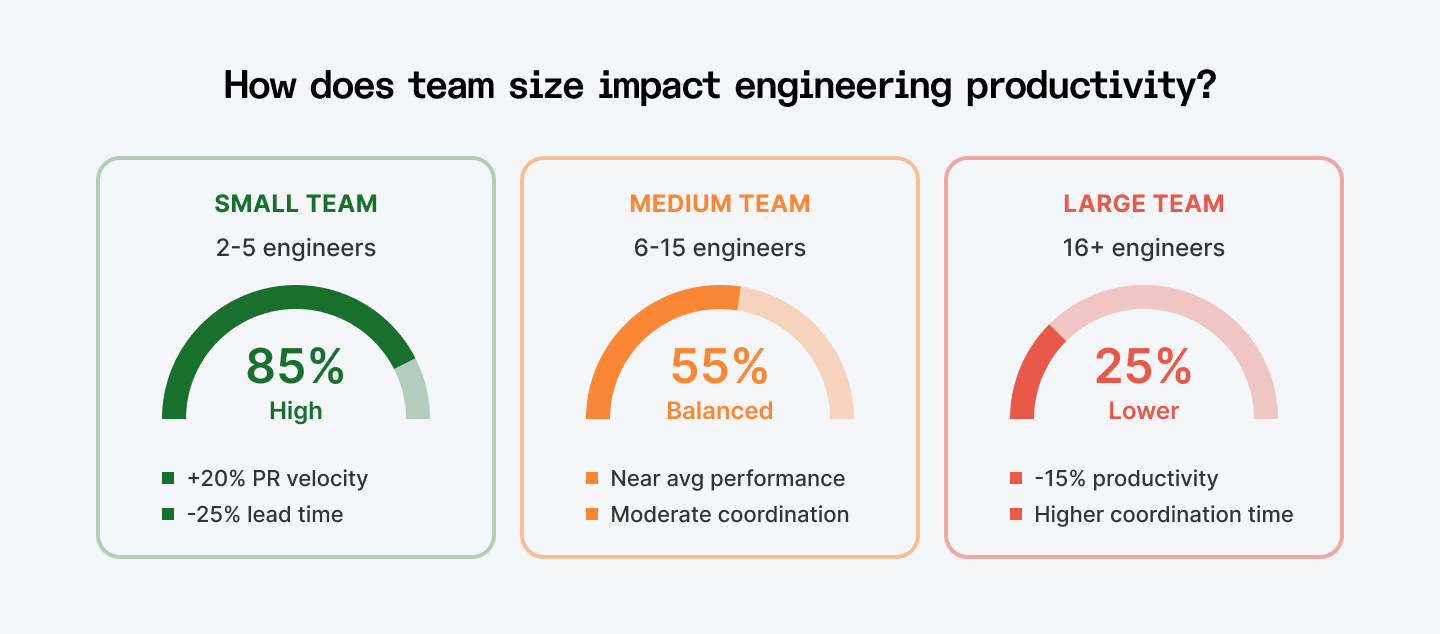
Team size has a direct impact on how fast engineers can work. Small teams move faster because they have fewer dependencies. They spend more time building and less time coordinating.
Medium teams balance speed and specialization. They can handle more complex work without adding too much overhead.
Large teams face more challenges. As team size grows, communication becomes harder. Engineers spend more time in meetings and alignment. This reduces focus time and slows down delivery.
⭢ See how high retention of engineering talent quietly becomes your biggest competitive advantage in delivering faster, better projects.
How Do Internal Platforms Impact Engineering Teams?
Internal developer platforms improve how engineering teams build and ship software. Data shows they increase individual productivity by 8%, improve team performance by 10%, and raise delivery and operations performance by 6%.
These platforms standardize development and deployment workflows across teams. Engineers spend less time on setup and infrastructure tasks. This reduces manual work and removes common bottlenecks.
Teams can focus more on writing code and shipping features. At the same time, shared tools and processes reduce errors and improve coordination between teams.
This impact grows as companies scale. Large organizations run many small teams in parallel. Internal platforms help maintain speed, consistency, and reliability across all teams.
Final Words
Enterprise engineering teams follow clear patterns that help them scale without slowing down. They use strong leadership structures, keep teams small, and maintain balanced role ratios. This allows them to manage complex systems while still delivering fast.
As companies grow, they do not build larger teams. They build more small teams with clear ownership. They also invest in platforms and infrastructure to support these teams at scale.
The key idea is simple. Keep teams small, give them ownership, and support them with the right structure. This is how modern enterprises build and deliver software efficiently.
➡︎ Building an engineering team that scales? At Index.dev, you get verified senior engineers who slot into your team structure from day one — no lengthy hiring cycles, no mismatched hires. Just the right talent, fast.
➡︎ Want to go deeper into engineering team performance and growth? Explore how AI tools are driving real ROI, what it takes to scale after Series A, and the retention strategies that keep high-performing teams intact.
Data Sources
- https://digitaldefynd.com/IQ/cto-vs-vp-engineering/
- https://dora.dev/research/2024/dora-report/2024-dora-accelerate-state-of-devops-report.pdf
- https://rework.withgoogle.com/intl/en/guides/understanding-team-effectiveness/
- https://www.sciencedirect.com/science/article/abs/pii/S0164121211002366
- https://www.uber.com/en-AU/blog/up-portable-microservices-ready-for-the-cloud
- https://aws.amazon.com/executive-insights/content/amazon-two-pizza-team/
- https://www.functionly.com/orginometry/real-org-charts/spotify-org-structure
- https://www.iconiq.com/growth/reports/engineering-series-2024/building-engineering-teams
- https://pave.com/blog-posts/research-development-org-structure-benchmarks