
When it comes to building software, hiring skilled engineers is only half the battle. The other half? Keeping them long enough to deliver impact.
Replacing a senior developer can cost anywhere from 30% to 150% of their annual salary. But the math is even worse than that. It’s the missed deadlines, the distracted managers, and the ramp-up months where a new hire is essentially a net negative to your codebase.
At Index.dev, we’ve found that high retention is a strategic advantage. Our network of senior, human-verified engineers stays on average 13+ months per project, and this longevity translates directly into faster delivery, higher quality, and real financial savings for our clients.
But why does retention matter so much, and how do we achieve it? Let’s dive in.
Still replacing engineers every few months? Index.dev places senior, human-verified talent that stays — 95% of our engineers commit 13+ months per project.
The Real Cost of Churn
The most expensive engineer you’ll ever hire is the one you have to replace in six months.
When your team churns, your roadmap suffers. Deadlines slip. Teams scramble. Knowledge disappears. You end up repeating work, fixing bugs, and constantly re-aligning.
High retention solves all of this. When engineers stay, they grow into their roles, internalize your product, and multiply their productivity over time.
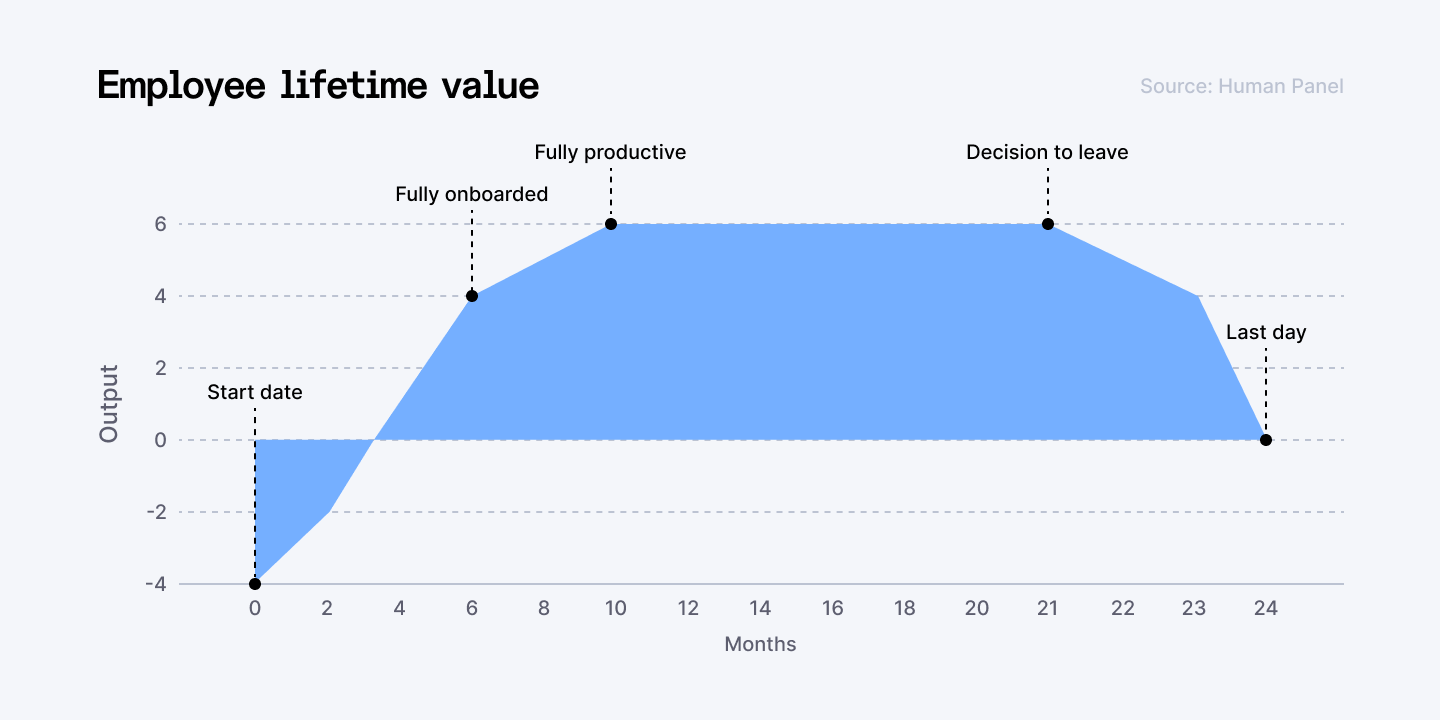
Source: Human Panel
“We’ve seen engineers at Index.dev become 2–3x more effective after the first year on a project because they’ve mastered the product and understand all its edge cases. That level of efficiency simply isn’t possible with high turnover,” says Mike Sokirka, CEO at Index.dev.
How High Retention Drives Compounded Value
With high retention, you avoid this hidden cost and gain more predictable budgets. Here’s how it creates compounding benefits for your team:
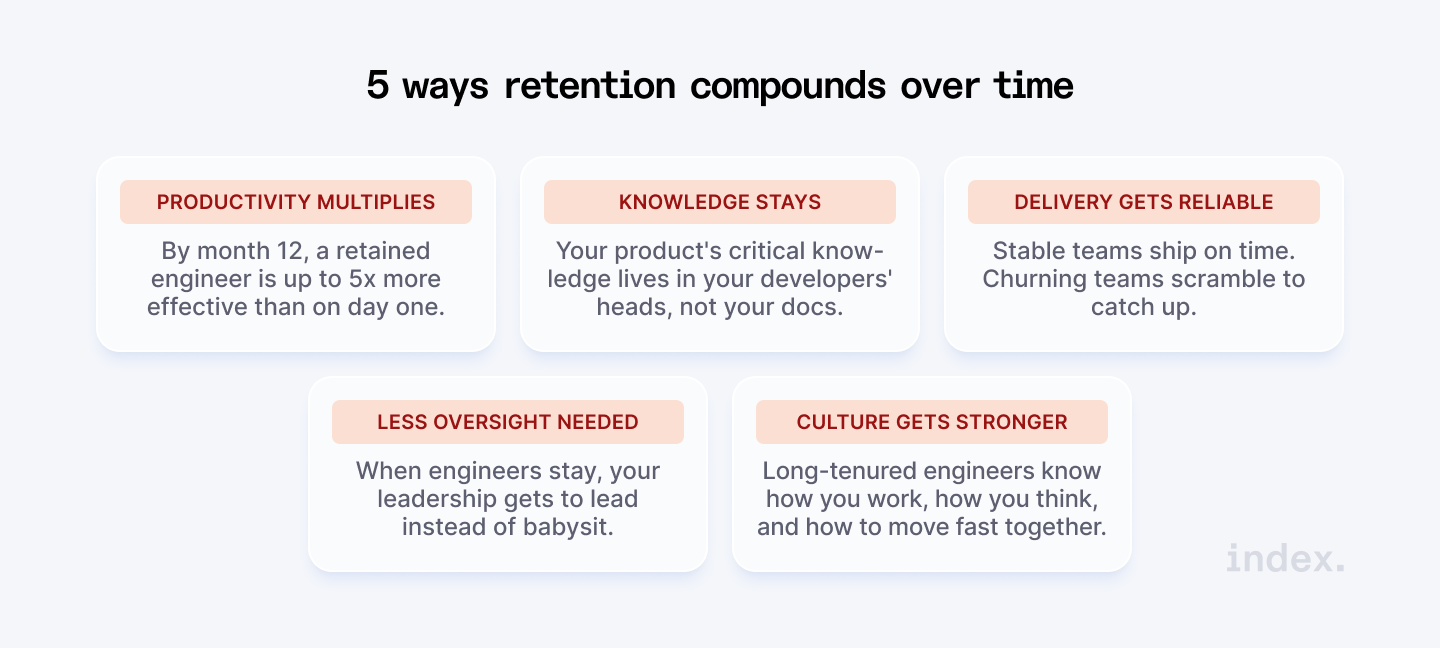
1. Productivity multiplies
Engineering output is non-linear. Engineers who stay longer don’t just get faster at coding, they accumulate context. By month twelve, a retained engineer can be two to five times more effective than in month two. They understand your codebase, anticipate issues, and require less supervision. They ship faster and make fewer mistakes. Retention becomes compounding productivity.
2. Knowledge stays in the team
Documentation is a lie we tell ourselves to feel better about turnover. The truth? Most of your product’s critical knowledge lives in your developers' heads.
With continuity, institutional memory grows. You avoid the re-learning cycles where a new team accidentally breaks a feature that was solved two years ago. High retention equals fewer bugs, faster iterations, and a roadmap you can trust.
3. Delivery becomes reliable
High turnover disrupts sprints and creates constant realignment. Retained talent keeps velocity stable, milestones predictable, and execution faster. You can plan your roadmap with confidence instead of crossing fingers.
4. Teams require less oversight
If you are constantly interviewing, onboarding, and ‘getting people up to speed,’ you aren't leading—you’re babysitting a revolving door. You spend more time interviewing, onboarding, and fixing gaps.
High retention gives your leadership team their time back. Instead of worrying about a ‘what happens if X leaves?’, you can focus on market expansion, technical debt, and high-level strategy.
5. Teams and culture gets stronger
Long-tenured engineers understand your culture, communicate effectively, and collaborate smoothly. This cohesion leads to fewer conflicts, faster decisions, and a team that feels like it’s working together, not around each other.
⭢ Struggling with AI talent retention? Discover what keeps top AI developers engaged and committed for the long run.
How Index.dev Ensures Talent Stays
Retention doesn't start on day thirty of a placement. It starts during the evaluation process.
At Index.dev, 95% of our engineers stay 13 months or more on average per engagement. That number didn't happen by accident. It starts before the engineer ever reaches a client.
"The verification we do before a match is made is what makes the long-term engagement possible. We're not just checking technical skills. We're evaluating whether this person is built to commit — to a project, to a team, to a client's way of working," adds Eugene Garla, Talent Advisor at Index.dev.
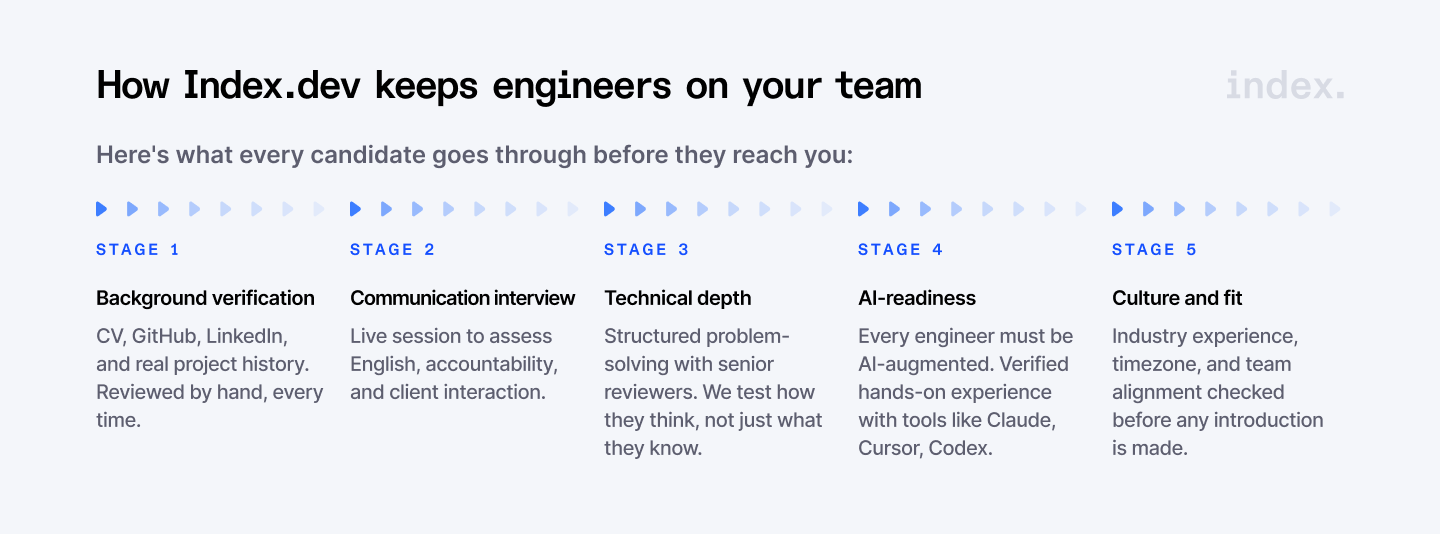
Stage one begins with a manual review of CVs, LinkedIn profiles, GitHub activity, and past project work. The focus is on verified, real experience, not polished resumes. We're also looking for a meaningful track record in remote, international environments, because the ability to work effectively across time zones and cultures is a prerequisite for the kind of long-term, embedded engagement our clients need.
Stage two is a live communication and soft skills interview. We're looking for what we call ‘outcome owners’ — engineers who take genuine accountability for their work, communicate clearly with both technical and non-technical collaborators, handle ambiguity without needing constant direction, and know how to be a reliable presence on a team. These are the traits that predict longevity, not just competence.
Stage three is a deep technical evaluation. Engineers go through structured problem-solving sessions and project discussions with senior reviewers. We're trying to understand how an engineer thinks: how they approach system design, how they handle trade-offs, how they respond to constraints. A strong resume and good communication only go so far — this stage is where we verify whether the thinking is there.
Stage four is new, and increasingly important. Every engineer in our network is now required to be AI-augmented. We verify at least six to twelve months of hands-on experience with tools like Claude, Cursor, or Codex for coding, testing, and documentation workflows. Engineers who work with AI tooling ship higher-quality work faster, which means fewer fires for your team to fight. This matters directly to your velocity.
Stage five is about fit. A developer who thrives in a seed-stage startup may be entirely wrong for a regulated financial services environment. We evaluate industry experience, availability, timezone overlap, and cultural alignment before making any introduction. The goal is that when an engineer joins your team, they feel like they belong there, because that feeling is what makes people stay.
We check every engineer by hand, at every step, to ensure they are technically elite, reliable, and AI-enabled. “We look at the engineer behind the resume. Are they proactive? Can they take ownership? Will they fit the culture? This is how we know they’ll stick,” explains Eugene.
The Part Most Skip
We check in regularly — with the engineer, with the client, with both sides together when needed.
Matching well is necessary, but it’s not sufficient. What happens after placement is where most talent marketplaces go quiet. Introductions are made, contracts are signed, and the platform moves on to the next deal. What gets left behind is a relationship with no ongoing support structure — and when friction arises, as it always does, there's no one to resolve it before it becomes a reason someone leaves.
“My job starts the moment an engineer joins a client's team. We check in regularly — with the engineer, with the client, with both sides together when needed. Not because we expect problems, but because catching something small early is the difference between a two-year engagement and a two-month one,” notes Natalia Munteanu, Account Manager for Developers at Index.dev.
Our Account Managers for Developers runs structured check-ins throughout every active engagement. These conversations are relationship maintenance. They surface misalignment before it compounds, identify growth opportunities on both sides, and ensure that what looked like a strong match at the start is functioning that way in practice.
This is the operational layer that most platforms don't build, because it costs time and doesn't scale as easily as a matchmaking algorithm. But it's also the layer that produces long-term engagements.
⭢ If you're serious about fixing your tech talent retention, these 10 proven strategies are exactly where to start.
What It Looks Like in Practice
Take Netrefer, an AI-powered affiliate marketing software provider that has been working with Index.dev since 2020. One of their engineers has been on the same project for five years. Not five years at a company. Five years on a single engagement, through the same platform, still delivering, still trusted, still there. That's not common. In an industry where the average software engineer tenure sits under one year, and where churn is quietly accepted as the cost of doing business, five years of uninterrupted contribution to one product is almost unheard of. But it's the kind of outcome that becomes possible when you get the match right from the start and stay invested in it throughout.
Entrupy, the AI-powered authentication platform, came to Index.dev with a specific and technically demanding challenge: they needed an experienced iOS developer proficient in Objective-C to modernize a legacy app, in a market where that profile is genuinely hard to find. Over two years, Index.dev placed 12 senior developers across iOS, Python, Vue.js, and QA — sourced from both LATAM and Europe. The result was a 14-month average retention rate and a team that reached full productivity three times faster than Entrupy's previous hiring approach.
Omio, the European travel platform, faced a different but equally common problem: they needed senior full-stack Java developers quickly, in one of the most competitive and saturated corners of the hiring market. Index.dev delivered four qualified, certified developers with international remote experience after comprehensive vetting. The hiring process was five times faster than Omio's previous approach, and came in at 40% lower cost than equivalent local hires. Tomas Vocetka, CTO at Omio, pointed to something beyond the speed and savings — the nuanced understanding of what Omio actually needed, and the reliability of the ongoing relationship, were what made it work.
Three very different companies. Three very different technical challenges. The same consistent outcome: talent that arrives ready, integrates quickly, and stays.
Wrapping Up
Every engineer who leaves takes with them months of accumulated knowledge, trust, and context that no documentation can fully replace. Every new hire starts the clock over. And every time that clock resets, your roadmap pays for it.
At Index.dev, we've built our model around a different assumption: that the most valuable thing we can do for a client isn't just find them an engineer. It's to find them an engineer who stays. It's the result of rigorous curation, honest matching, and an ongoing commitment to the health of every engagement we manage.
➡︎ Index.dev connects founders, CTOs, and engineering leaders with senior, AI-enabled engineers built for the long game. If you want to talk about what high-retention engineering capacity could look like for your team, get in touch.

