Something shifted in software engineering over the last two years. The tools changed. The speed changed. The scope of what one engineer can do alone changed. And most importantly, what companies expect from engineers is changing fast.
- 76% of developers now use AI tools as part of their daily workflow
- 40% of engineering tasks at leading tech firms are now AI-assisted or AI-generated
- Over the next two to three years, 50% to 55% of jobs in the US will be reshaped by AI.
AI hit software engineers first, not because they are replaceable, but because they were the first ones close enough to the technology to feel every shift. They build it, they test it, they ship with it every day. Which makes them the best people to ask about what is happening, not the forecasters or the analysts.
So that is what Index.dev did. We went to our Talent Network™ — 27,000 human-verified engineers placed on projects for clients across SaaS, fintech, healthcare, and AI products — and asked them directly.
- What is AI doing to your job right now?
- What should every developer understand before it is too late to adapt?
Forget the doom and gloom headlines. Here is the honest view from the front lines.
01. Anyone can build software now. That changes everything.
A McKinsey report found that 75% of the value generative AI delivers will come from just four areas, one of them being software engineering. Code generation, test writing, and documentation are already being compressed into seconds.
Intent → Software
Building software used to be a gate. You either knew how to code or you waited for someone who did. That gate is gone. A non-technical founder can go from idea to working prototype in an afternoon. A product manager can write and deploy a script without filing a ticket. A designer can build a functional UI without ever touching a codebase. The tools made it possible. AI made it easy.
The bar for what counts as your contribution just went up. Shipping code is no longer enough. Anyone can ship code. The question now is whether what you ship is right: architecturally sound, edge-case aware, production-ready, and built for the thing it is supposed to solve. You become the judgment layer. The person in the room who knows the difference between code that works and code that is good.
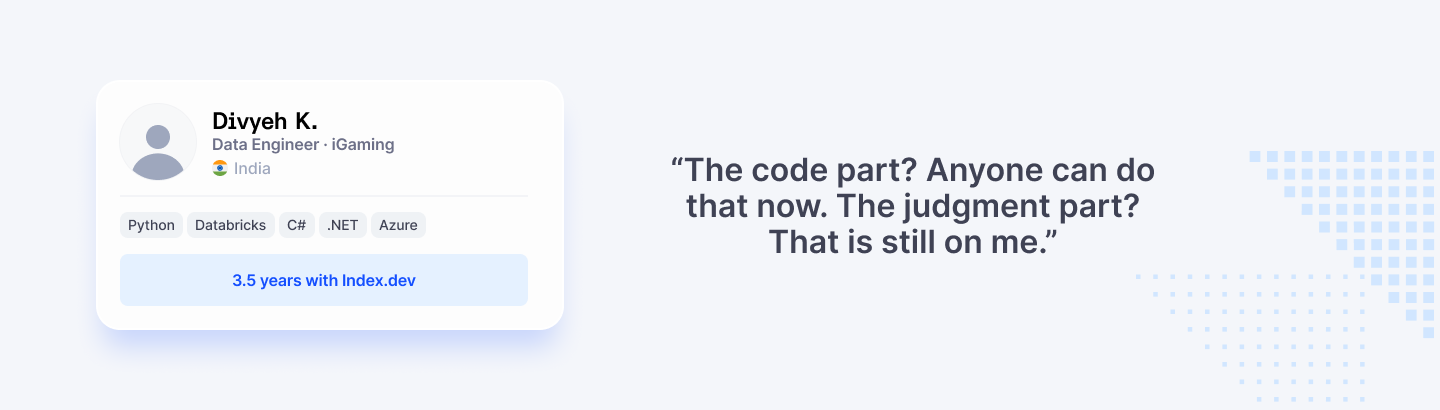
“I used to spend 60% of my time writing code. Now I spend 60% of my time deciding whether the code is right. That shift happened in under a year.”
How to stay ahead
- Stop competing on output volume. Compete on judgment. Review AI-generated code the way a senior engineer reviews a junior's pull request. Critically, with context.
- Own the architecture decisions. AI can write the code. It cannot decide what the system should look like in six months. That is yours.
- Get comfortable being the person who says no. When a PM ships a prompt-generated feature that has a security hole, someone needs to catch it. Make sure that someone is you.
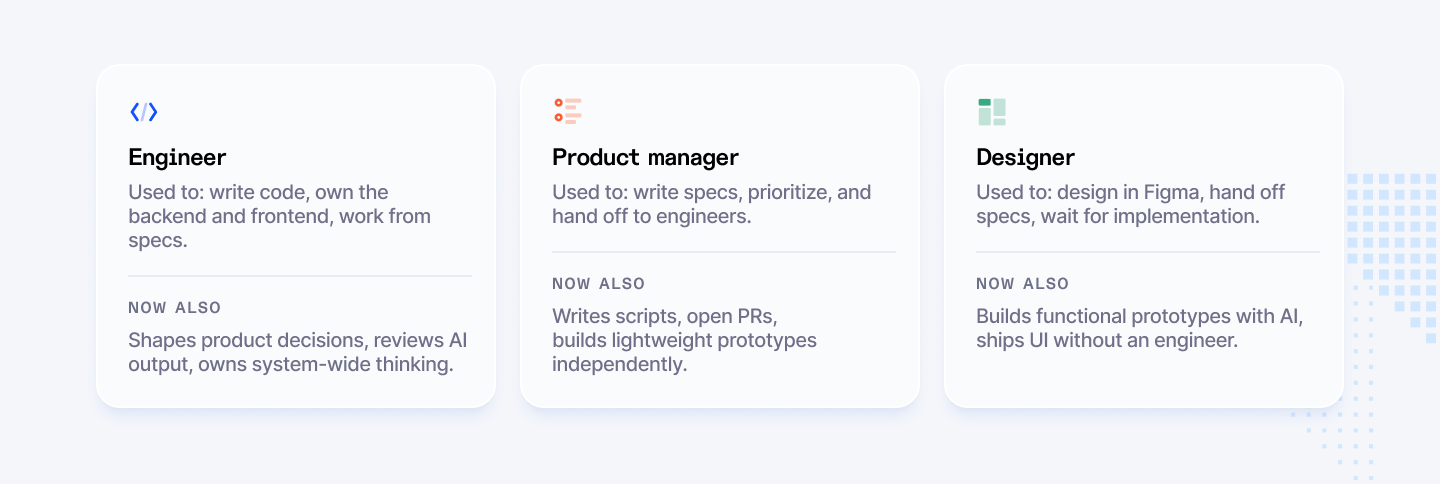
02. Goodbye to deep specialization. Hello to the full-stack human.
According to the LinkedIn Workforce Confidence Index, 65% of engineering managers say they now prefer hiring engineers who can work across product, design, and code over those with deep single-discipline expertise.
The Generalist Wins
The walls are coming down. For a long time, we lived in silos: Engineering, Product, Design. You stayed in your lane, and someone else stayed in theirs. Backend engineers owned the backend. PMs owned the roadmap. Designers owned the interface. Clean lines, clear ownership, no overlap. That model worked because each role was hard enough on its own to justify the separation.
AI broke the logic. A PM can now open Claude Code, describe what they want, and open a pull request. A designer can prompt their way to a working prototype without writing a line of code themselves. The skills that used to require years of specialization can now be approximated by anyone with a good prompt. That changes who gets to sit at the table and it changes what you need to bring.
This does not mean specialization is dead. Deep expertise still matters. But hyper-specialization — knowing only one narrow thing, working only in your lane — is becoming genuinely fragile. If the only thing you do is write backend APIs, AI can already produce a version of that. What it cannot do is understand the full system, make product trade-offs, push back on a flawed feature spec, and then implement the right solution. Engineers who can do all of that are not just more valuable.
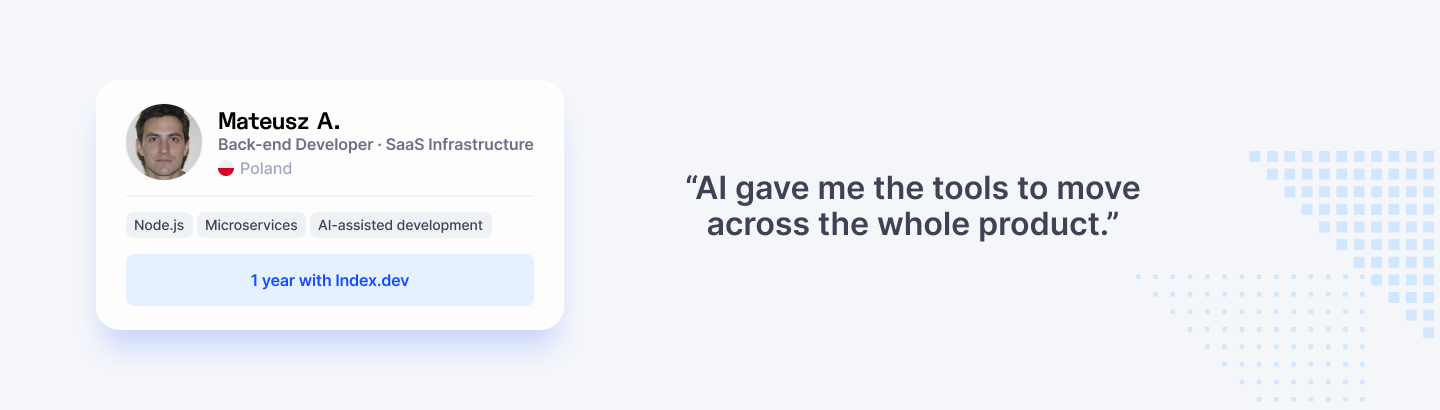
“Two years ago I was a backend engineer. Today I write product specs, review design decisions, and close my own tickets. AI just made the walls disappear.”
How to stay ahead
- Deliberately work outside your lane. Sit in product reviews. Give opinions on design. Build a feature end-to-end at least once a quarter, from spec to deployment. Get comfortable being the generalist in the room.
- Learn enough about adjacent roles to have useful opinions. You do not need to become a designer. But you should be able to say why a UX decision is the wrong trade-off and be taken seriously when you do.
- Make your specialization a foundation. Go deep on your core skill. It still matters. But use it as the base from which you reach wider.
03. There is a new member on your team. It does not sleep and it never complains.
Deloitte's 2024 AI survey found that 43% of software teams reported assigning recurring tasks — documentation, code review summaries, dependency checks — to AI agents operating autonomously within their development workflow.
AI as Teammate
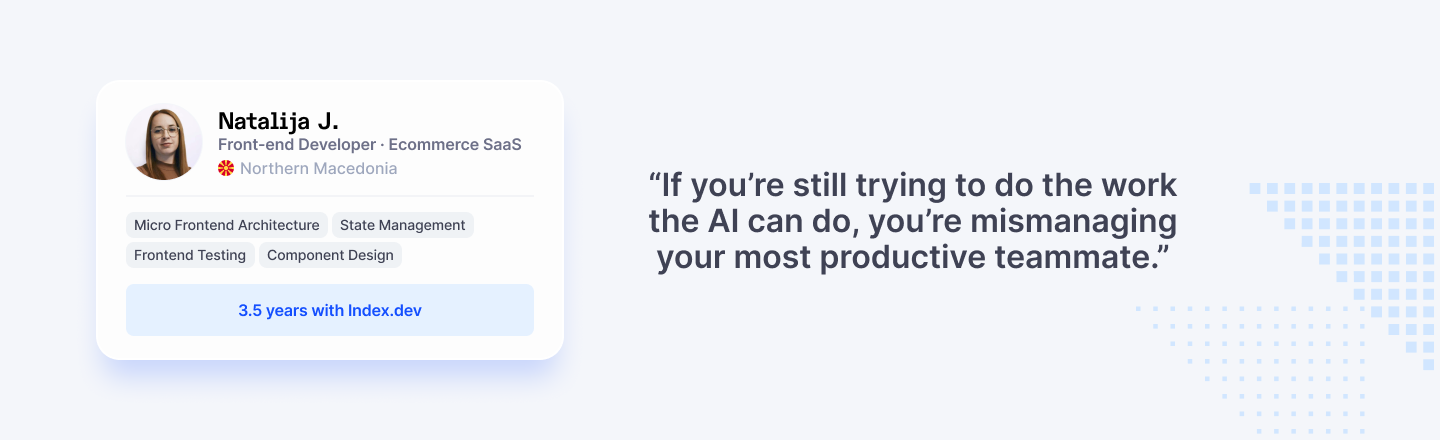
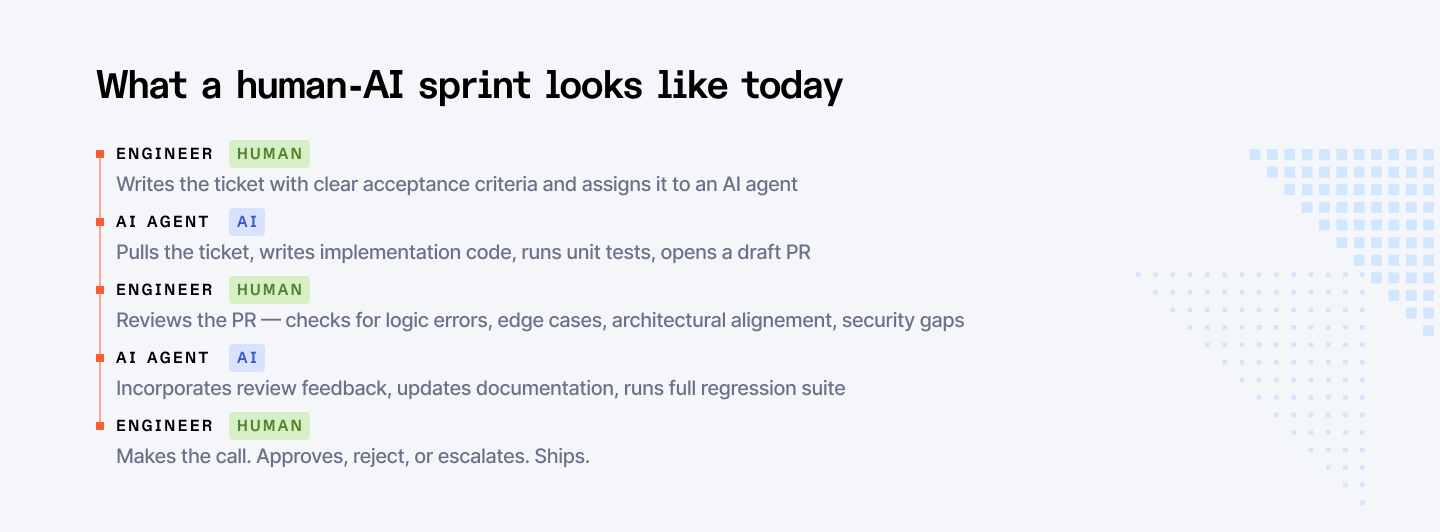
AI agents are not tools anymore. They are starting to behave like junior teammates. They pick up tickets, write first-draft code, run checks, flag issues, and report back. Some teams at AI-native companies already assign work to agents in the same sprint board they use for humans. The team is no longer just people.
What changes for you is not the work itself. It is your relationship to it. You are no longer just someone who writes code. You are someone who delegates, sets expectations, reviews output, and decides what to ship. That is a management function. Not people management: output management. And the engineers who get good at it earliest will operate at a different level than everyone else.
"I have an agent that handles our release notes, another that triages bug reports, and one that writes the first pass on any new API endpoint. I spend my time on the decisions they cannot make. That is a different job than the one I had two years ago, and honestly, a better one."
How to stay ahead
- Practice writing instructions the way you would brief a contractor: specific, unambiguous, with a clear definition of done. Vague input to an AI agent produces vague output. The quality of what comes back is a direct reflection of how clearly you defined what you wanted.
- Build a review instinct, not a trust instinct. AI output that looks clean at a glance often has subtle issues: wrong assumptions, missing edge cases, security gaps that pass a lint check. Review like a senior engineer.
- Pick one repetitive task in your workflow and try running it with an agent this week. Move past simple prompts. Set up workflows where AI agents handle the repetitive work of the sprint (unit tests, docs, linting).
04. You will ship faster. You will also need to think harder.
Stack Overflow's Developer Survey found that 81% of developers using AI tools reported writing code faster, but 62% said they spent more time reviewing and debugging AI-generated output than they expected.
Speed vs. Depth
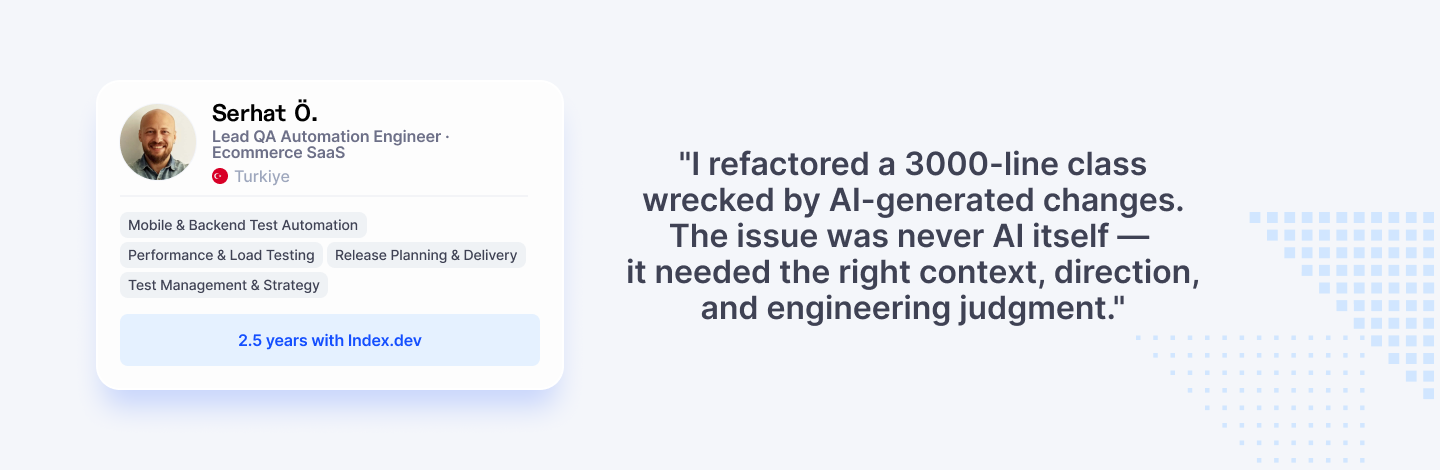
AI gives you speed. That is real and it is significant. A task that took you two days can sometimes be prototyped in two hours. But speed without judgment is just faster mistakes. When you were slow, a bad decision had time to get caught before it became a bad build. When you are fast, bad decisions ship faster too.
The mistake most engineers make with AI is treating velocity as the point. It is not. Velocity is the byproduct. The point is what you do with the time you get back. The engineers getting the most out of AI are spending that reclaimed time going deeper: harder architecture reviews, more careful edge case thinking, more honest conversations about whether the feature being built is the right one. They use AI for throughput and bring their own experience to correctness.
"AI makes you fast. Experience makes you right. You need both, and right now, most teams have plenty of the first and are underinvesting in the second. In the end, it can just mean failing faster.”
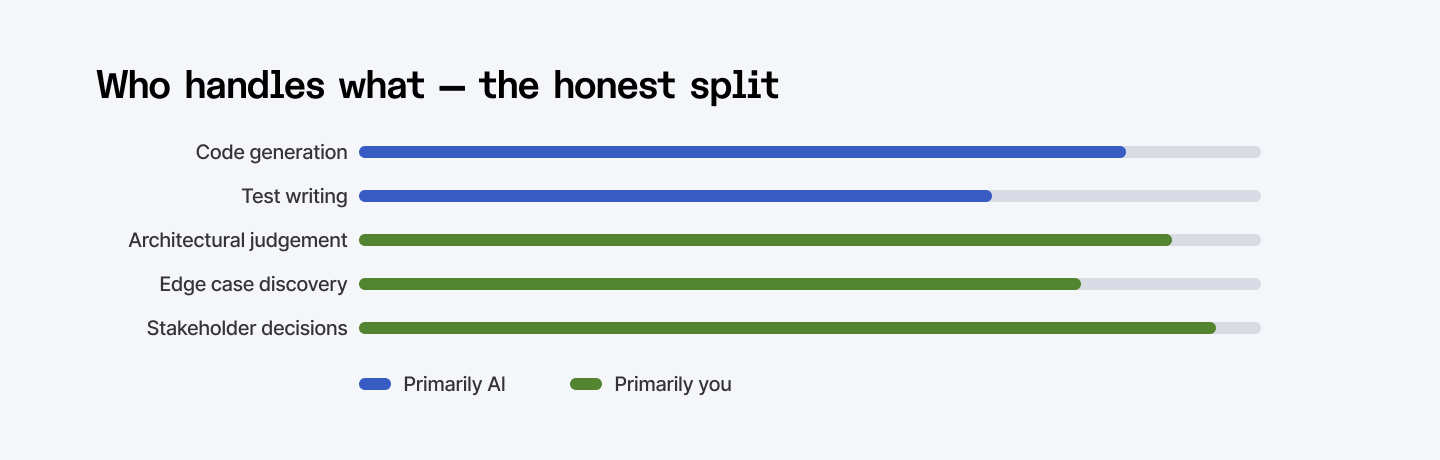
What AI gives you
- First-draft code in minutes
- Boilerplate and scaffolding on demand
- Test cases generated from your spec
- Documentation written as you build
- Faster research across unfamiliar codebases
What you still own
- Whether the architecture will hold at scale
- The edge cases the model did not consider
- Whether this feature solves the real problem
- The security and privacy implications
- The call on what ships and what does not
05. Communication is now a technical skill. Treat it like one.
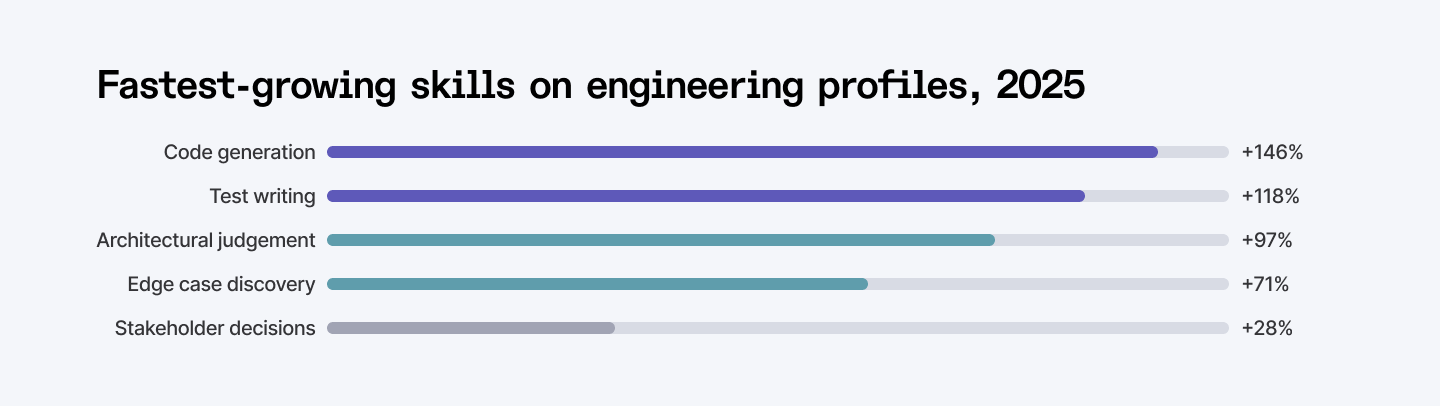
Prompt engineering and technical communication are now the fastest-growing skills listed on software engineering profiles, outpacing every programming language, framework, and cloud certification tracked.
The New Core Skill
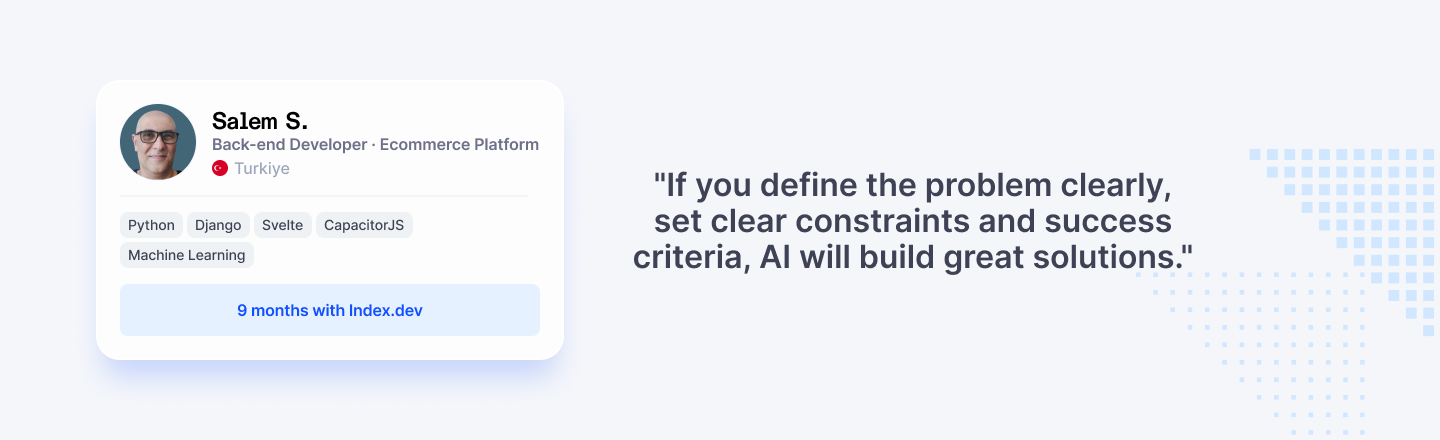
For a long time, technical skill meant the ability to write precise code. That definition is expanding. The engineers who get the most out of AI are the ones who can explain what they want clearly, completely, and in the right level of detail. Vague instructions produce vague results. Precise prompts produce precise outputs. This is not just about talking to an AI. It is about the same skill that makes you effective with a team: the ability to communicate intent without ambiguity. Engineers who write well, explain their thinking clearly, and can break down a complex problem in plain terms are now significantly more productive than those who cannot. Communication used to be a soft skill. Now, it has massive technical leverage.
“The model does not care how many years of experience you have. It responds to the quality of your instructions. That is a genuinely new dynamic and it means a mid-level engineer who writes and thinks with clarity can consistently outperform a senior engineer who does not.”
How to stay ahead
- Write your prompts the way you would write a technical spec: with context, constraints, edge cases, and a clear definition of done. If you would not hand a vague spec to a junior engineer, do not hand one to a model either.
- Start writing more. Technical docs, decision logs, architecture notes. The act of writing forces the clarity of thinking that makes every other part of your job better, including how you use AI.
- When a prompt produces a bad result, do not blame the model first. Reread your instructions as if someone else wrote them. Nine times out of ten the problem is in the ask, not the answer.
06. Some roles are already being absorbed. Know if yours is one of them.
92M jobs are expected to be displaced by AI by 2030, with software-adjacent roles involving repetitive, well-defined tasks at the highest risk of full or partial automation. Roles with high AI exposure, low human-specific value, and flat demand growth as most at risk, including certain QA roles, entry-level data analysts, and routine scripting positions.
Automation Risk
Nobody wants to say it plainly, so here it is. Some engineering roles are already being absorbed — not by other engineers, not by outsourcing, but by AI doing the work faster, cheaper.
The roles disappearing first share three traits: the work is repetitive and well-defined, it does not require reading between the lines, and the output can be checked without much human context. Routine QA scripting. Boilerplate code generation. Entry-level data wrangling. First-draft documentation. These are not low-skill jobs. They were legitimate engineering work for a long time. But AI handles them competently enough today that teams are starting to think twice before hiring for them.
The roles with staying power are the opposite. They require judgment in situations where the right answer is not obvious. They involve human context. And they get harder, not easier, the more ambiguous the problem gets. AI is not good at ambiguous. You need to be.
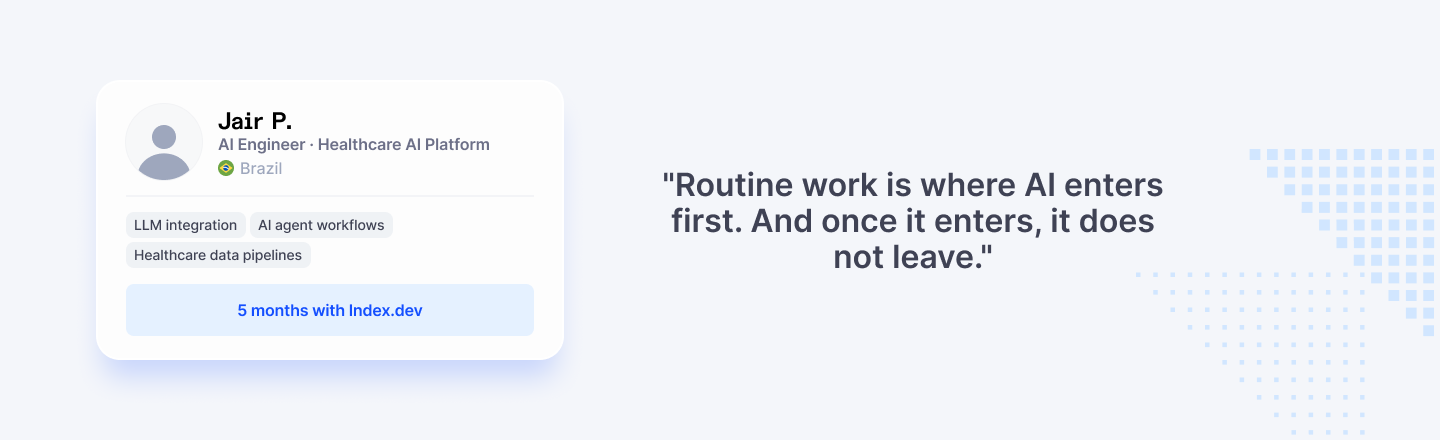
“The safest job in tech right now is the one where you know how to use AI better than anyone else on your team.”
| Role type | What AI already handles | Risk level |
| Manual QA & regression testing | Test script generation, coverage analysis, regression runs | High |
| Entry-level data analyst | Cleaning, basic queries, templated reporting | High |
| Junior backend developer | Boilerplate, CRUD endpoints, basic integrations | Medium |
| Technical writer | First-draft docs, API references, changelogs | Medium |
| Senior engineer / architect | Assists with research, code review, drafting | Low |
| Engineering lead / staff engineer | Summarization, meeting prep, draft proposals | Low |
How to stay ahead
- Do an honest audit of your week. How much of what you do is repetitive and well-defined? If the answer is more than half, that is your signal to move.
- Lean into the ambiguous work. Take on the problems where the brief is incomplete, the stakeholders disagree, and the right answer requires judgment. That is where AI underperforms and you do not.
- Build AI fluency as a deliberate skill, not a side habit. The engineer who knows how to run, evaluate, and improve an AI-assisted workflow is not being replaced by AI. They are running it.
Conclusion
The future of software is automated. The future of engineering remains profoundly human.
AI did not make engineering easier. It made the easy parts of engineering irrelevant. The mechanical work, the boilerplate, the repetitive scripts — that was always the least interesting part of the job. What is left is the harder, more human part. The judgment calls. The ambiguous problems. The moments where someone needs to push back, take ownership, and care about what gets built.
That is not a smaller job. It is a bigger one. And it is the job that compounds. Every engineer who builds strong judgment, clear communication, and genuine ownership of outcomes is building something AI cannot replicate and cannot deprecate.
To thrive in the next decade of software, you have to shift your weight:
- Think: Ask harder questions. Own the decisions no model can make. The clearer you think, the more the tools amplify you.
- Adapt: Move toward the heat. Build AI fluency now, or spend the next five years catching up.
- Own: Take responsibility for the outcome, not just the Jira ticket. Feel responsible for what gets built and how it lands. That is what makes you irreplaceable.
The threat was never AI. It was standing still while everything moved.
➡︎ Build faster with engineers who already know how to work with AI. Our engineers are not learning AI on the job. They use it every day: to ship faster, review smarter, and build AI products that hold up. They come from AI companies, SaaS platforms, fintech teams, and healthcare products where the bar for what good engineering looks like is already higher than most. When you hire from the Index.dev Talent Network, you get engineers who add velocity from day one, because they bring the judgment and the tools to back it up. Hire AI-ready talent today →