AI talent hiring LATAM vs Eastern Europe is a choice between two practical trade-offs: same-day collaboration (choose LATAM) or deep specialist expertise for enterprise systems (choose Eastern Europe).
Latin America now supplies a larger, faster-growing developer pool — ~2 million devs and ~220K STEM graduates annually — while Eastern Europe offers dense, enterprise-grade AI talent. Both regions typically save you 40-70% versus US hiring, but senior LATAM salaries can narrow that gap. Read the nine comparisons below, pick the playbook that matches your output goals, and use Index.dev to validate hires fast.
Surprise hook: LATAM is not always the cheapest option for senior AI talent, many hiring managers underestimate top-tier salaries in São Paulo and Mexico City.
Hire elite AI developers in 48 hours! Index.dev connects you with the top 5% from LATAM and Eastern Europe.
Why This Matters
Hiring choices are no longer just rate-card decisions. They determine how fast models ship, how quickly feedback loops close, and whether ML systems scale safely in production. If the priority is daily stand-ups, fast feedback loops and nearshore alignment with US working hours, LATAM is the better fit.
But if the priority is complex system design, niche AI specializations and seasoned enterprise engineering, Eastern Europe often wins. The rest of this article explains the nine dimensions that should drive the hiring decision.
Snapshot – The Nine Comparisons
- Talent pool: LATAM = scale; EE = depth.
- Cost: Major savings; senior ceilings can be similar.
- Skills: LATAM: applied ML & product; EE: systems, security, enterprise ML.
- Timezone: LATAM aligns with US; EE aligns with EU.
- English: EE more consistent; LATAM hubs improving fast.
- Culture: LATAM relationship-driven; EE task-focused.
- Scalability: LATAM for velocity; EE for specialist scaling.
- Delivery: LATAM for iterative releases; EE for high-assurance projects.
- Tooling: Both fluent in PyTorch/TensorFlow, MLOps and cloud ML.
Top-Line Evidence
Key numbers to share with stakeholders:
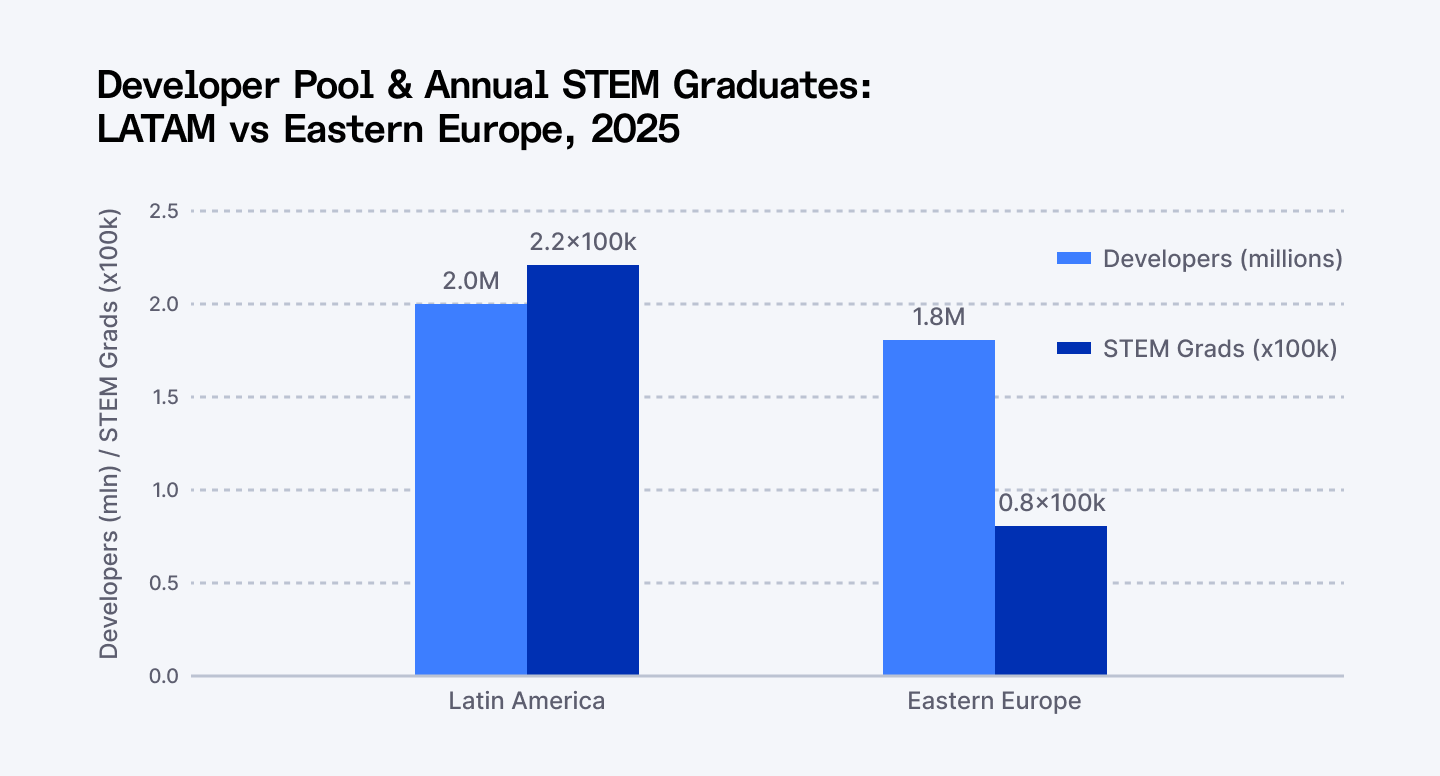
- ~2M software developers in Latin America; ~220K STEM graduates annually.
- ~1.8M+ tech professionals across Eastern Europe (concentrated in Poland, Romania, Ukraine).
- Hiring savings vs US typically 40-70% (city and seniority dependent).
Check out the top Eastern European outsourcing countries and the reasons why Eastern European developers are highly sought after.
The AI Talent Pool: Rapid Growth vs Established Depth
Both regions boast impressive and expanding talent pools, but their characteristics reveal a surprising contrast between rapid, broad growth and deep, specialized expertise.
Latin America's Explosive Growth
The LATAM tech scene is experiencing unprecedented expansion. Brazil and Mexico alone are adding over 150,000 new STEM graduates to the market annually. This growth is fueled by a vibrant startup culture; as of 2025, an astonishing 87% of LATAM startups are actively using AI solutions.
Brazil leads the region with 154 active AI companies, followed by Mexico with 32, showcasing a dynamic and expanding ecosystem . The talent is skilled in in-demand areas like machine learning, NLP, and computer vision, with proficiency in key frameworks such as TensorFlow and PyTorch.
Eastern Europe's Deep Expertise
Eastern Europe presents a more mature and deeply specialized market. The region is home to over 1.8 million tech professionals and is recognized as a powerhouse for complex IT solutions, particularly in AI, cybersecurity, and fintech.
Poland has the largest number of AI and ML providers in Europe, with around 330 vendors, followed by Ukraine with 210. This maturity is creating demand for a new generation of specialized roles like AI Compliance Managers and Model Auditors.
Surprising Comparison: While Eastern Europe has a larger, more established base of tech professionals, the sheer velocity of AI adoption among LATAM's startups is remarkable. The surprise isn't just growth, but the grassroots, business-driven integration of AI that is rapidly upskilling a massive developer base.
Salary Benchmarks: A Closer Look at the Cost-Benefit Equation
Both regions are cost-efficient, but the pay picture is more complex than a mere "cheaper is better" scheme. Recruitment in either region presents 40-70% cost saving over the US, but the details differ drastically.
LATAM Salaries
LATAM isn’t always the bargain bin: senior talent costs surprise many hiring managers. AI engineer salaries in Latin America can range from $16,000 to $60,000, though this varies greatly by country and seniority. For example, senior AI/ML engineers in Mexico can earn between $4,500 and $7,500 per month ($54,000 - $90,000 annually), while senior roles in Brazil can reach up to $7,000 per month ($84,000 annually).
Eastern Europe Salaries
This region is also highly competitive, with annual AI developer salaries typically ranging from $30,000 to $70,000. A senior AI/ML engineer in Poland can earn around $80,400 annually, while the median salary for an ML/AI software engineer in Ukraine is approximately $44,400.
Salary Comparison Table (Annual Averages, USD)
| Role | LATAM (Average Range) | Eastern Europe (Average Range) |
| AI Engineer | $40,000 - $60,000 | $45,000 - $80,000 |
| Data Scientist | $35,000 - $55,000 | $40,000 - $70,000 |
| ML Engineer | $45,000 - $65,000 | $50,000 - $85,000 |
Sources: Various reports including alcor-bpo.com, techwavehires.com, datateams.ai.
Surprising Comparison: The cost gap between the regions is not as straightforward as it seems. While LATAM generally offers lower entry-level salaries, senior, highly skilled professionals in major hubs like Mexico City and São Paulo command salaries that are competitive with, and sometimes exceed, those in Eastern European countries like Ukraine. LATAM isn’t always the bargain bin, senior talent costs surprise many hiring managers.
The 9 Comparisons
1. Talent Pool and Supply: Scale vs Depth
Short answer: LATAM = scale and velocity. Eastern Europe = depth and focus.
LATAM’s developer population is roughly 2 million, producing ~220K STEM graduates yearly — a high-velocity supply that fuels broad AI adoption in startups and product teams. Eastern Europe’s tech workforce is smaller but deeply specialized across Poland, Romania, Ukraine and others, producing talent that often has strong theoretical and enterprise backgrounds. Use LATAM when scaling teams quickly; use Eastern Europe when hiring for niche, high-complexity roles.
2. Cost and Salary Structure: Headline Savings vs Ceiling Exceptions
Short answer: Major savings in both places; top LATAM talent can equal EE at senior levels.
Typical savings vs US hiring sit in the 40–70% range, but senior AI engineers in São Paulo or Mexico City can command salaries that approach Eastern European senior rates. Budget for mid-level hires at the lower end, but expect market-rate senior hires to reduce that delta. Always benchmark by city and role rather than region-wide averages.
3. Technical Skills and Specializations: Practical AI vs Deep Systems
Short answer: LATAM excels at applied ML, product-driven AI; Eastern Europe excels at complex systems, cybersecurity, and enterprise ML.
LATAM’s startup ecosystem drives hands-on experience in ML, NLP and computer vision applied to fintech, e-commerce and customer automation. Eastern Europe has a long history of systems engineering, strong theoretical CS curriculums, and expertise in regulated industries — ideal for reliability, security and scale. Use this alignment to map hiring needs to region strength.
4. Time Zone and Collaboration: Overlap Matters
Short answer: LATAM = same-day collaboration with North America. EE = better alignment with Europe, limited overlap with the US.
Mexico, Colombia, and parts of Argentina overlap many US time zones for 4–8 hours, enabling live stand-ups and immediate troubleshooting. Eastern Europe commonly provides 2–4 hours overlap with US coasts but excellent daytime alignment with Western Europe. For agile US-led workflows, LATAM reduces latency in feedback loops.
5. English and Communication: Narrowing the Gap
Short answer: EE is consistently strong; LATAM is catching up fast in key hubs.
Countries like Poland and Romania report high English proficiency among tech professionals. LATAM hubs (Buenos Aires, Medellín, Mexico City) have rapidly improved bilingual hiring pools. For roles demanding flawless client-facing English, EE provides more uniform coverage; for collaborative engineering work with US teams, LATAM hubs now routinely meet the bar.
6. Cultural Fit and Work Style: Relationship vs Task-Orientation
Short answer: LATAM tends toward relationship-driven collaboration; EE is more task/direct and process-driven.
LATAM’s culture supports close integration, strong team loyalty and adaptability — useful for product teams needing tight alignment. EE’s directness and process focus help in rapid execution on complex technical specs. Match hiring style to management processes and expected hand-holding level
7. Scalability and Hiring Velocity: Pipelines and Education Pipelines Matter
Short answer: LATAM for rapid scale; EE for controlled, specialist scaling.
The larger new-graduate flow in LATAM enables faster team expansion. EE’s universities produce specialized candidates useful when scaling specialist pods (ML infra, MLOps, model governance). Both regions are investing heavily in AI education, so ongoing hire velocity favors LATAM while specialist hiring favors EE.
8. Delivery Speed and Reliability: Execution vs Integration
Short answer: EE delivers reliably on complex scope; LATAM speeds up integrated delivery cycles.
EE teams excel at delivering large, modular projects with clear SLAs. LATAM teams excel when work requires frequent iteration with product owners and stakeholders across the Americas. For tight release cadences with heavy cross-team input, LATAM reduces friction.
9. Tooling and AI Stack Familiarity: Modern Stack Adoption Across Both
Short answer: Both regions are proficient in TensorFlow, PyTorch, cloud ML platforms and MLOps — pick for depth or breadth.
Expect broad fluency in PyTorch/TensorFlow, Hugging Face, Docker/Kubernetes, and cloud ML (AWS/GCP/Azure) in both regions. Eastern Europe often brings deeper experience with enterprise tooling and MLOps pipelines; LATAM shows fast adoption driven by product needs. Validate candidates with hands-on assessments and code reviews rather than assumptions.
Discover the top 5 Latin American countries to hire software developers, including insights into their tech ecosystems, talent skills, and benefits.
Quick Hiring Playbooks: Choose One and Act
Scenario A: US Product Team that Needs Daily Collaboration
- Need same-day collaboration with US product teams? Prioritise LATAM — faster feedback, lower coordination friction.
- Primary hires: ML engineers, data scientists, junior MLOps — source from LATAM hubs (Mexico City, Bogotá, Buenos Aires).
Scenario B: Enterprise ML Platform or Regulated Industry
- Need system architects, compliance, or enterprise ML pipelines? Prioritise Eastern Europe — deeper theoretical training and enterprise experience.
- Primary hires: MLOps architect, model governance lead, security engineer — source from EE (Poland, Romania).
- Interview tactic: architecture deep-dive, portfolio review, reference checks focused on compliance and scaling.
Scenario C: 24/7 Global Delivery
- Want 24/7 coverage for a global product? Budget-conscious but need senior talent?
- Blend both regions: LATAM for Americas-facing sprints; EE for EU/night builds and specialist modules. Standardize CI/CD and docs for smooth handoffs.
- Expect cost parity at the top — bench test and hire for impact, not pure location.
How Index.dev Helps: Practical and Product-Led Integration
Index.dev runs the end-to-end hiring pipeline so your core team focuses on shipping models. We accelerate hiring across both regions by owning candidate sourcing, technical vetting, payroll and compliance, reducing time-to-value while ensuring engineers meet the role’s exact technical bar.
Typical engagement: define role → Index.dev sources & vets → 30-day risk-free trial → transition to direct hire or employer-of-record payroll.
For example, use Index.dev to:
- Run role-specific coding and MLOps assessments.
- Source hybrid teams (one EE specialist + two LATAM product engineers) for 24/7 delivery.
- Provide localized hiring insight for salary benchmarking and offer design.
Learn the best practices for vetting software developers, including technical skills, soft skills, culture fit, and more.
Practical Checklist for Hiring Managers
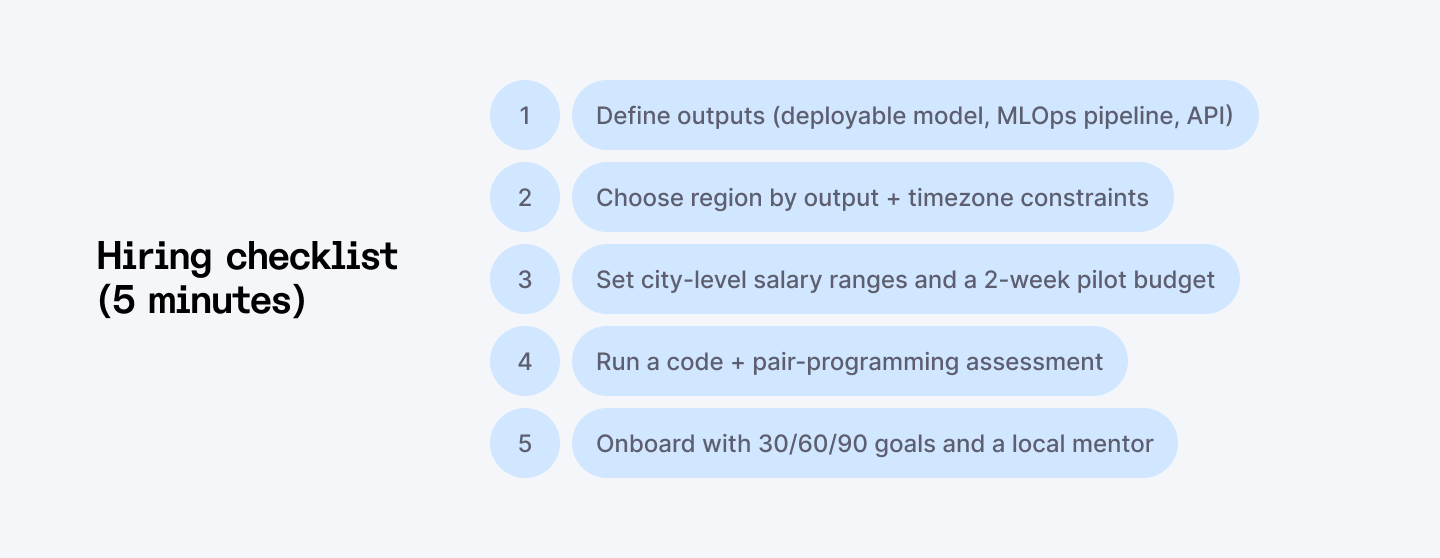
- Define the output expected from the hire (research, prototype, production ML).
- Choose region by output + timezone constraints.
- Set city-level salary ranges, not region-level assumptions.
- Use project-based technical trials and pair-programming sessions.
- Onboard with a 30/60/90 goals sheet and a local mentor (reduces churn).
- For blended teams, standardize code style, infra templates, and CI/CD to minimize context switching.
Closing Recommendation
For 2025, you should adopt a hybrid sourcing strategy: use Latin America to rapidly staff collaborative, product-facing AI teams with significant US overlap, and use Eastern Europe to staff specialist roles requiring deep systems thinking, security, and enterprise-grade architecture.
Index.dev is a pragmatic partner to run this blended approach for you. We’ll take care of handling assessments, local hiring nuances, payroll and compliance frictions so your core team can focus on delivering models that move the business.
Hire smarter, scale faster! Access the top 5% AI engineers from LATAM & Eastern Europe now.