Workplaces are changing fast. Many are now hybrid, mixing remote and office work. More employees feel stuck in their roles, unsure of their next step. Workforce resentment is on the rise. At the same time, AI is increasingly encroaching on the workplace. All this is shaking things up across technology, the job market, and hiring. As a result, 71% of leaders report feeling imposter syndrome, dealing with challenges they were never trained for.
As a people manager or team leader, you must keep up or risk falling behind. Is your plan in place? Here are five ‘worrying’ workplace trends you need to watch out for in 2025–and how to stay ahead of them.
Looking for top talent? Hire the best through Index.dev for fast, interview-ready candidates and a hassle-free remote hiring experience.
1. The Great Detachment Could Hurt Your Performance
Gallup reports that U.S. employee engagement hit an 11-year low in 2024. Overall satisfaction is at a record low, with more workers actively job-hunting than at any time since 2015.
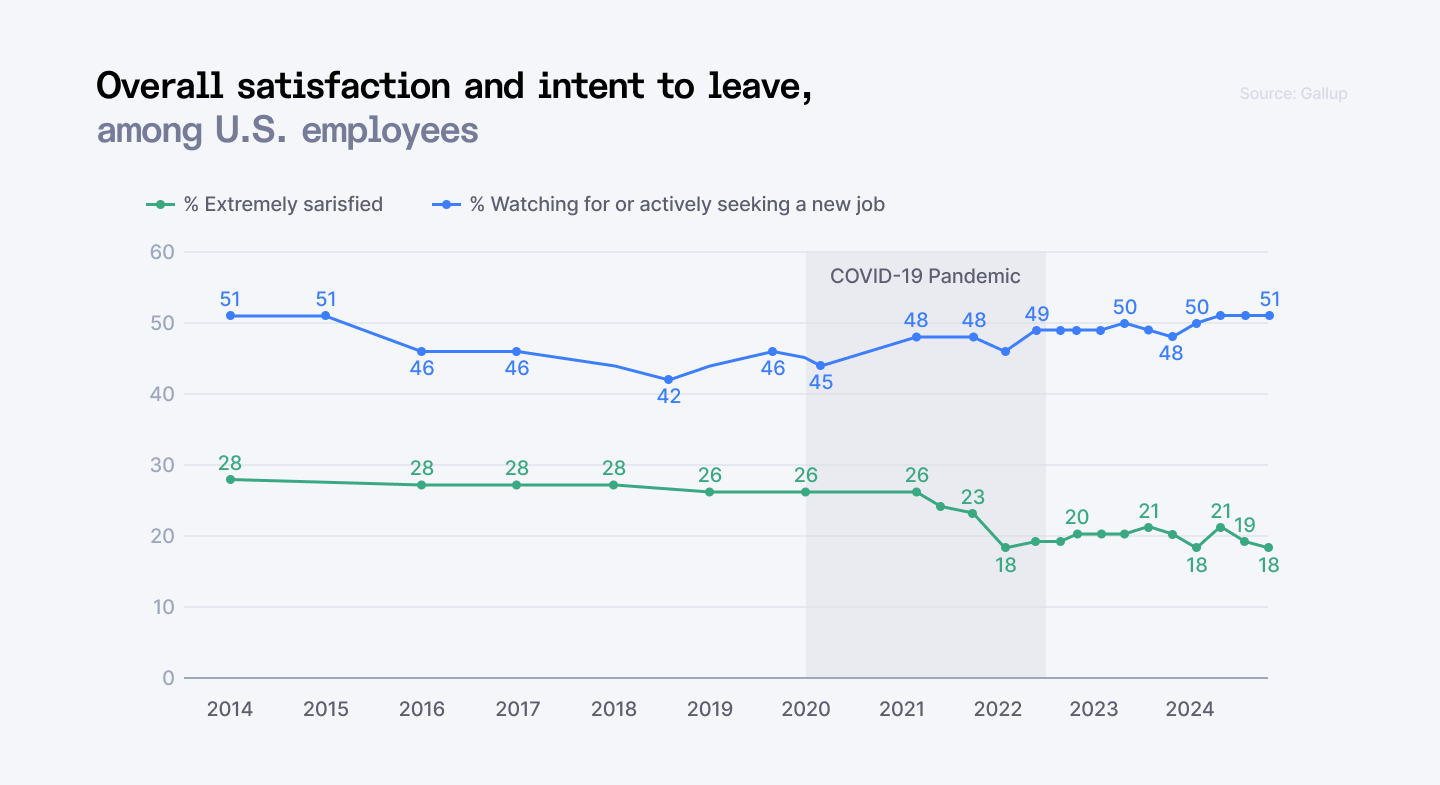
What does this mean? Employees are feeling increasingly disconnected from their jobs. And this isn’t just a U.S. issue—it’s spreading globally. Unlike the Great Resignation of 2021, people aren’t leaving in droves. Instead, they’re staying, but they’re more disengaged than ever. Gallup calls this trend the “Great Detachment.”
So, why are employees detaching? Here are three major reasons:
- Frequent organizational changes are pushing employees into unfamiliar roles or new career paths they didn’t choose.
- Hybrid and remote teams work on different schedules and face communication and coordination challenges, creating silos.
- Many leaders lack confidence in their performance management systems failing to set clear expectations, align teams, recognize achievements, or grow talent.
For employers, this creates hidden risks. Turnover may have slowed, but productivity and future talent loss are looming threats. Disengaged employees are also more likely to resist or ignore change initiatives. In 2025, re-engaging teams and rebuilding commitment will be a critical leadership task.
2. Resentment Among Employees Will Increase
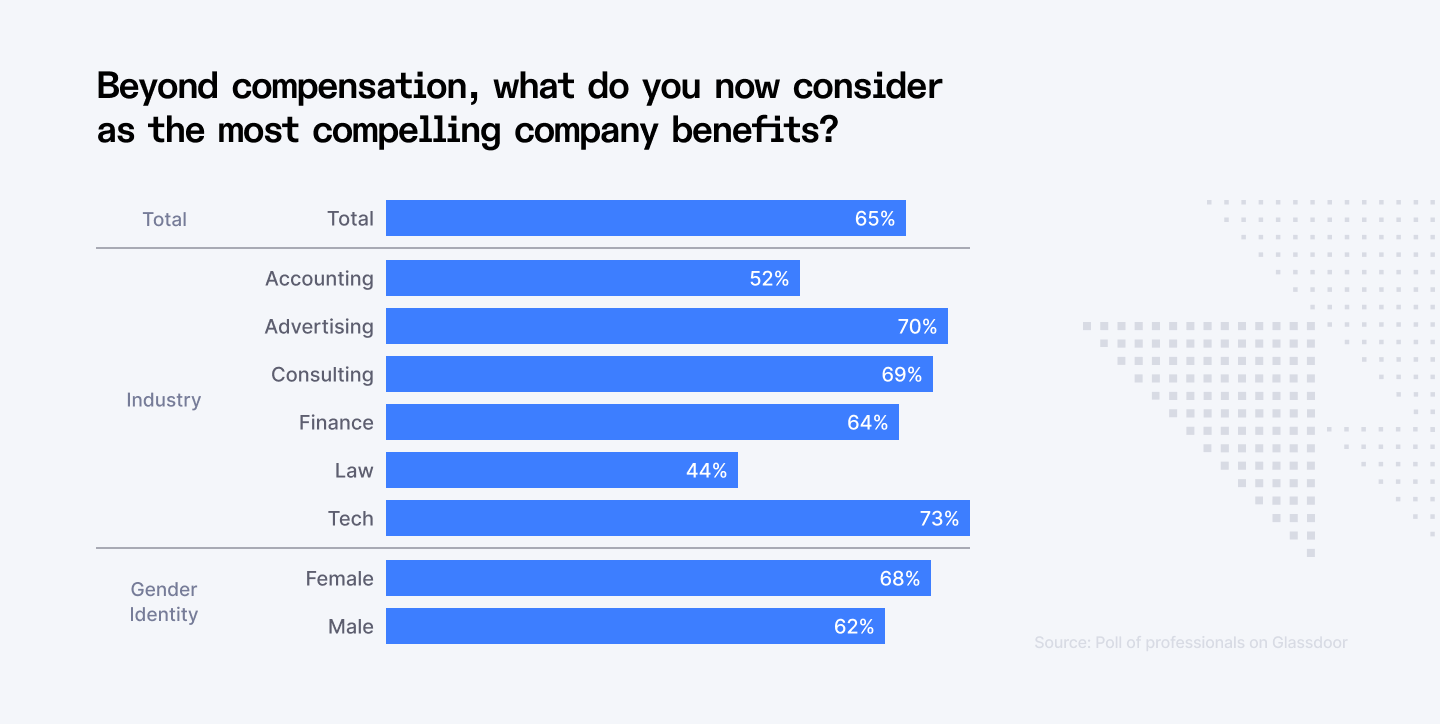
Looking back at the Great Resignation, many workers who left their jobs quickly found better-paying ones. But now, with the job market cooling or even freezing up, it's not as easy for talent to make a quick leap—and that’s causing frustration and resentment. In its newly released report Glassdoor Worklife Trends 2025, Glassdoor found that 65% of professionals say they feel “stuck” in their jobs. This feeling is especially strong in tech, where 73% of respondents report feeling trapped. Women (68%) feel it more than men (62%).
At the same time, company ratings on Glassdoor have been declining in recent years. This suggests a growing sense of discontent among employees.
So, how can you as a manager or leader tackle this resentment before it boils over? The first step is acknowledging the problem. If you don’t, you risk seeing your employees quit as soon as the job market picks up again. To keep your employees happier, you can offer internal mobility or create new projects that help employees expand their skill set.
Read More: Top 10 Mistakes in Managing Remote Talent and How to Fix Them
3. Gen Z is Stepping Into Management Roles
The kids are all grown up. In 2025, the oldest members of Gen Z will be 28, with nearly a decade of work experience. They already make up nearly 20% of the workforce. And as they grow older, many are stepping into management and leadership roles. As a result, Gen Z will make up one in ten managers by 2025. Their entry will bring a shift in leadership style, one that’s more empathetic and people-focused.
But not all Gen Z workers are interested in people management. Many prefer not to take on leadership roles, which will drive a reinvention of middle management. You as a leader will need to rethink what middle management looks like and review career progression. Across generations, employees want meaningful work, real connections with colleagues, and a sense of purpose. To bridge multi-generational gaps, focus on aligning your workplace with these shared expectations.
4. The End of the RTO Debate
Some companies are pushing for a full-time return to the office, while others are embracing remote work. In 2025, employees will have more options, choosing the company that fits them best. However, companies will also push forward with the work arrangements that best support their culture, innovation, and employee well-being, while still ensuring a strong return on investment.
Many companies have already settled on a three-day-a-week in-office requirement, but there will still be a wide range of working models. Even those organizations insisting on a five-day return will likely offer some flexibility. At the same time, companies will become stricter about office requirements. Expect a more structured approach to hybrid work, with clearer expectations about which days employees need to be in the office.
There will also be a greater variety in the types of work people do. The rise of freelancing will continue, and flexible or part-time roles will become more common. Workers with in-demand skills will seek more autonomy, leading to a mix of full-time employees at the core and a growing freelance workforce around them.
Read More: Top 10 Mistakes to Avoid When Onboarding Remote Talent
5. Building Skills for an AI-Enabled World
The advanced use of AI technology in the workplace is already a requirement. But it will become even more important in 2025. As technology evolves, so too must employees.
The shelf life of skills is getting shorter because of technology. In tech industries, the hard skills employees learn today could be outdated within five years—or even less. Upskilling alone won’t be enough to keep up. Reskilling is what will help employees stay relevant and AI-ready.
Without access to strong reskilling programs, employees will fear becoming obsolete, losing their jobs not only to technology but to a better-skilled and AI-ready workforce.
The real worry about AI shouldn’t be about machines replacing humans—it should be about people without AI skills being replaced by those who have them.
AI will continue to shape the workplace, but in 2025, we’ll start to see its limits. We’ll figure out where AI works best and where it is least useful. While some roles will be more vulnerable to automation, human experience—especially in creative work and software development—will remain valuable. 2025 will be the year we fully appreciate the value of human skills and the unique qualities that make us human.
Read More: How to Adapt to the Future of Work
Wrapping Up
In a time of fast changes in all facets of the workplace, leaders and people managers must find ways to tune out the noise and adjust to new ways of working. They also need to grapple with the growing influence of AI, employee disengagement, and an increasingly multi-generational workforce. By focusing on these issues and thinking strategically, leaders can face challenges head-on and turn them into opportunities.
As Winston Churchill once said, "To improve is to change; to be perfect is to change often." Astute leaders see opportunities where others don’t, guiding their teams to new heights.
Index.dev: Your Solution for Top Workplace Talent
At Index.dev, we offer a network of pre-vetted talent who are ready to tackle your most complex projects. Whether you're looking for a software developer, AI engineer, project manager, or UI/UX designer, you can trust that you're hiring professionals with strong technical expertise, high work ethics, and global experience.
Our team of talent recruiters has conducted hundreds of interviews to ensure we match the right talent to your needs.
Here’s what you get with Index.dev:
- Access to the elite 5% of developers, QA specialists, designers, and project managers.
- Hard-to-find experts ready to fill your most in-demand roles.
- No hidden hiring fees and a 30-day risk-free trial to evaluate your new hire’s performance.
Sign up at Index.dev and gain access to expertly vetted talent who can help you achieve all your project goals.