The tech recruitment landscape in 2025 is nearly unrecognizable from what we faced just five years ago. Despite spending the last decade watching these shifts firsthand, the radical change in remote developer hiring trends still blows our mind.
What's fascinating isn't just how many people are working remotely (though those numbers are impressive), but how the entire hiring ecosystem has evolved around this shift. Throughout this piece, I'll share what I'm seeing on the ground with clients across three continents, backed by the latest market research that actually matters.
Whether you're weighing staff augmentation options for your growing startup or a senior developer contemplating your next career move, let's dig into the trends that will actually impact your decisions this year.
Hire the elite 5% of vetted developers through Index.dev in just 48 hours. Start your 30-day free trial now.
Remote Work: Beyond the Pandemic Pivot
Remember 2020? When we all thought remote work was a temporary solution? Five years later, we've moved well beyond that initial reactive phase. About 28% of employees worldwide now work remotely – up from 20% in 2020. But these broad statistics only tell part of the story.
Through our various client interactions, we’ve noticed a fascinating pattern: companies that were remote-reluctant pre-pandemic have become the most innovative remote-first organizations today. Why? Because they were forced to intentionally design their remote processes rather than inheriting legacy systems.
In the US specifically, remote work has skyrocketed – with 22.8% of employees (about 35.1 million people) working remotely at least part-time as of August 2024. That's nearly double (a staggering 87% increase!) the pre-pandemic numbers. But as per reports, the tech industry shows some interesting nuances in this trend:
- 54% of new tech job postings are for on-site positions
- 28% for hybrid roles
- 18% for fully remote positions
This rapid expansion is not just a temporary uptick; it reflects that companies aren't abandoning offices entirely, but they're making calculated decisions about which roles truly benefit from in-person collaboration versus those where global talent access outweighs physical presence.
Businesses are now tapping into a global talent pool while following remote developer hiring trends, instead of limiting recruitment to a local market. This approach not only offers competitive compensation packages but also provides diverse perspectives that drive innovation. Platforms like Index.dev have become key allies in this process, connecting you with qualified developers from all corners of the globe.
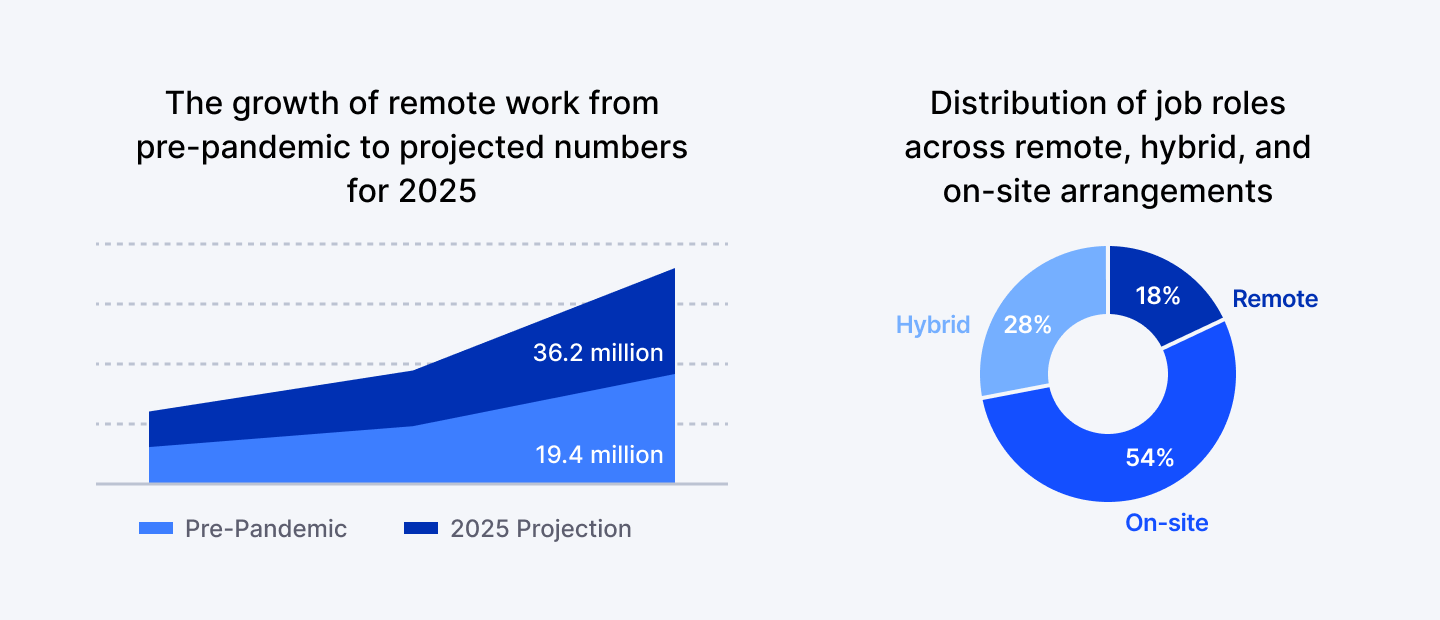
These figures indicate a cautious yet steady embrace of remote work within the tech industry.
The Reality of Developer Demand in 2025
The demand for remote developers isn't just growing – it's evolving in ways that catch even experienced tech leaders off guard, thanks to digital transformation and technological innovation. Tech jobs in the US are projected to grow from 6 million in 2024 to 7.1 million by 2034, but these numbers mask the dramatic shifts happening within specific skill domains.
The languages dominating GitHub repositories tell an interesting story: Python and JavaScript remain essential (no surprise), but we're seeing Rust adoption spike 47% year-over-year among enterprise clients – particularly those building performance-critical systems. Meanwhile, Go has become the unofficial language of cloud infrastructure, with demand outpacing available talent by roughly 3:1 in major tech hubs.
The most striking shift we've witnessed this year is how AI expertise has transformed from a specialist nice-to-have into a fundamental requirement across almost all development roles. A front-end developer in 2025 isn't just expected to know React – they need to understand how to integrate with ML endpoints and design interfaces for AI-driven features. The World Economic Forum wasn't exaggerating in their "Future of Jobs Report 2025" – big data specialists, fintech engineers, and AI/ML specialists aren't just growing roles, they're increasingly becoming hybrid positions that blend multiple domains of expertise.
What does this mean for hiring? The days of posting a job with a checklist of technical requirements are fading fast. At Index.dev, we've seen the most successful placements happen when companies focus less on specific language experience and more on a developer's learning velocity and adaptability across adjacent technologies. Beyond technical skills, soft skills are taking center stage. Remote work requires a high degree of collaboration, adaptability, and communication, especially in asynchronous environments. When you’re hiring or being hired, it’s essential to look for individuals who can navigate these nuances with ease.
Also Check Out: How to Vet Software Developers | Top Insights from Index.dev
Beyond the ‘Talent Shortage’ Narrative
The tech industry loves to bemoan the "talent shortage." But after helping hundreds of companies build remote teams, we've come to see this challenge differently. It's not simply a shortage – it's a mismatch between where companies are looking and where the talent actually exists.
Yes, the statistics sound alarming: by 2026, more than 90% of organizations worldwide expect to face IT skills shortages, potentially leading to $5.5 trillion in losses. But these projections assume companies continue with traditional, geographically-limited hiring approaches instead of adopting the remote developer hiring trends.
Let us share something counterintuitive we've discovered at Index.dev: some of the most "shortage-plagued" specialties – like Scala developers or PostgreSQL performance experts – exist in abundance when you expand your search globally. The trick is knowing where to look and how to evaluate talent effectively across cultural contexts.
Take Romania and Ukraine, for instance. Despite the regional challenges, these countries have produced extraordinary engineering talent, particularly in distributed systems and backend development. One of our clients spent six months trying to hire a senior Kafka specialist in Seattle before finding three exceptional candidates in Eastern Europe within two weeks – all at a more competitive rate.
The most successful companies we work with have stopped thinking about talent acquisition as a local zero-sum game. Instead, they're asking more fundamental questions:
- "Do we actually need everyone in the same time zone?"
- "Could this role be broken into specialized components?"
- "Are we evaluating international candidates with culturally biased assessments?"
What started as a 'we can't find enough talent' problem for our clients transformed into a continuous development cycle that leveraged time zone differences to achieve nearly 24-hour productivity. Turns out they weren't facing a talent drought – they were just fishing in a puddle when the entire ocean was available. Once they stopped hammering square pegs into local round holes and embraced global talent pools, their 'impossible hiring challenge' magically became their competitive advantage.
Of course, building global teams introduces new challenges - communication complexities, cultural differences, and compliance hurdles. But these are solvable problems with the right systems and partners. The alternative (restricting yourself to local talent pools during a transformation period in tech) is the riskier approach.
The Flexible Work Spectrum: Beyond ‘Remote vs. Office’
The conversation about flexible work has matured significantly since the pandemic. We've moved beyond the false binary of "remote vs. office" to something much more nuanced and interesting. Flexibility has become a cornerstone of modern work culture.
However, this evolution hasn't been without pushback against remote developer hiring trends. Some companies are re-evaluating their remote work policies, creating tension between organizational preferences and what research shows about productivity. A Microsoft study found that nearly 90% of workers reported being productive in remote or hybrid arrangements – data that seems at odds with policies like Amazon's mandate for a five-day office return.
What's more revealing is the growing sophistication around when and why teams choose to come together physically. The pendulum swing is real, though. We've spoken with developers who left these rigid organizations specifically because of return-to-office mandates – and with others who welcomed the structure. There's no one-size-fits-all approach here.
What's emerging in 2025 is a spectrum of arrangements optimized for specific team needs:
- Fully distributed teams with quarterly in-person gatherings (popular among product engineering groups).
- "Hub and spoke" models with small satellite offices in multiple locations.
- Synchronized collaboration days - where everyone on the team picks one workday to come together in a physical location, put their heads together, and work in-person.
- "Core hours" approaches – remote work with 3-4 hour overlaps for meetings.
- Results-only work environments where physical location is irrelevant.
In Singapore, where we have several Index.dev partner companies, 76% of employers have formalized remote work policies – but the implementations vary dramatically based on team composition and function.
The smartest companies have stopped treating flexible work as a monolithic policy decision and started seeing it as a strategic design choice. They're asking: "What arrangement would maximize our specific team's creativity, execution speed, and talent retention?" The answers differ, but the thoughtfulness of the approach is what separates thriving tech organizations from those constantly fighting talent battles.
Explore More: 5 Worrying Workplace Trends Managers Can’t Ignore in 2025
Tools and Technologies Driving Remote Hiring
"Our team was drowning in Zoom meetings until we completely reimagined our collaboration stack," a VP of Engineering said recently. His team had fallen into the common trap of trying to replicate office interactions through video calls – with predictably exhausting results.
The most effective remote teams in 2025 aren't just using digital tools – they're deliberately designing custom workflows that combine synchronous and asynchronous collaboration. Here's what that looks like in practice: Traditional project management platforms like Jira and Trello remain popular, but they're increasingly integrated with richer contextual information. We’re seeing engineering teams combine these tools with thoughtful documentation practices (Notion, Confluence) and real-time collaboration spaces (Figma, Miro) where work happens transparently.
Communication has evolved too. Slack remains ubiquitous, but the most effective teams use it very differently than they did five years ago:
- Structured channels with clear purposes
- Integration with developer workflows
- Asynchronous update cadences
- Dedicated focus time without notifications
The most interesting remote developer hiring trends is how hiring practices have adapted to evaluate a candidate's ability to thrive in these environments. At Index.dev, we've developed assessment methodologies that go beyond technical skills to evaluate a developer's asynchronous communication ability, documentation practices, and self-direction - skills that prove crucial for remote success.
The tech stack supporting remote hiring has seen remarkable innovation. Traditional applicant tracking systems (ATS) now incorporate specialized features for technical evaluation without introducing bias. For example, just switching to a blind coding assessment approach can potentially let more candidates from underrepresented groups advance to final interview stages. The most forward-thinking companies are going further - using data from their development environments to understand which collaboration patterns lead to successful outcomes, then designing their remote workflows accordingly.
These tools aren't just facilitating remote work – they're creating entirely new possibilities for how teams collaborate that weren't available in traditional office environments.
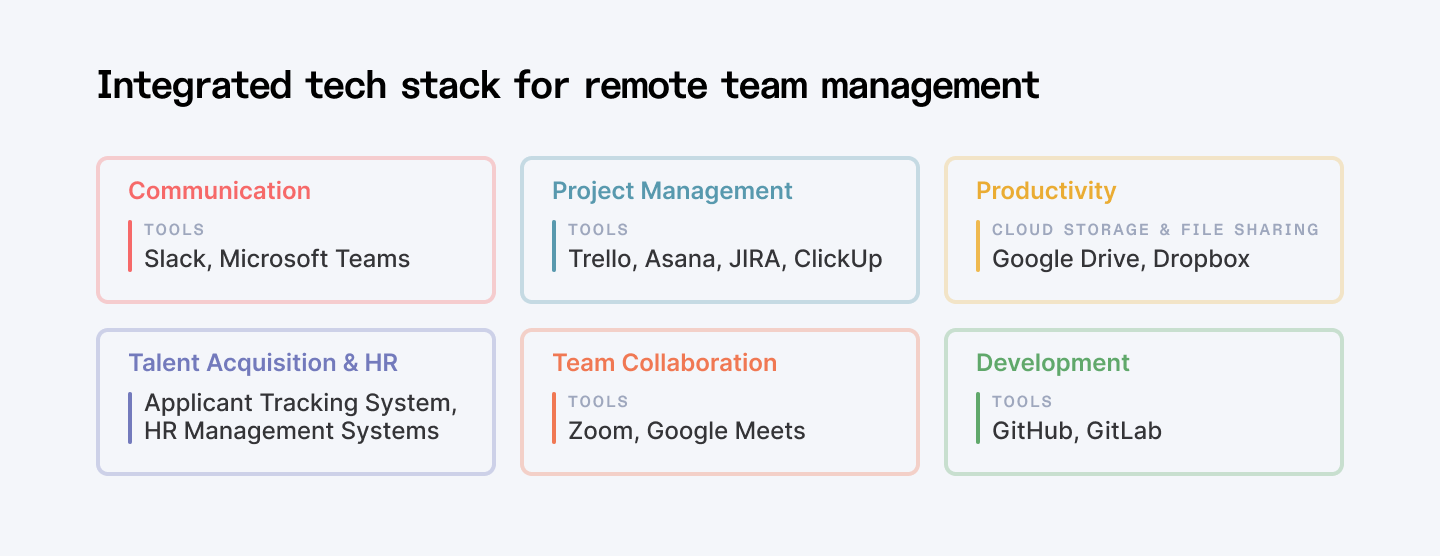
This diagram showcases an integrated tech stack—from ATS to project management tools—that supports remote teams in real time.
Also Read: 18 Indispensable Productivity Tools for Remote Development Teams
Global Compliance, Legal, and Economic Considerations
Hiring remote developers from around the world comes with its own set of challenges. The compliance aspects of global hiring often blindside even experienced companies.
Global hiring introduces a complex web of considerations:
- Employment laws that vary dramatically by country
- Data privacy regulations like GDPR and LGPD, tax implications
- Contractor versus employee classification risks
We've seen companies rack up six-figure penalties for misclassifying workers in countries with strict labor protections. As you expand your remote teams, it’s wise to engage legal experts who specialize in international employment to ensure that your practices meet local and global standards. The most effective approach we've observed:
- Partner with an Employer of Record (EoR) service for countries where you're testing the waters
- Build country-specific expertise for regions where you hire consistently
- Create clear documentation about time-off policies that respect local holidays and customs
Economically, tapping into international talent can lead to cost efficiencies extending beyond direct salary considerations. By sourcing developers from regions with lower living costs, organizations can offer competitive salaries without compromising quality. This not only helps companies maintain profitability but also encourages a diverse and inclusive workforce.
Strategies for Attracting Diverse Talent
Diversity in remote teams requires intentionality – it doesn't happen automatically just because you're hiring globally and following remote developer hiring trends. The 76% of job seekers who prioritize diversity initiatives are looking beyond platitudes to tangible evidence of inclusive practices.
To attract a diverse range of candidates, we recommend:
- Building an Inclusive Employer Brand: Showcase your commitment to diversity through authentic stories and testimonials.
- Leveraging Specialized Recruitment Platforms: Utilize job boards and networks that cater to underrepresented groups. Rewrite job descriptions using language analysis tools to eliminate subtly exclusionary terms.
- Implementing Blind Hiring Practices: Reduce unconscious bias by anonymizing resumes and standardizing interview processes. Implement structured interviews with consistent scoring rubrics. Create a "blind" technical evaluation process where candidate identifiers were removed.
- Fostering a Supportive Remote Culture: Offer flexible work hours, mentorship programs, and opportunities for continuous learning.
Overcoming Challenges in Remote Hiring
Remote work isn't all sunshine and productivity spikes. Let's talk honestly about the challenges:
- Time zone tetris can be brutal. Imagine trying to schedule a critical meeting with team members in San Francisco, Kyiv, and Singapore. A downright nightmare! The solution? Consider designated overlap windows (4 hours twice weekly) where everyone is available, with asynchronous processes handling everything else.
- Communication gaps happen too. "The same Slack message that reads as 'direct and efficient' to a Dutch developer might seem 'abrupt and rude' to their Filipino counterpart," noted a team lead who learned this lesson the hard way. Successful teams create explicit communication norms and regularly calibrate understanding.
Here are some practical strategies to overcome these challenges:
- Enhance Communication: Use synchronous and asynchronous tools to bridge time zone gaps and ensure clear, consistent messaging.
- Invest in Onboarding: A robust remote onboarding program (not just managers) helps new hires integrate into your team quickly and effectively.
- Adopt Flexible Schedules: Allow team members to work during their most productive hours while still coordinating key meetings.
One surprising insight from our Index.dev placements: teams that invest in cultural sensitivity training see 46% fewer misunderstandings and 28% faster integration of new team members.
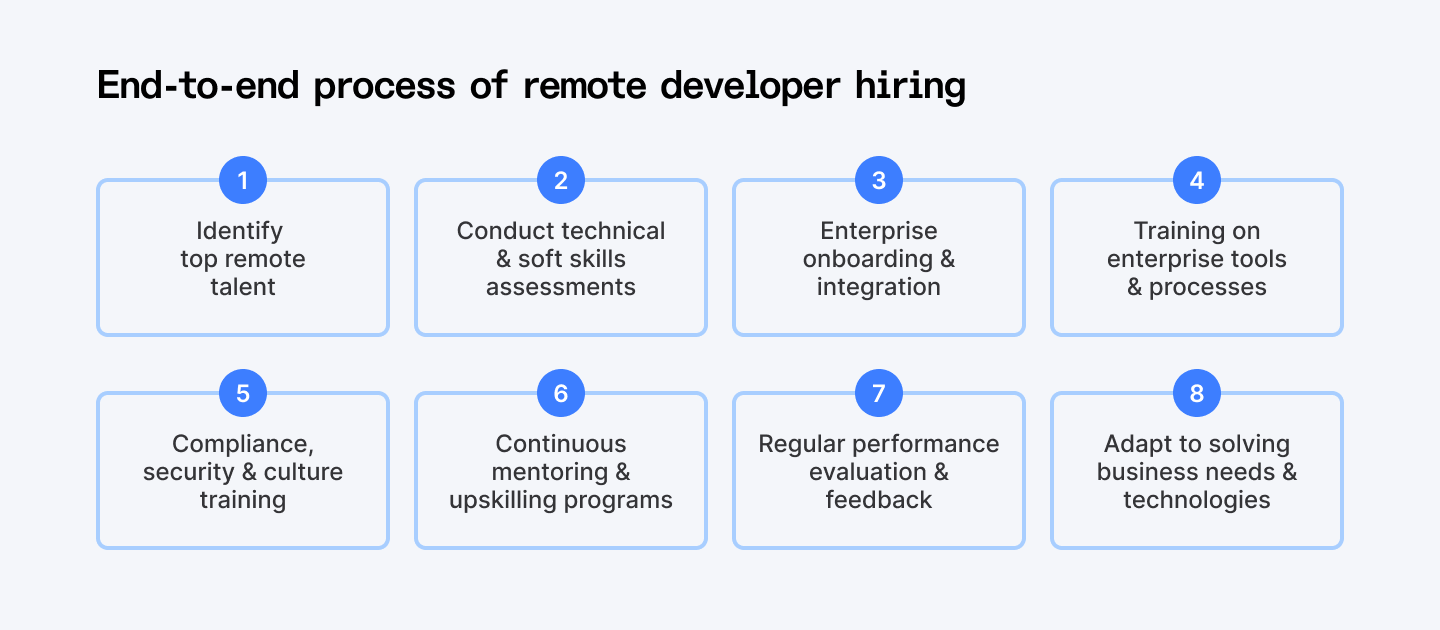
The flowchart shows a holistic view of building and nurturing remote developer teams, addressing not only the technical and soft skills but also the structural and cultural integration needed for long-term success.
Read More: How to Avoid Remote Work Pitfalls | 11 Tips for Tech Leaders
The Road Ahead for Remote Developer Hiring Trends
What lies ahead? We see three transformative shifts:
- Truly integrated global operations – finance, product, and engineering teams functioning seamlessly across continents with localized expertise informing global strategy.
- Hybrid collaboration breakthroughs – tools that finally capture the spontaneous creativity of in-person work while preserving the deep focus of remote environments.
- Talent access equalization – exceptional developers flourishing regardless of whether they're in Bangalore, Bogotá, or Berlin.
The remote landscape of 2026-2027 will build on current foundations while introducing new dynamics. The interplay between digital innovation, flexible work models, and global talent sourcing is creating a dynamic environment that both challenges and rewards forward-thinking organizations.
For companies, success will depend on building systems that adapt to these shifts - flexible enough to incorporate new collaboration models while maintaining security and cohesion. For developers, the premium will be on demonstrable skills and adaptability rather than location or credentials.
The winners in this evolving landscape won't just be those who adopt remote work, but those who reimagine what work itself can be when freed from industrial-era constraints of time and place.
Ultimately, as you monitor the hiring trends and regulate strategies or career paths, you will discover that the future of work is undeniably remote. By understanding these remote developer hiring trends, you can better position yourself for success in this ever-evolving landscape.
Conclusion
Five years into the remote work revolution, we’re struck not by how far we've come, but by how much uncharted territory remains. We're still pioneers in this space, learning as we build.
Technical leaders, your hiring playbook needs rewriting. The most forward-thinking companies that Index.dev works with are pouring over the latest remote developer hiring trends. They now view global talent access as their secret weapon, not a reluctant adaptation.
Developers, the career currency has shifted. Your GitHub profile matters, but equally important is your ability to explain complex concepts asynchronously, bridge cultural gaps, and build trust without face-to-face interaction. The developers thriving in 2025 aren't just technically brilliant – they're exceptional communicators and collaborators.
We’ve watched dozens of teams at Index.dev transform from remote skeptics to distributed work adopters. Their success formula isn't about specific tools or rigid policies – it's their willingness to experiment, measure results, and adapt. They've learned that remote work isn't something you implement once – it's something you continuously adjust.
The future isn't just about working from anywhere. It's about rethinking work itself – making it more intentional, inclusive, and ultimately more aligned with how humans actually create value together.
For Clients:
Hire top global developers through Index.dev – access the top 5% of vetted talent, fast matching in 48 hours, and a 30-day free trial!
For Developers:
Join Index.dev's talent network today and connect with global companies offering exciting remote opportunities and great pay!