Project (hereon also referred to as ‘Fixed-price’) wins on predictability; hourly wins on flexibility.
In freelance software, you’re choosing whether to bill a lump-sum for a well-defined deliverable or an hourly rate for evolving work.
Below, you’ll find a quick answer, then context and data to help you decide.
Want better freelance projects? Join Index.dev and get matched with top global clients using the model that fits you (hourly or project-based).
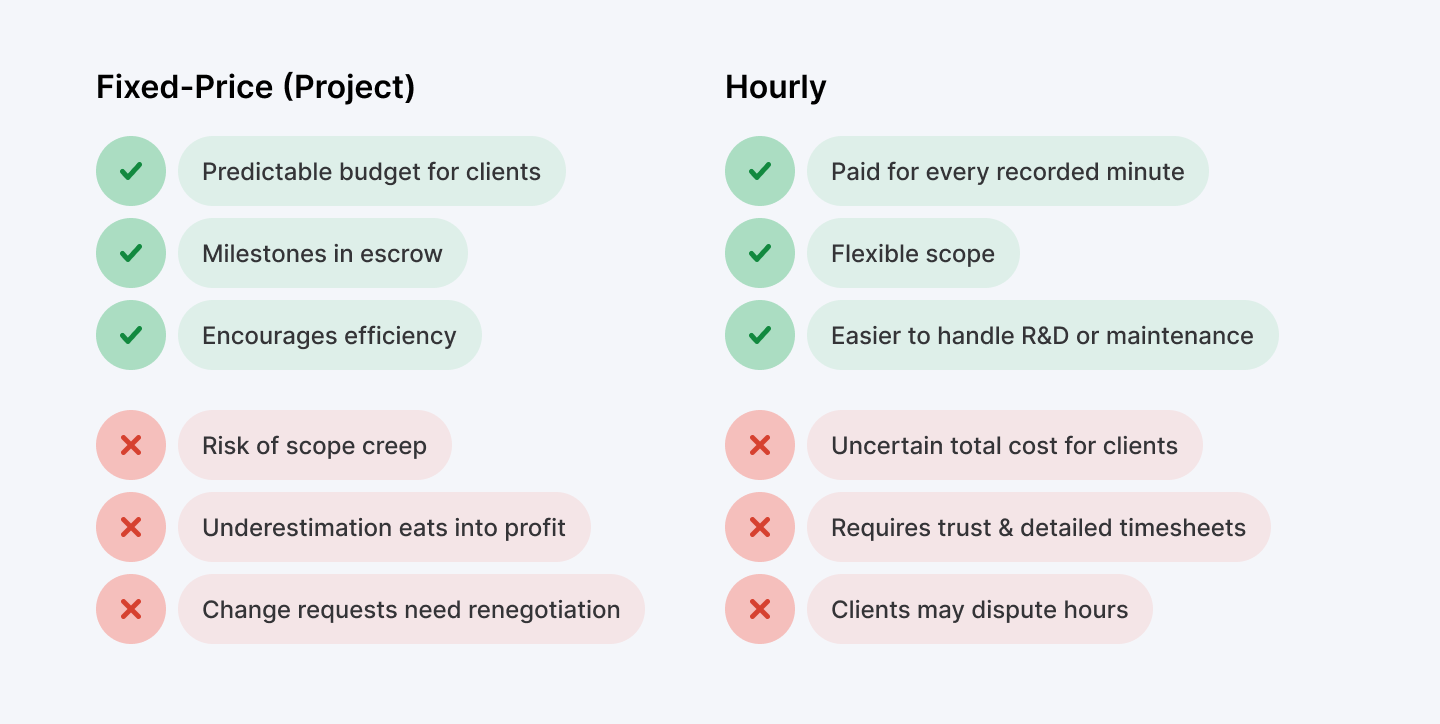
Quick Stats and Definitions
Freelance software teams use fixed-price to lock in budgets and milestone payments in escrow. They use hourly to adapt mid-project, billing only for logged time thereby delivering scope flexibility: freelancers log every hour, get paid for actual time spent, and adapt to changing requirements.
In most cases:
-
Clear, stable scope? Go fixed-price.
- Uncertain, exploratory work? Go hourly.
A hybrid model pairs a lump-sum for primary features with hourly rates for additional tasks, thereby balancing predictability and flexibility. This decision, which shifts budgeting and risk between client and developer, has major implications for productivity, satisfaction, and outcomes.
Upwork defines:
- Fixed-Price Contract: “You’ll pay your freelancer one single fee for the entire project.
-
Hourly Contract: “You’ll pay your freelancer an hourly rate for the time they work on your project.”
- Earnings snapshot: Digital nomads report a median freelance income of $85K/year.
Freelancers’ income can vary by pricing model and skill level. A fixed-price bid lets a developer quote a lump sum for the whole project.
If the project takes fewer hours than estimated, the effective hourly earnings rise. The developer is guaranteed pay for every hour worked, reducing underpayment risk.
Market Context and Pricing Trends
Online freelance work is booming worldwide. Recent estimates suggest that up to 12% of the global labor force now works on gig platforms, generating roughly $5.4 trillion in annual revenue by 2021.
Freelancers can work from anywhere, but they must decide whether to charge clients by the hour or by project. Each model carries different incentives, risks, and administrative processes.
In practice, developers tend to use fixed pricing when a task is well-defined and scope is stable, and hourly billing when requirements are uncertain or expected to evolve.
These guidelines mirror common advice:
Project-based bids suit clear, short-term scopes, whereas hourly contracts fit longer-term or open-ended projects.
Pros and Cons at a Glance
| Model | Pros | Cons |
|
Fixed-Price (Project) |
• Predictable budget for clients • Milestones in escrow • Encourages efficiency |
• Risk of scope creep • Underestimation eats into profit • Change requests need renegotiation |
| Hourly |
• Paid for every recorded minute • Flexible scope • Easier to handle R&D or maintenance |
• Uncertain total cost for clients • Requires trust & detailed timesheets • Clients may dispute hours |
Hourly vs Project: What’s the Difference?
Hourly Pricing Model
Under an hourly contract, you and your developer agree on a rate (e.g. $30/hr). Platforms like Upwork provide work diaries or time-tracking tools to log each hour, with clients billed weekly. Off-platform, the same detail has to live on the invoice itself, and a consulting invoice template keeps the hours, rate and payment terms in the same format for every client.
-
Ideal for: Maintenance, support, R&D, or projects where requirements may shift.
-
Advantages for Clients:
-
Pay only for work performed so that there are no funds locked in advance.
-
Flexibility to reprioritize mid-project.
-
Easy off-ramp: terminate without losing escrowed funds.
-
Pay only for work performed so that there are no funds locked in advance.
-
Drawbacks for Clients:
-
Harder to forecast total spend if hours exceed estimates.
-
You must review timesheets or work diaries to ensure productivity.
-
Potential disputes over billed hours.
-
Harder to forecast total spend if hours exceed estimates.
Project-Based (Fixed-Price) Pricing Model
Fixed-price contracts charge one lump sum for the full scope or defined milestones. You and the freelancer agree on deliverables, deadlines, and payment schedule.
-
Ideal for: Well-defined features like building a website (e.g. “build a login module”), one-off consulting, short-term sprints.
-
Advantages for Clients:
-
Complete budget certainty, meaning that there are no surprise invoices.
-
Milestones in escrow ensure payment only upon approval.
-
Simplified oversight: focus on deliverables, not timesheets.
-
Complete budget certainty, meaning that there are no surprise invoices.
-
Drawbacks for Clients:
-
Rigid scope: late changes require renegotiation.
-
Risk of under-scoped requirements leading to disputes or extra fees.
- Potential for rushed work if the freelancer underestimates complexity.
-
Rigid scope: late changes require renegotiation.
For freelancers, fixed fees can be lucrative if they finish efficiently, since the rate effectively goes up as they work faster. This model also frees freelancers from tracking every minute; once scope is agreed, they focus on delivering results.
A recent experiment found freelancers set higher prices and earned greater profits under fixed pricing.
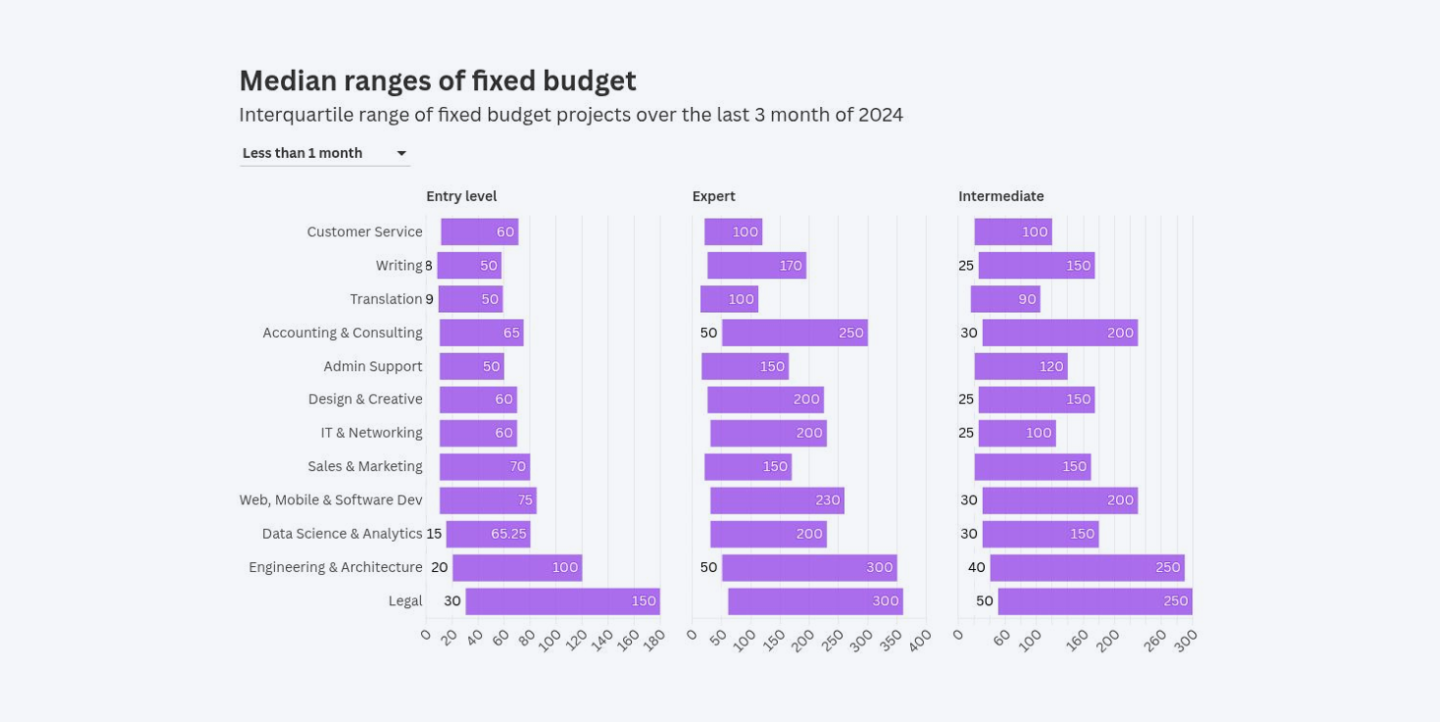
Figure 1: Median fixed-price project budgets vary widely by category and experience level (Upwork data). High-skill IT/development projects typically have the highest budgets, while entry-level support jobs pay much less.
In practice, top-tier developers and specialized fields capture especially high budgets. For instance, Upwork data show expert software engineers and legal consultants command far larger fixed budgets than entry-level roles.
A visualization of fixed-project budgets (Figure 1) illustrates this range. Experienced developers who efficiently deliver on scope can significantly boost earnings under project-based contracts.
However, underestimating effort on a fixed bid means extra hours come out of the developer’s pocket. In contrast, hourly billing shifts overrun risk to the client, so developers earn more linearly with time but without large surges.
When to Choose Which
1. Fixed-Price
-
Use if requirements and deliverables are crystal-clear.
-
How it works:
-
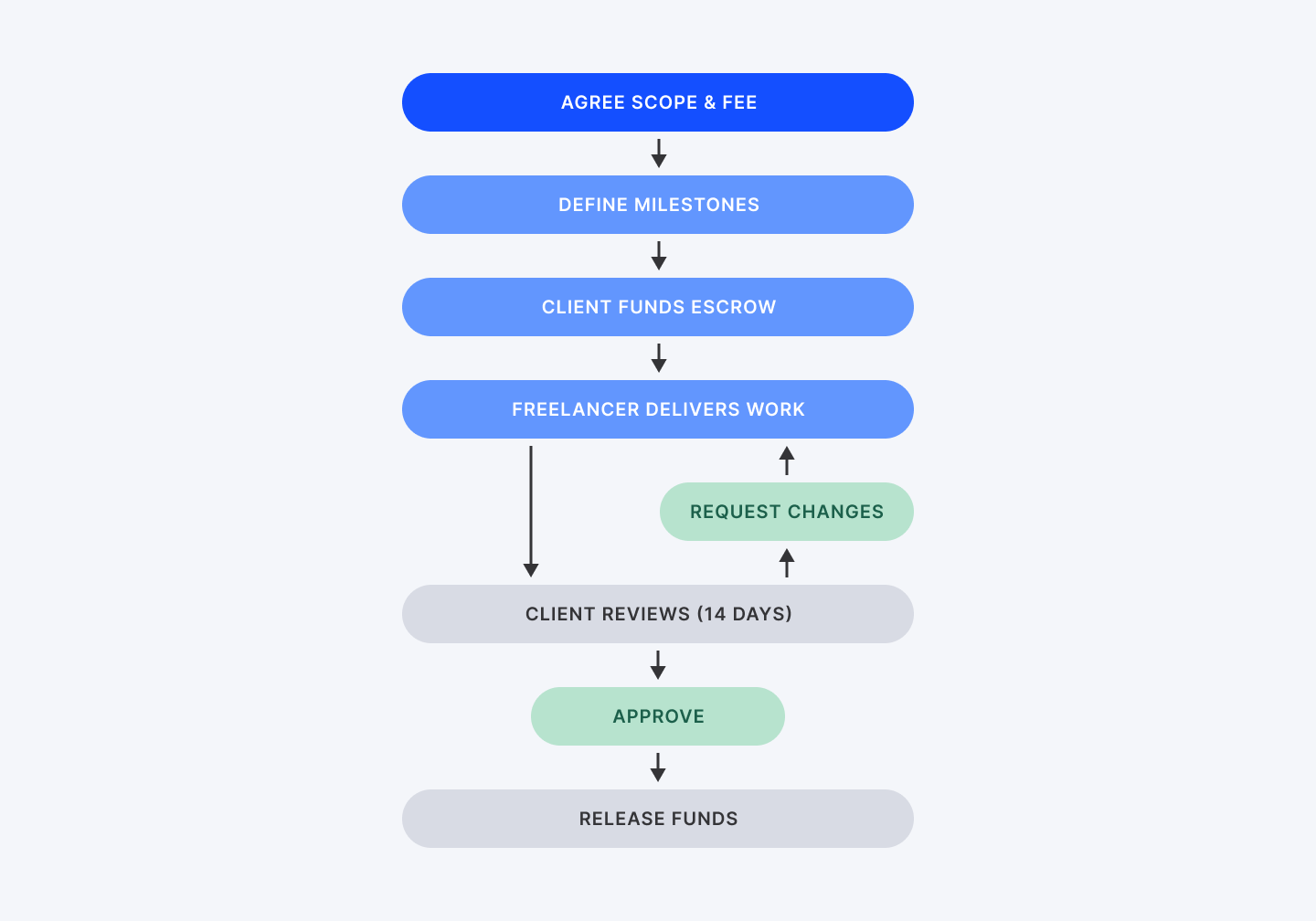
Agree on total fee and milestones.
-
Client funds each milestone in escrow.
-
Submit work → client reviews for 14 days → funds release.
-
Agree on total fee and milestones.
-
Watch out for: Hidden complexity that blows your estimates.
2. Hourly
-
Use if scope is fluid; like bug fixes, ongoing support, R&D.
-
How it works:
-
Agree on an hourly rate (e.g. $30/hr).
-
Track time with Upwork’s desktop app or similar.
-
Invoice weekly; clients see work diaries and can dispute hours.
-
Agree on an hourly rate (e.g. $30/hr).
-
Watch out for: Overruns can scare budget-minded clients.
3. Hybrid
-
Use if the core scope is defined but extra work may arise
-
How it works:
-
Agree fixed fee for core deliverables.
-
Set hourly rate for any additional tasks.
-
Client funds core milestones; extra hours billed weekly.
-
Agree fixed fee for core deliverables.
- Watch out for: Accurate estimation of core vs extra
Trade-Offs Between Fixed-Price and Hourly Models
-
Budget Predictability
With a fixed-price model, you know exactly what you’ll spend upfront. This makes budgeting simple and shields you from cost overruns. In an hourly model, total cost equals rate × hours worked. If work expands, your invoice grows too.
-
Scope Flexibility
Hourly contracts let priorities shift as the project evolves. You can add features or pivot without renegotiating the entire agreement. Fixed-price work demands a detailed plan from the start because any late changes usually require a new quote.
-
Risk Allocation
Fixed-price places the estimation risk on the freelancer. If the project takes longer than expected, the extra hours come out of their pocket. Hourly places that overrun risk on you; every extra hour is billable.
-
Payment Flow and Oversight
Hourly work relies on time-tracking tools and weekly invoices. You review work diaries or screenshots before approving payment. Fixed-price uses milestone funding in escrow. Each deliverable triggers its own release of funds once it meets the agreed criteria.
-
Incentives and Outcomes
Fixed-price can encourage efficiency since finishing early effectively increases the freelancer’s hourly rate. However, there’s a temptation to cut corners to protect margins. Hourly billing rewards thoroughness but may drag out tasks without strong progress checks.
Client Satisfaction and Trust
Clients value clarity and confidence above all. Fixed-price milestones tied to deliverables build trust when each piece arrives on time and on quality. Hourly contracts offer transparency through logged hours, which is reassuring when oversight matters most.
In one study, setting price early (fixed) was predicted to increase effort from both sides, but in practice quality didn’t improve unless overseen closely. This suggests that client satisfaction depends more on communication and management than the pricing model itself.
Managing Risk and Scope Creep
Fixed-price engagements require strict change control. Any unforeseen work or delays are the freelancer’s burden: “the risk of additional costs generally falls on the supplier” under fixed-price terms. Project managers stress that fixed-price projects require strict scope definition and change control.
Written change orders or add-on estimates help prevent unplanned work from eating into profit. With hourly projects, set initial sprint goals so you can cap hours if needed.
Scope creep is a common pitfall: without extra fees, unplanned feature requests mean working for free or renegotiating. To mitigate this, careful upfront planning and written change orders are crucial.
A hybrid approach (fixed for core features, hourly for extras) often keeps risk balanced.
Ensuring Productivity and Quality
Neither billing method guarantees high quality on its own but the billing model can influence how developers approach a project.
Fixed-price work benefits from clear “definition of done” checklists, automated testing, and demo sessions. Fixed contracts can also motivate systematic workflows (good planning, clear deliverables) which can enhance quality if done right. However, without careful oversight, some freelancers might rush or reduce scope to maintain profit.
Hourly work thrives under regular standups and shared dashboards that verify progress. This can allow deeper exploration or more thorough work, at the cost of longer schedules. However, it also requires discipline: without efficiency, hourly projects can drag on and inflate costs.
In both models, frequent feedback loops and well-documented acceptance criteria are the real drivers of excellence.
Looking for vetted talent that matches your project style? Browse Index.dev’s curated talent network.
Long-Term Relationship Building
Both models can support ongoing collaboration if managed well. A successful project, whether fixed or hourly, can lead to repeat work and referrals.
Fixed-price engagements that stay on budget build confidence that the developer understands the client’s needs. On the other hand, long-term hourly contracts can evolve into retainer arrangements or dedicated roles, deepening the partnership.
Crucial factors are trust and communication. Platforms note that “happy clients lead to repeat business and referrals”, which holds for either pricing method. Transparency about progress, willingness to renegotiate scope, and professionalism all foster loyalty. Some freelancers start small (maybe fixed price for a test project) to prove themselves, then transition to hourly or ongoing contracts once trust is established. Conversely, ongoing hourly work may be wrapped into fixed scopes over time if the client prefers budget certainty after several phases.
Best Practices to Add Value
-
Define “Done.” Agree detailed acceptance criteria (tests, UX reviews, documentation).
-
Scope Documents & Milestones: Even under hourly, define initial milestones or sprints.
-
Regular Updates: Weekly (or bi-weekly) status reports prevent surprises. This kind of frequent, concise status reports build trust.
-
Change Control: For fixed-price, handle extra requests via formal change orders with new estimates.This ensures that you keep your scope (and your profit) intact.
- Leverage Escrow & Milestones. Protect both parties by funding per deliverable.
Conclusion
Both fixed-price and hourly arrangements are simply tools in your toolbox. Match the model to the work: choose fixed-price when scope is clear and deadline is firm, choose hourly when requirements may shift or you need ongoing support.
Seasoned teams often blend both to balance predictability with flexibility. They use fixed bids for core deliverables and hourly for extras or maintenance.
Make sure that you track your results over time (the costs, delivery speed, client/result satisfaction, etc.) to continually refine your approach and build stronger, longer-term partnerships.
For Developers:
Want better freelance projects? Join Index.dev and get matched with top global clients using the model that fits you—hourly or project-based.
For Clients:
Want to lock down the right freelancer at the right price? Partner with Index.dev and get tailored proposals within hours.