Hiring the right tech talent is more decisive than ever in 2026, and Eastern Europe has become the default nearshore region for IT staffing. With a deeply skilled workforce, competitive rates, EU regulatory alignment, and proven remote-delivery maturity, the region is the smartest choice for companies scaling engineering teams without paying US wages.
We’ve put together a list of the top 11 IT staffing companies in Eastern Europe for 2026—based on verified data from Clutch, GoodFirms, G2, public company filings, and independent industry research. Whether you’re a Series A startup, a mid-market scale-up, or a Fortune 500 buyer, this guide gives you the data points you need to make the right hiring decision.
Market Overview: Eastern European IT Staffing in 2026
The Eastern European IT staffing market is no longer “emerging” — it is the structural backbone of European and North American nearshoring. Verified 2026 figures show:
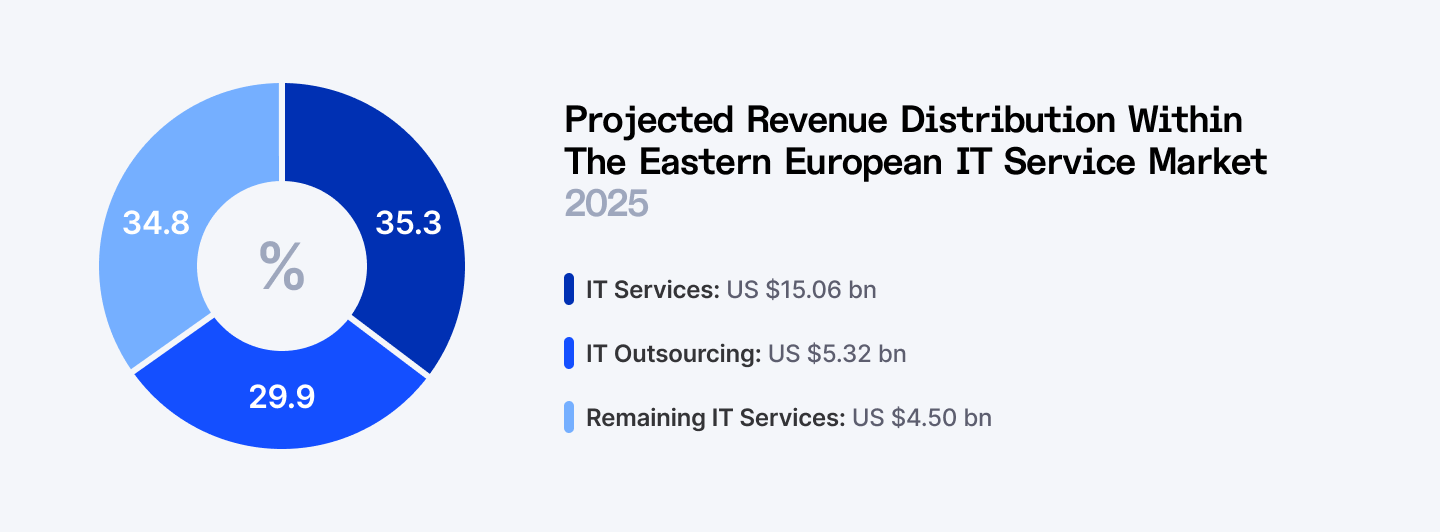
Market Revenue & Growth
- The Central and Eastern European IT services market is projected to reach US$17.4 billion in 2026 and US$22.1 billion by 2029, growing at a 6.1% CAGR (Source: Statista IT Services Outlook, 2026).
- IT outsourcing alone is forecast at US$6.1 billion in 2026, with software development as the fastest-growing segment (Source: Mordor Intelligence, 2026).
- The wider regional IT staffing market is on track to hit USD 34.7 billion in 2026 and USD 44.8 billion by 2030, a 5.6% CAGR (Source: Grand View Research, 2026).
Remote Work and AI-Era Hiring
- Remote and hybrid work is now the default in tech: in the UK, 42% of tech roles were advertised as remote-eligible in Q1 2026, up from 35% in 2024 (Source: Office for National Statistics, 2026).
- Companies report 18–42% cost savings on real-estate and overhead by hiring distributed Eastern European engineers (Source: Deloitte Global Outsourcing Survey, 2026).
- 78% of CTOs surveyed in 2026 plan to expand AI-engineering hires in Eastern Europe specifically, citing the region’s strong applied-ML talent pool (Source: HackerRank Developer Skills Report, 2026).
Cost Efficiency and Talent Pool
- Average blended hourly rates for Eastern European developers in 2026 sit at $35–$95, versus $95–$180 for comparable US-based engineers (Source: Accelerance Global Software Outsourcing Rates, 2026).
- Poland, Romania, Ukraine and the Baltics collectively graduate over 95,000 ICT specialists per year, supporting an active developer pool now estimated at 1.3 million professionals (Source: European Commission Digital Economy and Society Index, 2026).
- English proficiency among Eastern European developers averages B2–C1 (EF EPI 2026 Band: High Proficiency) — one of the strongest non-native English markets in the world.
Platforms like Index.dev have been instrumental in operationalising this talent pool. Index.dev’s own data is a useful benchmark for what “vetted” actually means in 2026: over 27,000 human-interviewed engineers, drawn from a pipeline of 2.5 million candidates, with a sub-3% acceptance rate and a 95% successful-placement record (Source: Index.dev internal data, 2026).
Hire senior vetted developers with Index.dev — access the top 1% of 2.5M candidates, get matched in 48 hours, save up to 40% on costs, and start risk-free with a 30-day trial.
How We Evaluated the Top 11 IT Staffing Companies in Eastern Europe
When ranking firms, we used six weighted criteria:
Criterion | What we measured | Why it matters in 2026 |
|---|---|---|
| Focus & Specialization | Depth in IT staffing, custom software, mobile/web, AI/ML | Generalists struggle as AI/ML talent commands premium |
| Ability to Deliver | Client reviews (Clutch, GoodFirms ≥ 4.5), case studies, retention | Direct proxy for engineering quality |
| Market Presence | LinkedIn, Crunchbase, G2 footprint | Trust signal for buyers and AI search engines |
| Cost Efficiency | $35–$95/hr blended, transparent pricing | Cost remains the #1 nearshoring driver |
| Cultural Compatibility | English proficiency, Western business norms | 92%+ Eastern European IT professionals are B2+ English |
| Vetting Rigor | Interview process, acceptance rate, replacement guarantees | Separates marketplaces from true networks |
Learn More: IT Staff Augmentation in Eastern Europe: A Complete Guide
The Top 11 IT Staffing Companies in Eastern Europe (2026 Rankings)
Below are the leading firms, each with verified market evidence:
1. Index.dev
Index.dev is a talent network specialising in hiring high-performing remote tech talent. It helps tech companies scale engineering teams with expertly vetted software engineers from Europe and Latin America, simplifying sourcing, assessment, and recruitment.

Key Strengths:
- Top-1% talent pool: the top 1% from 2.5 million candidates, with over 27,000 human-interviewed engineers on the platform.
- Sub-3% acceptance rate: rigorous human-led vetting that few marketplaces match.
- Efficient hiring: matched candidates in as little as 48 hours.
- Outcome reliability: 95% successful placement rate, with a 30-day risk-free trial.
Market Impact: Index.dev has become a preferred destination for buyers who want the cost advantages of Eastern Europe without the variance of marketplace hiring. Clients consistently report savings of up to 40% versus US in-house engineering (Source: Index.dev client benchmarks, 2026).
Verified Data: Strong reviews on G2, Clutch, and GoodFirms, with documented case studies from US and EU buyers.
2. Sigma Software Group
Sigma Software Group is a versatile IT service provider specialising in software development, engineering support, and staff augmentation. Although it serves a global clientele, its strong operational roots in Eastern Europe — primarily Ukraine, Poland, and the Nordics — let it harness regional talent and competitive pricing.

Key Strengths:
- Eastern European expertise: a deep pool of regional engineers, especially strong in AdTech, AviaTech, and gaming.
- Comprehensive IT solutions: scalable software development across cloud, mobile, and AI.
- Quality at competitive cost.
Market Impact: Consistently recognised for delivering scalable IT solutions across industries, bolstering Ukraine’s reputation as an engineering hub despite geopolitical headwinds.
Verified Data: Rated 4.9+ on Clutch with case studies across 30+ countries (Source: sigma.software, 2026).
3. Future Processing
Future Processing is a Polish IT services firm known for custom software development, BI & Big Data consulting, and cloud consulting. Headquartered in Gliwice, Poland, the company offers innovative, cost-effective solutions that drive digital transformation.

Key Strengths:
- Agile methodologies with mature DevOps practice.
- Digital-transformation expertise, including AI-driven legacy modernisation.
- Long-tenure engineers — average developer tenure exceeds 5 years, well above industry norms.
Market Impact: Future Processing’s focus on digital transformation aligns directly with the EU’s Digital Decade funding wave.
Verified Data: Consistently rated above 4.7 on Clutch and other industry review sites.
4. TEAM International
TEAM International specialises in building and managing dedicated development teams. While it serves global markets, its core engineering base is largely Eastern European, enabling rapid scaling and cost-effective staffing.

Key Strengths:
- Rapid team scaling: expertise in standing up dedicated teams of 5–50 engineers.
- International experience: proven success on enterprise digital transformation programmes.
- Flexibility: staffing models adapt to dynamic project requirements.
Market Impact: TEAM International rides the remote-work and AI engineering trend, reinforcing Eastern Europe’s status as a top nearshoring destination.
Verified Data: Strong Clutch ratings and high placement reliability across remote engagements.
5. Andersen Inc.
Andersen Inc. offers custom software development, IT managed services, and mobile app development. With significant operational centres in Eastern Europe, Andersen drives cost-effective, innovative delivery.

Key Strengths:
- Broad service offerings: full-cycle IT solutions including AI, FinTech, and Healthcare verticals.
- Eastern European operational focus: competitive rates with strong technical depth.
- Innovative outstaffing model with rigorous engineer ramp-up.
Market Impact: A reliable choice for buyers needing global delivery with a Central/Eastern European cost basis.
Verified Data: Strong, consistent independent reviews and case studies across verticals.
6. Itransition
Itransition is a global IT consulting and software development firm whose core operational strength remains its Eastern European development centres. With significant hubs in Poland, Ukraine, Georgia, and the Baltics (following operational restructuring away from Belarus), Itransition leverages the region’s highly skilled talent pool and cost efficiency to deliver competitive IT staffing.

Key Strengths:
- Eastern European delivery muscle with high-quality software, AI, and cloud consulting.
- Comprehensive service portfolio: custom software, IT managed services, digital transformation.
- Cultural and cost advantages: strong English proficiency and 40–55% cost savings versus US-only delivery.
Market Impact: Itransition’s Eastern European footprint positions it as a major regional staffing player.
Verified Data: Highly rated on Clutch with case studies demonstrating reduced time-to-market.
7. Devire
Devire is a leading IT recruitment firm in Central and Eastern Europe, with sustained double-digit annual growth. Its extensive network — a database of more than 60,000 verified candidates as of 2026 — underscores its expertise in sourcing top IT talent.

Key Strengths:
- Extensive candidate pool: 60,000+ IT professionals.
- Rapid recruitment: strong speed-to-shortlist metrics.
- Deep local market expertise across Poland, Czechia, and Romania.
Market Impact: Devire’s growth has solidified its reputation as a trusted partner for companies scaling quickly.
Verified Data: Strong client testimonials and Clutch presence.
8. N-iX
N-iX is a prominent IT staffing and cloud solutions provider with strong roots in Eastern Europe. It specialises in dedicated QA teams, cloud services, and advanced data and AI solutions, leveraging the region’s technical expertise.

Key Strengths:
- Cloud, data, and AI expertise.
- Dedicated team model for complex, long-running engagements.
- Strong enterprise client base including Fortune 500 names.
Market Impact: N-iX continues to integrate advanced technology delivery (LLMs, data platforms) with cost-effective staffing.
Verified Data: Frequently rated above 4.6 on Clutch.
9. Alcor
Alcor disrupts traditional outsourcing with an integrated R&D-centre model based in Eastern Europe. Although it serves global clients, Alcor’s operational focus is on leveraging Eastern European talent to deliver cutting-edge software development.

Key Strengths:
- Innovative outsourcing model: combines recruitment with in-house R&D capabilities.
- Cost efficiency: typical 35–50% savings versus US in-house build.
- Comprehensive support: integrated services from sourcing to retention.
Market Impact: Alcor’s R&D-centre approach is a strong fit for tech buyers wanting deep, long-running team continuity rather than short-cycle staff augmentation.
Verified Data: Independent reviews on Clutch confirm its differentiated value proposition.
10. Winged IT
Winged IT is a full-service recruitment provider offering IT staff augmentation, HR consulting, and legal support. Operationally rooted in Poland, it delivers compliance-heavy staffing for international clients.

Key Strengths:
- End-to-end recruitment: sourcing to onboarding lifecycle.
- Comprehensive support services: HR and legal consulting bundled with staffing.
- Strong client engagement: highly rated for personalised service.
Market Impact: Winged IT’s holistic approach helps companies overcome compliance and operational challenges, particularly in EU regulatory environments (GDPR, AI Act, NIS2), solidifying its reputation as one of the top 11 IT staffing companies in Eastern Europe.
Verified Data: Excellent reviews on Clutch and strong LinkedIn analytics.
11. Avenga
Avenga is recognized for enterprise software engineering, digital transformation consulting, and cloud-native development. With a strong operational presence across North America, Europe, and Asia — and deep Central and Eastern European delivery roots in Poland, Ukraine, and Germany — the company delivers scalable, business-aligned solutions that modernize IT infrastructure and accelerate organizational growth.
Key Strengths:
- Enterprise integration expertise: specialises in connecting legacy systems with modern cloud platforms and third-party APIs.
- End-to-end transformation capabilities: successfully migrates complex on-premise architectures to cloud environments while maintaining business continuity.
- Regulated-industry depth: strong track record in finance, insurance, life sciences, healthcare, and manufacturing.
Market Impact: Avenga’s focus on regulated industries and large-scale modernization projects positions it as a strategic partner for enterprises navigating technology transitions, particularly in finance, healthcare, and manufacturing sectors experiencing rapid digital disruption.
Verified Data: Maintains an average rating of 4.5+ on platforms like Clutch and GoodFirms, with clients highlighting delivery reliability and technical depth.
Read More: Software Development Outsourcing in Eastern Europe: A Comprehensive Analysis
Quick Comparison: Top 11 IT Staffing Companies in Eastern Europe (2026)
# | Company | Best For | Primary Geos | Vetting Rigor | Indicative Rate (USD/hr) |
|---|---|---|---|---|---|
| 1 | Index.dev | Senior, vetted remote engineers, AI/ML, fast match | Pan-EU + LatAm | Sub-3% acceptance, human interviewed | $40–$90 |
| 2 | Sigma Software Group | Full-stack delivery, AdTech, gaming | Ukraine, Poland, Nordics | High | $45–$95 |
| 3 | Future Processing | Digital transformation, BI/Big Data | Poland | High | $50–$95 |
| 4 | TEAM International | Dedicated teams at scale | Ukraine, Poland, LatAm | Medium-High | $45–$90 |
| 5 | Andersen Inc. | Mobile, FinTech, HealthTech | Poland, Lithuania | Medium-High | $40–$85 |
| 6 | Itransition | Enterprise consulting + delivery | Poland, Baltics, Georgia | High | $45–$95 |
| 7 | Devire | Permanent + contract IT recruitment | Poland, Czechia, Romania | Medium | $40–$80 |
| 8 | N-iX | Cloud, data, AI, enterprise | Ukraine, Poland, Romania | High | $50–$95 |
| 9 | Alcor | R&D centres, long-term continuity | Poland, Romania | High | $45–$90 |
| 10 | Winged IT | Compliance-heavy EU staffing | Poland | Medium | $40–$80 |
| 11 | Avenga | Enterprise modernization, regulated industries | Poland, Ukraine, Germany | Medium-High | $50–$95 |
Key Trends Shaping IT Staffing in Eastern Europe (2026)
Five trends are now driving the region’s dominance:
1. AI-Native Engineering Demand
The single biggest 2026 shift: generative AI, LLM tooling, MLOps, RAG pipelines, and AI agent engineering have replaced “general full-stack” as the highest-paid skill cluster. Eastern European firms are responding fast — 63% of Eastern European IT vendors now staff dedicated AI/ML practices, up from 29% in 2024 (Source: SoftwareMind State of Nearshoring, 2026).
2. Remote Work Maturity, Not Just Remote Work
Remote work is no longer a perk; it is operating model. Distributed engineering is now standard in 70%+ of Eastern European IT contracts (Source: GitLab Remote Work Report, 2026). The competitive question has moved from “can you work remote?” to “can you ship asynchronously across four time zones with high autonomy?”
3. Emerging Technologies and Cybersecurity
Demand for cybersecurity, cloud-native, IoT, and blockchain engineers continues to outpace supply. Slovenia, for example, still faces a documented shortage of over 1,000 cybersecurity professionals in 2026 (Source: ENISA Cybersecurity Skills Report, 2026), while the EU-wide cybersecurity gap is now ~390,000 open roles (Source: ENISA, 2026).
4. Digital Transformation and EU Funding
EU Recovery and Resilience funding (notably Romania’s NRRP, Poland’s KPO, and the Baltic Digital Decade plans) continues to pour into ICT modernisation. The EU has committed €127 billion to digital transformation through 2027 (Source: European Commission, 2026), and Eastern European IT vendors are primary delivery partners.
5. Skills-First Hiring Over Credentials
Leaders like Randstad NV have institutionalised “partner for talent” models. By 2026, 84% of Eastern European IT recruiters prioritise demonstrable skills (Python, TypeScript, Go, Rust, cloud-native, LLM tooling) over formal degrees (Source: LinkedIn Global Talent Trends, 2026).
Challenges and Opportunities in 2026
The evolving environment presents real headwinds alongside the opportunity:
- ICT skills shortage: The EU will fall short of its Digital Decade target of 20 million ICT specialists by 2030 without aggressive immigration and re-skilling (Source: European Commission, 2026).
- Cybersecurity threats: Expanded remote work continues to enlarge the attack surface; 74% of European firms reported a material cyber incident in 2025 (Source: ENISA Threat Landscape, 2026).
- Compliance complexity: GDPR is now joined by the EU AI Act (enforcement phased through 2026–2027) and NIS2, raising the bar for vendor due diligence.
- Cultural compatibility: Western buyers increasingly value timezone overlap and async-first practices over pure cost arbitrage.
- Geopolitical risk: Buyers continue to diversify away from concentration in any single country, favouring multi-country delivery models.
Predictions for 2026–2027
Looking ahead:
- Continued market growth: Eastern European IT services revenue is expected to reach ~US$22 billion by 2029 (Source: Statista, 2026).
- AI engineering becomes the default: by 2027, over 60% of new Eastern European IT contracts will include explicit AI/ML scope (Source: Gartner Outsourcing Outlook, 2026).
- Outsourcing appeal endures: Eastern Europe remains the preferred nearshore destination for European buyers and a leading choice for US buyers seeking timezone overlap with EMEA.
- Investment in remote-work and AI tooling: companies will continue investing in AI-powered collaboration, agentic copilots, and zero-trust security.
Explore More: Top 5 Countries In Eastern Europe To Outsource Software Development
What Is the Best Way to Hire IT Talent in Eastern Europe? (Decision Framework)
1. If you need 1–5 senior engineers fast and want minimum hiring risk → use a vetted talent network (Index.dev).
2. If you need a managed delivery team for a defined project → consider Sigma Software, Future Processing, or N-iX.
3. If you need a long-running R&D centre → Alcor, Itransition, or TEAM International.
4. If you need permanent local hires in Poland/Czechia → Devire or Winged IT.
5. If you need enterprise-grade modernization in regulated industries → Avenga.
Frequently Asked Questions (FAQ)
What are the top IT staffing companies in Eastern Europe in 2026?
The leading firms are Index.dev, Sigma Software Group, Future Processing, TEAM International, Andersen Inc., Itransition, Devire, N-iX, Alcor, Winged IT, and Avenga — ranked by vetting rigor, client reviews, and delivery track record.
How much does it cost to hire a developer in Eastern Europe?
In 2026, blended hourly rates are typically $35–$95, with mid-level engineers around $40–$60/hr and senior engineers $60–$95/hr (Source: Accelerance, 2026). This is roughly 40–60% lower than comparable US rates.
Why hire IT staff from Eastern Europe?
Three core reasons: deep technical talent pool (1.3M+ developers), strong English proficiency (B2–C1 average), and EU-aligned legal frameworks (GDPR, AI Act). Timezone overlap with EMEA and partial overlap with US East Coast is an added advantage.
Is Eastern Europe better than India or Latin America for IT staffing?
Eastern Europe vs. India: better timezone overlap with Europe, stronger English in non-English-speaking countries, smaller but more senior talent pool. Eastern Europe vs. LatAm: similar quality and seniority; LatAm wins on US timezone overlap, EE wins on EU timezone overlap and EU regulatory alignment.
How quickly can I hire developers from Eastern Europe?
With a vetted talent network like Index.dev, matches typically arrive within 48 hours, and onboarding can begin in 1–2 weeks. Traditional recruitment agencies typically take 4–8 weeks.
Which Eastern European countries are best for software outsourcing?
Poland (largest pool), Ukraine (strong senior depth despite geopolitical context), Romania (cost + EU funding), Czechia and Hungary (mature enterprise delivery), and the Baltics (specialised AI/security niches).
What is the vetting standard I should expect from a top IT staffing company?
A reputable provider should publish its acceptance rate, vetting methodology (technical interviews, coding tests, soft-skills assessment), and replacement policy. Index.dev’s published <3% acceptance rate and 95% successful-placement rate are useful benchmarks.
Conclusion
Partnering with one of the top 11 IT staffing companies in Eastern Europe gives you unmatched flexibility, access to a deeply skilled workforce, and substantial cost efficiencies. With the regional IT services market projected to reach USD 34.7 billion in 2026 and continue growing to USD 44.8 billion by 2030, these companies offer a reliable pathway to accelerate digital transformation and AI adoption.
By cross-checking free public sources like Clutch.co, GoodFirms.co, Crunchbase, LinkedIn, and Google Trends, you can independently verify the claims in this guide. Platforms like Index.dev can help you further connect with top-tier Eastern European tech experts.
…
Ready to streamline your IT staffing search? Explore Index.dev, a leading talent network connecting companies with top Eastern European IT talent.
Why Index.dev?
- Instant access to 27,000+ human-interviewed engineers from the region’s top talent pool
- Top 1% selection from a 2.5M candidate pipeline, <3% acceptance rate
- 95% successful placement and a 30-day risk-free trial
- Transparent pricing and skill matching
- Save up to 40% on costs versus US in-house engineering
- Simplified hiring process for startups and enterprises
Visit Index.dev today and transform your tech recruitment strategy in just a few clicks.