
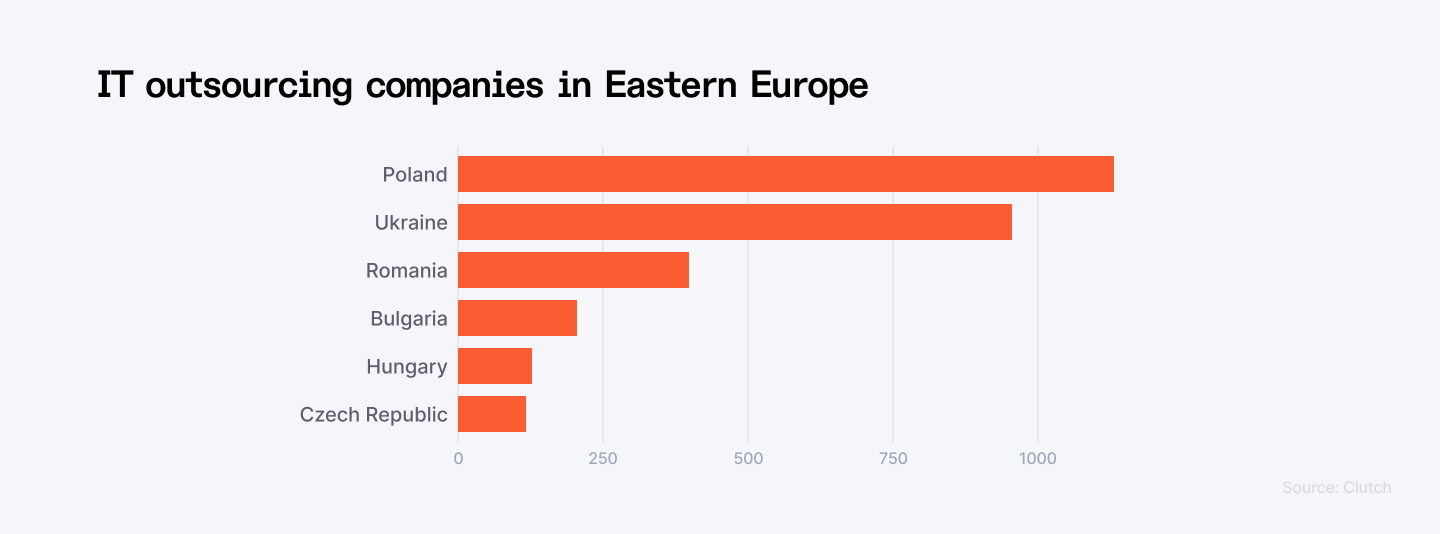
IT staff augmentation is a strategic model that allows organizations to fill gaps in their internal teams by temporarily hiring skilled professionals from external sources. This approach has gained significant traction in Eastern Europe, where a rich talent pool of over 1 million IT specialists is available, particularly in countries like Poland and Ukraine.
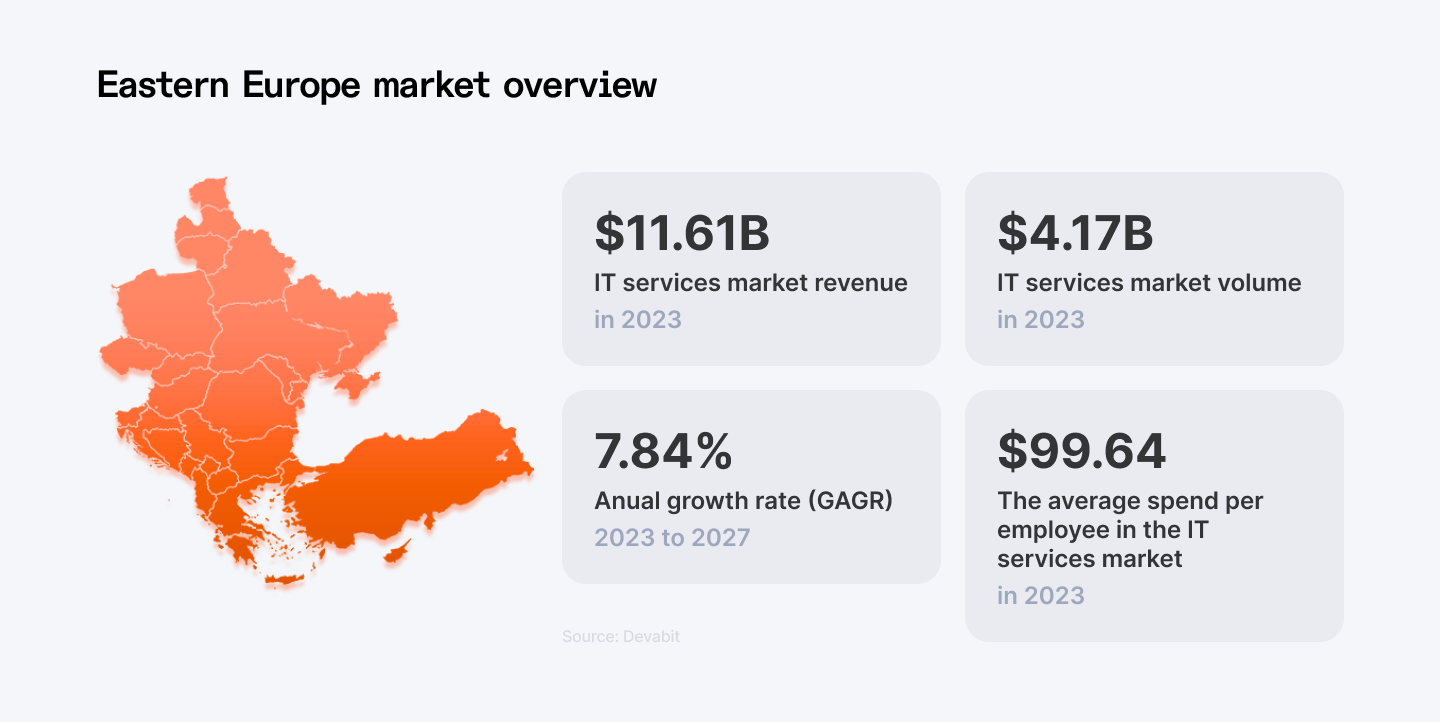
The region's appeal lies not only in its highly educated workforce, with around 80,000 graduates from more than 1,000 higher education institutions annually but also in the competitive pricing of services, averaging between $50 and $99 per hour. The IT staff augmentation market in Eastern Europe is projected to grow at a compound annual growth rate (CAGR) of 9.43%, potentially reaching a market volume of over $23 billion by 2028.
The advantages of this model are manifold. Companies benefit from improved flexibility, allowing them to scale their teams according to project demands without the long-term commitment associated with traditional hiring. A Gartner report indicates that 71% of organizations utilizing IT staff augmentation in this region have reported improved project outcomes, including faster time-to-market and higher customer satisfaction.
Additionally, cultural proximity and advanced English proficiency among Eastern European professionals facilitate seamless communication with Western clients, further boosting collaboration and project efficiency. As businesses increasingly recognize these benefits, IT staff augmentation in Eastern Europe is solidifying its status as a preferred solution for accessing high-quality tech talent.
Read Also: How to Hire Skilled Developers for Startups
Understanding IT Staff Augmentation
Definition:
IT staff augmentation is a type of outsourcing approach that fills the need of companies for staff for special projects or skills required temporarily. This has the added advantage of allowing the companies to be flexible and make adjustments depending on the market forces pull without having to employ full-time employees.
IT staff augmentation is becoming increasingly popular in Eastern Europe due, among other things, to the abundant number of IT specialists; over one million with Poland and Ukraine as the leading countries, which annually graduate over 80,000 IT specialists.
How It Works:
Staff augmentation when recruiting IT professionals especially entails the involvement of a staffing agency where the company goes to source for talents. The companies state their requirements for a particular project, and the agency submits people who will fit in the company environment.
This model also avoids rigid human resource management personnel assigned to a particular project and allows for expansion or even a reduction of the workforce depending on the project needed to give timely results and increased efficiency. The staff augmentation model has been on the rise and consequently, the industry reports indicate the global staff augmentation market is expected to reach $45 billion by 2025.
Benefits:
The benefits of outsourcing IT staffing are numerous, as explained below: Firstly, it is affordable; firms can harness the specialized knowledge of experienced professionals at considerably less than the cost employers bear for employees, with freelance developers charged anything, on average, below $99/hr in Eastern Europe. Secondly, this model offers flexibility since it allows organizations to easily expand or reduce their human resources depending on the demands of a particular project.
According to a report from Gartner, staff augmentation results in increased project success rates for 71% of organizations including shorter time to market and increased customer satisfaction. Finally, IT staff augmentation provides companies with skills they do not always possess in their organizations and which are necessary to solve intricate problems as fast as possible.
Also Read: How to Hire Skilled Developers for Startups
Why Eastern Europe?
Eastern Europe has become one of the most important regions to provide IT staff augmentation services, meaning that there are a multitude of benefits for companies that want to improve their technological profile.
Geographical Location
The region is located strategically between Europe and Asia, thus offering a lot of accessibilities. Some countries include Poland, Ukraine, and Romania, thus making it easy to communicate and carry out businesses since they are only a few flying hours away from most Western European countries. This way businesses in Western Europe and the United States can conveniently communicate with Eastern European IT professionals which is not a constraint on time zones normally, as it is a max of two hours’ difference.
Skilled Workforce
Eastern Europe has a strong pool of skilled IT human resources over 1 million that is made up of developers, engineers and analysts. Some of the new European countries that offer around 80,000 IT graduates per annum include Poland and Ukraine and most of these graduates have some level of competency in some of the programming languages and technologies. European Commission Ryan, part 147 states that 60% of IT workers in the Eastern Europe region possess an advanced degree showing the region’s emphasis on educational attainment.
Competitive Pricing
One of the most important and the most influential factors that go in favour of Eastern Europe as the preferred area for IT staff augmentation is the price of services. This report also established that IT professionals in Eastern Europe earn an average of $50 to $99 per hour, this is much cheaper than the rates in Western Europe and the US where it can cost between $100 and $250 per hour. This pricing nature enables organizations to obtain good personnel while reaching for their wallets least; thus, it is the best strategy for businesses that consider the dollar and cents.
Cultural Compatibility
Cultural compatibility remains one of the highly important facets that determine whether an international collaboration will be successful or not. Other attributes that are common with most of the western developed nations include hard work and dedication as well as adherence to quality.
Also, about 92% of the IT professionals in the region have good English language proficiency besides helping in the enhancement of communication. That is where cultural differences still creep in, for instance in this case hierarchy and decision-making styles may be poles apart. It is therefore critical to learn about these subtleties to be able to achieve positive results while working with partners.
Thus, it has been concluded that using the Eastern Europe IT staff augmentation is the optimal solution that offers numerous benefits, including the geographical position, a highly skilled workforce, cost-efficiency, and cultural proximity to most international companies, which helps to improve their technological solutions without incurring significant expenses.
Also Read: Hiring a Developer: The Know-All Guide
Key Considerations for IT Staff Augmentation in Eastern Europe
When it comes to the use of IT staff augmentation in Eastern Europe, there are several factors that a company needs to take into consideration to ensure that all the project deliverables are accomplished in a manner that will support business goals and objectives.
Skillset Requirements
It is always important to define the requirements of particular skill sets when working on IT projects. Companies need to seek personnel with experience in different programming languages, for instance Java, Python and C++ that are required in the development of software. Further, one should know the software development frameworks like React, Angular, Django etc as per the technical stack being adopted. Cloud computing skills are also important as the candidates should have an understanding of AWS, Azure or Google Cloud. The survey report shows that compared to the IT professionals who worked for the international companies from Eastern Europe, 92% of them have advanced English language proficiency which will ease communication with the teams.
Project Scope and Timeline
Regarding the number of IT specialists required for the project, the most relevant factors are the project’s scope and time frame. The extent of a project describes what needs to be accomplished to achieve the intended goals and objectives, when this is well defined then it is easier to determine the needed resources and skills. For example, a large-scale project may require five to ten professionals who will work on the project for six months while a simple project may need only two to three specialists for a shorter time of one to two months. Eastern Europe’s IT staff augmentation market is expected to perform with a CAGR of 9%. 43%, and as per market volume it will reach USD 23707.30 Million by 2028 pointing towards a very healthy market demand for flexible staffing services that can be adjusted according to the requirements of the project timeline.
Engagement Model
There is hardly any doubt that comprehending the multiple engagement models that can be utilized concerning IT staff augmentation is critical. The options available to companies are extensive and allow hiring employees, contractors, or dedicated teams. There are benefits of having full-time employees because they are fully committed towards the job and can offer a stable working relationship, on the other hand, contractors are beneficial when there is a need for flexible arrangements to meet project-specific requirements.
On the other hand, dedicated teams help companies hire employees as project development requires making changes in the size of the employees’ team. This flexibility is crucial because an organization can introduce or release employees to tackle projects depending on the project’s needs thus optimizing resource utilization.
Legal and Compliance Considerations
It is important to discuss legal implications and other legalities which come into play when hiring IT personnel from Eastern Europe. Employers are challenged by the legal systems of recruitment that govern the hiring of personnel and the tax systems of the country. Considering services of reliable staff augmentation suppliers, who may keep the legal requirements for hiring personnel of a foreign company in mind can help overcome the risks of hiring in a foreign state. This is especially relevant considering the increasing popularity of the IT industry in Eastern Europe and IT outsourcing with revenues over $5 billion indicating the importance of compliance with local legislation to sustain the business’s credibility and avoid legal issues.
Business considerations that should be made when outsourcing IT staff augmentation in Eastern Europe include; knowing the skills needed for the job, determining the project goal and timeline, identifying the most suitable engagement model for the business, and legal compliance. The management of each organization should deal with these factors thoroughly, and in this way, it will be possible to get the best talents in this region and achieve the objectives of a given project.
Connect with senior developers from Eastern Europe in just 48 hours. Enjoy a risk-free trial, slash your hiring costs, and scale your team effortlessly.
The Process of IT Staff Augmentation in Eastern Europe
IT staff augmentation in Eastern Europe is a systematic process that entails the following major steps to ensure organizations acquire the right talent who can support their IT needs.
Vendor Selection
The staff augmentation process begins with the identification and selection of a reliable IT staffing vendor in Eastern Europe. Those involved in the purchasing of these services should ensure that they carry out research that sees them land on the most appropriate vendors in the industry. These are some of the factors to look into most importantly before you hire any service provider: In the report by N-iX, Ukraine only has over 1,600 software development providers with many of them offering team extension services. Cooperating with the vendors that have been named in the lists of international outsourcing, including the IAOP’s Global Outsourcing 100 list, can also increase the success rates.
Skill Assessment
When a vendor is chosen, the next process is the evaluation and determination of the qualifications of the candidate. Skill assessment generally involves screening resumes, more so technical interviews and coding tests to check the competency of the candidates in the relevant technologies. For example, they may search for experienced professionals in such programming languages as Java or Python or such frameworks as React or Angular. Outsource IT Today’s survey reveals that the current year’s IT workforce of Ukraine only sums up to 278,000 individuals that are assessed.
Onboarding and Integration
The recruitment of new IT professionals into the existing professional team is key to facilitating proper integration. Such a process should involve the orientation of each employee to the corporate culture, systems, tools, and practices of the organization. Moreover, the goals and expectations should be established from scratch if augmented staff is to be integrated. Hence there is a need for companies to ensure that all the needed resources and tools to aid in the transition are made available. It also shows that in companies where extensive onboarding is conducted the rates of new employee retention go up by 82% and productivity by over 70%.
Communication and Collaboration
Managing interpersonal relations within the IT staff augmentation process is critical to achieving organizational objectives of IT staff augmentation. Currently, 92% of IT specialists in Eastern Europe reported they are fluent in English, which means that the companies can use this as an advantage in promoting effective and honest communication lines.
Another practical part of strategic adjustment is the daily use of such software as Jira and Trello, as well as constant video meetings that make everyone aligned. Also, culture of feedback and promoting the culture of improvement of every work can foster collaboration and increase the chances of the completion of the project. According to Gartner, organisations using IT staff augmentation noted enhancement in project results by 71% affirming the essence of communication in the delivery of intended results.
IT staff augmentation in Eastern Europe requires a strong vendor identification procedure, adequate staff’s skill assessment and evaluation, appropriate onboard process, and strong communication plans. When these steps are effectively followed then it will be possible to take advantage of the talent that is available in the region besides improving on the technological aspect of an organization.
Success Stories and Case Studies
Some of the companies have adopted IT staff augmentation in the Eastern Europe region, and the model has proved viable in improving the organizations technological personnel and their business objectives. Here are a few examples and the things that have been learnt from these successful individuals.
1. Ciklum
Currently, Ciklum, a global software engineering and technology partner successfully embraced the strategy of IT staff augmentation by positioning the main development teams in Ukraine. By engaging more employees locally, Ciklum was able to shorten the projects’ time by thirty percent while still being able to provide high quality service. It stated that the cooperation with Ukrainian developers not only helped to meet the lack of skills but also added new ideas to the projects.
2. Luxoft
As the leading IT service provider, Luxoft sought to open new offices in Eastern Europe to leverage talent, especially in Poland and Ukraine. The company used staff augmentation as it allowed the company to quickly expand teams to cover multiple projects like the ones in financial services and auto software. The positive impact of augmentation was seen at Luxoft, as the company’s project performance improved by 25 per cent because complex solutions were delivered in a shorter time than expected by the managers.
3. Zebra Technologies
Specializing in mobile computing and data capture, Zebra Technologies sought assistance in software development which led it to staffing or IT staff augmentation. It also proved beneficial for Zebra to employ experienced developers in Eastern Europe to bolster their solutions and decrease their time-to-market by a jaw-dropping forty per cent. The cross-venture helped Zebra because it could outsource several activities that in-house teams lacked specialities in IoT and cloud compelling for their product development.
Also Read: 33 Best Places for Hiring Software Engineers
Lessons Learned From These Case Studies
Emphasize Clear Communication
This is a very important highlight of the case studies pointing to the fact that organizations need to have well-defined communication. The effective fulfilment of this need requires constant updates with related communication as well as the consistent use of collaboration technologies to avoid misalignments between the in-house and augmented teams. Those organizations that took time to ensure open communication in the workplace recorded high satisfaction and better overall performance on projects.
Invest in Onboarding
Many successful organizations agreed to a need to have comprehensive onboarding programs for its augmented staff. Through the orientation programme and institutionalization of the organisations’ culture, new entrants to the organisations saw improved employee cooperation and productivity. According to the Trust Model, relatively greater investment over on boarding can translate into better results in terms of attrition control and performance of augmented teams.
Define Roles and Responsibilities
From the work discussed it can be concluded that the definition of duties from the beginning is essential for the effective implementation of IT staff augmentation. The organizations which have set specific specifications about augmented staff were able to reduce vagueness and enhance coherence. It also assists to bring about measurability and accountability in performance.
Leverage Local Expertise
Inviting candidates from the region can be highly beneficial as they know the culture and can provide valuable insights into the customs needed for the project. Firms that embraced augmented employee teams to contribute their special skills and ideas received innovative ideas that enhanced the general product quality.
Be Flexible and Adaptable
Flexibility is also very important to be able to adjust to the changes which may occur in the projects. This means that organizations that adopted flexibility for scaling of teams and changes in the scope of projects were more effective on delivery and organizational objectives. This is where the IT staff augmentation model holds its main strength – the employees’ flexibility.
It can be stated that the cases of Ciklum, Luxoft, and Zebra Technologies prove the efficiency of the IT staff augmentation model in Eastern Europe. Accordingly, by following such policies as focus on communication, onboarding commitments, role definition, local knowledge, and flexibility, the advantages of this model can be optimized and lead to positive results of the project.
Also Read: Hiring a Developer: The Know-All Guide
The Bottom Line
Outsourcing IT staff in Eastern Europe is a perfect solution for enterprises that have to change their work and adapt to the new requirements. Some of the advantages of this method include hiring lots of professional talents in IT where there are more than 1 million applicants, affordability since the rates per hour range from $50 to $99, and the possibility of expanding or contracting teams depending on the project scope. Third, Eastern European professionals are culturally compatible, and most of them have a very good command of English; this ensures easy communication and cooperation, which improves the projects’ performance.
As organisations strive to manage the various aspects of a digital environment, the use of IT Staff Augmentation can be of great importance. Therefore, recruiting talent from Eastern Europe also presents an opportunity to acquire skills from competent candidates and at the same time fast track project implementation since skilled human resources shortens the project duration.
So, if you are being faced with questions regarding how best to strengthen your IT potential and advance your IT projects, we would like to suggest you turn to IT staff augmentation. There is no better chance to use the services of highly qualified specialists who will enable you to accomplish your business goals and remain relevant in the modern world with the help of advanced technologies.
Get Started with Index.dev
Index.dev plays a pivotal role in facilitating IT staff augmentation in Eastern Europe. The platform connects businesses with top-tier developers and IT specialists, helping slash development costs by up to 60%.
With Index.dev, companies can quickly find and hire qualified professionals who meet their specific project needs, thereby accelerating project timelines and improving overall productivity.
Here’s why choose Index.dev:
- Access a large pool of pre-vetted IT professionals in Eastern Europe, including developers, testers, project managers, AI/ML professionals, and system administrators.
- Reduce costs with competitive rates.
- Improve your team's efficiency and scalability with vetted engineering talent.
- Get a dedicated account manager to ensure a smooth onboarding process.
Post a job today and discover how Index.dev can support your IT staff augmentation needs in Eastern Europe with expertly vetted talent and full project delivery.


