Building a world-class development team can feel like searching for a needle in a haystack. For companies seeking cost-effective, high-caliber IT professionals, Eastern Europe remains the premier destination going into 2026. In this guide, we cover the current state and future prospects of IT recruitment in Eastern Europe, fresh 2026 market data, key advantages, and actionable steps to help you build a robust technical team.
Eastern Europe has spent the past decade moving from peripheral outsourcing hub to one of the world’s most-respected engineering regions. When you think about IT recruitment in Eastern Europe today, you are not just accessing a large talent pool — you are tapping a market shaped by strong STEM education, cultural compatibility with Western teams, and prices that still undercut the US by close to half. Below is what works in 2026 and how to act on it.
5 Key Takeaways
- 1.5 million+ developers across the region — Poland, Ukraine, and Romania alone graduate roughly 80,000 STEM students every year, keeping the pool replenishing faster than Western Europe.
- Up to 40% lower fully-loaded cost vs. US hires — a senior back-end engineer in Bucharest or Warsaw costs $55K–$75K all-in versus $130K–$160K in San Francisco for comparable seniority.
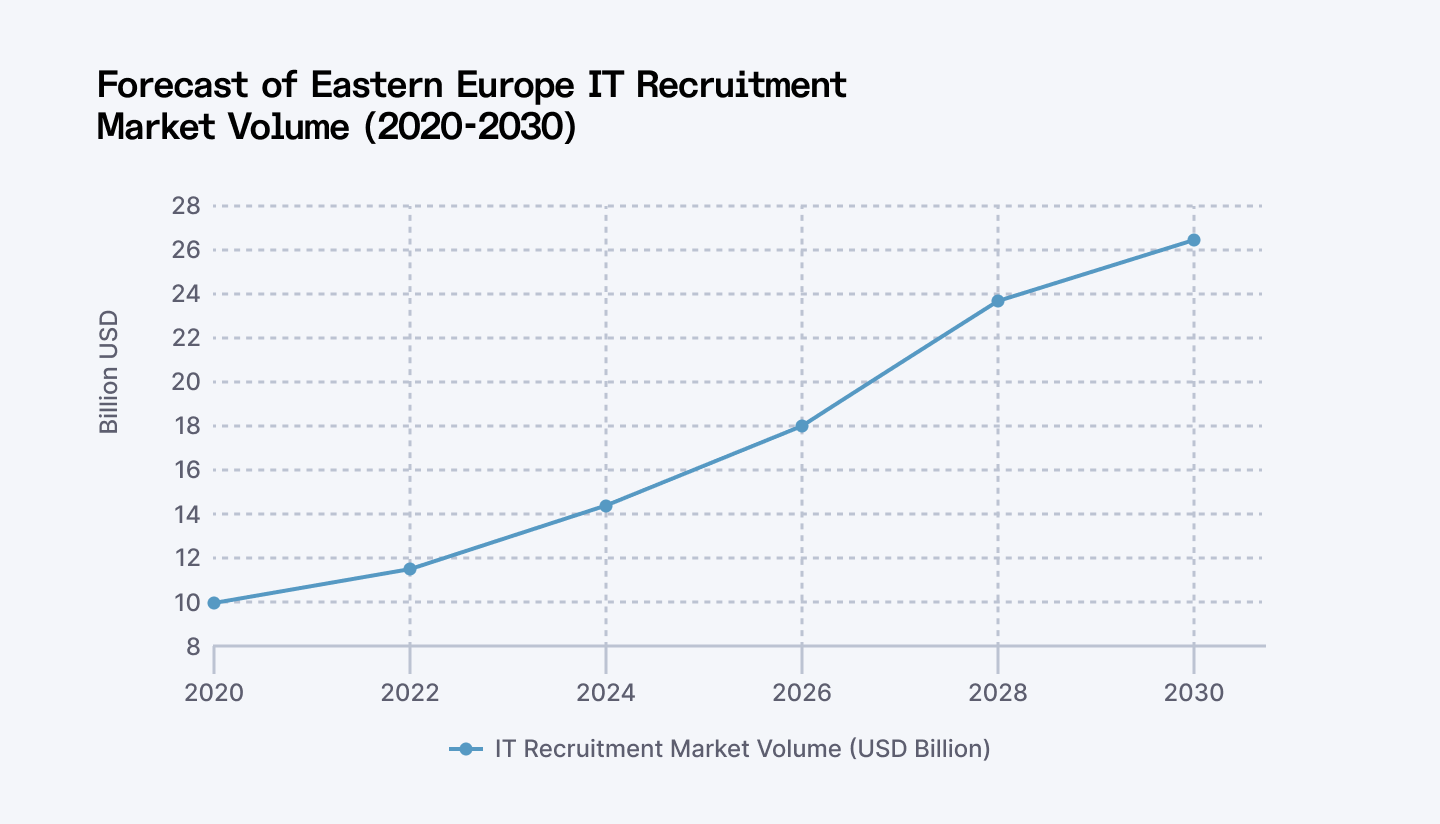
- Eastern Europe IT services market projected at $16B in 2026, $23.7B by 2028 — driven by EU-funded digital programs (Romania NRRP, Digital Bulgaria 2030) and continued nearshoring from Western Europe.
- 2–6 hour time-zone overlap with London, Berlin, and the US East Coast — making same-day handoffs realistic in a way that LATAM or APAC nearshoring struggles to match for European clients.
- Index.dev places the top 1% of 2.5 million screened candidates in 48 hours — 27,000+ human-interviewed engineers, 95% successful placement rate, 30-day free trial.
Introduction
Eastern Europe has undergone a remarkable transformation over the past decade. Once viewed as a peripheral region, it now sits at the front of European tech innovation and IT outsourcing. Today, when you think about IT recruitment in Eastern Europe, you are not just accessing a large talent pool — you are tapping into a market shaped by strong educational systems, cultural compatibility with Western businesses, and competitive pricing. In this guide, we share the research and insights you need to navigate the Eastern European tech recruitment landscape successfully.
Hire elite IT talent from Eastern Europe through Index.dev with 48-hour matching, a 30-day free trial, and access to the top 1% of vetted developers from a pool of 2.5 million screened candidates.
Eastern Europe’s Thriving IT Market
Rapid Market Expansion and Growth
Remember when Silicon Valley was your only option for top-tier tech talent? Those days are long gone. Let us look at the numbers. The IT recruitment market in Eastern Europe has scaled from $9.93 billion in 2020 to roughly $14.4 billion in 2024, with industry projections pointing to about $16 billion by the end of 2026 and $23.7 billion by 2028. So what is driving the climb?
This expansion is propped up by strong government initiatives — Romania’s National Recovery and Resilience Plan and the follow-on Digital Bulgaria 2030 programme, which succeeded the original Digital Bulgaria 2025 plan — that modernise digital infrastructure, expand STEM places at universities, and channel EU funds into deep-tech R&D.
Foreign Direct Investment Boost
Foreign direct investment is a clean signal of how the region is being valued. Poland pulled in roughly $29 billion in FDI in 2023 (and remained the CEE leader through 2025), anchored by landmark plays like Intel’s $4.6 billion semiconductor facility near Wrocław. Romania, meanwhile, posted record FDI inflows above $9 billion in 2024 alone, with global tech employers continuing to scale Bucharest and Cluj engineering centres.
A Vast and Renewing Talent Pool
According to industry reports, Eastern Europe boasts a talent pool of over 1.5 million software developers. Leading nations like Poland, Ukraine, and Romania graduate around 80,000 STEM students every year. Top universities — recognised in global rankings — make sure the region’s workforce is both large and highly qualified in cutting-edge technologies such as JavaScript, Python, Rust, C++, cloud computing, AI/ML, and cybersecurity.
Why Choose IT Recruitment in Eastern Europe?
Quality and Technical Expertise
Eastern European developers come out of rigorous STEM education systems that produce technically adept professionals. Prestigious institutions in Poland (University of Warsaw), Ukraine (Taras Shevchenko National University of Kyiv), and Romania (Politehnica University of Bucharest) produce highly skilled graduates proficient in:
- Full-stack development using modern JavaScript and TypeScript frameworks
- Cloud computing and DevOps practices (AWS, Azure, GCP, Kubernetes)
- Artificial intelligence, machine learning, and LLM application engineering
- Cybersecurity and data protection (GDPR, NIS2, EU AI Act)
- Emerging technologies like blockchain, edge computing, and IoT
This produces a workforce that excels in core technologies and in newer fields like LLM tooling and cloud-native engineering. For example, this LinkedIn analysis notes that developers in Poland, Ukraine, and Romania have a strong track record of delivering production-grade software for global clients.
Cultural Affinity and Communication
A significant advantage of IT recruitment in Eastern Europe is the cultural compatibility with Western businesses. High English proficiency (above 90% among IT specialists in the major hubs) and shared work culture with Western markets lead to smoother communication and collaboration — a real factor when integrating remote teams with global headquarters. This cuts cultural friction and supports efficient project integration.
Competitive Pricing and Cost Savings
Even as salaries rise, Eastern Europe remains cost-effective and substantially cheaper than Western Europe or North America. Companies can land up to 40% fully-loaded cost savings while still accessing high-performing senior talent.
Geographic and Time Zone Benefits
Eastern Europe’s location gives you a 2–6 hour time-zone overlap with both Western Europe and the US East Coast. Real-time collaboration is easier here than with LATAM or APAC offshoring, and same-day handoffs are realistic, keeping project communication prompt and effective.
Read also: Cost to Hire Python Developers in 2026: CEE, LATAM & Asia
Deep Dive: Regional Tech Hubs and Their Specialisations
Eastern Europe is home to several prominent tech hubs, each with its own industry focus and compensation profile. These hubs offer significant cost savings versus Western markets, backed by a rich ecosystem of top universities and R&D centres.
1. Overview of Regional Tech Hubs
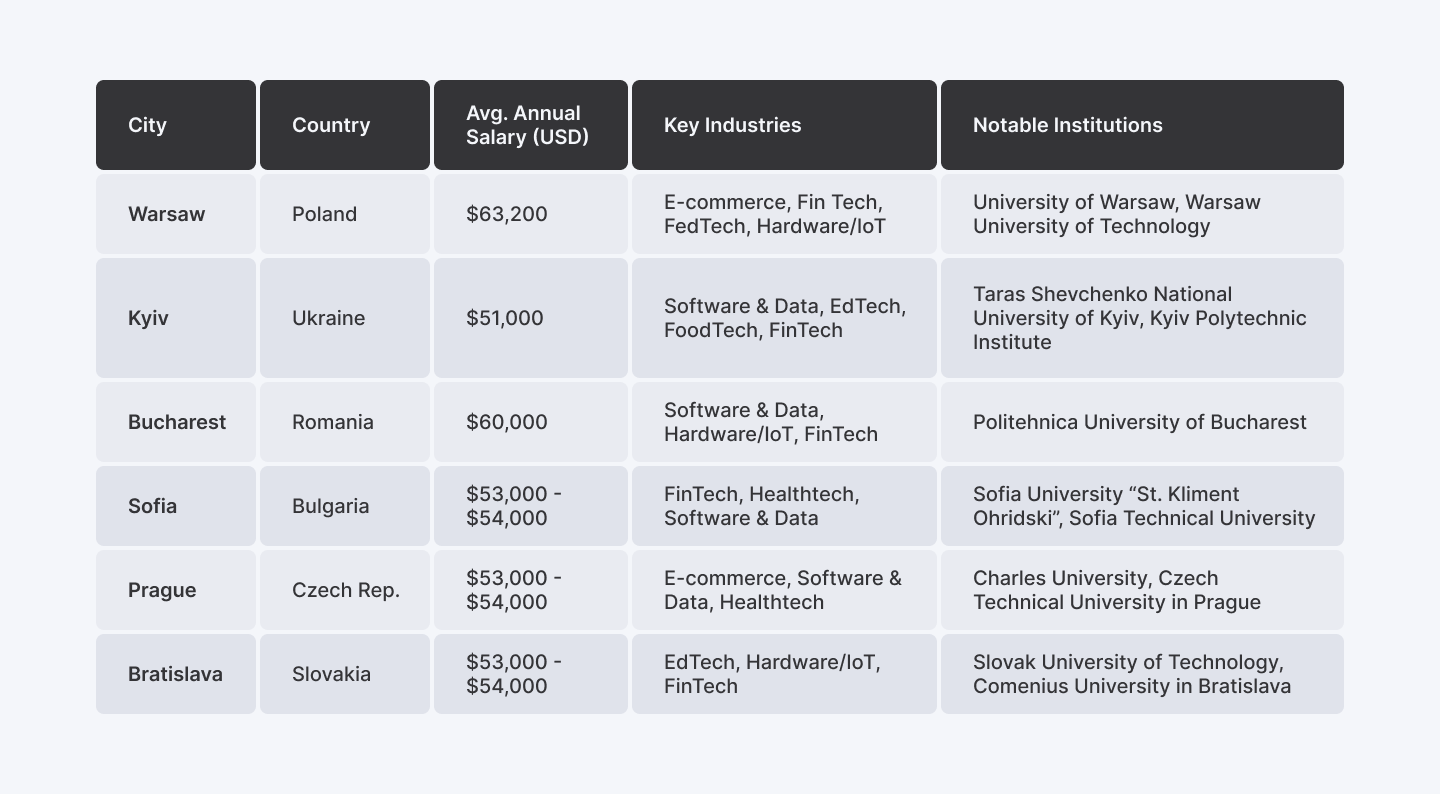
- Warsaw, Poland: Warsaw leads in e-commerce, FinTech, FedTech, and Hardware/IoT. The city pulls from a deep talent pipeline anchored by the University of Warsaw, with average annual developer salaries of about US$66,000.
- Kyiv, Ukraine: Known for excellence in software & data, EdTech, FoodTech, and FinTech. Kyiv hosts top institutions like Taras Shevchenko National University and Kyiv Polytechnic Institute, with developer salaries averaging around US$54,000.
- Bucharest, Romania: A vibrant hub for software & data, Hardware/IoT, and FinTech. Anchored by Politehnica University of Bucharest, the average salary sits at roughly US$63,000.
- Other Key Cities (Sofia, Prague, Bratislava): Specialised expertise in FinTech, health-tech, and hardware innovation, with annual salaries typically in the US$55,000–US$58,000 range.
The variety of tech specialisations across Eastern Europe lines up well with different project profiles. Warsaw and Kyiv are well-suited to large-scale enterprise platforms; Bucharest is strong on cybersecurity engineering; Prague has deep healthcare-tech expertise. Salary ranges are competitive throughout, offering significant cost advantages over Western markets while quality stays consistently high.
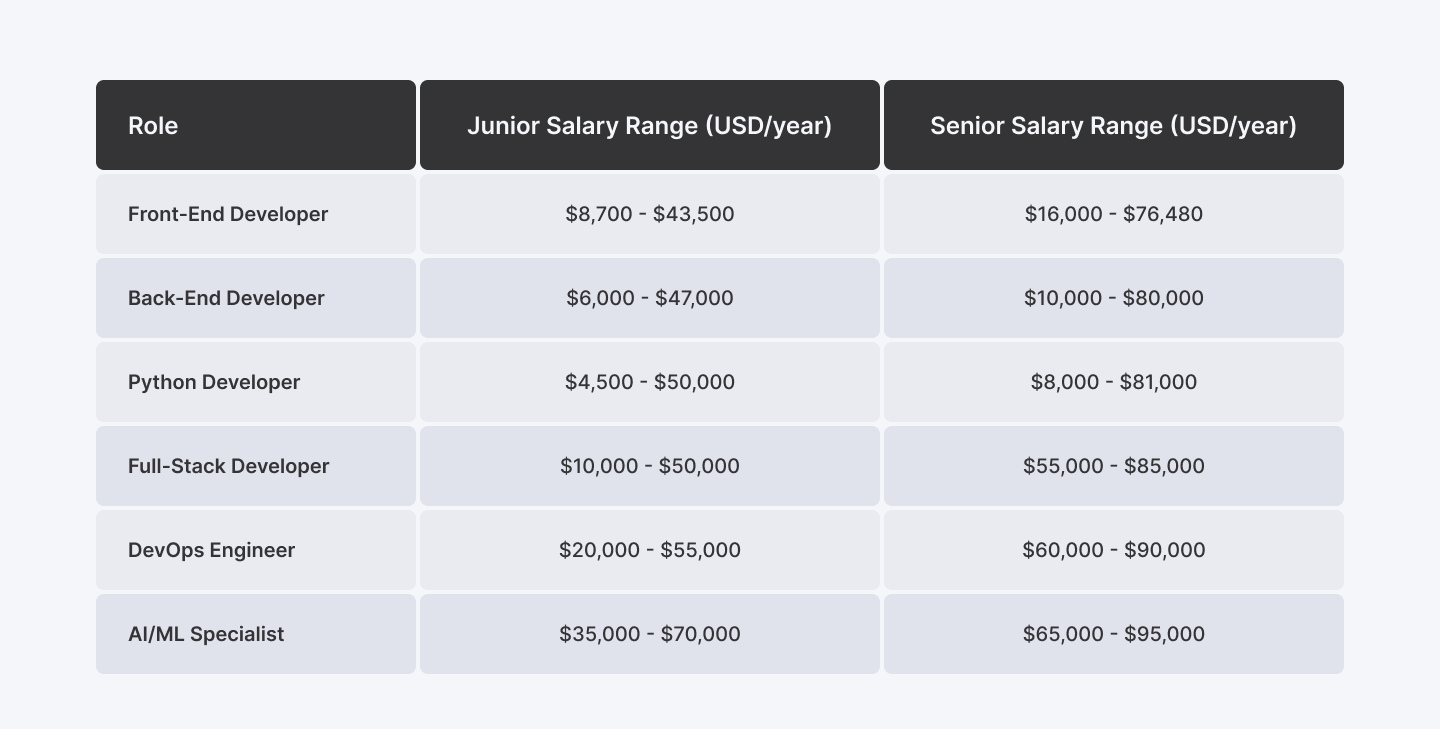
Note: these figures represent up to 40% cost savings compared to Western markets, where similar roles routinely command significantly higher salaries.
Each of these hubs brings its own combination of specialised talent, educational excellence, and cost advantages. When picking a location, weigh local ecosystem, technical specialisation, and university strength alongside the headline salary number.
2. Role-Specific Salary Trends
Eastern European salary levels vary widely based on skills, experience, and location. Even though Eastern European salaries sit below Western markets (a senior back-end developer in the US runs $130K–$160K annually), the gap still translates to up to 40% cost savings without compromising on quality. The ranges below, aggregated from Glassdoor, Payscale, Numbeo, and national labour statistics, reflect current 2026 market data:
| Seniority | Eastern Europe (annual USD) | US in-house (annual USD) |
|---|---|---|
| Junior developer | $18,000 – $28,000 | $95,000 – $120,000 |
| Mid-level developer | $32,000 – $50,000 | $120,000 – $160,000 |
| Senior developer | $55,000 – $85,000 | $155,000 – $200,000 |
| Tech lead / staff engineer | $80,000 – $120,000 | $200,000 – $260,000 |
These figures show that while Eastern European IT professionals are paid significantly less than their Western counterparts, the region delivers world-class technical expertise and consistently high performance.
3. Cost Savings Without Compromise
By choosing Eastern Europe, companies can achieve:
- 30–50% cost savings compared to Western Europe
- 40–60% savings compared to US in-house rates
Remote-first engagements also cut office space and infrastructure spend, further compounding the savings.
Read also: Top 5 Countries in Eastern Europe to Outsource Software Development (2026 Edition)
Want vetted Eastern European engineers without managing the hiring funnel?
Index.dev runs the screening so you do not have to: 27,000+ human-interviewed engineers, the top 1% of 2.5 million candidates, a 95% successful placement rate, and a 30-day free trial. Most clients receive matched candidates within 48 hours.
IT Outsourcing and Recruitment Trends
Rising IT Outsourcing Market
IT outsourcing remains a core pillar of Eastern Europe’s tech industry, with the regional outsourcing market projected to clear roughly $7 billion in 2026 and Statista forecasting volume above $7.5 billion by 2029. Companies in Western Europe and North America continue to outsource IT functions to tap the region’s skilled workforce and cost advantages.
Remote and Hybrid Work Adoption
The shift to remote work has held in the region. According to Eurostat, about 22% of EU employees now work remotely at least some of the time, and the figure trends higher in tech-heavy sectors. Eastern European professionals integrate cleanly into distributed and hybrid teams, supported by robust digital infrastructure and flexible work practices.
Integration of AI in Recruitment
Modern recruitment platforms now use AI and large-scale skills-graph models to match candidates to roles more accurately. These tools cut time-to-hire and surface the best candidates — both technically and culturally — at the top of the funnel. Gartner expects 80% of mid-to-large hiring teams to use AI-driven screening as a default by the end of 2026.
Addressing Challenges and Opportunities
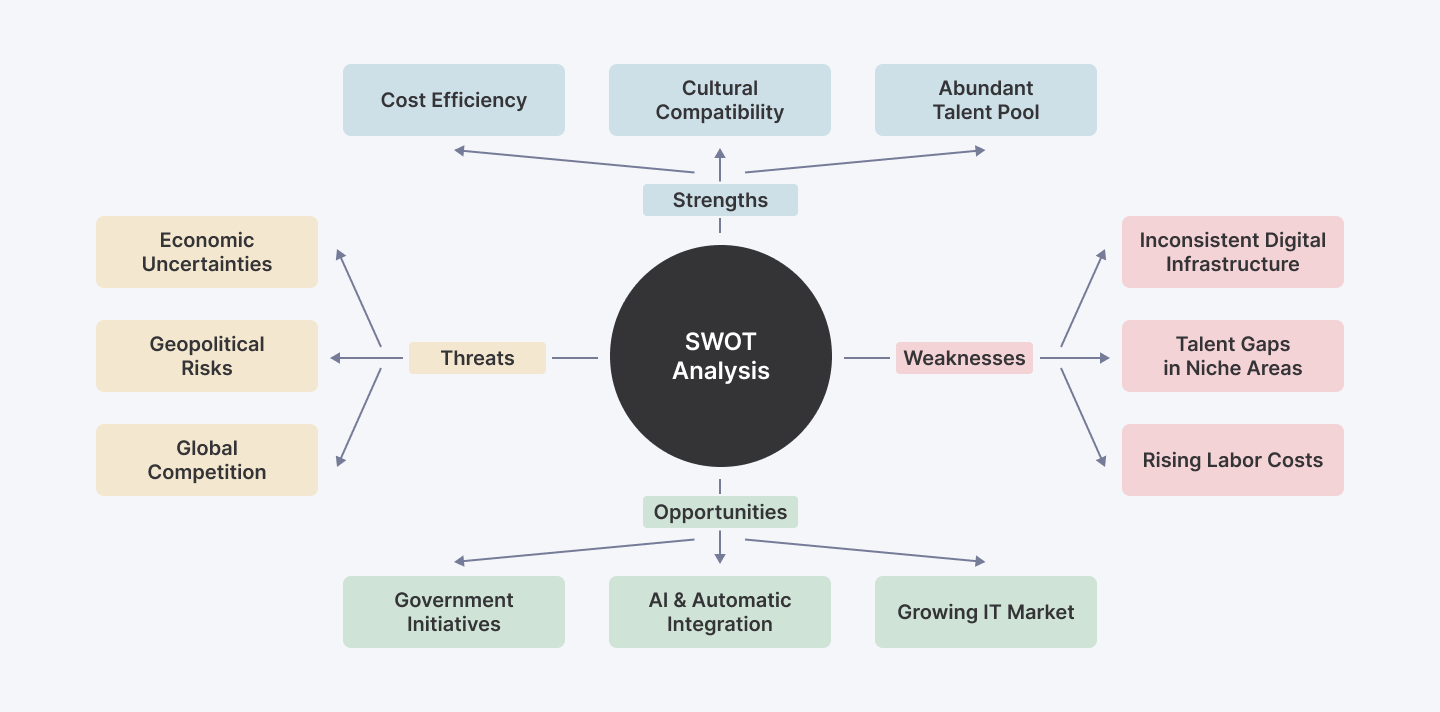
Despite the upside, the region still faces real challenges: talent gaps at the senior level due to fierce competition for experienced developers, and steadily rising labour costs in the leading hubs. The standard playbook for handling this is partnering with local recruitment specialists, R&D centres, building dedicated long-tenure engineering teams, and investing in continuous upskilling.
Read also: 5 Worrying Workplace Trends Managers Can’t Ignore in 2026
To overcome these challenges, companies are blending several strategies. Partnering with local R&D centres and IT recruitment companies opens up access to talent and local-market insight. Building dedicated engineering teams gives you more control over delivery and protects intellectual property. Many companies also focus on creating a business-friendly environment, paying competitive salaries and benefits, and investing in upskilling and training programmes.
SWOT Analysis of IT Recruitment in Eastern Europe: the diagram above gives an at-a-glance view of strengths, weaknesses, opportunities, and threats when recruiting IT talent from Eastern Europe — abundant talent and cost advantages on one side, regional and macro pressures on the other.
Factors Influencing These Trends
- Cost of living and local economic conditions: In most Eastern European countries, lower living costs mean comparatively modest salaries still buy a high quality of life. That said, rising inflation and intensifying demand for IT professionals continue to push wages upward each year.
- Government initiatives and investment: Programmes like Romania’s National Recovery and Resilience Plan and the new Digital Bulgaria 2030 strategy (the follow-on to Digital Bulgaria 2025) are modernising the IT sector, lifting education quality, and improving infrastructure. These efforts grow the talent pool and lift average salaries.
- Global demand for skilled talent: With more than 1.5 million developers in the region, Eastern Europe is still the first call for many Western European and North American companies looking to outsource IT work. Competitive pressure from that global demand keeps wages climbing.
- Experience and specialisation: Junior developers naturally earn less than mid-level and senior peers. Specific skills (cloud computing, AI/LLM tooling, cybersecurity) command meaningful pay premiums and widen the salary spread.
Reference: European Parliament briefing on Eastern Europe digital transformation
How to Get Started
Immediate Actions
- Assessment: Evaluate your current tech needs and skill gaps.
- Research: Identify target countries and cities based on your requirements.
- Strategy: Develop a recruitment timeline and budget.
- Partnership: Choose between direct hiring or working with a vetted talent partner.
- Implementation: Start with a small pilot team before scaling up.
Long-term Planning
- Establish local legal entities or use an EOR partner where needed.
- Develop career-progression frameworks for retained engineers.
- Create knowledge-transfer programmes between core and extended teams.
- Build cultural-integration initiatives so distributed teams operate as one.
Best Practices for Successful IT Recruitment
Leveraging Vetted Talent Platforms
Platforms such as Index.dev have changed IT recruitment in Eastern Europe by surfacing pre-vetted, high-performing engineers from across the region. Index.dev’s screening process is famously selective — only the top 1% of 2.5 million candidates make it through, with a sub-3% acceptance rate and a 95% successful placement rate.
Tailoring the Hiring Process
Customise your recruitment strategy to the regional nuance. That often means working with local HR experts who understand the market, cultural norms, and legal frameworks — cutting onboarding time and lifting team cohesion from day one. It also means tightening how you find people in the first place. Local market knowledge pairs naturally with semantic search for engineers, which reads what a developer can actually build instead of stopping at the keywords on their CV.
Emphasising Long-Term Engagement
Rather than relying only on short-term contracts, build long-term relationships with hires. Long tenure improves productivity, protects intellectual property, and keeps retention rates high.
Optimising Communication
Deploy collaboration tools like Slack, Jira, Linear, and Notion to bridge the physical distance between teams. Regular virtual meetings and in-person team-building offsites significantly boost morale and keep project execution smooth.
Success Metrics That Matter
Track your recruitment success through:
- Time-to-hire reduction
- Quality of technical output
- Team retention rates
- Project delivery effectiveness
- Return on investment per engineering seat
Case Studies and Success Stories
Case Study 1: Ciklum’s Strategic Expansion
Ciklum, a global software engineering partner, leveraged IT recruitment in Eastern Europe to shorten project timelines by 30% while keeping output quality high. By tapping local talent in Ukraine and Poland, they filled skill gaps quickly and brought fresh ideas into their projects. It is a clean illustration of the tangible benefits of tapping Eastern Europe’s talent pool.
Case Study 2: Luxoft’s Agile Team Building
Luxoft, a leading IT service provider, scaled its development teams across Eastern Europe by combining staff augmentation with embedded delivery. The result: a 25% improvement in project performance and a much faster ramp into new domains — proof that agile IT recruitment in Eastern Europe pays off in fast-moving industries.
Case Study 3: Zebra Technologies’ Cost-Effective IT Outsourcing
Zebra Technologies cut time-to-market by 40% by outsourcing software development to Eastern European specialists. The move let them tackle complex IoT and cloud-computing challenges at a fraction of the cost of equivalent Western hires.
Read also: India vs Latin America vs Eastern Europe for IT Outsourcing (2026 Edition)
The Future of IT Recruitment in Eastern Europe
Looking ahead, the trends point to continued growth and evolution in IT recruitment in Eastern Europe:
- Stronger talent matching: AI-driven tools will refine candidate selection further, producing more precise role alignment.
- More hybrid work models: As companies tune their remote-work strategies, Eastern European talent will continue to slot into global teams cleanly.
- More investment in tech hubs: Continued government and private investment will keep upgrading infrastructure and training, lifting the region’s competitive edge.
- Expansion of IT staff augmentation: Flexible engagement models will become the default, giving companies the agility to scale teams up and down as needed.
What the 2026 Data Says
- Eastern Europe IT services market: ~$16B in 2026, ~$23.7B by 2028 (Statista, internal industry projections).
- Developer pool: 1.5M+ active engineers; ~80,000 STEM graduates per year across Poland, Ukraine, and Romania.
- Remote work share: ~22% of EU employees work remotely at least some of the time (Eurostat 2025).
- Cost delta: 30–60% lower fully-loaded cost than equivalent US in-house engineers, with up to 40% savings on senior roles even after benefits and EOR fees.
- Time-to-hire via vetted platforms: 48 hours from brief to matched candidate on Index.dev, against an industry average of 4–6 weeks for direct hire.
Conclusion
Eastern Europe is more than just a talent pool — it is your gateway to building a world-class tech team while keeping cost efficiency tight. The region’s IT recruitment market delivers exceptional value through affordability, top-tier technical expertise, and seamless cultural integration with Western markets. That makes it a strategic cornerstone for any global tech initiative in 2026.
Success in Eastern European IT recruitment is not just about finding the right talent — it is about building sustainable partnerships that drive long-term growth. The strategies and insights above should leave you well-equipped to make informed decisions that shape your company’s technical future.
Ready to take the next step in your tech team’s evolution? Embrace the opportunity, adopt modern recruitment workflows, and let Eastern European engineers power your next phase of growth.
For Developers
If you are an engineer in Poland, Ukraine, Romania, Bulgaria, Hungary, or Czechia, Index.dev is one of the most selective routes into long-term remote roles with European and US clients.
- Top 1% of 2.5 million candidates make it through screening — sub-3% acceptance rate.
- Join a community of 27,000+ human-interviewed engineers.
- Long-term contracts with vetted clients, paid in USD/EUR.
For Clients
Hire vetted Eastern European engineers through Index.dev and skip the recruiting funnel entirely.
- 27,000+ human-interviewed engineers across Eastern Europe, LATAM, and global markets.
- Top 1% from 2.5 million candidates, with a sub-3% acceptance rate.
- 95% successful placement rate and 48-hour match time.
- Save up to 40% on hiring costs versus US in-house rates.
- 30-day risk-free trial — pay nothing if the match does not work out.