“The only thing of real importance that leaders do is to create and manage culture. If you do not manage culture, it manages you, and you may not even be aware of the extent to which this is happening.” — Edgar Schein, Organizational Culture and Leadership
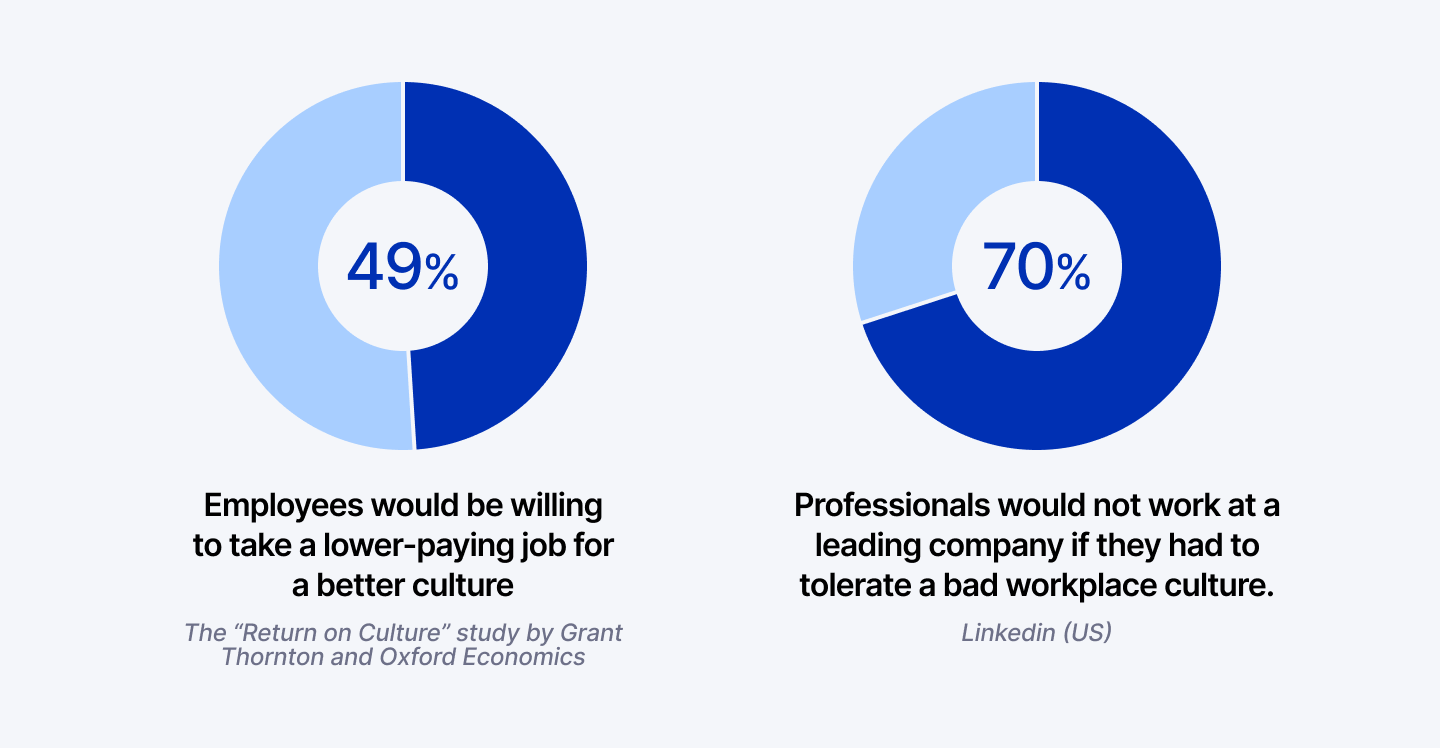
Company culture is the shared set of values, goals, attitudes, and practices that define how work gets done in your organization, from how you handle a missed deadline to who you choose to promote. It is the personality of your business. It is the glue that holds your team together when things get hard.
You cannot dictate culture through an executive memo, and you certainly cannot set it and forget it. Culture is alive, constantly evolving, and remarkably unforgiving.
If you want a high-performing team, stop treating culture as an HR project. It belongs entirely to you. Your team watches your every move, measures your every word, and copies your behavior. If they do not see your cultural goals embodied in you, their immediate leader, your culture will rot from the inside out.
There are countless guides out there promising three, five, or seven steps to a thriving culture. I suggest you concentrate on these six golden rules. They are not easy. They are not comfortable. But they work.
Rule 1: Make Your Values Earn Their Place
Most corporate values are complete fiction. Executives sit in a retreat, pull snappy bullet points from Netflix or Amazon decks, and slap them on the wall. They mistake cool phrases for identity.
Values copied from somewhere else are just words. They carry no weight because they carry no history. Netflix's values work for Netflix because they grew out of specific bets that the company made, about talent density, about risk, about how much rope to give smart people. Your company hasn't made those same bets. Why would you inherit the same values?
People spot fake culture instantly. They know the difference between a value that's lived and one that's borrowed. When leadership preaches "innovation" while punishing every failed experiment, or claims to value "customer obsession" while cutting support staff to hit quarterly numbers, you've already lost the room.
So where do real values come from? Not from a leadership offsite with sticky notes and a facilitator. They come from your company's actual history. The hard calls you made in year one. The way your founders handled the first crisis. The kind of people your best performers are, not the kind you wish they were.
The values exercise should start with questions, not answers. Ask your longest tenured employees what made them stay. Ask the people who left what pushed them out. Pull the pattern from real behavior, not from a competitor's careers page. That pattern is your culture, whether you like it or not. Your job is to name it honestly, then build on it.
Rule 2: Hold People Accountable
Culture lives or dies by what you tolerate. And it becomes real only when it is enforced. This starts with you, not HR. HR can support it. HR can measure it. HR can build systems to reinforce it. But leadership owns the behavior that sets culture. Every single day, in every decision.
First, own it. Be accountable for it yourself. Your team watches you. They see what you tolerate. They see what you reward. They see what you ignore.
Second, look at all your major decisions through the lens of culture. Just as you submit them to financial and regulatory scrutiny. Make culture as important to the red light green light verdict as revenue, compliance, or timelines.
Third, hire for fit as well as competence. Promote for fit as well as results. Listen carefully for what resonates and what causes dissonance. Be open to feedback, even when it hurts. Especially when it hurts.
Living your culture means making hard, expensive choices. If keeping a promise costs you margin, you pay it. If a high performer treats colleagues like dirt, you fire them. When people see that values are taken seriously, they take pride in living them. Accountability, delivered with fairness and care, turns culture from a statement into a shared standard of excellence.
Rule 3: Build Trust Through Transparency
Most leaders think transparency means holding quarterly town halls with polished slide decks. It is not. Real transparency is ugly, uncomfortable, and raw. It is admitting you missed a revenue target before the board asks, or telling your team you do not know the answer when a strategy fails. When you admit your missteps, you show that truth matters more than ego. You signal that it is safe for others to do the same and it’s exactly what makes people follow you when things get hard.
If you only share good news, your people will assume you are hiding the bad stuff. And silence creates suspicion. In the absence of information, human beings always fill the gap with worst-case scenarios.
Trust starts with you trusting yourself first, your own integrity, your intent, your character and your competence, whether your skills match what you claim, whether you follow through. If people doubt any one of these, trust crumbles.
So how do you build it?
Share information proactively. Do not wait for people to ask. Do not drip feed the hard stuff. Explain the why behind your decisions and walk people through how you made them.
Admit what you do not know. Say I do not have the answer yet. Say we are still figuring this out. Your team does not need you to be flawless. They need you to be real.
Own your mistakes. Publicly. Acknowledge specifically what went wrong, take full responsibility without deflecting, and explain what you learned. Share what you will do differently.
Every time you choose honesty over comfort, communication over silence, and accountability over blame, your culture grows stronger.
Learn more: Explore how to structure engineering teams when growth starts breaking things so your tech stack and company culture can scale seamlessly together.
Rule 4: Make Failure Safe to Improve Agility
Every company has a front and a back. Up front, your customer facing teams move fast, adapt constantly, chase what the market demands this week. In the back, finance, operations, HR, everything moves slower, often for good reason. Regulations don't shift with trends.
This often creates dysfunction. Your front end is trying to innovate while your back end is built to prevent risk. The result. Great ideas die in committee. Or worse, people learn to game the system just to get approval.
My honest opinion. Most leaders obsess over the visible culture, the front end energy, the mission statement, the values on the wall, while completely ignoring the invisible plumbing running underneath it. That's a mistake. Your back end systems either support the agile culture you want or they slowly strangle it. There's no third option.
So what should you do instead? Build small, low risk ways for people to test new ideas without needing permission from five layers up. Treat a smart failure as data, not a mark against someone's name. Redesign incentives so effort gets noticed, not smoothed out into an average everyone shares equally.
Do that, and agility stops being a value you claim. It becomes something your whole organization practices, front to back.
Rule 5: Give People Room to Lead
If your people come to you for permission on basic decisions, you do not have a team of owners. You have a team of order-takers. True empowerment is not about stepping back and hoping for the best. It means being crystal clear on the outcome you need, then getting out of the way of how it gets done. That's the hard part for most leaders. Letting go of the how.
Micromanagement is usually fear disguised as high standards. When you hoard control, you create a bottleneck that slows down the entire business. People stop thinking for themselves because they know you will rewrite their work anyway. That kills initiative faster than anything else.
Here's my take. Real empowerment isn't the absence of accountability, it's accountability pushed down to where the work happens. People who own a decision feel it differently than people who just execute one. They notice the details. They fix the small things nobody asked them to fix. That's not because they're better employees. It’s because the work is actually theirs.
Trust is the trade here. You give trust, you get initiative back. Withhold it, and you get compliance at best. Most leaders say they want initiative while structurally rewarding compliance. That mismatch is where cultures quietly break down.
Give people real ownership, not the appearance of it, and something shifts. They stop waiting for permission. They start driving the thing forward on their own. That's the whole point.
The Seven Pillars Every Strong Culture Has In Common
Strip away the perks, the swag, the values posters, and every strong culture I've ever seen shares the same underlying structure and foundations. Here's what holds it up.
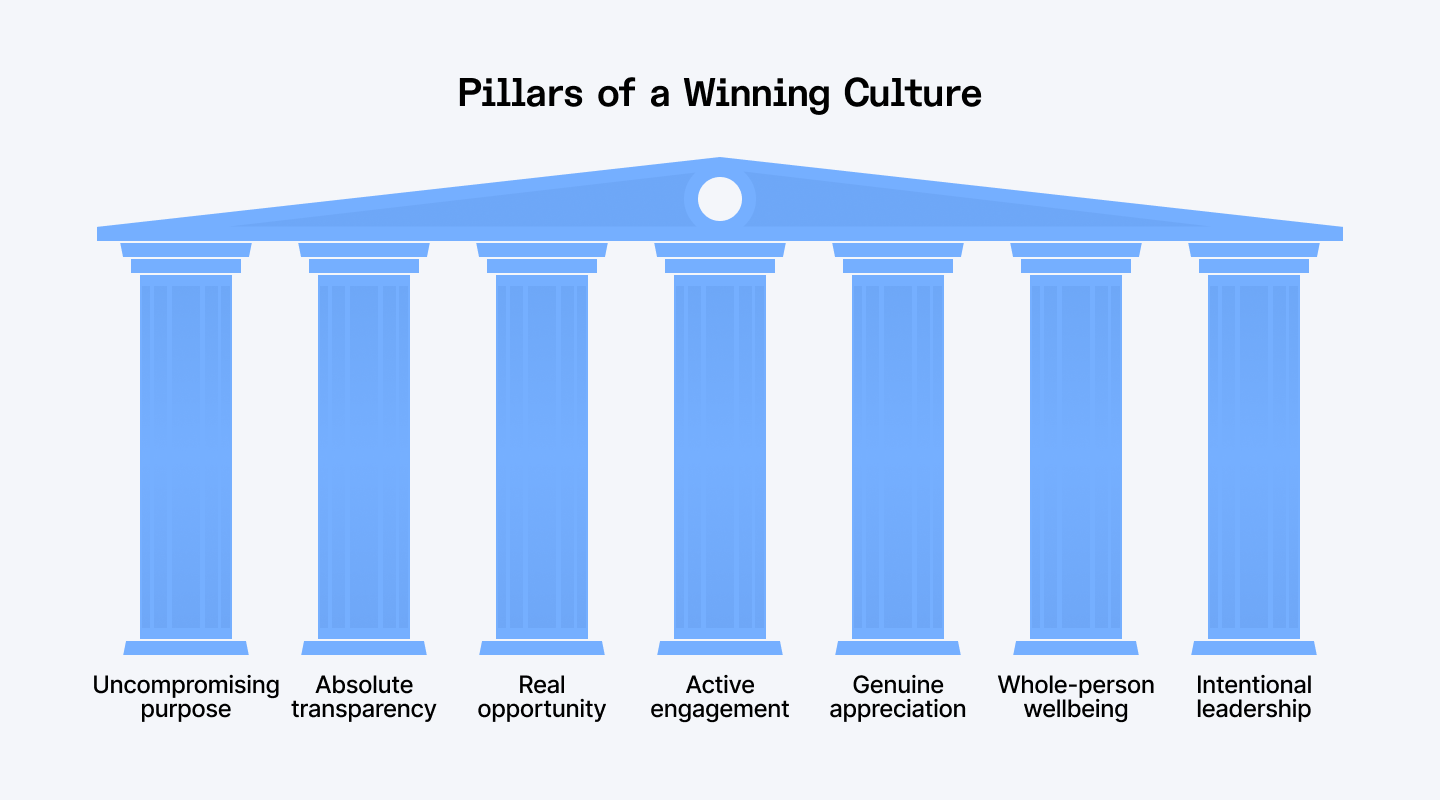
Uncompromising purpose. People don't wake up excited to hit a quarterly number. They wake up for meaning. Connect someone's daily work to why it matters and you get a different level of effort entirely.
Absolute transparency. Trust is built when you share raw numbers, explain tough trade-offs, and stop treating your team like children who cannot handle bad news.
Real opportunity. True opportunity is autonomy, flexibility, and hard problems to solve. Give your people space to stretch their capabilities and own their projects. If they are not building mastery on your watch, they will go build it somewhere else.
Active engagement. Roughly 70% of people say their sense of purpose comes from work. Yet only about 15% of frontline employees and managers feel they can live that purpose on the job. Engagement happens when you stop managing tasks and start connecting individual contributions directly to the primary mission.
Genuine appreciation. Throwing an annual recognition event is useless if your managers ignore great work 364 days a year. People need to feel seen in real time. Acknowledge the specific behavior, highlight the impact, and do it publicly.
Whole-person wellbeing. Wellbeing is not a meditation app subscription. Treat people as whole humans, not job functions. Their emotional and physical state doesn't stop at the office door, and pretending otherwise is naive leadership, honestly.
Intentional leadership. Your managers are the actual face of your culture. They are not there to monitor timecards or track status updates. Their job is to mentor, clear roadblocks, and advocate for their teams. Invest heavily in coaching your leaders, because a toxic manager will destroy the six other pillars single-handedly.
Up next: Discover why employee engagement is falling in the AI era and how to fix it before your top tech talent tunes out.
Final Thought: Never Stop Reassessing Your Leadership
Here's the last thing I'll say. Culture never graduates. You never arrive at "done."
Every strategy we've walked through, owning your values, holding people accountable, building trust through honesty, learning from what fails, handing people real ownership, none of it works as a one time fix. It's not a project with an end date. It's a practice. And that practice starts with you, not your team.
Your people won't grow past where you've stopped growing. If you're not learning, not adjusting, not willing to be wrong in front of them, you can't expect them to take risks either. Leadership sets the ceiling for how much culture evolves. That's a heavy thing to sit with, but I believe it's true.
So keep developing. Not because it looks good on a leadership bio, but because your team is watching how you handle not knowing something, how you adapt when the old playbook stops working. That's the real lesson, more than any value statement you'll ever write.
➡︎ Strong teams need more than great people. Index.dev gives you flexible engineering capacity through a verified senior talent network, software delivery expertise, and AI focused teams. Build the team your culture deserves.