For years, open source AI carried a kind of apology with it. You reached for it when the budget was tight, when procurement was too slow to wait for a vendor contract, or when your team just wanted to poke around without shipping sensitive data to someone else's server. Fair enough, at the time. But that story is getting old fast.
Open models got good. The tooling around serving them matured into something a mid-size engineering team can run without a PhD in distributed systems. Local runtimes stopped being a hobbyist's weekend project and became a normal line item in a deployment plan. And the agent layer, the part everyone assumed only the well-funded labs could pull off, is now showing up in public repos faster than the commercial vendors can respond to.
None of this means open models have caught up on every benchmark. They haven't, quite. Stanford's own numbers put the frontier gap at a few percentage points, and depending on how you measure it, open models still trail by a matter of months. If you're chasing the single best score on the hardest exam, closed still wins.
But that was never really the question. The question is whether the gap still justifies the price, the lock-in, and the loss of control. And for a growing number of teams, the answer is no. You don't need the best model in the world. You need the one you can run on your own terms, audit when something goes wrong, and not have to ask permission to change.
Scale your AI team with Index.dev →
Intelligence Shouldn't Belong to a Few Companies
Proprietary AI asks you to surrender your core operational independence to a few vendors on the West Coast or in China. That works fine for a simple customer service chatbot. It fails completely when AI becomes the primary digital infrastructure mediating all human knowledge, enterprise workflows, and cultural data.
Proprietary AI is now too expensive and too centralized for most countries and companies to rely on as their core stack. Yann LeCun, ex-Meta’s chief AI scientist, put it bluntly at UN Open Source Week. He called open source AI the only viable path to global AI sovereignty, cultural and linguistic diversity, and long term safety. If a handful of proprietary systems from the West Coast and China mediate most of our interaction with information and the digital world, you get a dangerous concentration of power that erodes democracy, human rights, and local culture. The fix is not to hope for benevolent vendors. It is to build and contribute to shared open platforms that let every region digitize its own material, fine tune on its own data, and participate in a global model without handing over raw datasets.
Mark Zuckerberg has framed this moment with an older analogy. Unix used to mean a few companies shipping closed, incompatible versions until Linux quietly became the backbone of the internet. Open source AI could play a similar role, but the analogy is not exact. Most open AI models still keep training data private, so outsiders can inspect the weights without fully knowing how the system was made.
That's really the story underneath all of this. It's not one clean fight between open and closed. It's a dozen separate layers of how AI gets built, run, and paid for, all becoming contestable at once. Who trains it. What hardware it runs on. What architecture sits inside it. What data it learned from. What even counts as a "model" anymore. Where it physically lives. What the internet itself is made of, going forward. Every one of those layers used to feel settled. None of them are anymore.
Slow in the Boardroom, Explosive Everywhere Else
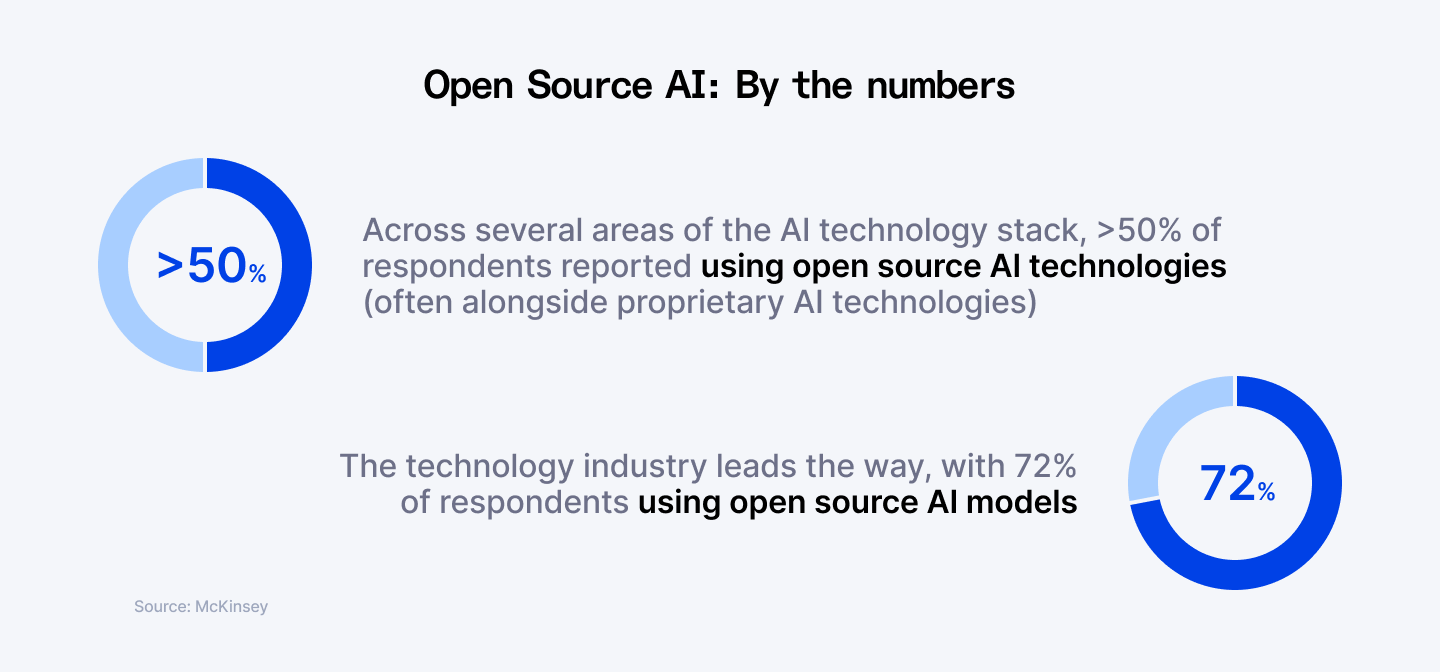
Enterprise use of open source models actually shrank last year. Menlo Ventures found open source LLMs held just 11% of enterprise production API usage in 2025, down from 19% the year before. If you only looked at that number, you'd conclude open source is losing.
You'd be wrong, though, or at least only half right. Large companies still lean toward closed vendors for managed service and lower operational burden. That’s what they do first. Yet developer interest has shifted hard toward Chinese model families and platforms such as Qwen from Alibaba, DeepSeek's V3 and R1 series, Kimi from Moonshot AI, MiniMax, and GLM from Z.ai.
The public ecosystem tells a different tale. Hugging Face's Spring 2026 review puts its network at 13 million users, with more than 2 million public models and over 500,000 public datasets, and more than 30% of the Fortune 500 now holding verified accounts. A public market for open source AI components is taking shape, and it is growing fast.
And the performance story keeps tightening too. Stanford's 2026 AI Index notes the best closed model led the best open model by just 3.3% as of March 2026, with six of the top ten on the Arena Leaderboard still closed but the floor for open models rising sharply. In February 2026, Zhipu AI shipped GLM 5, a 744 billion parameter open model that rivals GPT 5.2 and Claude Opus 4.5 on key benchmarks, and it was trained from start to finish on Huawei Ascend hardware with zero Nvidia dependency. A few weeks ago, Moonshot AI released Kimi K3, a 2.8 trillion parameter model and, as far as anyone can tell, the first open model to cross into the 3 trillion parameter class at all. Add DeepSeek's R1 and V3 line, Alibaba's Qwen family, which now has more derivative models on Hugging Face than Google and Meta combined, and MiniMax's lineup, and you get a pattern that's hard to argue with. This isn't one lab occasionally catching up. It's several labs, mostly Chinese, releasing frontier-class open models on a rhythm closer to monthly than yearly.
So yes, the market is split. Enterprises are cautious, and they have reasons to be. But developers, researchers, and increasingly entire countries are voting with their downloads, and that vote has been running in one direction for a while now. You can call that a contradiction. I'd call it the gap between where the market is today and where it's clearly headed.
Three Cracks That Closed Vendors Can't Patch
Closed vendors still do a lot of things better than open source can, at least for now. Stronger polish, tighter product integration, a single procurement conversation instead of five, and safety layers that took years to build. If you want the best model in the world with the least operational overhead, closed still wins that argument, often by a lot. But cracks have opened up.
The first is COST.
Usage pricing is easy to tolerate in experimentation but much harder to ignore in steady production. Teams serving internal copilots, research workflows, or agent systems can watch a small test turn into a real operating expense with surprising speed. OpenAI and Anthropic keep refining how they meter flagship model usage, long outputs, and tool calls, and every refinement moves cost closer to the surface. Subscriptions aren't immune either. Microsoft now spells out AI credits and feature caps on its consumer Copilot plans. Google's AI Ultra Access includes a monthly credit allotment and even supports paid overages beyond that cap. The more AI behaves like always on infrastructure, the less comfortable buyers become with paying for it as if it were a series of casual chats, and the more they hit what had previously been seen as very generous subscription limits. This does not mean open source is always cheaper in absolute terms. Self hosting brings hardware, engineering, and operations costs of its own. However, for sustained, high volume, or autonomous workloads, many buyers are deciding they would rather own more of the cost structure than stay fully exposed to token billing, subscription usage caps, and the need to pay for overage usage.
Then comes the issue of invisible CONTROL.
Beyond basic data privacy, closed vendors constantly push silent backend updates that alter model behavior overnight. You wake up to find your carefully engineered prompts failing because the provider re-aligned their API without warning. When you run open weight models inside your own architecture, you eliminate model drift completely. You gain full control over data residency, exact versioning, and compliance logging, while bypassing the aggressive, generic safety filters that routinely block legitimate enterprise work.
A third pressure is PLATFORM DEPENDANCE.
Once your systems are built around one vendor's API, you inherit their rate limits, their pricing changes, and their model lifecycle, whether or not any of that suits you. For a lot of the world outside the US, that dependence has started to look less like a convenience and more like a risk. Europe called this out directly. In June 2026, the European Commission adopted a full Technological Sovereignty Package, including a formal Open Source Strategy built specifically to cut the EU's reliance on non-European chips, cloud, and AI providers. That's not a developer preference showing up in a policy paper. That's a government deciding dependence on someone else's stack is itself the risk to manage.
Finally, open ecosystems simply move faster. Every major release is improved by thousands of developers, researchers and companies around the world. New techniques spread in days instead of months. That's becoming one of open source AI's biggest competitive advantages. Innovation is no longer happening inside one lab. It's happening everywhere.
Six Market Realities Making Open-Source AI Unstoppable
1. Nobody Owns the Meter Anymore
Open models are not cheap because of corporate charity. They are cheap because open-weight models are forced to compete in a brutal, free-market race to the bottom.
Back in 2022, running a model with GPT 4 level reasoning cost around $20 per million tokens. Today, equivalent quality costs under 50 cents. When dozens of cloud providers host the exact same open-weight models, they undercut each other on margins until serving compute becomes a standard utility. Nobody controls the meter anymore. That is the literal definition of a commodity.
Watch what that pressure does to a closed lab. Reports around OpenAI's Sora video product in early 2026 showed roughly 15 million dollars a day in inference costs against about 2.1 million dollars in total lifetime revenue. Serving a closed model at scale costs real money every single time someone uses it, and there is no way to spread that cost across a market of competing hosts the way open weights allow. As the model layer commoditizes, the value is migrating up the stack, to whoever owns the workflow, the data, and the relationship with the user, not to whoever owns the weights underneath it.
2. Open Source Doesn't Have to Catch Up Everywhere
Conventional wisdom claims open models only play catch-up to proprietary giants on complex tasks. That myth just died. While closed systems still hold minor edges on ambiguous, qualitative reasoning, open-weight architectures are already setting the global pace in software engineering and competitive math.
DeepSeek's open V4 Pro currently tops LiveCodeBench and holds one of the highest Codeforces ratings recorded for any model, closed frontier systems included. Some of those numbers come from DeepSeek's own launch benchmarks rather than a neutral leaderboard, so take the exact decimal points with a grain of salt. The direction, though, holds up under independent testing too.
Competitive coding and math have a single, machine checkable right answer, which makes them exactly the kind of task that thrives on open reinforcement learning environments. An agent attempts a problem, a verifier scores it instantly, and the loop repeats thousands of times.
So no, open source is not winning everywhere yet. It is winning first in the exact domains designed to reward rapid, unconstrained algorithmic iteration.
3. The Long Tail Nobody at a Big Lab Would Ever Build
Hugging Face passed 2.2 million public models in 2026. Roughly half of them have fewer than 200 downloads. On paper, that looks like waste. A graveyard of abandoned projects nobody wanted. It's not.
Those are models built for one company's internal contracts, one clinic's intake forms, one region's dialect, markets too small for any closed lab to ever justify building a product around. Fine tuning a small open model now costs a few hundred dollars and a few hours instead of a research team and months, an economic reality that simply did not exist five years ago.
This is the real case for open-source AI. It is not about replacing every corporate API with a single, massive open rival. It is about unleashing thousands of specialized, hyper-efficient micro-models tailored to specific workflows that would never even make it onto a proprietary vendor's product roadmap.
4. The AI Stack Is Becoming Less Locked In
Nvidia's grip on AI was never really about having the fastest chip. It was about CUDA, the software layer developers have built their entire careers on for almost twenty years, with nothing mature enough to switch to even if they wanted out.
That is starting to change. Huawei opened up its CANN framework and MindSpore stack specifically to let developers train models without Nvidia’s blessing. The proof arrived fast: Zhipu AI’s 745B parameter GLM-5 was trained start to finish on domestic Huawei Ascend chips. DeepSeek followed suit by optimizing its frontier V4 series directly for Huawei’s Ascend 950PR hardware, granting domestic platforms early optimization access while leaving traditional GPU vendors out of the loop. At the same time, AMD's open ROCm stack and Google's open-source TPU software are deploying the exact same playbook.
None of this replaces Nvidia overnight. CUDA's twenty year head start is real, and it's not evaporating because a few open frameworks showed up. But for the first time in AI history, the software stack needed to train and run a frontier-class model on alternative chips is open, accessible, and proven at scale. You no longer have to build alternative infrastructure from scratch just to avoid hardware lock-in.
5. Models That Fork, Merge, and Evolve Like Species
Here's one of the strangest things happening in open source right now, and also one of the most distinctly open source things, because it simply cannot happen any other way.
Take two or more fine-tuned models built on the same base architecture. Average or recombine their weights using a free tool like mergekit. No new training data. No GPU cluster. Just arithmetic performed directly on tensors. The result regularly outperforms either parent model, and it has turned the open ecosystem into something closer to an evolutionary tree. A base model gets forked into a coding specialist and a writing specialist, those get crossed back together, the cross gets forked again into something narrower, and the lineage just keeps branching.
Sakana AI pushed the idea further with evolutionary search, letting an algorithm test thousands of merge combinations on its own and keep whatever actually works. That's AI breeding new AI out of older AI, without a single new training example written by a human.
This only works because the weights are public. You cannot fork or cross breed a model you can only reach through an API.
6. Models Keep Getting Smaller, and Keep Getting Better
For a while, the assumption in AI was simple. Bigger wins. A 70 billion parameter model beat a 7 billion parameter model by enough that paying for the bigger one was obviously worth it. That assumption quietly broke over the last two years.
Look at what's happening at the small end right now. Google's Gemma 4, in its 4.5 billion parameter version, scores 69.4% on MMLU-Pro, a benchmark where models ten times its size were struggling just two years ago. Alibaba's Qwen3-4B holds its own against Qwen2.5-72B, a model eighteen times its size. Microsoft's Phi-4-Reasoning, at 14 billion parameters, outperforms models fifty times larger on olympiad level math.
Gartner expects that by 2027, organizations will use small, task-specific models three times more often than general-purpose ones. That's a shift toward AI that's cheaper to run, faster to respond, and doesn't need a data center on the other side of the world just to answer a question. A small model running on your own device doesn't wait on someone else's servers, doesn't send your data anywhere, and doesn't go down when someone else's infrastructure has a bad day.
What China's Rise in Open Source Means
China is not just participating in open-source AI. It’s quietly driving the global download volumes. Chinese model families like Moonshot's Kimi K2.5 and Z.ai's GLM-5.1 now account for a massive share of active downloads on Hugging Face, becoming the go-to backend engines for viral agentic frameworks like OpenClaw and Hermes Agent. Rather than building generic consumer chatbots, these labs focused directly on long-horizon, complex agentic workflows and code execution. By flooding the global developer ecosystem with high-performing open weights, China has transformed open source from an alternative option into the default substrate for modern software development.
Even the Closed Giants Are Responding
Yes. Watch what they do, not what they say. The clearest tell was DeepSeek's R1 release in January 2025, which wiped $593 billion off Nvidia's market value in a single day, the largest one-day loss any company has ever posted. That's not a reaction to a toy. OpenAI answered by shipping its own open weight models for the first time since GPT-2. Anthropic has been tightening how third-party agent tools like OpenClaw can draw on Claude subscriptions. Even Microsoft is reportedly testing Copilot features that look a lot like OpenClaw's autonomous task execution.
Here's the part worth sitting with. Open source doesn't need to beat these companies everywhere. It only needs to get good enough, cheap enough, and flexible enough on a growing slice of real work. Once that threshold gets crossed, price pressure shows up fast, and customers start actively shopping between hosted and self-run setups.
The Verdict: Open Source Is No Longer a Backup Plan
So, is now the time? For a lot of teams, yes. Not in the sense that you should rip out your commercial vendor tomorrow. Not in the sense that open source has locked down the top of every leaderboard, because it hasn't. But the honest picture in 2026 is this: credible models, mature infrastructure, workable local runtimes, and a live agent ecosystem moving fast enough to change how buyers decide. China added real speed and real pressure to that shift, whether or not that's the story anyone expected three years ago.
Hermes and OpenClaw prove the agent layer was never going to stay locked inside a handful of closed products. Kimi and GLM prove Chinese open models are already running inside serious, high stakes projects. The old instinct was to treat open source as the backup plan. That instinct doesn't hold up anymore. Open-source AI is the main path forward.
➡︎ Building self-hosted, open-source AI infrastructure requires elite talent. Index.dev delivers verified senior AI engineers and custom development teams to expand your engineering capacity. We handle end-to-end software delivery and match you with top-tier AI developers in under 48 hours so you can deploy production-ready open-source models fast.