AI is reshaping how we work, fast and uneven. It gives teams the power to move quicker, make smarter decisions, and strip away routine tasks. Used well, AI frees people to do more meaningful, higher-value work.
You can see the upside from the C-suite: faster delivery, better insights. New product possibilities. You also see something different on the ground. People are asking quietly and repeatedly:
Is my job shrinking or becoming more valuable?
What skills will keep me relevant?
Am I being set up to excel, or am I slowly being automated out of a job?
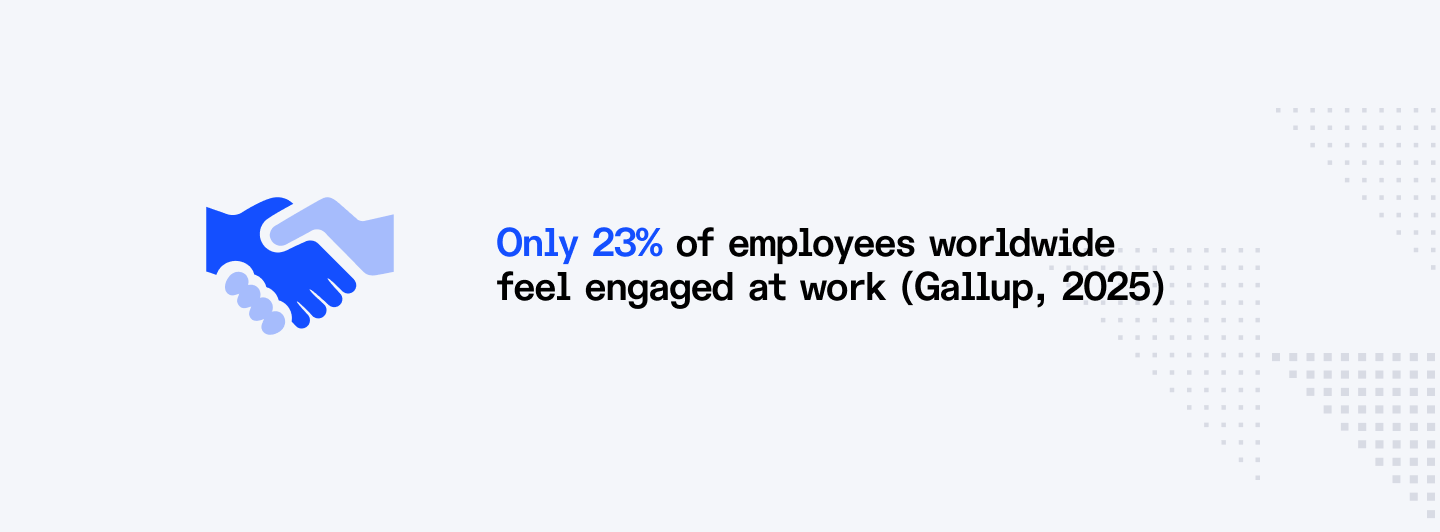
Those questions matter because engagement is slipping as AI grows. Gallup finds only 23% of workers are engaged, while 16% are actively disengaged. Forty percent report job-related stress. Nearly two-thirds say they are either “struggling” or “suffering,” with only a third “thriving.”
We are pouring billions into artificial intelligence, yet our human infrastructure is fracturing. A study by Chronus and Wynter highlights this exact tension: 40% of HR and learning leaders admit their teams feel outright fearful about AI entering the workplace, while 46% say they feel excited.
That mix — big opportunity plus real anxiety — makes engagement a leadership imperative. You don’t get to outsource this to HR or to an IT rollout. Engagement in the age of AI is a strategy conversation. It’s about clarity, skills, and trust. It’s about making people feel useful, respected, and equipped for what’s next.
Below I’ll walk you through the core, practical strategies that keep employees engaged as AI becomes part of daily work.
1. Reframe AI as an Amplifier
Let's start here, because this is where most leaders get it wrong. AI feels disruptive. People hear AI and their brain jumps straight to replacement, every time. That fear is real. Ignoring it doesn't make it go away, it just makes it quieter, and quiet fear is worse, because you can't address what nobody says out loud.
- So say it plainly. AI doesn't replace your best people. It removes the parts of their job that were never the best use of their time anyway. The repetitive reporting. The manual data pulls. That first, ugly draft of everything. Hand that to AI. Let your people spend their energy where it counts: judgment, creativity, the relationships that no model can fake.
- Get specific. Fewer low value tasks. Faster insight. More hours for the strategic work and the customer conversations that actually move the business. Put numbers next to it whenever you can.
- Bring people into the rollout itself. Ask your engineers, your product managers, the folks on the front line with customers, where they're wasting time. Let them help build the solution. I've seen this firsthand: the moment someone helps design a tool, they stop fearing it. They start defending it. That's the whole game right there.
- Then build momentum in public, small and visible. Run a two week AI co-pilot hackathon, give teams one real problem to chase. Keep it low risk. Keep the feedback loop tight. Celebrate what worked, and just as importantly, write down what didn't, because that's where the next real insight usually hides.
And watch your language. This is a small thing that matters more than people think. Skip the corporate fog. Don't say "AI will enhance operational efficiency." Say this instead: "We're using AI to remove ten hours of repetitive work a week so you can spend that time on the customer relationships that grow this business." One sentence. Clear tradeoff. People remember that.
What you can do today
- Run a two week paired pilot, real task, real AI, measure time saved and quality side by side.
- Ask three teams to co-design the highest value AI use cases. Start with the easiest wins.
- Publish a simple before and after for a few roles, tasks removed, responsibilities added.
- Run one short, gamified challenge. Make it social, make it fun, see what people invent.
- Share results in plain numbers. Just what happened and what's next.
2. Make Time for Upskilling
Skills are moving fast right now, faster than most training calendars can keep up with. If you want people to embrace AI, you have to give them real time to learn it.
Think about how the old model worked. Hire someone for a role, train them once, and that was basically it for years. That model is dying, and honestly, it should. The new shape of work looks more like a rotation. People shift through different tools, different skills, different problems, because the work itself won't sit still long enough to teach the old way. A site reliability engineer today might be doing AI-assisted architecture work by next year, whether you planned for it or not. If you don't build that flexibility into your org now, your best people will go build it somewhere else. They will, I've watched it happen.
A few things matter here:
- First, stop framing learning as remedial. Nobody wants to feel like they're catching up. Frame it as access, access to better projects, more visibility, a clearer path up. Tie skills directly to things people already want. And keep the learning close to the actual work, not separate from it. A long theory-heavy course loses people fast. A short, hands-on sprint where they apply a skill to something real? That sticks. Pair people with AI on a live problem and let them figure it out together.
- Second, ditch the one size fits all training plan. Some people want to go deep technical. Others want a hybrid, part product, part analytics. Some are headed toward leadership and need to understand AI strategy and ethics more than the code itself. Build separate tracks for these. And make lateral moves count for something, not everyone wants to climb straight up, and that's fine. Depth and breadth both keep people engaged, just in different ways.
- Third, bring in outside credibility, but keep the practice internal. A certificate from a university or a known provider gives people something real to point to. Good. But the actual growth happens closer to home: mentor groups, small learning squads, demo days where people show what they built. That's where knowledge turns into reputation, the kind that moves careers internally.
What you can do today
- Block four hours a month per person for applied learning, and put it in sprint capacity, not as an afterthought.
- Launch one two-week project where a small cross-functional team learns a new AI skill by solving a real problem, then demos it.
- Build three clear learning tracks, technical, product/analytics, leadership, each with real milestones.
- Offer a small learning stipend, and actually talk about it at your next all-hands, don't bury it in an email.
- Start a monthly demo day. Let people show their work. Reward the visible wins with stretch assignments, not just applause.
Learn more: why high retention of engineering talent is the hidden advantage your projects need, and how to build it.
3. Rethink Recognition
Here's something strange about good technical work. When it's done right, nothing happens. No outage. No breach. Quiet is the whole point. Which means the people doing the best work often look, from the outside, like they're not doing much at all. That quietly erodes engagement faster than almost anything else on this list.
So if you want engagement to hold up in the age of AI, recognition has to attach to something real. Not effort. Not hours logged. Outcomes. Praise the person who used an AI-assisted workflow to actually fix a customer's problem, and say what changed. That tells everyone watching exactly what good looks like, and why it mattered, which a generic ‘great job!’ never does.
- Make recognition frequent. Not an annual award nobody remembers by March. A quick, specific note, this person, this action, this result, beats a trophy every time. Build it into the rhythm of the week. A shoutout channel people check. A standing recognition moment in the team meeting.
- Stop asking your managers to manage. Ask them to coach. A manager hands out tasks and checks boxes. A coach asks what someone's trying to get better at, and helps clear the path. That's a different job entirely, and most managers were never trained to do it. Swap the task list for a real conversation: what are you learning right now, what experiment do you want to try, what's the next stretch assignment that scares you a little.
- Give people somewhere safe to actually try things, too. A sandbox, a low stakes pilot, somewhere getting it wrong doesn't cost the business anything real. Growth without room to fail isn't growth. It's just performance with extra pressure attached.
- Don't let your best people calcify into one identity forever. ‘The AI person’ or ‘the infrastructure guy.’ Push them toward range. The strongest technical talent right now is broad enough to sit across from a non technical exec and explain a tradeoff in plain English. That makes them more valuable. It also, honestly, makes the job a lot more interesting for them.
What you can do today
- Add a five minute recognition slot to next week's team meeting. Name the person, the action, the impact. That's it.
- Run a two week sandbox pilot with a small team experimenting on an AI workflow. Ask for one short lessons learned note from each person.
- Turn your next round of 1:1s into coaching conversations. One learning goal, one stretch assignment, every time.
- Publish a single role playbook: what AI removed, what skills it now requires, what the next promotion looks like.
4. Redesign Work Around Human Strengths
Most leaders make a quiet mistake with AI. They drop it into the old workflow, leave everything else exactly as it was, and just expect magic to happen. It almost never does. Tools don't redesign work. Leaders do.
Here's a useful way to think about any role. Split it into two buckets. The first is repeatable work: pulling data, drafting a first version, routing a request, checking a routine box. AI is genuinely good at this. The second bucket is judgment: weighing a tradeoff, reading the room in a tense client call, deciding what matters when the data gives you three reasonable answers and no clean one. That second bucket stays human. For a long time, probably.
So go bucket by bucket. Take a role, break it into its actual tasks, and tag each one: automatable, augmentable, or inherently human. Suddenly the decisions about tooling, training, even who's accountable for what, get a lot clearer.
Three principles to hold onto as you do this:
- Let AI own the repeatable, data heavy work. Extraction, first drafts, routine triage, spotting patterns in a pile of data nobody wants to read manually. Every task you hand off here frees up real capacity, not just time, capacity for harder work.
- Keep humans on judgment, relationships, and context. The interpretable calls. The negotiation with a difficult stakeholder. Anything tied to trust or ethics stays a human decision, full stop. No model should be making that call alone.
- Build in guardrails and a clear path to escalate. Set a confidence threshold. Run bias checks. And when AI's confidence drops below whatever line you've set, the handoff to a person needs to be fast and obvious, not buried three clicks deep in a dashboard nobody opens.
Cynergy Bank in Europe worked with HCLTech to rebuild its customer service operation around exactly this logic, automating the routine contact center and back office work, and giving employees more room for the conversations that actually needed a human touch. Complaints dropped over 50%. Productivity rose 8%. Customer experience scores climbed 25%. That's what redesign looks like when you commit to it, not just bolt a chatbot onto an old process and call it innovation.
What you can do today
- Run a one day task-mapping workshop for a single role. List the tasks, mark automatable versus human, agree on next steps.
- Write three guardrail rules for any AI output: a confidence threshold, a bias check, and a named person who owns escalation.
- Build a simple before and after, two columns, and share it with the team. Let them see the shift, not just hear about it.
- Name one person as the ‘orchestration owner’ for a pilot, someone who owns the human plus AI handoff and reports back weekly.
- Require a basic runbook for any model you deploy: inputs, expected outputs, what you're monitoring, and where it escalates.
5. Build Trust from the Start
Trust is the currency that lets AI scale. You can have the best models, the cleanest data, the smartest engineers in the room, and still stall out completely if your people, your customers, or your regulators don't trust how you're using any of it. I'd argue this matters more than the technology itself. Build the model right but skip trust, and adoption stalls anyway.
Four things deserve your attention here:
- Don't hide AI behind vague labels. ‘Powered by AI’ on a footer somewhere doesn't count. Tell people, plainly, where it's used, what it actually changes, and when they should lean on it versus double check it. Be honest about the limits too, what it's good at, where it tends to fail, and exactly when a human needs to step in. Vagueness breeds suspicion. Clarity, even uncomfortable clarity, builds trust faster than any polished announcement ever will.
- Keep humans in the loop where the stakes are real. Hiring. Credit decisions. Anything safety-critical or legal. AI can inform these calls, it shouldn't make them alone. Pick the exact moments where a human has to sign off, and make those moments visible in the workflow.
- Design inclusively, on purpose. A system trained on narrow data produces narrow outcomes, every time. Bring different perspectives into the design and testing process from the start. And don't just involve technical reviewers, bring in the people who'll use the thing day to day. A frontline worker will catch a problem an engineer never would, simply because they're the one living with the tool.
- Make reskilling reach everyone, not just a few specialists. If only your data science team understands AI, you've built a knowledge bottleneck, and bottlenecks break under pressure. Fund training that goes all the way down and across, operators, managers, leadership. Build shared skill frameworks so people can move between roles as the work shifts.
What you can do today
- Publish a simple, one page ‘Where we use AI’ brief for one core product or process, with the human checkpoints clearly marked.
- Name three high-stakes decision types in your organization and require human sign-off on each, no exceptions.
- Run one inclusive design review before your next pilot. Include a frontline worker, a domain expert, and a DEI reviewer, not just the technical team.
- Set up three monitoring metrics for any deployed model: accuracy drift, a bias indicator, and time to escalation.
- Stand up a small cross-functional group with a two-week SLA to handle AI incidents and ethics questions as they come up, not months later.
Up next: discover the hard truth about scaling engineering teams from a handful of developers to a hundred or more.
Where This Leaves You
People remain the decisive factor. Only 37% of workers say their employers clearly explain how AI or automation will improve their work. That gap is your opening.
You can pursue raw efficiency or you can redesign work so efficiency and human flourishing move together. The latter is harder. It requires clear communication, real reskilling, redesigned roles, responsible guardrails, and visible recognition.
If you lead, make this simple promise to your teams: we will use AI to remove low-value work, invest in your skills, and protect your agency. Say it, show it, and measure it. You don't need to get all of this perfect at once. Start with one strategy. Prove it with pilots. Make it visible. Expand what works. Repeat the cycle until the work genuinely changes for the better.
➡︎ Build AI-ready teams. Partner with Index.dev to scale engineering capacity through a verified global network, accelerate software delivery, and get immediate access to vetted AI and cloud talent.