A great engineering team structure may not guarantee success. But the wrong one will almost certainly lead to failure.
Most engineering slowdowns are not caused by poor developers, outdated tools, or a lack of effort. They happen because the team structure no longer matches the company's stage of growth.
What worked when you had ten engineers often breaks when you have fifty. Communication becomes slower. Ownership becomes unclear. Decisions get pushed into meetings. Teams wait on other teams. Product delivery slows down, quality suffers, and your best engineers become frustrated.
I've seen this pattern repeatedly in high growth companies. Leadership keeps adding people to increase output, yet output barely moves. More engineers create more coordination overhead, more dependencies, and more complexity. At some point, the structure itself becomes the bottleneck.
In this guide you’ll get practical rules for when to restructure, battle-tested frameworks for different stages, and exact moves that make transitions less risky.
Build engineering capacity through a vetted global network, assemble full product teams, and get support with team structures and delivery models →
The Warning Signs: When to Rebuild
If you recognize these signs, restructure now. Waiting makes fixes costlier and messier.
- Too many high-priority initiatives for one team to handle. When every roadmap item is urgent, context switching kills throughput.
- Deadlines are consistently missed. Repeated misses mean scope, dependencies, or ownership are broken.
- Cycle times increase even after adding engineers. Adding people to a flawed process compounds communication overhead.
- Ownership is unclear across teams. Ambiguity breeds handoffs, rework, and decision paralysis.
- Product, design, and engineering are misaligned. If priorities change mid-sprint or specs arrive late, your structure doesn’t support cross-functional collaboration.
- Low morale or rising attrition linked to lack of direction. Engineers leave when autonomy, impact, or career paths vanish.
- Too many approvals and meetings block work. When more time is spent coordinating than building, velocity collapses.
- Critical knowledge concentrated in a few people. Bus factor risk signals brittle structure. Rotate ownership every quarter.
Team Structures that Scale
There is no universal engineering team structure. Some models lean heavily into deep technical specialization, while others prioritize sheer delivery velocity and absolute product ownership.
As a scaleup leader, your job is to select a framework that actively minimizes communication overhead and maximizes execution speed.
The following structures are among the most effective frameworks used by high growth startups and scaleups today.
Structure #1: Cross functional product teams
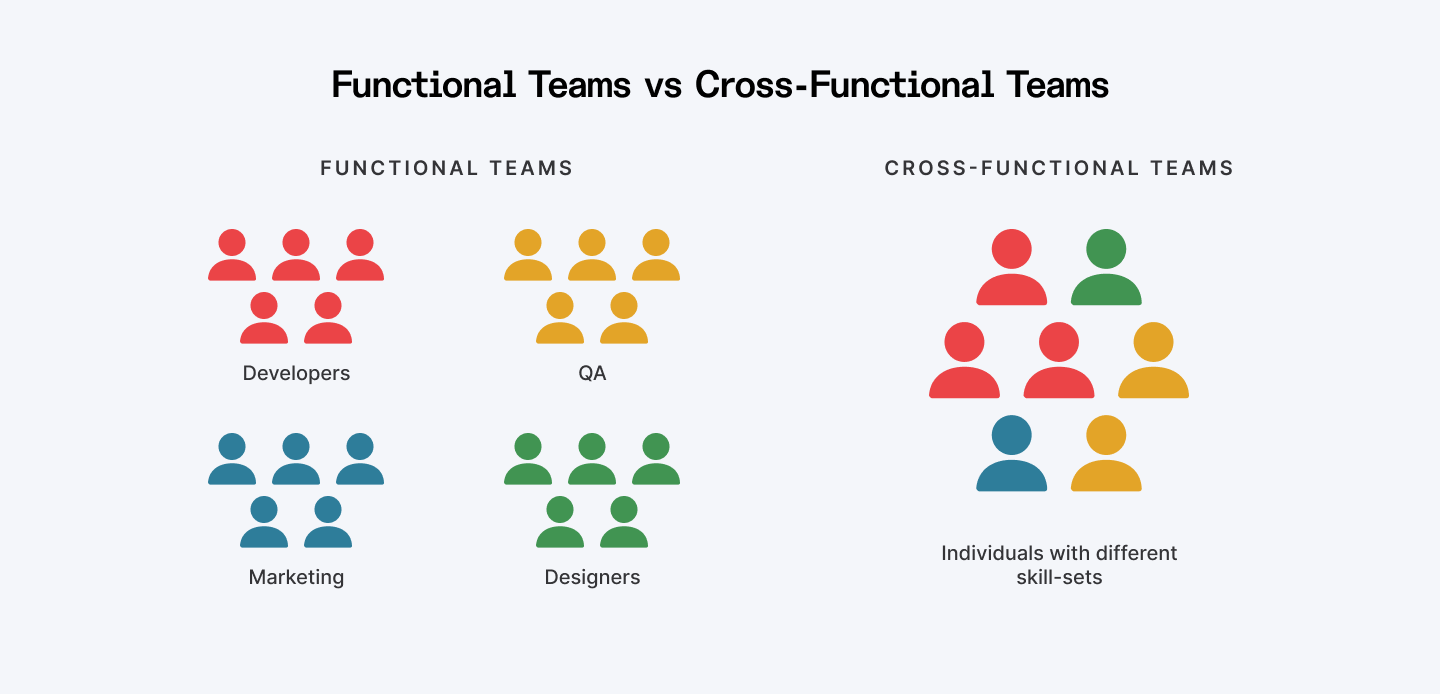
Cross functional teams are small, autonomous teams built around a product area, customer journey, or business outcome. Each team includes product, frontend and backend engineers, QA, and usually design and product analytics. They own feature discovery, delivery, and live operations for their scope.
This model has become the default structure for many of the world's fastest growing technology companies because it reduces handoffs and increases accountability.
Common examples
- Growth Team owning acquisition, onboarding, activation, and retention
- Core Product Team owning the primary user experience
- Payments and Billing Team owning subscriptions and monetization
- AI Product Team owning copilots, automation features, and AI workflows
- Developer Platform Team focused on customer facing APIs and developer experience
When it works best
- Your product serves multiple user journeys, customer segments, or feature areas
- You need short feedback loops and rapid experimentation to find product-market fit
- You want to reduce handoffs and push decisions to the people closest to customers
What can go wrong
Teams become highly effective within their own area but gradually create different processes, architectures, and technical standards. Over time, the product can start to feel fragmented.
As organizations scale, engineering leaders should pay close attention to platform consistency, shared architecture, developer experience, and technical governance.
Structure #2: Functional team
If your primary competitive advantage is deep technical innovation — like building a custom LLM infrastructure, specialized developer tools, or highly secure financial pipelines — you cannot just rely on generalists scattered across product squads. You need concentrated, deep technical expertise.
Functional teams organize engineers by technical expertise rather than product ownership. Frontend engineers work together, backend engineers work together, infrastructure engineers work together, and each group supports multiple products across the organization.
While product teams dominate startup discussions, many companies eventually discover that some problems require deep specialization rather than broad ownership. Reliability, security, infrastructure, developer productivity, and AI systems often benefit from dedicated functional teams.
Common examples
- Platform Teams building internal tools, infrastructure, and developer platforms
- Site Reliability Engineering teams responsible for availability, performance, and incident response
- Security Teams managing application security, compliance, and risk
- AI and Data Infrastructure Teams building shared models, pipelines, and evaluation frameworks
- Developer Experience Teams improving tooling, testing, and engineering productivity
- Component Teams maintaining APIs, SDKs, and reusable services used across the organization
When it works best
- Your competitive edge depends on technical excellence, consistency, or regulatory compliance
- You run complex infrastructure where mistakes are costly and predictable operations matter
- You need to scale many product teams quickly while keeping core services stable
What can go wrong
The biggest risk is creating bottlenecks. When every product team depends on the same group of specialists, work begins to queue up. Requests wait for approvals, priorities compete, and delivery slows down. This is why many companies struggle with centralized DevOps, data, security, or AI teams. The expertise is concentrated, but so are the dependencies.
Structure #3: Hybrid team
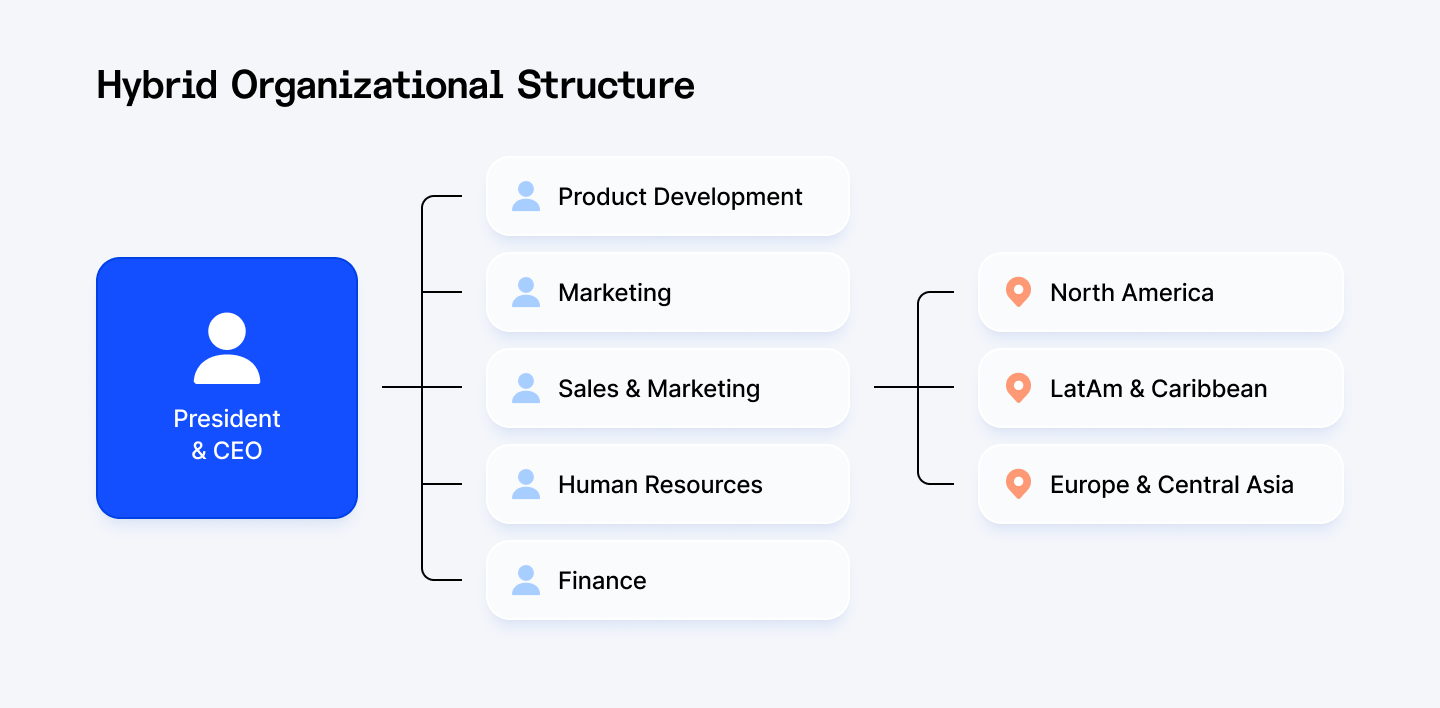
Most successful scaleups eventually adopt a hybrid model. Not because it's trendy, but because they discover that neither product teams nor functional teams can solve every problem on their own. Product teams provide speed, ownership, and customer focus. Functional teams provide technical depth, consistency, and scale. Hybrid organizations combine both.
A common setup might include several cross functional product teams responsible for customer outcomes, alongside platform, infrastructure, security, data, or AI teams that support the broader engineering organization.
Common examples
- Product Teams supported by dedicated platform and infrastructure teams
- AI Product Teams supported by centralized AI platform and evaluation teams
- Temporary Strike Teams formed to tackle major migrations, security initiatives, or critical incidents
- Internal Developer Experience Teams focused on improving engineering productivity
- Inner Source Models where engineers contribute across team boundaries when needed
When it works best
- You’ve outgrown a single-team product model and need to reduce duplicated effort
- You need both rapid delivery and technical consistency: product teams ship; domain teams protect long-term health
- You have senior engineering leaders able to balance product trade-offs with platform priorities
What can go wrong
The biggest challenge is unclear ownership. Many hybrid organizations create confusion by introducing domain teams without clearly defining responsibilities. Product teams assume platform teams own a problem. Platform teams assume product teams own it. As a result, work stalls and accountability disappears.
Another common mistake is allowing domain teams to become approval layers. Their role should be to enable teams, not slow them down. The healthiest hybrid organizations keep decision making close to the teams doing the work while using specialist groups to provide expertise, tooling, and guidance.
Structure #4: Domain Aligned or Layered Teams
This is one of the most common starting points in engineering organizations, especially in early stage companies or teams with strong technical foundations. Instead of organizing around products or outcomes, teams are structured around technical layers. Each team owns a specific part of the system.
For example:
- Frontend engineers work together
- Backend engineers own services and APIs
- Data engineers manage pipelines and infrastructure
- QA or automation teams handle testing and quality
On paper, this creates clarity. Everyone knows what they own. Engineering work feels structured and predictable.
Key responsibilities
- Frontend Team owning UI frameworks and component libraries
- Backend Services Team responsible for APIs, business logic, and service contracts
- Data Engineering Team building pipelines, models, and analytics platforms
- QA and Automation Team owning test strategy, CI pipelines, and release gating
When it works best
- Your product scope is narrow and technically focused
- You operate with a modular monolith or clearly separated services
- Most work is engineering heavy rather than product exploration
- Interfaces between layers are stable and well defined
This model is often used in companies where engineering excellence is prioritized over rapid product iteration, or where systems must remain highly reliable and controlled.
What can go wrong
The biggest problem is coordination cost. Every product change becomes a multi team effort. A single feature might require frontend, backend, and data teams to align, sequence work, and coordinate releases. This introduces delays that compound as the organization grows.
Over time, backend or platform teams often become unintentional bottlenecks because most meaningful product changes depend on them.
Another risk is separation from customer outcomes. When teams are organized by technical function, it becomes harder for engineers to see how their work connects to user value.
Structure #5: Platform led product teams
This structure is becoming increasingly common in AI driven and infrastructure heavy companies.
Instead of organizing purely around product or function, the organization is designed around a strong platform foundation that product teams build on top of.
Product teams move fast because they do not rebuild infrastructure, data pipelines, authentication, deployment systems, or AI capabilities. They consume them as services. At the same time, they remain fully responsible for customer facing outcomes.
Common examples
- Platform Engineering Team owning infrastructure, CI/CD, developer tools, and core services
- AI Platform Team providing shared models, evaluation systems, embeddings, and orchestration tools
- Data Platform Team managing pipelines, warehousing, and real time data access
- Product Teams focused on end user features built on top of platform capabilities
- Internal API and Service Teams exposing reusable building blocks for the entire organization
When it works best
- You have multiple product teams and the same infrastructure concerns keep surfacing across all of them
- Your product roadmap requires frequent AI model deployment, experimentation, or heavy infra automation
- You want to avoid rebuilding core systems across every product team
- Engineering maturity is high enough to invest in long term infrastructure
What can go wrong
The biggest risk is over investing in the platform too early. If the platform team builds ahead of real product needs, you end up with sophisticated systems that no one fully uses. The organization slows down because product teams depend on a platform that is still evolving.
Another risk is internal misalignment between platform and product teams. If platform teams lose touch with real usage, they start optimizing for technical elegance instead of developer or customer impact.
This creates a gap between what is built and what is needed.
⭢ Up next: If you're scaling fast, don't miss the 12 AI team scaling strategies that take engineering teams from 3 to 50 engineers in under a year.
Steps to Take: How to Restructure Safely
Restructuring is a change management challenge. The technical decisions are usually the easy part. What derails most restructures is how they are handled, not what they decide.
Here are the principles that matter most.
Protect your best people first
Your top engineers and leads are also the people with the most options. If the transition stretches them too thin, leaves their role unclear, or puts them in a structure where they feel less impactful, they will leave. Include your senior people in the planning process early. Give senior ICs expanded scope and visibility. Don't promote engineers into leadership without real support and coaching to back it up. And be crystal clear about how performance will be evaluated in the new structure.
Over-communicate the change
Change creates ambiguity, and ambiguity creates anxiety. Engineers start wondering if their role is safe, whether their team will survive, and who they report to now. Fill that vacuum before rumor does. Visualize the new structure early and share it widely. Explain not just what is changing but why, and what it means for each person.
Assign ownership
Adding people to a team without clarifying what that team owns is one of the most common and most expensive mistakes in scaling. For every team, be explicit about responsibilities, decision rights, escalation paths, and what success looks like six months from now.
Give context to decision-makers
Equip your team leads with a clear understanding of company priorities, customer problems, and the reasoning behind product decisions. When engineers understand the why, they make better tradeoffs, escalate the right problems, and don't need to wait for permission on every decision.
Stabilize culture through shared rituals
Restructuring fragments teams. People who used to sit together, share context naturally, or work closely on the same codebase suddenly find themselves in different reporting lines with different priorities. Shared rituals are what hold the engineering culture together through that transition. Weekly demos, engineering guilds, cross-team architecture reviews, and joint planning sessions are the connective tissue that keeps standards high.
Treat structure as a living system
Your first version of a new structure will be wrong in some places. Treat restructuring as an iterative process, not a one time transformation. Revisit it every 6 to 12 months as product complexity, team size, and business priorities evolve.
A Case Study: From Functional Silos to a Scaled Hybrid Structure
One of our clients, a Series B fintech scaleup building embedded payment infrastructure for B2B platforms, came to Index.dev at an inflection point. They had grown from 18 to 35 engineers in under a year, largely through aggressive hiring. On paper, the team looked strong. In practice, delivery had slowed.
The challenge
Their engineering organization had been built around functional specialization:
- A frontend team
- A backend team
- A data team
- A small DevOps function
That structure had served them well at 18 engineers. At 35, it was the source of almost every bottleneck they had.
The backend team was overwhelmed. Every feature, regardless of complexity, required backend involvement, and the queue never cleared. Frontend engineers were blocked waiting on API changes. The data team operated largely in isolation, with little visibility into product priorities. PMs were managing dependencies across four different teams just to ship a single feature. And with three major product lines now in flight simultaneously, there was no team with clear end-to-end ownership of anything.
How Index.dev helped
We came in at three levels.
First, we embedded two senior engineers and a technical lead from our talent network to stabilize delivery immediately while the structural work was underway. This gave the team breathing room.
Second, we worked with the CTO and VP of Product to redesign the team topology. We transitioned from functional silos to a hybrid structure built around three cross-functional product teams, each owning a core product line end to end, with a fourth domain team taking ownership of shared backend infrastructure, internal APIs, and the data platform.
Each product team was given a dedicated PM, a tech lead with real decision-making authority, and a clear mandate with measurable outcomes. We helped define team charters, ownership boundaries, and escalation paths so that the new structure had teeth from day one.
Third, we worked directly with their CTO to close four senior engineering hires through Index.dev, including a principal engineer who took on the domain team lead role and immediately began reducing the API bottleneck that had been slowing every product team for months.
Results in 90 days
- Deployment frequency increased by over 40%.
- New engineer onboarding time dropped from six weeks to under two
- All three product teams shipped their highest-priority roadmap items within the quarter for the first time in over a year
The CTO put it simply: “The problem was never the engineers. It was that the structure made it impossible for good engineers to do good work.”
⭢ Learn more: Freshly raised your Series A? Explore exactly how to scale your engineering team after funding without losing speed or structure.
What Makes an Engineering Team Highly Effective
Three frameworks that consistently show up in strong engineering organizations.
1. Enable, empower, expand
This one is simple and it works. Leaders who build strong teams do three things consistently.
- Enable the team by removing blockers, providing tools, and ensuring clear priorities.
- Empower the team by giving real ownership and decision making authority.
- Expand the team by growing capability through mentorship, hiring, and long term thinking.
Most engineering leaders are decent at enabling. Far fewer are genuinely good at the other two.
2. Google's five drivers of team effectiveness
Research from Google’s Project Aristotle, one of the most rigorous studies ever done on team performance, highlighted five consistent factors behind high performing teams.
- Psychological safety
- Dependability
- Structure and clarity
- Meaning
- Impact
What matters is not just having these factors individually, but how they reinforce each other. When people feel safe to speak up, they surface problems earlier. When ownership is clear, execution becomes predictable. When work feels meaningful and impact is visible, motivation becomes self sustaining.
3. The core engineering team qualities
Across fast growing startups and scaleups, the strongest teams consistently show four traits.
- Trust
- Autonomy
- Collaboration
- Technical excellence
Trust reduces unnecessary control. Autonomy increases the speed of decision making. Collaboration reduces duplication and friction. Technical excellence prevents long term drag on the system.
When one of these is missing, the system compensates in inefficient ways. For example, lack of trust creates process overhead. Lack of autonomy creates bottlenecks. Lack of technical excellence creates hidden future costs.
Final Thought
In high growth companies, structure is not about reporting lines. It is about how fast a team can go from idea to production without asking permission from three other teams.
This is becoming even more critical in the AI era. Because AI does not slow down complexity. It amplifies it. Teams that already struggle with coordination will struggle even more when systems, data, and product cycles become faster and more interconnected.
So the real question is not what org chart you should build.
It is this:
Where does your organization lose speed today, and what would you need to change so decisions move closer to the people doing the work?
If you can answer that honestly, the structure usually becomes obvious. And if it is not obvious, that itself is the signal that something needs to change.
How Index.dev Can Help
Index.dev works with high-growth startups and scaleups at every stage of the engineering journey.
- Engineering talent placement. We source and vet the top 1% of remote tech talent globally, across frontend, backend, data, DevOps, and everything in between.
- Team structure consulting. If your team has outgrown its current structure, we help you diagnose the constraint and design what comes next.
- Full team assembly. When you need to move fast, we assemble complete, high-performing teams built around your product goals. Engineers, tech leads, and product contributors who work together from day one.
- AI training contributors and specialists. As AI becomes core infrastructure, the need for specialized contributors who understand model training, data annotation, evaluation, and prompt engineering is growing fast. We provide vetted specialists who plug directly into your AI development workflows.
If this guide raises questions about your own engineering organization, we would like to help you answer them.