A global study by KPMG and the University of Melbourne, spanning over 48,000 respondents, found that 57% of employees admitted to hiding their AI use at work. When people don't know the rules, they make up their own, quietly.
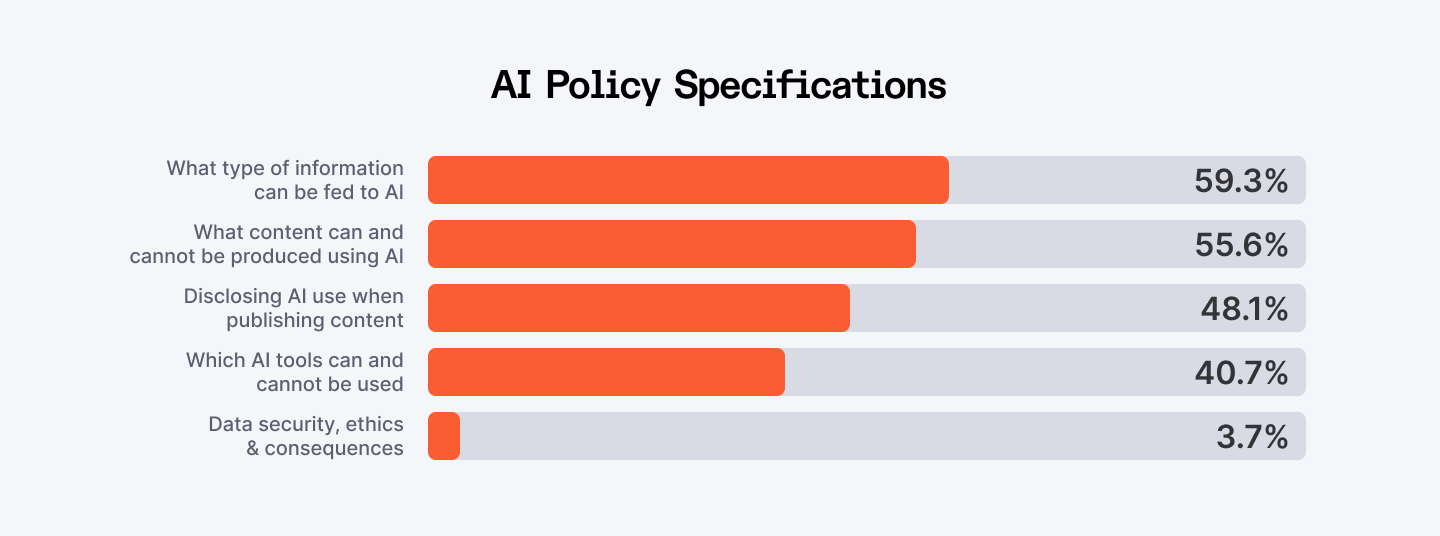
At the same time, leadership is lagging. According to the PEX Report 2025/26, only 43% of organizations have governance policies that address data security, responsible use, and ethical AI practices. A quarter are still figuring it out.
So what happens in the gap? Employees use whatever tools help them move faster. They paste a client contract into ChatGPT to summarize it. They use AI to screen job applicants without knowing that algorithmic hiring tools are under active regulatory scrutiny in multiple jurisdictions. They build internal workflows on top of AI systems that quietly retain your data.
Misuse of AI can trigger data breaches, discrimination claims, intellectual property violations, and regulatory scrutiny. The technology moves faster than the law, and with minimal regulation on AI providers themselves, an uninformed employee can create serious liability with a single prompt.
That's what an AI policy fixes. If you want your company to use AI safely, you need rules that are usable and enforceable.
This article breaks down what a corporate AI policy actually is, why you need one now, and how to build one that works in practice.
Scale AI safely with Index.dev. Get vetted engineering capacity, faster software delivery, and governance-ready teams to embed policies and ship responsibly →
What an AI Policy Is
A corporate AI policy is your company’s operating plan for using AI safely, legally, and in line with your values. It tells people what they can and cannot do with AI, how to protect sensitive data, and who’s accountable when something goes wrong.
A clear policy reduces surprise risk — data leaks, biased decisions, IP exposure, regulatory fines — and makes responsibility visible. When people know the rules, you get predictable outcomes instead of hidden, risky workarounds.
What a good AI policy does for you
- Aligns AI use with your mission and legal obligations, so tools support strategy rather than undermine it.
- Protects sensitive data and intellectual property, so your assets stay yours.
- Creates accountable roles and approval paths, so decisions aren’t ad hoc.
- Sets practical guardrails, so employees can use AI without guesswork.
- Enables faster, safer adoption, because teams can move with confidence instead of fear.
Why Every Company Needs an AI Policy
AI shows up in your company faster than policies do. People start using tools to write, code, analyze, and decide, often without knowing the risks. That gap creates exposure you can quantify and manage.
Here's what a formal policy actually protects you from:
- Legal exposure. If your team uses generative AI daily, you are operating in a legal gray zone. AI models cross directly into data privacy laws, intellectual property rights, and consumer protection. A policy draws a hard line between legal leverage and a compliance disaster.
- Data breaches. Every piece of data your employees paste into a standard public LLM can become part of its public training set. A policy defines what can go in, what can't, and which tools are approved in the first place. Many high-growth companies are mitigating this by enforcing partnerships only with enterprise AI vendors that offer private environments or use synthetic training data.
- Biased outputs. AI models are data sponges. If they train on biased data, they generate biased outcomes. For example, AI tools used in hiring or data analysis can quietly discriminate based on race or gender if left unchecked. Your policy must mandate regular audits of the data your models ingest. Clean, diverse data inputs are the only way to ensure your AI-driven decisions do not create toxic bias.
- Internal friction. Rolling out AI without explanation creates tension. Your IT department will try to lock everything down out of caution. Your marketing and product teams will try to bypass them to move faster. People resist what they don't understand and resent what feels imposed. Involving your team in building the policy, changes that dynamic entirely. It starts feeling like a strategy.
→ Up next: Discover the biggest enterprise AI adoption barriers holding companies back and the practical steps leaders can take to overcome them.
Practical Ways to Bring Your Workplace AI Policy to Life
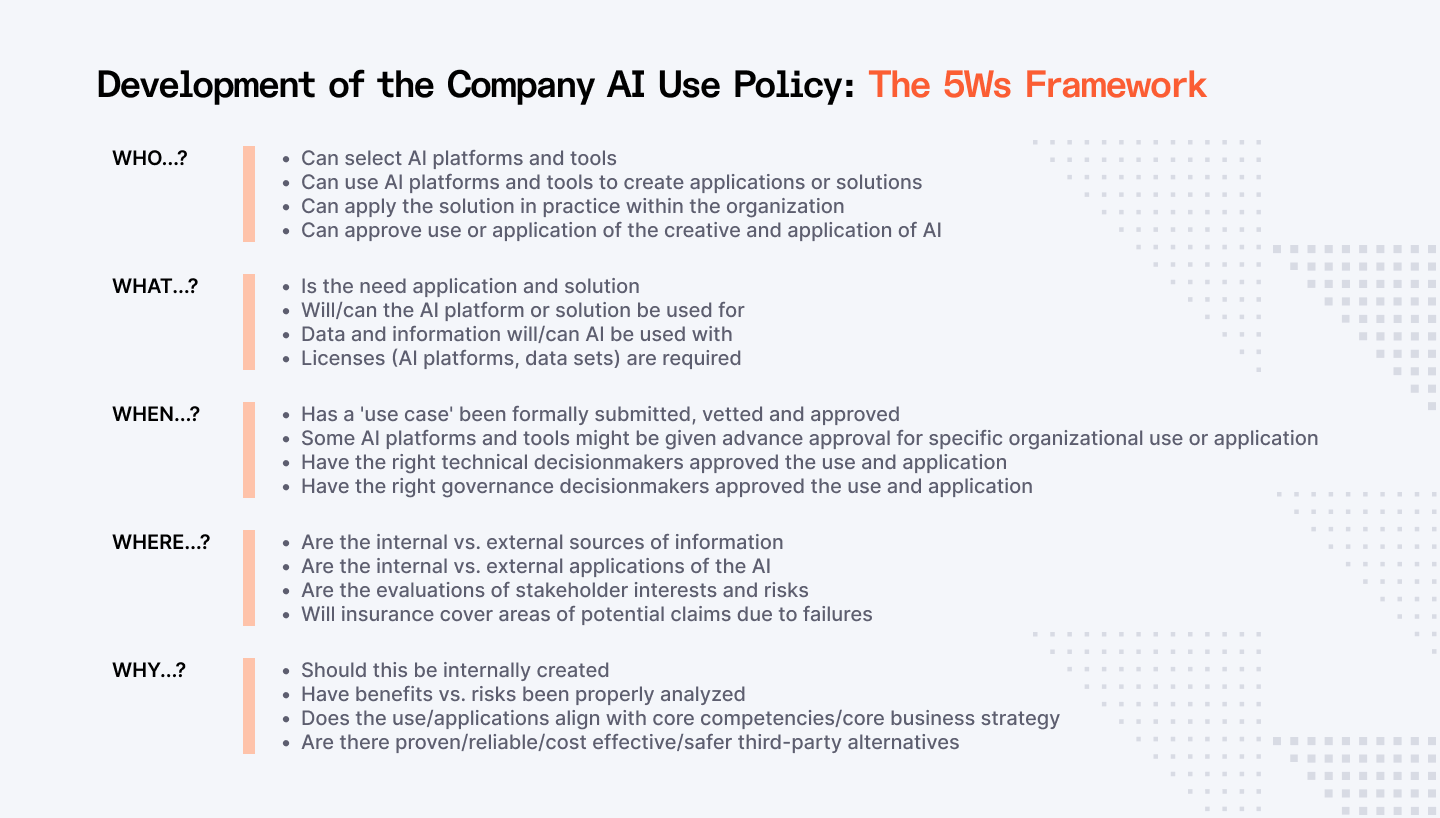
Step 1: Build the Team Before You Build the Policy
If you leave AI governance solely to your IT department, they will block tools to eliminate risk, stalling your growth. If you leave it to your growth teams, they will adopt tools recklessly, exposing your data.
A single department cannot own this. Data from Optro shows that when no single function owns more than a quarter of AI governance responsibility, accountability gets lost. This is why 48% of corporate AI projects miss their business goals.
You need a dedicated, cross-functional AI governance team. Bring HR, IT, Legal, and Operations into the same room. Depending on your industry, you might also want Finance, Product, or a dedicated Data Privacy lead in the room. This group becomes your central clearinghouse for AI strategy, taking the guesswork away from individual employees.
Core mandates
- Define a fast, clear process to approve or reject new AI tools based on data safety.
- Map out exactly what use cases are permitted by the department, ensuring an intern isn't handling critical code with public LLMs.
- Build continuous monitoring protocols for algorithmic fairness and data privacy, and maintain a clear, single point of contact for employee questions.
Step 2: Conduct a Targeted AI Risk Assessment
Before you write a single line of policy, you need to map your exposure. Do not let this turn into a generic risk assessment. A high-growth company faces specific, structural vulnerabilities when deploying AI. Recent data highlights the stakes: industry reports show that 63% of organizations hit with AI-related data breaches either had no governance policy or were still drafting one.
You need a practical, proactive audit across five specific friction points:
- Data privacy: Ask exactly where your information is traveling. When an employee uploads a dataset to an external tool, do you lose visibility into where it is stored or how long it is retained? Look for tools that allow you to opt out of model training entirely.
- Intellectual property: Track what your builders are using. If your engineering team is using AI assistants to write proprietary code, you risk polluting your codebase with unvetted, open-source fragments. This can create massive ownership disputes when you scale toward an acquisition or funding round.
- Algorithmic management and bias: Audit your hiring and evaluation workflows. If you use automated platforms to screen resumes or track productivity, you are exposed. AI models mimic their training data, meaning they can quietly introduce systemic bias and discrimination into your hiring loop without your knowledge.
- Worker rights and autonomy: Watch out for what Gartner calls "AI workslop": the hidden productivity drain caused by overly aggressive workplace surveillance or clunky, automated workflows. If your team feels heavily policed by algorithmic tools, engagement plummets.
- Regulatory shifting: Ensure your infrastructure complies with incoming frameworks like the EU AI Act, which is actively rolling out strict obligations for automated decision-making.
Step 3: Make AI Policy Part of Learning and Development
If you want people to follow your AI guidelines, you have to teach them. Not once, not in a company-wide email, but as a structured part of how your organization learns and develops.
There's also a legal reason to take this seriously. Under Article 4 of the EU AI Act, organizations that deploy AI systems are required to ensure sufficient AI literacy among staff operating those systems.
In practice, that means weaving AI policy into your existing L&D programs the same way you'd handle data protection or security training. Cover why the policy exists, not just what it says. People follow rules they understand. Connect the guidelines to real consequences: data breaches, customer trust, legal risk, quality of output. Then translate principles into concrete behavior. Not "use AI responsibly" but "here's what you do when a client asks you to run their data through an AI tool."
Green-lighting and black-listing
To make this training useful, you must give your team absolute clarity on what is allowed and what is blocked.
- The white list: Provide a clear, living directory of approved AI tools. Highlight which enterprise assistants are cleared for automation and decision-making because they protect your corporate data.
- The black list: Explicitly name prohibited tools that present unacceptable risk to your intellectual property or violate privacy terms.
- The exception pipeline: Create a fast, frictionless process for employees to request approvals for new technologies. If your approval process takes three weeks, your team will simply bypass it, driving AI back into the shadows.
Step 4: Run an Awareness Campaign
A policy rollout is a classic change management challenge. In change management, this is known as the Awareness and Desire problem. People need to understand the change, and more importantly, they need a reason to care.
Most executives launch a policy with a single, long-winded email, then wonder why compliance drops to zero. Data shows that a message needs to be repeated between five and seven times before it registers.
Do not dump your entire AI policy on your team all at once. Run a light, high-frequency awareness campaign instead. Break the rules down into small, digestible pieces. Focus on plain language and hyper-specific scenarios that your team encounters every day.
The starter campaign
- The data boundary. Focus on what counts as sensitive. Use a real scenario, like an account executive copying customer data into a public prompt. Explain what is allowed, what is banned, and the exact alternative tool they should use instead.
- The verification mandate. Focus on accuracy. Use a scenario where a manager uses AI to summarize a legal vendor contract or a technical spec sheet. Reinforce the rule that AI output is always a draft, never an absolute fact, and outline the human verification process.
- The tool matrix. Focus on infrastructure. Explicitly show the difference between logging into a secure, approved enterprise tool versus an unvetted public platform. Remind them why the public tool puts company IP at risk.
- The escalation route. Focus on confidence. Give your team a clear roadmap for uncertainty. If they find a new tool or hit a weird edge case, show them exactly who to ask, what information to include, and how to get a fast answer.
Step 5: Make the Policy Usable in the Moment
The real test of your AI policy is whether employees can apply it in the moment, under time pressure, without having to dig through a document.
Usability and performance-support research consistently shows that people rarely flip through a handbook when they are in the middle of a task. They look for guidance only when it appears directly in their line of sight, at the exact moment of decision.
- One‑page Can I / Can’t I? checklist. Keep it to a single page and make it highly visible. Put it in templates, editors, and chat platforms. Three questions cover most situations:
- What data am I uploading? Is it public information, internal strategy, proprietary code, or confidential customer data?
- Where is this output going? Am I using this for an internal scratchpad, a direct client email, an enterprise software patch, or public-facing marketing copy?
- Am I authorized to store this? If this tool saves history or uses data to train future models, does our enterprise contract permit it, and where does the final file live?
- Scenario-based guides. Use short scenarios that mirror daily tasks and give a clear call to action:
- Scenario A: You want an LLM to summarize a customer success call transcript that includes personal names and revenue figures. [Status: Restricted. Action: Use the enterprise-tier tool with data anonymization turned on.]
- Scenario B: You want an AI coding assistant to help debug an internal API script. [Status: Allowed. Condition: Ensure the tool does not store code snippets for public training.]
- Scenario C: You want to generate an automated pricing proposal for a major vendor. [Status: Banned. Action: Escalation required through procurement for manual oversight.]
- Leaders and champions. Just-in-time tools are only effective if your leadership team actively references them. Do not let your executives treat the policy as a hands-off IT initiative. Identify internal AI champions within your product, sales, and marketing teams. These are the peers who naturally adopt new tools first. Train them on the guardrails so they can anchor daily conversations.
- Keep the ‘why’ visible. Show why the rule exists next to the rule. Link to concrete consequences: data loss, IP risk, regulatory fines, customer trust. When people understand the cost, they follow the guardrail.
Step 6: Set Clear Ethics and Responsibility Rules
Ethics sections in corporate policies tend to be where good intentions go to die. Vague commitments to "responsible AI" that no one can act on. Don't do that.
If you're going to include ethics guidelines, make them specific enough to guide behavior:
- Keep humans in the loop. AI is excellent at automation, but it lacks judgment. Your policy must state that every single piece of AI-generated content, code, or analysis must pass through a designated, competent human reviewer before it leaves your internal ecosystem.
- Take bias seriously. If AI touches hiring, performance, compensation, or customer decisions, you have a responsibility to audit those outputs regularly for discriminatory patterns. Tie this to your existing DEI and ESG commitments. If your organization has public-facing diversity goals, your AI practices need to be consistent with them.
- Be specific about sensitive data. Don't just say "protect privacy." Define exactly what data your team can feed into an AI system. Create a zero-tolerance policy for uploading un-anonymized customer data, internal financials, trade secrets, or employee records. If your HR team uses an external vendor for salary benchmarking, mandate that all data must be fully anonymized before it touches that platform.
- Be honest with your workforce. According to research cited by Brightmine, 54% of employees have no idea how their company is using AI. That erodes trust, slows adoption, and creates exactly the kind of underground AI use you're trying to prevent. Your policy should include a genuine, specific commitment to transparency: what AI systems are in use, what decisions they inform, and how employees can raise concerns.
- Connect this to your existing policies. Do not build your AI guidelines in a vacuum. Tie your AI security expectations directly to your existing cybersecurity protocols and workplace safety rules.
→ Up next, explore the global enterprise AI adoption trends and forecast for 2026 to see where businesses are moving fastest and what that means for your strategy.
Final Thoughts
Writing your AI policy is just the starting point. The real work begins when you turn that document into a living, daily habit across your organization.
If you leave your teams in the dark, they will continue to use AI in the shadows, creating unmanaged risks for your data, intellectual property, and brand reputation. But when you establish a cross-functional governance team, run hyper-focused awareness campaigns, and embed clear, one-page checklists directly into daily workflows, you remove the friction.
Bring AI out of the shadows. Protect your infrastructure. Establish the guardrails today, and give your company the foundation to scale securely, aggressively, and responsibly.
➡︎ Build AI with confidence. Whether you need AI engineers, RLHF experts, or a dedicated delivery team, Index.dev helps you scale AI projects through a verified global network of specialists and flexible engineering support.