
If you’re gearing up for a tech interview this year, this guide will be your best friend. We’re diving into the most commonly used algorithms every programmer should know. Think of this as your cheat sheet for mastering the logic behind the code.
But what exactly are algorithms? Let’s break it down with a simple analogy. Picture assembling IKEA furniture. The instruction manual is your algorithm—it gives you step-by-step directions to turn a box of parts into a functional piece of furniture. Or imagine you’re organizing a bookshelf. You could pull out every book, stack them all on the floor, and then rearrange them one by one. Or, you could sort them shelf by shelf, placing similar genres together and only moving what’s necessary. Both approaches work, but one is faster and more efficient. Similarly, in software development, an algorithm is a set of instructions a program follows to solve a problem or complete a task.
Algorithms are the foundational pillars that enable efficient problem-solving and data processing. They are the step-by-step procedures or formulas for solving problems, and their importance cannot be overstated. And they’re everywhere—from the GPS app calculating the fastest route home to streaming platforms recommending your next favorite show.
For programmers, the goal is to choose algorithms that are fast, efficient, and solve problems with minimal effort.
In this article, we’ll explore 11 essential algorithms across different categories, showing how they work through code examples in various programming languages and why they matter. Let’s dive in!
Looking to build a strong remote career? Join Index.dev for high-paying job opportunities with global companies.
1. Searching Algorithms
Searching algorithms are the backbone of any system that retrieves data from large structures. Whether you’re querying a database, navigating a maze, or running a web crawler, these algorithms make it possible to find the information you need quickly and efficiently.
Key Search Algorithms
1. Binary Search
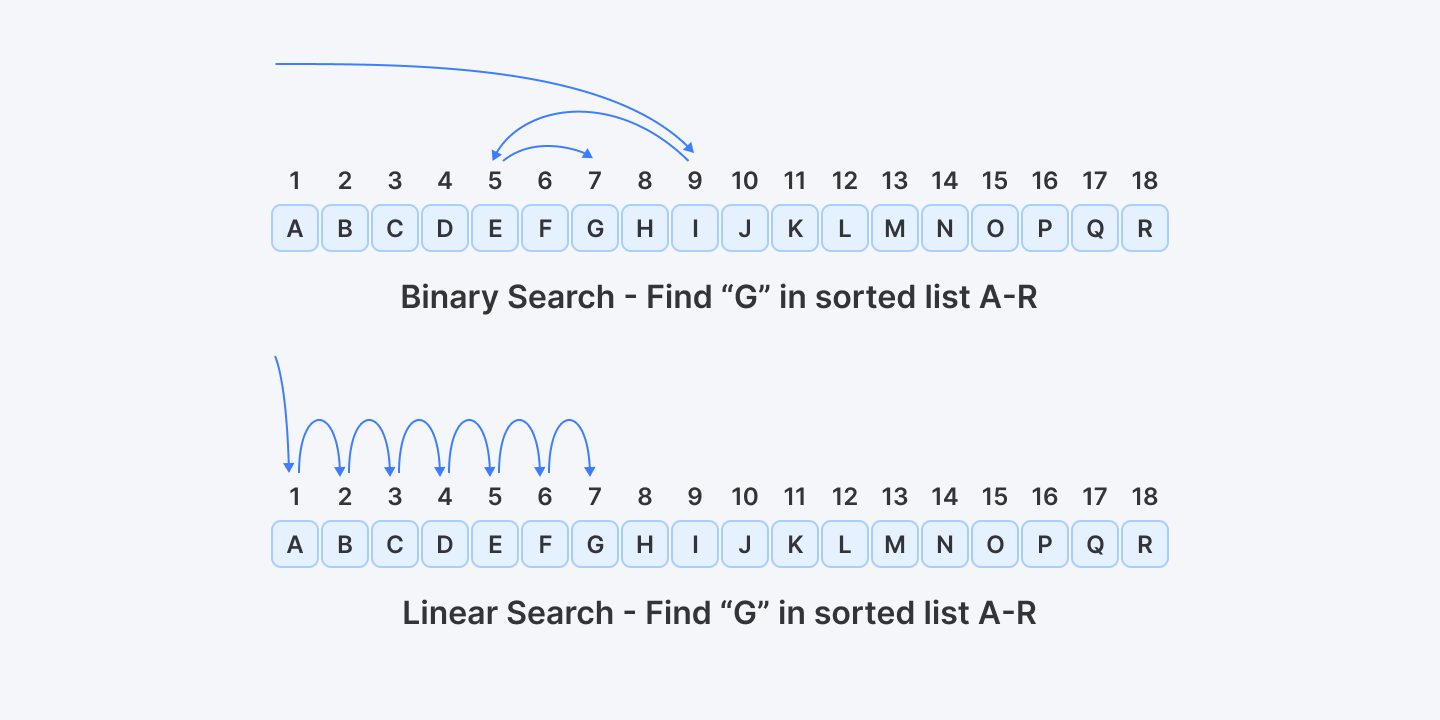
Binary Search is a highly efficient algorithm for locating an element in a sorted array. It works by repeatedly dividing the search range in half, eliminating half of the possibilities with each step. With a time complexity of 𝑂(log𝑛), it’s much faster than a linear search for large datasets.
2. Linear Search
Linear Search is the simplest search method. It scans each element in a dataset one by one until it finds the target. While it’s easy to implement, it’s not the best choice for large datasets due to its 𝑂(𝑛) time complexity.
3. Depth-First Search (DFS)
DFS is a graph traversal algorithm that explores as far as possible along each branch before backtracking. This method is particularly useful for tasks such as finding connected components in graphs.
4. Breadth-First Search (BFS)
BFS is another graph traversal algorithm, but unlike DFS, it explores all neighbors of a node before moving deeper. It’s particularly valuable for finding the shortest path in unweighted graphs or for applications like social network analysis.
Code Example: Binary Search in Python
Let’s see Binary Search in action. Imagine you’re building a library app and need to find a specific book’s ID in a sorted list. Here’s how Binary Search can do the job:
def binary_search(arr, target):
    low, high = 0, len(arr) - 1

    while low <= high:
        mid = (low + high) // 2

        if arr[mid] == target:
            return mid  # Found the target!
        elif arr[mid] < target:
            low = mid + 1
        else:
            high = mid - 1

    return -1  # Target not found

# Example usage
books = [101, 203, 304, 450, 501]
target_book = 304
result = binary_search(books, target_book)

if result != -1:
    print(f"Book found at index {result}.")
else:
    print("Book not found.")
Key Applications
- Web Crawlers: Search algorithms power web crawlers, helping search engines index billions of web pages efficiently.
- Pathfinding: BFS is often used in games and robotics to find the shortest path in grids or graphs.
- AI and Machine Learning: Searching is fundamental in decision-making processes, from exploring game moves to optimizing neural networks.
Importance in 2025
In 2025, searching algorithms will still be at the core of efficient data handling. With the explosion of data and increasingly complex systems, you, as a developer, will need powerful algorithms like Binary Search, DFS, and BFS to quickly and accurately find the information you need. Whether you're working on AI, data analysis, or complex software systems, these algorithms will help you tackle large datasets. Mastering them will not only speed up your development process but also ensure your solutions are scalable and reliable.
2. Sorting Algorithms
Sorting algorithms play a crucial role in organizing data in a specific order, whether it's ascending or descending. They are fundamental in software development for tasks like data analysis, searching, and preparing data for display. From arranging files alphabetically to sorting numbers in ascending order, these algorithms are an essential part of every developer’s toolkit
Key Sorting Algorithms
1. Bubble Sort
This is one of the simplest sorting algorithms. It repeatedly steps through the list, compares adjacent elements, and swaps them if they’re in the wrong order. This process continues until no swaps are needed, indicating that the array is sorted. Although easy to implement, its average and worst-case time complexity is (𝑂(𝑛2)O(n2), making it inefficient for larger data sets.
2. Quick Sort
Quick Sort uses a divide-and-conquer approach. It selects a "pivot" element and partitions the array into two halves—elements smaller than the pivot and those larger. This process is repeated recursively. With an average time complexity of 𝑂(𝑛log𝑛), Quick Sort is often faster than other algorithms for large data sets.
3. Merge Sort
Merge Sort is another divide-and-conquer algorithm. It splits the array into halves, sorts each half recursively, and then merges them back together in sorted order. It guarantees a time complexity of 𝑂(𝑛log𝑛) and is particularly useful for large datasets that don’t fit into memory.
4. Insertion Sort
This algorithm is a straightforward algorithm that sorts an array by building a sorted section one element at a time. It works similarly to how you might sort playing cards in your hands—taking each card and placing it in the correct position among the already sorted cards. It’s efficient for small datasets but struggles with large ones due to its 𝑂(𝑛2) time complexity.
Code Example: Quick Sort in JavaScript
Let’s see how Quick Sort works in JavaScript. Imagine you’re building an e-commerce app and need to sort a list of product prices in ascending order:
function quickSort(arr) {
    if (arr.length <= 1) {
        return arr; // Base case: an array of one or zero elements is already sorted
    }

    const pivot = arr[arr.length - 1]; // Choose the last element as pivot
    const left = []; // Elements smaller than pivot
    const right = []; // Elements larger than pivot

    for (let i = 0; i < arr.length - 1; i++) {
        if (arr[i] < pivot) {
            left.push(arr[i]);
        } else {
            right.push(arr[i]);
        }
    }

    return [...quickSort(left), pivot, ...quickSort(right)]; // Recursively sort and merge
}

// Example usage
const prices = [99.99, 19.99, 49.99, 9.99, 199.99];
const sortedPrices = quickSort(prices);
console.log(sortedPrices); // [9.99, 19.99, 49.99, 99.99, 199.99]
Key Applications
- Data Analysis: Sorting algorithms are crucial for organizing data before analysis or visualization.
- Database Management: Efficient sorting helps in optimizing query performance in databases.
- Search Optimization: Sorted data allows for faster searches and retrievals using algorithms like binary search.
- E-commerce: Sorting algorithms help organize product listings by price, popularity, or ratings.
Importance in 2025
Sorting algorithms are your secret weapon to handle data at lightning speed. With data growing exponentially, you'll need efficient algorithms like Quick Sort and Insertion Sort to power fast, responsive applications. Whether you're optimizing search results or managing complex AI datasets, mastering these algorithms is essential to keep your code sharp and your apps fast. As a developer, knowing how to use sorting will set you apart in the race for performance and efficiency.
3. Graph Algorithms
Graphs are all around us—from social networks to navigation systems, even to the recommendation engines that suggest your next movie. Graph algorithms help you understand relationships and connections between data points. Whether it’s finding the shortest path, identifying critical nodes, or optimizing routes, these algorithms are important for solving complex structures.
Key Graph Algorithms
1. Dijkstra’s Algorithm
Use this when you need to find the shortest path between two nodes in a weighted graph. It operates by repeatedly selecting the nearest unvisited vertex and updating the distances to its neighbors. It’s widely used in routing and navigation systems like Google Maps.
2. Kruskal’s Algorithm
Want to build a minimum spanning tree? Kruskal’s algorithm connects all nodes in a graph with the least total edge weight, making it great for optimizing networks like pipelines or electrical grids.
3. Prim’s Algorithm
Similar to Kruskal’s, but Prim’s algorithm grows the spanning tree from a starting node, adding the smallest possible edge at each step. It’s another way to build minimum spanning trees.
4. Topological Sort
When tasks have dependencies (e.g., project scheduling), Topological Sort arranges them in the correct order. This only works for Directed Acyclic Graphs (DAGs).
5. Johnson’s Algorithm
Johnson’s Algorithm finds the shortest paths between all pairs of vertices in a weighted graph. It combines both Dijkstra’s and Bellman-Ford algorithms to achieve this efficiently, even with negative weights.
6. Articulation Points (or Cut Vertices)
Articulation points are critical nodes in a graph. Removing them disconnects the graph, which makes this algorithm handy for analyzing vulnerabilities in networks.
Code Example: Dijkstra’s Algorithm in Python
Imagine you’re developing a delivery app and need to find the fastest route between two locations:
import heapq

def dijkstra(graph, start):
    distances = {node: float('inf') for node in graph}
    distances[start] = 0
    priority_queue = [(0, start)]  # (distance, node)

    while priority_queue:
        current_distance, current_node = heapq.heappop(priority_queue)

        if current_distance > distances[current_node]:
            continue

        for neighbor, weight in graph[current_node].items():
            distance = current_distance + weight

            if distance < distances[neighbor]:
                distances[neighbor] = distance
                heapq.heappush(priority_queue, (distance, neighbor))

    return distances

# Example usage
graph = {
    'A': {'B': 5, 'D': 9, 'E': 2},
    'B': {'A': 5, 'C': 2},
    'C': {'B': 2, 'D': 3},
    'D': {'A': 9, 'C': 3, 'E': 2},
    'E': {'A': 2, 'D': 2}
}

shortest_paths = dijkstra(graph, 'A')
print(shortest_paths)  # {'A': 0, 'B': 5, 'C': 7, 'D': 4, 'E': 2}
Key Applications
- Navigation Systems: Algorithms like Dijkstra’s and Johnson’s are essential for route planning and traffic management.
- Network Optimization: Kruskal’s and Prim’s help design cost-effective communication or transportation networks.
- Dependency Management: Topological Sort ensures tasks are completed in the right sequence, perfect for project planning tools.
- Task Scheduling: Topological Sort helps manage dependencies between tasks effectively.
- Cybersecurity: Articulation points help identify weak spots in networks, making them vital for strengthening security.
Importance in 2025
Graph algorithms will remain vital as we rely more on interconnected systems, from IoT devices to large-scale social networks. Whether you're working on network optimization, AI, or mapping systems, algorithms like Dijkstra’s and Kruskal’s will help you tackle large-scale data with precision. As a developer, mastering these algorithms will let you unlock powerful solutions for routing, connectivity, and resource management.
Read More: 13 Python Algorithms Every Developer Should Know
4. Dynamic Programming
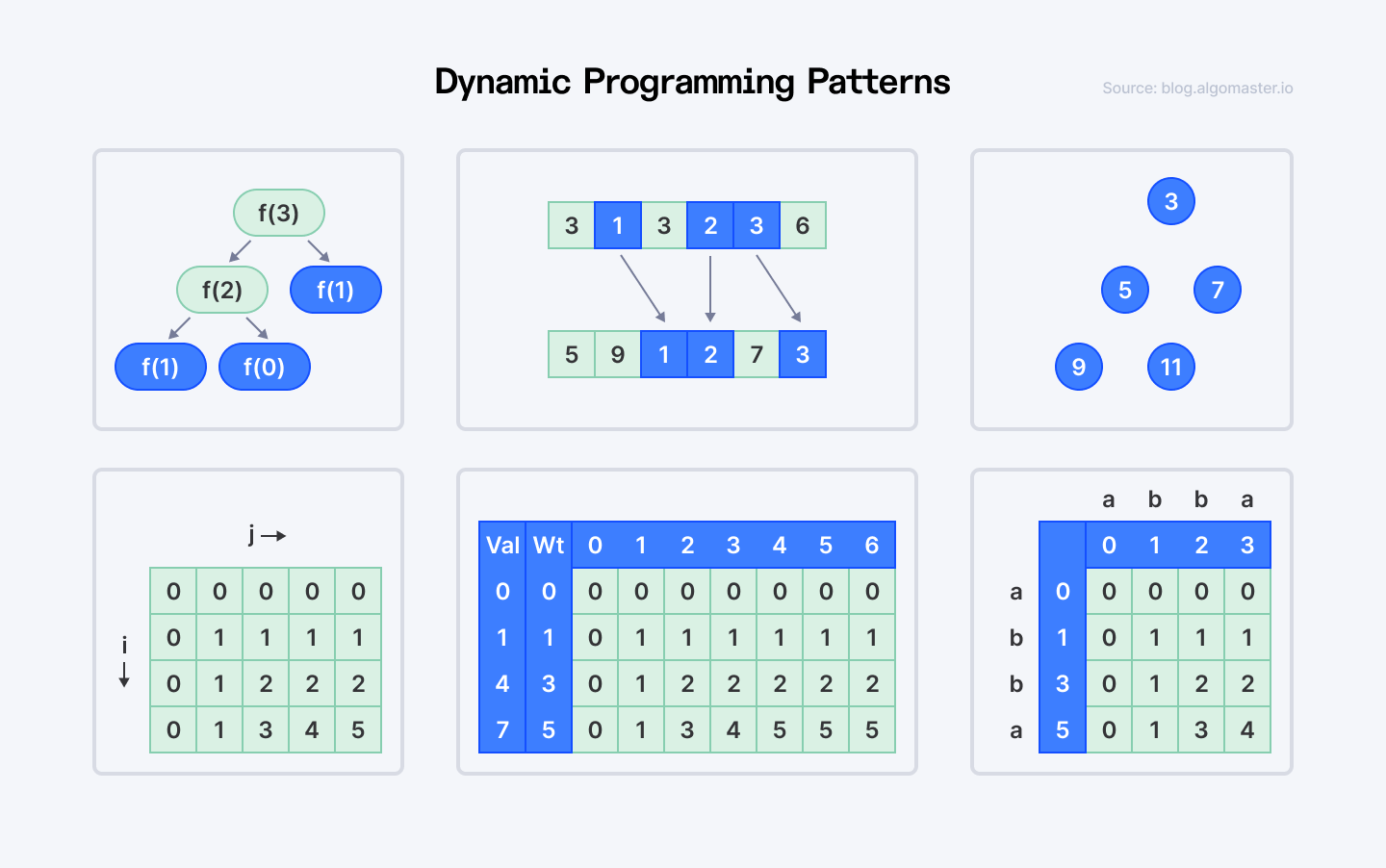
Dynamic programming (DP) might sound fancy, but it’s really just about breaking down a big problem into smaller, overlapping sub-problems and solving them efficiently. Think of it as being smart about avoiding repetitive calculations. You’ll see DP in action in optimization problems, string processing, and more.
Key Dynamic Programming Algorithms
1. Fibonacci Sequence Calculation
This classic problem finds numbers in a sequence where each number is the sum of the two before it. Using DP, you can calculate it efficiently by storing previously computed results.
2. Knapsack Problem
Imagine you’re packing a bag for a trip and want to maximize the value of items you carry without exceeding the weight limit. The Knapsack Problem is all about finding the best combination of items to optimize value. It can be solved using dynamic programming by creating a table that stores the maximum value achievable for each weight limit.
3. Longest Common Subsequence (LCS)
LCS helps you figure out the longest sequence that appears in the same order in two strings. This problem can be efficiently solved using dynamic programming by constructing a table that tracks the lengths of common subsequences at each step. It’s incredibly useful in DNA sequence analysis or version control systems.
4. Longest Path in a Matrix
Finding the longest path in a matrix involves navigating through a grid to find the longest increasing path. This problem can also be approached using dynamic programming, where you keep track of the longest path from each cell. It’s handy in grid-based games or terrain analysis.
Code Example: Fibonacci Sequence Calculation in JavaScript
Let’s say you want to calculate the 10th Fibonacci number. Here’s how DP can make it efficient in JavaScript:
function fibonacci(n) {
    const dp = Array(n + 1).fill(0);
    dp[1] = 1;

    for (let i = 2; i <= n; i++) {
        dp[i] = dp[i - 1] + dp[i - 2];
    }

    return dp[n];
}

// Example usage
const result = fibonacci(10); // 55
console.log(`The 10th Fibonacci number is ${result}`);
Key Applications
- Financial Modeling: Fibonacci calculations are often used in financial algorithms for predicting market trends.
- Resource Allocation: The Knapsack Problem helps optimize resource allocation in various fields, including logistics and finance.
- Text Comparison: LCS is useful in applications like version control systems and plagiarism detection.
- DNA Analysis: LCS is vital in bioinformatics for comparing DNA or protein sequences.
- Game Development: Longest path algorithms can enhance gameplay mechanics by determining optimal paths for characters or objects.
Importance in 2025
Dynamic programming will continue shining in fields where optimization is critical. From AI and machine learning to logistics and genetic research, these algorithms are essential for solving real-world problems efficiently. If you master these, you’ll have tools to handle anything from data-heavy applications to complex optimization challenges.
5. Greedy Algorithms
Greedy algorithms are all about making the best possible choice at each step to solve a problem. While they might not always guarantee the perfect solution, they’re super fast and often good enough for many practical scenarios. Think of it as grabbing the most candy in each handful at a buffet without looking too far ahead.
Key Greedy Algorithms
1. Huffman Coding
This algorithm compresses data efficiently by assigning shorter codes to frequently occurring items, like characters in a file. This method minimizes the total number of bits used for encoding data. It’s widely used in file compression formats such as ZIP.
2. Coin Change Problem
Let’s say you need to make change for a certain amount using the fewest coins. The greedy approach picks the largest coin first and works its way down.
3. Activity Selection Problem
Imagine you’re scheduling the maximum number of non-overlapping meetings in a day. This problem helps you figure out the best way to fit them in.
Code Example: Coin Change Problem in Python
Let’s say you want to find the minimum number of coins needed to make a certain amount. Here’s how a greedy algorithm works:
def coin_change(coins, amount):
    coins.sort(reverse=True)  # Sort coins in descending order
    count = 0
    for coin in coins:
        while amount >= coin:
            amount -= coin
            count += 1
    return count if amount == 0 else -1  # -1 if the amount can't be made

# Example usage
coins = [25, 10, 5, 1]  # US coins: quarters, dimes, nickels, pennies
amount = 63
result = coin_change(coins, amount)
print(f"Minimum coins needed: {result}")
Key Applications
- Data Compression: Huffman Coding powers many compression algorithms, from text files to images.
- Currency Exchange: The Coin Change Problem is crucial for optimizing ATMs and payment systems.
- Event Scheduling: Activity Selection helps manage tasks, meetings, or even sports schedules effectively.
Importance in 2025
Greedy algorithms continue to be a go-to approach for problems that demand speed and simplicity. Whether it’s optimizing system resources, compressing massive data, or scheduling events, these algorithms will remain relevant. Understanding their limitations and strengths can help you decide when to use them and when to look for a more comprehensive solution.
Explore More: 21 Advanced C++ Coding Challenges for Senior Developers
6. Backtracking Algorithms
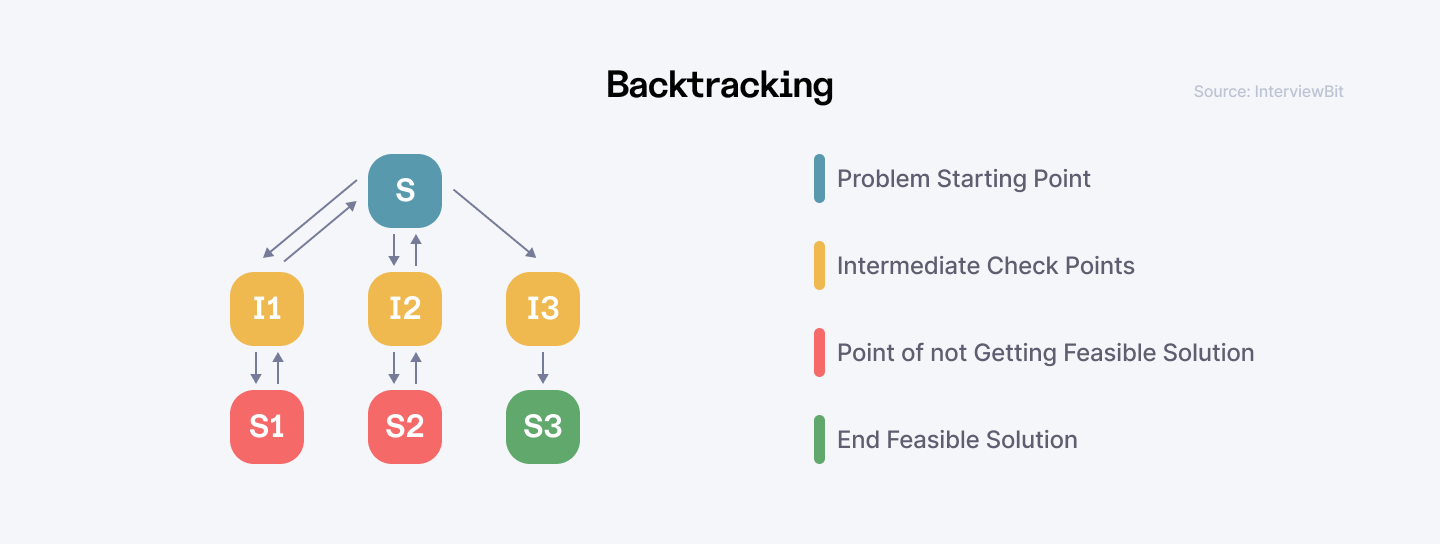
Backtracking algorithms are like problem-solving detectives. They try out solutions step by step, and if they hit a dead end, they backtrack to try a different path. This makes them perfect for exploring possibilities and finding solutions to complex problems.
Key Backtracking Algorithms
1. N-Queens Problem
You’re tasked with placing N chess queens on an N×N chessboard so no two queens threaten each other. Backtracking helps find all possible arrangements, ensuring that each solution is valid.
2. Sudoku Solver
Ever wondered how computers solve Sudoku puzzles so quickly? The Sudoku Solver algorithm fills in the empty cells of a Sudoku puzzle by trying numbers from 1 to 9. Backtracking systematically fills the grid, checking for valid placements until it solves the puzzle.
3. Subset Sum Problem
The Subset Sum Problem asks whether there is a subset of a given set of integers that adds up to a specific target sum. The backtracking approach tries different combinations of elements and backtracks when the current combination exceeds the target.
Code Example: N-Queens Problem in Java
Here’s how you can solve the N-Queens problem using backtracking:
public class NQueens {
    static void solveNQueens(int n) {
        char[][] board = new char[n][n];
        for (char[] row : board) {
            java.util.Arrays.fill(row, '.');
        }
        placeQueens(board, 0);
    }

    static boolean placeQueens(char[][] board, int row) {
        if (row == board.length) {
            printBoard(board);
            return true;
        }
        boolean hasSolution = false;
        for (int col = 0; col < board.length; col++) {
            if (isSafe(board, row, col)) {
                board[row][col] = 'Q';
                hasSolution = placeQueens(board, row + 1) || hasSolution;
                board[row][col] = '.';
            }
        }
        return hasSolution;
    }

    static boolean isSafe(char[][] board, int row, int col) {
        for (int i = 0; i < row; i++) {
            if (board[i][col] == 'Q') return false;
        }
        for (int i = row - 1, j = col - 1; i >= 0 && j >= 0; i--, j--) {
            if (board[i][j] == 'Q') return false;
        }
        for (int i = row - 1, j = col + 1; i >= 0 && j < board.length; i--, j++) {
            if (board[i][j] == 'Q') return false;
        }
        return true;
    }

    static void printBoard(char[][] board) {
        for (char[] row : board) {
            System.out.println(new String(row));
        }
        System.out.println();
    }

    public static void main(String[] args) {
        solveNQueens(8); // Solves the 8-queens problem
    }
}
Key Applications
- Puzzle Solving: Backtracking is widely used in solving puzzles like Sudoku and crosswords.
- Game Development: Algorithms like N-Queens help in developing AI for games that require strategic placement.
- Combinatorial Problems: Problems like generating permutations or combinations are solved efficiently using backtracking.
Importance in 2025
Backtracking algorithms will be a game-changer for you in 2025 when solving problems that need exploring all possibilities—like puzzles, optimization, or decision-making tasks. They let you try different paths, back up when something doesn’t work, and find the best solution efficiently. From solving Sudoku to designing algorithms for AI, backtracking helps you tackle challenges that seem impossible at first glance. As applications become more dynamic and complex, mastering backtracking ensures you have a reliable approach to solving even the trickiest problems.
7. Recursive Algorithms
Recursive algorithms solve problems by breaking them into smaller, similar subproblems. They call themselves with a smaller piece of the original problem until reaching a base case, where no further breakdown is needed. If you’ve ever peeled an onion layer by layer, you’ve basically seen recursion in action.
Key Recursive Algorithms
1. Tower of Hanoi
The Tower of Hanoi is a classic puzzle where you need to move disks between three pegs, following these rules: only one disk can be moved at a time, and no disk can be placed on top of a smaller one. The algorithm solves this using recursion, where you first move the top n-1 disks to an auxiliary peg, then move the nth disk to the target peg, and finally place the n-1 disks on top of the nth disk. This recursive process efficiently completes the puzzle step by step.
2. Tree Traversals
Traversing a tree structure, such as in binary trees, is made easy with recursion. There are several types of traversals, including:
- In-order Traversal: Visit the left subtree, then the current node, and finally the right subtree.
- Pre-order Traversal: Visit the current node first, then the left subtree, followed by the right subtree.
- Post-order Traversal: Visit the left subtree, then the right subtree, and finally the current node.
Code Example: Tower of Hanoi in Python
Here’s how recursion can solve the Tower of Hanoi problem:
def tower_of_hanoi(n, source, target, auxiliary):
    if n == 1:
        print(f"Move disk 1 from {source} to {target}")
        return
    tower_of_hanoi(n - 1, source, auxiliary, target)
    print(f"Move disk {n} from {source} to {target}")
    tower_of_hanoi(n - 1, auxiliary, target, source)

# Solve Tower of Hanoi with 3 disks
tower_of_hanoi(3, 'A', 'C', 'B')
Output Example
Move disk 1 from A to C
Move disk 2 from A to B
Move disk 1 from C to B
Move disk 3 from A to C
Move disk 1 from B to A
Move disk 2 from B to C
Move disk 1 from A to C
Key Applications
- Problem Solving: Recursive algorithms are widely used in solving mathematical problems like factorials and Fibonacci numbers.
- Game Development: Recursive algorithms like Tower of Hanoi inspire problem-solving mechanics in games.
- Tree Structures: Recursion is perfect for working with hierarchical data, like directory structures or JSON trees.
Importance in 2025
Recursive algorithms will matter more than ever in 2025 because they help you solve complex problems step by step. Their ability to break tasks into smaller, manageable pieces makes them essential for traversing hierarchical data structures like trees or file systems.
You’ll use it in AI, data analysis, and even generating graphics.

8. String Matching Algorithms
String matching algorithms are essential for finding patterns within text. Whether you’re building a search engine, analyzing DNA sequences, or creating a spam filter, these algorithms help you locate strings efficiently. Think of them as advanced detectives, scanning through massive amounts of text to find exactly what you’re looking for.
Key String Matching Algorithms
1. Knuth-Morris-Pratt (KMP) Algorithm
The KMP algorithm pre-processes the pattern to create a partial match table, which makes searching much faster by skipping unnecessary comparisons.
2. Rabin-Karp Algorithm
This algorithm uses a rolling hash function to quickly match patterns. It's great when you need to search multiple patterns simultaneously.
3. Boyer-Moore Algorithm
A highly efficient algorithm that compares the pattern from right to left, skipping chunks of text when mismatches occur. Ideal for long text searches.
Code Example: Rabin-Karp Algorithm in JavaScript
Here’s how you can implement the Rabin-Karp algorithm for pattern matching:
function rabinKarp(text, pattern) {
    const prime = 101; // A prime number for hashing
    const m = pattern.length;
    const n = text.length;
    let patternHash = 0, textHash = 0, h = 1;

    // Calculate the hash value of pattern and first window of text
    for (let i = 0; i < m - 1; i++) {
        h = (h * 256) % prime;
    }
    for (let i = 0; i < m; i++) {
        patternHash = (256 * patternHash + pattern.charCodeAt(i)) % prime;
        textHash = (256 * textHash + text.charCodeAt(i)) % prime;
    }

    // Slide the pattern over text
    for (let i = 0; i <= n - m; i++) {
        if (patternHash === textHash) {
            if (text.substring(i, i + m) === pattern) {
                console.log(`Pattern found at index ${i}`);
            }
        }
        if (i < n - m) {
            textHash = (256 * (textHash - text.charCodeAt(i) * h) + text.charCodeAt(i + m)) % prime;
            if (textHash < 0) {
                textHash += prime;
            }
        }
    }
}

// Test the function
rabinKarp("hello world", "world");
Output Example
Pattern found at index 6
Key Applications
- Text Processing: String matching algorithms are widely used in search engines and word processors.
- Bioinformatics: These algorithms help find patterns in DNA and protein sequences.
- Spam Detection: These algorithms match patterns to detect spam messages or emails.
- Data Mining: String matching plays a crucial role in identifying trends and patterns within large datasets.
Importance in 2025
From real-time text analysis and search engines to AI-driven content filtering and DNA analysis, the String Matching algorithms' role in handling complex text-based tasks ensures their relevance in modern software development.
Read More: 21 Advanced JavaScript Challenges That Test Your Skills
9. Tree Algorithms
Tree algorithms help you organize and access data hierarchically, making tasks like searching, inserting, and deleting incredibly efficient. Whether you’re working with dictionaries, implementing auto-suggestions, or storing hierarchical data, trees are your go-to structure. Think of them as branching pathways that ensure you always know where to go next.
Key Tree Algorithms
1. Binary Search Tree (BST)
A BST organizes data such that each node has at most two children, and the left child’s value is less than the parent, while the right child’s value is greater. It’s great for quick searches, inserts, and deletions.
2. AVL Tree
An AVL tree is a self-balancing BST. It maintains balance by performing rotations during insertions and deletions, ensuring that operations are consistently efficient.
3. Trie (Prefix Tree)
A Trie is a specialized tree used for searching strings, often for autocomplete, dictionary applications, or spell-checking. Each node represents a character, and paths through the tree spell out words.
Code Example: Trie Implementation in Python
Here’s how you can create and use a Trie for word searches:
class TrieNode:
    def __init__(self):
        self.children = {}
        self.is_end_of_word = False

class Trie:
    def __init__(self):
        self.root = TrieNode()

    def insert(self, word):
        node = self.root
        for char in word:
            if char not in node.children:
                node.children[char] = TrieNode()
            node = node.children[char]
        node.is_end_of_word = True

    def search(self, word):
        node = self.root
        for char in word:
            if char not in node.children:
                return False
            node = node.children[char]
        return node.is_end_of_word

# Usage
trie = Trie()
trie.insert("hello")
trie.insert("world")

print(trie.search("hello"))  # Output: True
print(trie.search("python")) # Output: False
Key Applications
- Search Engines: Trees like Tries are used for autocomplete features in search engines.
- Databases: Binary Search Trees and AVL Trees help maintain sorted data efficiently.
- Routing Algorithms: Trees are used in network routing protocols to manage paths effectively.
- Spelling Checkers: Tries can validate words quickly against a dictionary.
Importance in 2025
Tree algorithms will be crucial in 2025 as applications grow more complex and data structures evolve. Whether you're working on search engines, databases, or AI models, algorithms like Binary Search Trees, AVL Trees, and Tries will help you manage and query large datasets efficiently. With the increasing demand for performance and speed, tree algorithms will be your secret weapon for managing hierarchical data with ease.
10. Cryptographic Algorithms
Cryptographic algorithms keep your data safe, whether you're shopping online, sending a private message, or securing sensitive information. They encrypt, decrypt, and verify data, ensuring confidentiality, integrity, and authenticity. Think of them as digital locks and keys for secure communication.
Key Cryptographic Algorithms
1. RSA Algorithm
RSA (Rivest-Shamir-Adleman) is a public-key encryption algorithm widely used for securing sensitive data, especially in online transactions. It uses two keys: a public key for encryption and a private key for decryption and relies on the difficulty of factoring large numbers.
2. AES (Advanced Encryption Standard)
AES is a symmetric encryption algorithm known for its speed and security. It’s used in everything from securing Wi-Fi networks to encrypting files. AES operates through multiple rounds of processing, with the number of rounds depending on the key size.
3. SHA (Secure Hash Algorithms)
SHA is a family of cryptographic hash functions designed to produce a fixed-size hash value from input data of any size. These hash functions are one-way operations, meaning you cannot retrieve the original data from the hash value. It’s essential for password storage, data integrity checks, and digital signatures.
Code Example: Encrypting Data with RSA in Go
Here’s an example of how to generate keys and encrypt/decrypt data using the RSA algorithm:
package main

import (
"crypto/rand"
"crypto/rsa"
"crypto/sha256"
"fmt"
)

func main() {
// Generate RSA keys
privateKey, _ := rsa.GenerateKey(rand.Reader, 2048)
publicKey := &privateKey.PublicKey

// Encrypt a message
message := []byte("Keep this data secure!")
hash := sha256.New()
ciphertext, _ := rsa.EncryptOAEP(hash, rand.Reader, publicKey, message, nil)

fmt.Printf("Encrypted: %x\n", ciphertext)

// Decrypt the message
plaintext, _ := rsa.DecryptOAEP(hash, rand.Reader, privateKey, ciphertext, nil)
fmt.Printf("Decrypted: %s\n", plaintext)
}
Key Applications
- Secure Messaging: Algorithms like RSA ensure your messages stay private on platforms like WhatsApp.
- Data Protection: AES is commonly used to encrypt sensitive information in databases and applications.
- Online Transactions: AES secures your credit card details during online purchases.
- Digital Signatures: SHA verifies data integrity and authenticates messages or documents.
Importance in 2025
In 2025, cryptographic algorithms are a must-have skill. They’re what keep data safe in an increasingly connected and vulnerable world. Whether you're securing user information, enabling safe online transactions, or protecting sensitive communications, these algorithms are your shield against cyber threats. It’s not just about protecting data—it’s about proving you’re a developer who values security as much as functionality.
11. Machine Learning Algorithms
Machine Learning (ML) algorithms let you teach computers to make predictions, spot patterns, or solve problems—without explicitly programming them. They're like a brain for your applications, helping systems learn from data and improve over time.
Key Machine Learning Algorithms
1. Linear Regression
Linear regression is the simplest ML algorithm, used to predict continuous values. It draws a straight line through your data points to show the relationship between inputs and outputs. This algorithm is commonly used for tasks like predicting house prices based on features such as size or location.
2. Decision Trees
A decision tree works like a flowchart, splitting data into branches based on feature values, creating tree-like structure. Each decision node represents a feature, while leaf nodes provide the final prediction. Decision Trees can be used for both classification and regression tasks.
3. Neural Networks
Inspired by the human brain, neural networks consist of layers of interconnected nodes (neurons). They excel at capturing complex patterns in data, making them suitable for tasks like image recognition, natural language processing, and more. Neural networks can be deep (deep learning) with multiple hidden layers, allowing them to learn hierarchical representations of data.
4. K-Nearest Neighbors (KNN)
KNN predicts the output for new data points by looking at the closest “neighbors” in its dataset. It calculates distances using metrics like Euclidean or Manhattan distance and assigns the class label based on the most common label among its K nearest neighbors. It’s simple yet effective for classification and regression tasks.
Code Example: Decision Tree Classifier in R
Here’s how you can use a decision tree to classify data:
# Install and load necessary library
install.packages("rpart")
library(rpart)

# Example dataset
data <- data.frame(
  Age = c(25, 30, 35, 40, 45),
  Income = c("High", "High", "Medium", "Medium", "Low"),
  Outcome = c("Yes", "No", "Yes", "Yes", "No")
)

# Build a decision tree
tree <- rpart(Outcome ~ Age + Income, data = data, method = "class")

# Visualize the tree
plot(tree)
text(tree)

# Predict an outcome
new_data <- data.frame(Age = 28, Income = "High")
predict(tree, new_data, type = "class")
Key Applications
- Predictive Analytics: Linear regression helps forecast sales, stock prices, and user behavior.
- Image Recognition: Neural networks identify faces, objects, and even emotions in photos.
- Recommendation Systems: KNN powers systems like Netflix and Spotify to suggest content.
- Classification Tasks: Decision trees and KNN are popular for tasks like spam detection or customer segmentation.
Importance in 2025
In 2025, machine learning algorithms can help you analyze massive amounts of data, personalize user experiences, and automate complex tasks. Whether you're building smarter chatbots, improving search recommendations, or detecting fraud, these algorithms are your tools to make it happen. They let you solve problems that can’t be tackled with traditional programming. With the rise of AI in everyday tech, knowing how to use machine learning algorithms makes you a developer who’s ready to build the future of tech.
Wrapping Up
Algorithms are at the core of everything you do as a developer. They take your ideas and turn them into working code that powers apps, tools, and systems.
The ones we’ve covered aren’t just concepts—they’re practical solutions to real-world problems. Whether you’re organizing data, finding the best path, training machines to learn, or keeping information secure, these algorithms are your go-to tools.
Learning them isn’t just about improving your code. It’s about becoming a developer who can solve tough challenges, build smarter, faster systems, and create software that stands out. Master these, and you’ll always be ready for whatever the future of tech demands.
For Developers: Ready to level up your skills? Join Index.dev and get access to high-paying remote opportunities with top global companies. Build a career that grows with you.
For Clients: Need expert developers to tackle your projects? Let Index.dev help you hire from a pool of vetted, senior talent ready to deliver from day one. Fast, reliable, and flexible as your scaling plans.

