Wonder why your payment app transfers money in a flash, but your bank statement is stuck in the slow lane when it comes to updating? The magic is behind the screens, where fintech players handle two different methods of your data: one fast, the other slow but powerful.
Let's get a glimpse behind the curtain on how your financial apps function.
Tired of long hiring cycles? Tap into Index.dev’s curated pool of remote tech professionals today.
What Are Real-Time and Batch Processing?
When working with data, it’s important to understand how it’s processed. Two common methods are real-time and batch processing. Here's what each means.
- Real-Time Processing:
Data is processed immediately as it’s received, so results are available almost instantly.
- Batch Processing:
Data is collected over time and processed all at once in groups or batches at a scheduled time.
This is exactly how fintech firms treat your data.
The Need-It-Now Approach: Real-Time Processing
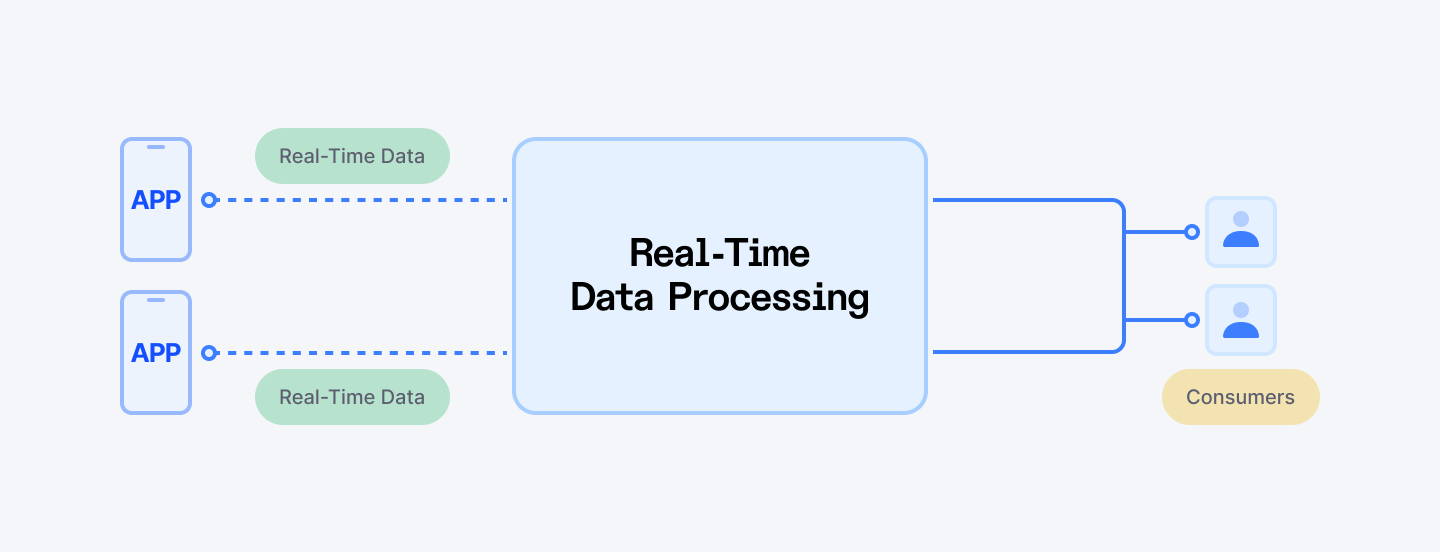
Real-time processing uses your data the moment it gets here, we are talking milliseconds.
The Inner Workings
- Your data keeps coming continuously without waiting for anything else
- The system processes the information as soon as it arrives
- You see results quicker than you can clap your hands (usually in less than 100 milliseconds).
Technologies Used
- Apache Kafka:
This technology can handle over 600 megabytes of data per second on each server. Think of it like a super-fast conveyor belt moving data.
- Apache Flink:
This tool processes the moving data and makes sure nothing gets lost.
- AWS Kinesis:
Amazon's tool that can automatically grow or shrink based on how much data is coming in.
Real-Life Examples:
When you use your credit card, the bank’s system checks the transaction instantly to see if it looks suspicious, like an unusual location or large amount.
How it works:
- You make a purchase.
- The system immediately analyzes the transaction using rules and machine learning.
- If it looks risky, it blocks the payment or sends you an alert, on the spot.
This helps stop fraud before money is lost, thanks to real-time processing.
Power in Numbers: Batch Processing
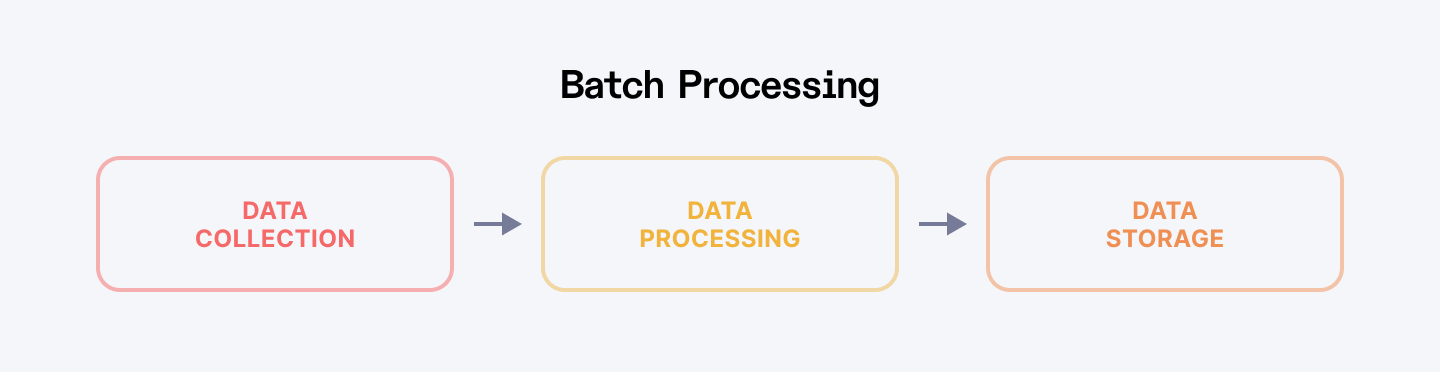
Batch processing gathers heaps of data, waits for the optimal time, then makes it all happen, i.e., processes all the data with one sweeping stroke.
The Inner Workings
- Data is collected and stored temporarily
- Processing happens on a schedule (hourly, daily, weekly)
- Processes staggering amounts of data efficiently
Technologies Used
- Apache Spark:
It can process terabytes of data per hour using 100 computers working together. That's like processing all the text in a million books every hour!
- Hadoop:
A cost-effective way to store and analyse massive amounts of data.
Real-Life Example
At the end of each month, your bank sends you a full statement of your account activity.
How it works:
- The bank collects all your transactions during the month.
- At a scheduled time (like the 1st of the next month), it processes everything together.
- Then it generates and sends your monthly statement in one go.
This is batch processing: handling all the data at once after a period of time.
Difference Between Real-Time and Batch Processing
Feature | Real-Time Processing | Batch Processing |
| Response Time | Instant (under 100 milliseconds) | Requires 1 to 24 hours |
| Cost | Considerably expensive (£4,000-£40,000 monthly) | Wallet-friendly (£800-£8,000 monthly) |
| Data Volume | Streams (MBs to GBs per second) | Large volumes (up to petabytes) |
| Tools Used | Kafka, Flink, Kinesis | Spark, Hadoop |
| Resilience | Complex, needs checkpointing | Easier recovery with restarts |
| Perfect for | Live alerts, payments, fraud detection | Reporting, analytics, compliance |
| Data Accuracy | Very fresh, sometimes partial | Older, but complete and deep |
| Scaling | Tricky under pressure | Scales easily in the cloud |
| Tech Skills Needed | Event-driven coding (Java/Scala) | SQL, Python or similar |
How Companies Choose Between Real-Time and Batch
Some companies mix the two approaches to get the best of both worlds.
- Micro-Batching:
Conceptualize micro-batching as a processing of mini-waves of data every few seconds rather than holding out for the tsunami. Not exactly instant, but fast enough without the technical hassles of actual real-time systems.
- Lambda Architecture:
This sneaky arrangement employs real-time handling for emergencies while at the same time sending everything into a batch system to dive deeper later. This architecture is like having a sprinter and a marathon runner on your staff.
- Real-Life Examples:
Some investment apps use micro-batching to group user trades made within a short time frame, like a few minutes, and execute them together. This helps reduce trading costs and offer commission-free investing to users.
Making the Choice Between Real-Time and Batch Processing
Factors | Real-Time Processing | Batch Processing |
The Speed Factor | Does the customer want immediate results? Real-time, it is.
| Exhaustive analysis more crucial than timeliness? Batch processing is ideal. |
Data Handling Capability | Small data streams? Either method is adequate. | Processing a huge chunk of data? Batch does a better job. |
Budget Concerns | Can I afford it? Real-time systems need expensive, always-on infrastructure. | Pinching pennies? Batch jobs execute off-hours when computing prices drop. |
Team Expertise | Group of trained engineers? Real-time systems are doable. | Handling diverse technical skills? Batch systems employ more universal tools. |
Real-World Success Stories
Stripe Radar (Real-Time)
- The Job: Catching suspicious card payments before they are finalised
- Scale: Processing millions of payments per second
- The Win: Reduce fraud losses significantly without delaying genuine purchases
Plaid's Data System (Batch)
- The Job: Processing financial information from thousands of banks
- Scale: Converting 200 terabytes per day (the equivalent of 40 million songs)
- The Win: Created deep financial intelligence without needing to be constantly connected
Meroxa's Hybrid System
- The Job: Enabling banks to comply with regulations without paying through the nose
- The Win: Cut compliance expenses in half without annoying regulators
Hire developers from Index.dev and bring real-time and batch processing projects to life, without the long lead times or guesswork.
What This Means in Your Daily Life
The technical choices fintech companies make have a direct influence on your daily banking life:
When Real-Time Rules:
- That delightful "payment sent" alert when dividing the bill at dinner
- Fraud notification before thieves drain your account
- Real-time account balances where each penny matters
- Instant alerts when your pay arrives
When Batch Processing is at Your Side:
- Accurate monthly statements listing all transactions
- Intelligent observations about your spending patterns over months
- Careful security checks that detect sophisticated patterns of fraud
- Reduced bank fees due to improved processing
The Verdict: All Tools for the Right Tasks
Neither strategy is a gold medal winner across the board:
- Real-time processing excels when seconds count, such as detecting fraud during a transaction or checking that your mortgage payment cleared ahead of schedule.
- Batch processing is brilliant at depth and economies of scale, ideal for building entire financial statements or analysing spend patterns for millions of consumers.
The smartest fintech businesses use both especially platforms handling payments for marketplaces and large-scale financial operations.
- Real-time for frontline fast-breaking issues
- Batch for in-depth background work
- Hybrid solutions for in-between cases
Technical Challenges You Never Notice
The technology teams must address intriguing challenges keeping these systems operational:
For real-time systems:
- Supporting "always-on" dependability, even in the face of huge traffic
- Trading off instant response against accuracy
- Processing data once and only once
- Recovering quickly when something fails
For batch systems:
- Scheduling jobs to complete before morning coffee time
- Dealing with surprise data quality problems
- Managing intricate processing chains
- Storing huge volumes of data cost-effectively
Industry Shifts Worth Watching
The financial technology landscape keeps changing:
- Computing on Demand:
Automatically expanding and contracting pay-as-you-go models are becoming popular for both types of processing.
- Processing at the Edge:
Computing closer to where data is produced reduces latency for time-sensitive applications.
- Smarter Everything:
AI is increasingly influencing processing strategies, improving accuracy and performance.
- Stricter Regulations:
With changing financial regulations globally, both systems will have to find room for tighter controls.
Learn more about 9 software architecture patterns: when to use them, why they work, and how to pick the best one.
The Bottom Line
Both processes are crucial in fintech. Real-time systems deliver live event experiences, such as quick transfers or notifications of fraud, while batch processing does the heavy work that keeps things humming along. With advancing technology, the two are fast merging.
Fintech will experience quicker processing, more intelligent systems and improved methods of managing increasing amounts of financial information. Whether getting coffee by tapping your card or viewing your statements, these quiet systems make up-to-date money management easy.
Whether you are building real-time systems or refining batch workflows, get our expert support from Index.dev to scale faster and smarter.