In recent years due to a rapidly evolving environment for software development and growing cases of distributed teams, it has become significant to be aware of the differences between Scrum Masters and Product Managers.
Although the Scrum methodology is practiced by 81% of agile teams, it is now a fundamental part of software development as evidenced by studies that show that good Product Management can raise the profit of a company by 34.2%. Both Product managers and Scrum Masters are pivotal in Agile-driven software product development.
Whether you are on the lookout for these positions, contemplating a career change, or seeking further information about these jobs, this article will help you gain a clearer perspective of how these positions are distinct from one another, how and when they intersect, and in what ways they all contribute to the process of creating new products.

Product Manager vs Project Manager vs Product Owner vs Scrum Master
Let's delve deeper into their similarities, differences, and collaborative dynamics.
Also read: Top agile tools for remote software team management
Understanding the Scrum Master Role
Scrum is the most popular agile framework used by 81 percent of agile teams. In a remote software team, the Scrum Master plays a pivotal role in ensuring that the team follows Agile principles and processes. As a facilitator, the Scrum Master guides the team through the Scrum process, helping them stay on track and overcoming any obstacles they may encounter. The Scrum Master's primary responsibilities include:
- Facilitating the Scrum process
- Ensuring the team follows Agile principles
To excel in this role, a Scrum Master must possess certain skills. Effective communication and problem-solving abilities which are emphasized in CSM training, are crucial for a Scrum Master to manage team dynamics and address any challenges that may arise during the development process.
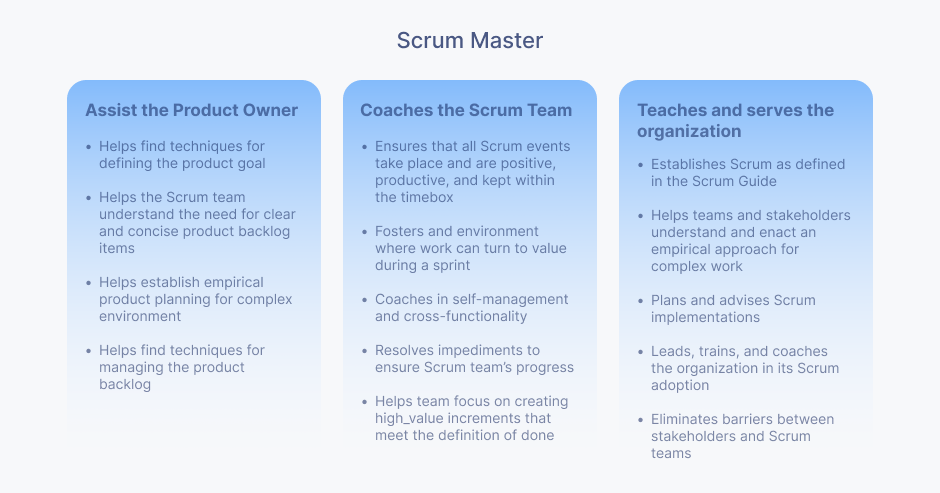
Scrum master responsibilities
The Scrum Master's Role in a Remote Setting
Remote work environments present unique challenges for Scrum Masters. In addition to their standard responsibilities, they must also adapt their approach to effectively facilitate virtual meetings, manage communication tools, and ensure the team stays connected despite geographical distances. This may involve:
- Facilitating virtual meetings: Scrum Masters must be adept at coordinating and leading remote meetings, ensuring that all team members can effectively participate and collaborate.
- Managing communication tools: In a remote setting, Scrum Masters must ensure that the team has access to the necessary communication tools and platforms, and that they are being used effectively to maintain open lines of communication.
- Ensuring the team stays connected: Scrum Masters play a crucial role in fostering a sense of connection and camaraderie among remote team members, encouraging collaboration and teamwork despite physical distances.
Understanding the Product Manager Role
The Product Manager plays a vital role in remote software teams by driving the product strategy and ensuring that it meets customer needs. This involves defining the product vision, prioritizing features, and continuously refining the product based on customer feedback and market research. A fully optimized product manager could increase company profits by 34.2%. A successful Product Manager must possess a strong understanding of their target market and be able to translate customer needs into actionable product requirements.
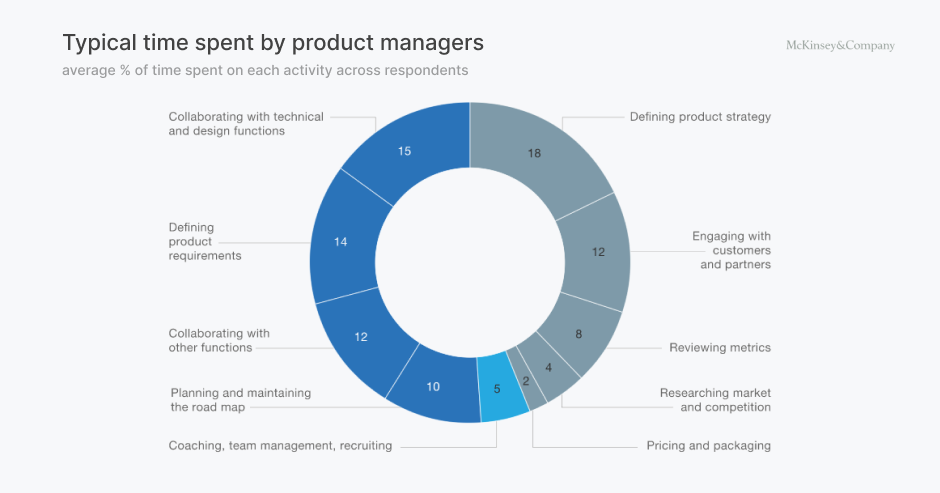
Time spent on each activity by Product Managers
Skills Required for a Product Manager
In addition to their strategic responsibilities, a Product Manager must also have a strong set of skills that enable them to excel in their role. These skills include:
- Market research: A Product Manager must be adept at conducting market research to identify customer needs, trends, and opportunities for product improvement.
- Understanding customer needs: A strong Product Manager should be able to empathize with their customers, understand their pain points, and translate these needs into product features and improvements.
- Data analysis and metrics: A Product Manager should be good at analysis so that he can use that analysis to make informed decisions. And this entails basic competence in comprehending users metrics, test statistics, conversion rates, and all other indicators when it comes to designing the product or evaluating its performance.
- Strategic thinking and roadmap planning: Clearness about a product vision and its details and a defined strategy on how to implement this vision is very important. This ranges from coming up with a product roadmap, determining what features to work on, as well as steering the whole product and ensuring it aligns to organizational goals and opportunities in the market.
- Cross-functional leadership: Leadership skills and successful team management based on informal authority. You are a Product Manager, and you have to lead a team or a number of teams without formal authority.” This means you need to liaise with the engineering, design, marketing, sales and other teams, all the while continuing to build good working rapport and open lines of communications.
- Technical aptitude: Product Managers do not necessarily have to code, but they should have a good idea of what is and what is not feasible. It is useful in provoking insightful conversations with engineers and in the decision making process about technical concerns.
- Communication and presentation skills: The identified skill is to understand Product Vision, Requirements and Rationale and present it to the appropriate audience. This comprises defining clear product requirements, making effective presentations, including those involving technical materials for professional audiences.
- Project management: Practical and effective organizational proficiency and time management are required to schedule and coordinate a number of workflows, meeting time constraints for product delivery and quality production.
- Business acumen: It is therefore important to comprehend foundational concepts such as, revenue models, pricing strategies, and market economics fundamental to directing change for business and product success.
- Problem-solving and decision-making: Product Managers must be able to compartmentalize, analyze, and synthesize, and make the hardest call in uncertain environments with regard to products, customers, brands or self-imposed expectations and demands.
The Product Manager's Role in a Remote Setting
As remote work becomes increasingly prevalent, Product Managers must adapt their approach to ensure they can effectively collaborate with their teams and conduct research in a virtual environment. This may involve:
- Adapting to collaboration tools: Product Managers need to become proficient in using collaboration tools, such as project management software, video conferencing, and file-sharing platforms, to effectively manage their teams and maintain clear communication.
- Conducting virtual user research: In a remote setting, Product Managers may need to rely on digital channels, such as online surveys, virtual focus groups, and social media listening, to gather customer insights and inform their product decisions.
Looking for contractors, project-based developers, or dedicated teams with exceptional retention rates? Join unicorns, startups & scaleups, like Omio, Glopal, and Perforce who hired Index.dev contractors, tapping the elite 5% of vetted tech talent and saving up 40% on web development →
Comparing and Contrasting Scrum Master and Product Manager Roles
Both Scrum Masters and Product Managers play essential roles in ensuring the success of a product. Although they have different areas of focus, they share a common goal of delivering a high-quality product that meets customer needs. In this section, we'll explore the similarities and differences between these two roles.
Similarities between the Roles
Scrum Masters and Product Managers have several commonalities in their roles, including:
- Both are focused on ensuring the success of the product: Their primary objective is to collaborate with the team and stakeholders to deliver a product that satisfies customer needs and drives business growth.
- Both need strong communication skills: Effective communication is essential for both roles, as they need to convey ideas, provide feedback, and facilitate collaboration among team members and stakeholders.
Differences between the Roles
While Scrum Masters and Product Managers share some similarities, they have distinct areas of focus:
- Scrum Master focuses on team processes and Agile practices: The Scrum Master's primary responsibility is to ensure that the team follows Agile principles and processes, helping them stay on track and overcoming any obstacles they may encounter during the development process.
- Product Manager focuses on product strategy and customer needs: The Product Manager is responsible for defining the product vision, prioritizing features, and continuously refining the product based on customer feedback and market research.
Collaboration between Scrum Master and Product Manager
For a remote software team to succeed, it is essential that Scrum Masters and Product Managers work together to ensure alignment and effective collaboration. Their combined efforts can help the team achieve its goals and deliver a high-quality product that meets customer needs.
Importance of Working Together for Team Alignment
Scrum Masters and Product Managers must collaborate to ensure that the team stays on track and works towards common goals. By synchronizing their efforts, they can help the team stay focused on the product vision, prioritize features effectively, and adhere to Agile principles and processes. This alignment is crucial for maintaining team efficiency, mitigating risks, and delivering a successful product.
Strategies for Effective Collaboration in a Remote Setting
In a remote work environment, Scrum Masters and Product Managers must adapt their collaboration strategies to ensure effective communication and coordination. Some strategies for fostering collaboration between these roles in a remote setting include:
- Regular communication: Establish a routine for regular check-ins and updates, ensuring that both roles are aware of the team's progress, challenges, and accomplishments.
- Shared tools and documentation: Utilize collaboration tools and shared documents to maintain transparency and facilitate effective communication between Scrum Masters and Product Managers.
- Virtual meetings: Hold virtual meetings to discuss priorities, address concerns, and collaborate on solutions, ensuring that both roles are engaged and aligned on the team's goals.
- Establish clear roles and responsibilities: Clearly define the roles and responsibilities of each position to avoid confusion and ensure that both Scrum Masters and Product Managers can effectively contribute to the team's success.
Also read: 18 indispensable productivity tools for remote & distributed development teams
Deciding Which Role is Right for Your Remote Software Team
Choosing between a Scrum Master and Product Manager for your remote software team involves considering various factors such as team dynamics, project requirements, and company culture. Understanding your team's needs and strengths will help you make an informed decision on which role will be the best fit for your team.
Factors to Consider
When deciding between a Scrum Master and Product Manager for your remote software team, it is essential to take into account the following factors:
- Team dynamics: The interpersonal relationships and communication styles within your team can heavily influence which role will be more effective in driving your team towards success.
- Project requirements: Depending on the specific needs and objectives of your project, one role may be more crucial than the other in ensuring the project's success.
- Company culture: The values and principles of your organization can also play a significant role in determining which role will be more suitable for your team.
This clarity is also necessary when deciding what type of workflow to adopt, whether Scrum or Kanban, as each framework shapes roles and responsibilities differently.
Looking to expand your tech team? We've successfully placed 300+ remote developers globally. 95% passed the trial and stayed over 13 months. Get matched with a vetted remote engineering talent in under 48 hours, ready to start at rates from $1600 per week. Sign up or book a tech consultant now →
Leveraging Platforms Like Index.dev to Find the Right Fit
Platforms like Index.dev can significantly simplify the process of finding the right Scrum Master or Product Manager for your remote software team. With access to a global talent pool and a curated network of experienced software engineers, Index.dev can help you connect with professionals who possess the skills and expertise needed for your specific project.
Also read: Vetting High-Performing Tech Talent: Our Rigorous 4-Step Process
Additionally, their team management and payroll services can streamline the hiring and onboarding process, allowing you to focus on building and scaling your remote software team.