Setting up Agile "pod" teams helps engineering managers deliver faster, align different departments, and give teams more ownership of their products. However, it's easy to forget how much it costs to build and support these pods. Without a clear plan, expenses like salaries, equipment, managing the pods, and training can add up very quickly.
This blog provides engineering managers with a realistic, data-driven strategy for budget planning for Agile pods. You'll get a full overview of all costs, both obvious and hidden. You'll also learn how to cut costs, see example budgets, and get real numbers from other companies. This will help you grow your "pods" with a clear financial plan, not just a goal to get things done.
Need cost-effective agile pod teams? Index.dev's vetted developers can slash your pod setup costs by 60%. Start hiring now!
What Is an Agile Pod Team?
An Agile pod is a small, cross-functional team that works autonomously to achieve particular goals. Each pod is often made up of designers, frontend/backend developers, QA experts, and product owner or pod lead giving them the ability to construct, test, and deliver products from start to finish.
This pod structure is inspired by concepts such as the Spotify Squad framework, which increases autonomy and delivery by structuring teams around skills rather than functions. Enterprises such as Accenture have used comparable delivery pods to effectively handle multi-regional agile rollouts. Pods are more than simply Agile teams; they are mini-startups within your engineering organization.
Key Cost Categories in Setting Up Agile Pods
Engineering managers frequently underestimate the multi-dimensional cost of establishing Agile pod teams. Below is an overview of the five key cost categories, with real examples and approximate ranges to help you budget.
a. Team composition costs
This is usually the highest-priced component. A 6-8 person pod might comprise frontend/backend devs, QA, designers, and a product manager. Salaries vary according to region and experience:
- In-house pod (US-based): $500,000-$800,000 per year.
- Nearshore pod (LATAM, Eastern Europe): $250K to $ 400K.
- Contractor pod: Higher per-hour cost but greater flexibility.
Also consider hiring costs, onboarding tools, and recruiting fees. Budget an additional 10-15% of your annual earnings for this.
b. Tools and Infrastructure
Pods require a fully equipped DevOps stack to work independently.
- Jira (issue tracking): $7–$14 per user/month
- GitHub/GitLab (repo + CI): $4-$21 per user/month.
- CircleCI and Jenkins are CI/CD solutions that range from free to $1000 a month, depending on volume.
- Communication tools (Slack, Zoom, Miro): $10-$30 per user/month.
Monthly tooling costs for a single pod can range from $800 to $2,000, depending on licensing and use tier.
c. Training and enablement
New pods require agile orientation, workflow onboarding, and domain training.
- Internal enablement sessions can cost around $5,000 for 4-6 pods.
- External coaching or Agile certifications (such as SAFe and CSM): $800 to $1500 per person.
Investing early in training results in a faster time-to-value and fewer alignment challenges later on.
d. Governance and Management Overhead
Scaling pods necessitates a governance layer—think Scrum of Scrums, delivery leaders, and centralised reporting.
- Program Manager salaries range from $120,000 to $180,000 per year.
- Dashboards and analytics tools (such as Power BI and Datadog): $500-$2000 per month.
This ensures visibility without micromanaging individual pods.
e. Operational logistics
Although pods are nimble, they still require operational assistance.
- Workspaces (hybrid setups): $300-$600 per person/month.
- Pod retros, rotation, and offsites: $5000-$10,000 per year.
- Tools for knowledge sharing include Confluence and Notion, among others.
These expenses are sometimes neglected, although they are essential for teamwork and cross-pod learning.
A single pod might cost anything from $50,000 to $90,000 per month, depending on location, team structure, and tools stack. Proactively preparing for these areas guarantees that Agile is more than simply quick; it is also fiscally sound.
Explore more developer cost tutorials and best practices.
Hidden and Recurring Costs of Agile Pods
Even with upfront planning, Agile pods have hidden and recurrent expenses that can slowly drain resources over time. Here are some significant areas engineering managers frequently overlook:
Context Switching and Role Overlap
Not every pod requires a full-time professional (such as QA or DevOps). However, separating resources, such as assigning 0.5 QA to each pod, might result in underutilization, fatigue, and inefficient context change. When you multiply this by ten or more pods, you're looking at thousands of hours wasted in production.
Knowledge Silos
When pods operate autonomously, they may generate separate knowledge bases. Without centralized technologies such as Confluence or Notion, tribal knowledge does not scale. Budgeting $500-$1000 per month for common documentation and integration layers provides consistency across pods and prevents duplication of work.
Agile Tooling Sprawl
Different pods may separately embrace Jira, Trello, Asana, or even Airtable, resulting in mayhem. This causes tool bloat, inconsistent reporting, and licensing inefficiencies. Consolidating tools and governance systems might result in yearly savings of $5,000 to $10,000 per organization.
Experimentation Overhead
Pods are designed for experimentation, including MVPs, design sprints, and fast proof of concept (POC). However, many prototypes fail to reach the market. The cost of unsuccessful experiments might range from $20,000 to $50,000 per year, depending on team size and project frequency.
These hidden costs, if not addressed, diminish ROI. McKinsey mentions this in their Agile Transformation Pitfalls, stating that poor cross-team integration and tool sprawl are significant cost drains when scaling. Budgeting for them proactively guarantees long-term Agile delivery.
Example Budget Template for a 6-Member Agile Pod
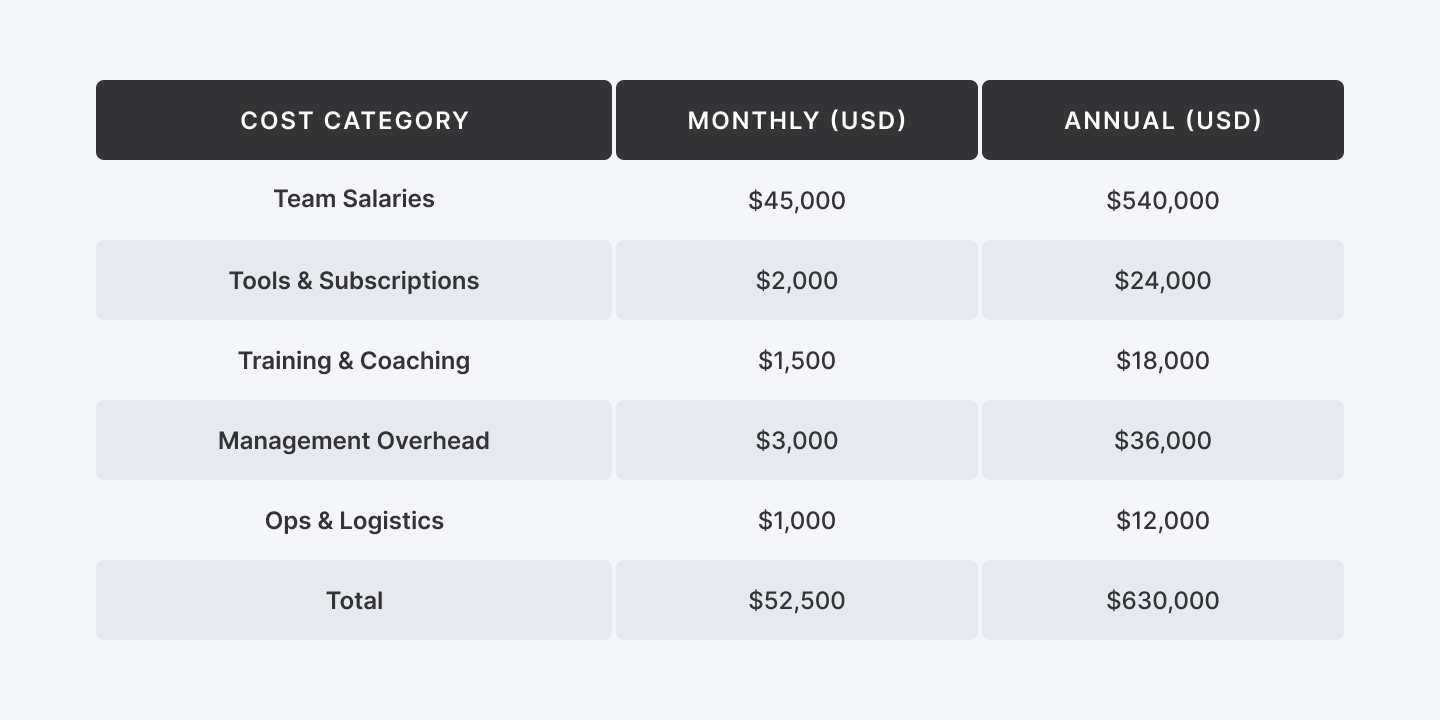
The following is a realistic monthly and annual cost breakdown for a single Agile pod of six people. This budget assumes mid-level developers in a US-based setting.
Cost Category | Monthly (USD) | Annual (USD) |
| Team Salaries | $45,000 | $540,000 |
| Tools & Subscriptions | $2,000 | $24,000 |
| Training & Coaching | $1,500 | $18,000 |
| Management Overhead | $3,000 | $36,000 |
| Ops & Logistics | $1,000 | $12,000 |
| Total | $52,500 | $630,000 |
This budget represents a US-centric design. Salaries for similar professions in India range between $12,000 and $18,000 per month, whereas in LATAM, the value might be about $20,000 to $25,000 per month. However, tool prices and operational overhead are rather consistent across areas.
Tip: While outsourcing can cut pay expenses by up to 60%, it may raise project coordination and QA costs owing to timezone or quality issues.
This budget template is intended to be used as a foundation. You may personalize depending on region, team seniority, remote vs hybrid models, and tool licensing options. A precise projection like this enables improved ROI planning and pod scalability decisions.
How to Optimize the Pod Budget Without Compromising Output
Optimizing your pod budget does not imply cutting costs; rather, it means investing wisely while maintaining velocity and quality. Here's how engineering managers can maximize every dollar:
1. Start with 1-2 pods and scale based on KPIs
Begin with 1-2 pilot pods dedicated to a specific product or user experience. Before scaling, evaluate throughput, sprint velocity, and time to market. Avoid releasing numerous pods without a reliable delivery baseline. A tiered approach identifies constraints early.
2. Use the Shared Services Model (QA, DevOps)
Instead of allocating full-time QA or DevOps to each pod, combine these activities into a common services layer. This eliminates underutilization and enables specialists to easily collaborate across pods. For example, two quality assurance professionals may support 4-5 pods without sacrificing quality.
3. Consolidate Tools Across Pods
Tool bloat increases expenses and complexity. Ensure that all pods utilize the same toolset: one ticketing system (e.g., Zendesk), one source control (e.g., GitHub), and one knowledge base. Centralized tools provide visibility while lowering license costs by 20-30% at scale.
4. Outsource Non-Core Skills (QA and Design)
Offshoring or outsourcing for non-core tasks, like QA, UI/UX design, or technical writing, can save costs without compromising results. Choose partners that understand Agile delivery to ensure that sprint cadences and team rituals are followed.
Google's DesignOps concept centralized design services across different teams, boosting consistency and decreasing per-pod personnel demands.
Budgeting for Scale: From Two to Twenty Pods
Scaling teams from 2 to 20 pods demands a proactive budgeting strategy. What is the most effective cost-cutting measure? Scalable economies.
Hiring Pipeline Planning
Begin by creating a map of predicted pod expansion over the next 6-12 months. Create a pipeline of staggered employment waves to minimize recruitment bottlenecks and onboarding weariness. Hiring in cohorts also optimizes training costs.
Reuse Tool Licenses and Workspace
Tool licenses, such as Jira or Slack, typically have bulk price options. Centralizing procurement allows you to negotiate enterprise pricing while lowering per-user tool expenditures by 25-40%. Workspace layouts can also be leveraged for dispersed teams via shared office subscriptions or time-based desk sharing.
Introduce Chapter Leads
Beyond 5-6 pods, team leaders will not suffice. Introduce "Chapter Leads" (based on Spotify's approach) to manage horizontal operations such as frontend, QA, and DevOps across pods. This saves management costs and ensures technical direction is consistent without adding full-time PMs to each pod.
Cost Justification: ROI and Efficiency Metrics for Tracking
To justify the expense of Agile pods, relate spending to outcomes. Use the following fundamental ROI and efficiency metrics:
- Sprint Throughput: Track the number of story points completed per sprint to determine velocity.
- Cycle Time: The time from ticket creation to deployment; shorter timeframes imply more efficiency.
- Bug Rate: Compare pre-pod and post-pod defect volumes throughout manufacturing. Fewer bugs indicate greater ownership.
- Employee Retention: Pods promote autonomy, which increases satisfaction and minimizes attrition costs.
Use OKRs to demonstrate how each pod contributes to company objectives.
For example:
- Objective: Reduce customer turnover.
- Key Result: Pod X decreases issue resolution time by 30% in three months.
Real-world example: Atlassian's Agile ROI model offers a systematic approach to connecting delivery outcomes to financial KPIs. When pods are coupled to quantitative outcomes, they transform from a cost center to a value generator.
Budget Breakdown from an Enterprise Case
A mid-sized SaaS company with scattered teams in North America and Europe transitioned from a traditional Scrum model to an Agile pod structure for better delivery ownership and cross-functional alignment.
Context: The organization started with five Scrum teams operating in silos. To simplify handoffs and improve autonomy, leadership restructured into ten cross-functional pods, each focused on a distinct user path or product feature set.
Budget Highlights and Impact:
- Delivery Speed: After 6 months, the average sprint throughput rose by 15%, owing to fewer dependencies and faster decision-making among pods.
- Tooling Cost: By integrating tools across pods and standardizing the DevOps stack, the organization saved $250,000 per year, mostly by removing duplicate licensing across Jira, Slack, and CI/CD platforms.
- Employee satisfaction surveys revealed increased involvement and ownership, resulting in a 20% reduction in voluntary attrition throughout the fiscal year.
To increase Agile operations while maintaining budget discipline, the business invested in team training, centralized design and QA services, and tool consolidation. This demonstrates how well-managed pods create efficiency and ROI.
Final Takeaways and Budget Planning Checklist
Agile pods are not cheap, but when done well, the ROI is apparent. The idea is to link each pod with specific business targets, rather than merely featuring delivery.
Begin with 1-2 pods, progressively increase, and monitor financial efficiency using sprint and product KPIs.
To summarize:
- Align pods with OKRs.
- Monitor expense vs. business effect.
- Standardize tools and services.
- Plan for scale from day one.
For Clients:
Get your Agile Pod up and running quickly. We'll match you with the top 5% of developers so you can cut development costs by 50%. Scale your pods more intelligently with Index.dev.
For Developers:
Join Index.dev and get matched with companies that already have their agile pod budgets figured out. Build your career without the financial stress. High pay, real impact, remote-first.