Modern businesses are redefining how teams operate, and agile pod teams are at the heart of this transformation. Unlike typical departmental structures, pod teams are tiny, cross-functional groupings designed for speed, autonomy, and ownership.
This strategy is more than simply a fad; it is a reaction to the desire for faster delivery and more responsibility in product development. We’ve seen this model work well in fast-moving environments. It gives people more autonomy, speeds up decision-making, and creates real accountability.
In this article, we'll explain what a pod team is, compare it to traditional teams, look at agile frameworks, define responsibilities inside the pod structure, and bring you through a realistic implementation approach for adopting this powerful model.
Build high-performing agile pod teams with top 5% remote developers from Index.dev. Fully vetted, fast-matched, and fully managed.
What Is a Pod Team?
A pod team is a small, self-sufficient entity that can handle the complete process, from conception to delivery, without relying substantially on other departments. It's an agile-aligned paradigm in which each pod has all of the critical functions required to achieve a certain business objective.
The key characteristics of a pod team are:
- Cross-functional: Include developers, designers, product managers, and QA.
- Autonomous: Operates alone and with minimum dependencies.
- Outcome-driven: Based on a defined product goal or consumer demand.
- Iterative: Supports agile processes and continual improvement.
The concept is based on agile concepts and was popularized by organizations such as Spotify, which implemented "squads", basically pod teams to extend agile across their organization.
Unlike traditional teams, which frequently transfer work across departments, pod teams improve communication and reduce friction, allowing firms to move more quickly while preserving responsibility. Their form allows flexibility and response, making them perfect for dynamic situations such as software development, marketing, and innovation labs.
Read More: How to Assess Candidate's Skills for Engineering Positions
Pod Teams vs Traditional Teams
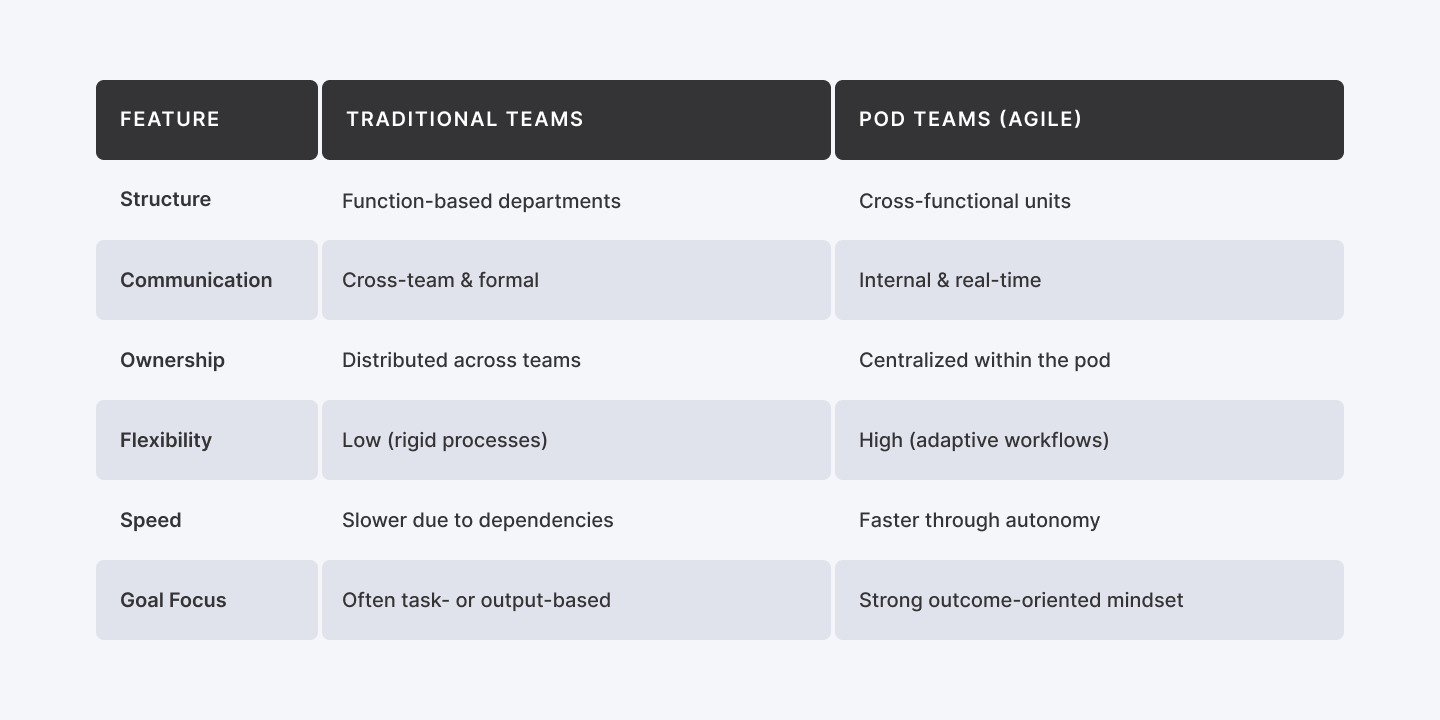
Agile pod teams beat traditional teams in terms of speed, clarity, and accountability. While traditional setups rely on departmental handoffs, pod teams consolidate all relevant tasks into a single unit to eliminate delays and increase responsibility.
Here is a short comparison:
Feature | Traditional Teams | Pod Teams (Agile) |
Structure | Function-based departments | Cross-functional units |
Communication | Cross-team & formal | Internal & real-time |
Ownership | Distributed across teams | Centralized within the pod |
Flexibility | Low (rigid processes) | High (adaptive workflows) |
Speed | Slower due to dependencies | Faster through autonomy |
Goal Focus | Often task- or output-based | Strong outcome-oriented mindset |
When Should You Use Pod Teams?
- You are creating customer-facing features or goods.
- Your workflows need rapid iteration and frequent adjustments.
- You want each team to own a certain result from beginning to end.
Traditional teams, on the other hand, may continue to operate in operations or compliance-heavy areas that require structure and control.
Agile Pod Team Frameworks
Pod teams are based on agile approaches, however, they are not limited to a certain framework. Whether you use Scrum, Kanban, or SAFe, pod teams may adapt and evolve inside these frameworks to meet your workflow demands.
Scrum in Pod Teams
Scrum structures pod teams with defined roles (Scrum Master, Product Owner, Developers) and rituals (sprints, reviews, retros). Pods may easily use Scrum to produce functioning features in short cycles.
For example, a mobile app pod employs Scrum to release a new feature every two weeks, including retros to optimize future work.
Kanban in Pod Teams
Kanban focuses on continuous delivery and visible process tracking. It's ideal for maintenance pods or teams who want to focus on incremental improvements rather than timed sprints.
For example, a DevOps pod prioritizes infrastructure changes and responds to concerns in real time using a Kanban board.
SAFe and Scalable Pods
In larger enterprises, the Scaled Agile Framework (SAFe) assists in aligning many pod teams on strategic goals. Pods in this paradigm may sync during PI planning or ARTs (Agile Release Trains).
For example, a financial services organization maintains numerous SAFe pods that sync during quarterly planning events to ensure delivery schedules are met.
Each framework has advantages, and the best match relies on your product scope, team maturity, and organizational structure.
Watch Spotify's Engineering Culture – Part 1 to see how the pod model works in practice.
Basic Pod Team Structure and Roles
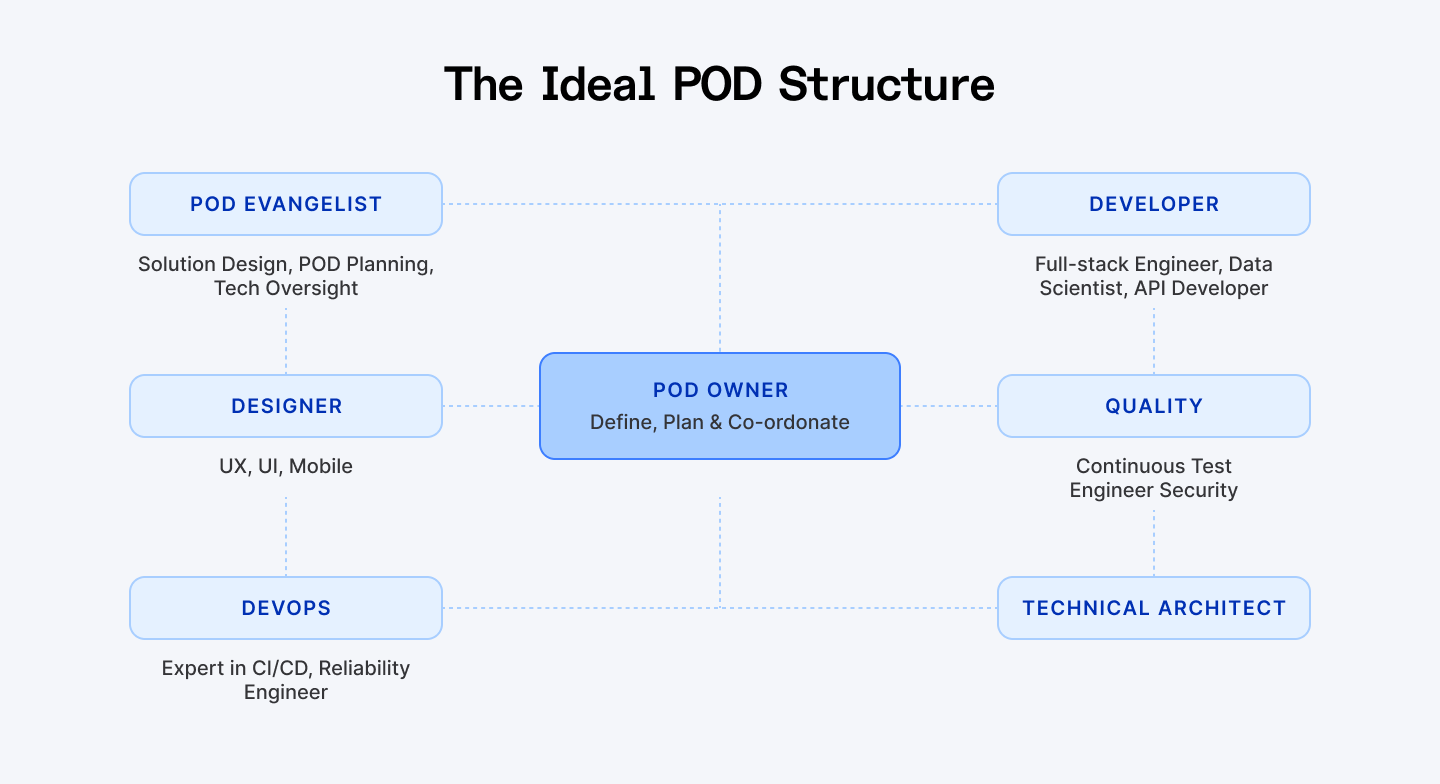
The efficacy of a pod team structure is in its explicit delineation of duties. Embedding all essential functions within the pod enables teams to minimize handoffs and operate more independently, resulting in expedited delivery and enhanced alignment.
Pod jobs are categorized into two types: core team members responsible for daily execution and supporting roles that offer specialized feedback or coaching.
Core Pod Team Members
Product Manager / Product Owner
Possesses the product vision and serves as the intermediary between business and technology. They prioritize activities, match work with user requirements, and expedite product choices - an essential function for corporate success.
Technical Lead or Engineering Lead
Supervises technical direction and judgments. Guarantees code quality, directs architecture, and assists in resolving impediments that impact velocity.
Developers
Accountable for product development. Their efficacy relies on a well-defined backlog, limited context shift, and rapid feedback loops.
Quality Assurance / Testers
Conduct frequent and early assessments. They mitigate the risk of defects in production and enhance assurance in deployments. In agile pods, quality assurance is integrated rather than segregated.
Designers (Dependent Upon the Project)
Design the user interface and enhance usability. They guarantee visual coherence and user-centered design, essential for consumer-oriented goods.
Supporting Roles
Agile Coach / Scrum Master
Directs the team in agile methodologies, facilitates rituals, and removes impediments. Their primary objective is team performance rather than project ownership.
Data Analyst / Business Intelligence Specialist
Delivers product insights and uses analytics. Facilitates teams in making evidence-based choices and assessing progress relative to key performance indicators (KPIs).
Business Stakeholders or Representatives
Provide strategic guidance, ensure team deliverables line with organizational objectives, and consistently assess progress.
This pod team structure fosters alignment, expedites delivery, and guarantees that teams possess all necessary resources, free from external impediments. Every job enhances the pod's autonomy, a fundamental premise of agile pod teams.
Pod Teams High-Level Implementation
To effectively operate an agile pod team, the configuration must be deliberate rather than merely reorganizing responsibilities. A pod is a unit characterized by strong trust and a focus on outcomes. Implementation starts with structure and concludes with culture.
Index.dev, a top talent network, creates pod teams by combining remote developers, designers, and project managers into specialized units focused on specific client objectives. Each pod is set up with clear OKRs, agile rituals (daily standups, sprint retros), and collaboration tools (ClickUp, Slack, Loom). This framework enables their geographically dispersed teams to move quickly, remain responsible, and constantly improve delivery quality, all without centralized micromanagement.
The result? Faster iterations, more customer satisfaction, and better retention of elite tech personnel.
Here is a systematic outline for initiating a pod team:
Step-by-Step Implementation
1. Establish a Precise Business Goal
Each pod must be associated with a distinct objective: enhancing a product feature, augmenting retention, or initiating a new service. Ambiguous objectives result in indistinct priorities.
2. Set up a Cross-Functional Team
Incorporate all necessary functions to accomplish independently. A standard pod comprises a Project Manager, engineers, Quality Assurance personnel, and maybe design and data specialists.
3. Designate Explicit Roles and Responsibilities
Clear delineation of roles mitigates conflict. The technical lead should refrain from making product decisions, and the project manager should not evaluate code. Establish duties promptly.
4. Implement Agile Practices
Conduct regular stand-up meetings, sprint planning sessions, and retrospectives. These maintain pods' concentration, adaptability, and continuous learning.
5. Track Success Using OKRs
Objectives and Key Results help pods in maintaining alignment with business effect. OKRs foster accountability throughout sprints and within teams.
Scaling Pods
As you expand, horizontally scale pods—multiple pods can address various facets of the same product. Utilize rituals such as Scrum of Scrums to ensure alignment without resorting to micromanagement.
Spotify categorizes pods into "tribes" and "chapters" to facilitate inter-pod communication while maintaining autonomy. Their paradigm is often utilized for reconciling structure with flexibility.
Recommended Tool Stack
- Task Management: Jira, Trello, ClickUp
- Communication Platforms: Slack, Microsoft Teams
- Documentation and Wikis: Notion, Confluence
- Analytics: Amplitude, Mixpanel
With a solid foundation, agile pod teams transform into high-performing engines that reliably produce value swiftly.
Best Practices for Scaling Pod Teams
1. Organize Pods Based on Business Objectives
Avoid scaling based on function or feature. Instead, assign each pod a business goal (such as user acquisition or retention) or a stage of the customer lifecycle. This assures continuity, minimizes overlap, and enhances user-centricity.
2. Adopt the Tribe-Chapter-Guild Model
Scale pods using a model similar to Spotify's:
- Tribes are groups of pods that have a common goal or domain.
- Chapters bring together team members with comparable roles (e.g., all designers or engineers) to promote alignment and skill development.
- Guilds enable volunteer groups from different pods to exchange best practices, tools, and expertise.
3. Maintain Process Consistency Across Pods
While pods continue to operate independently, agile rituals (daily standups, retros, sprint reviews) and tools (e.g., Jira, Notion) should be standardized to avoid fragmentation and provide unambiguous reporting.
4. Enable Cross-pod Visibility and Collaboration
Conduct frequent sync-ups, such as Scrum of Scrums. Internal demonstrations may be used to demonstrate progress and promote team-wide learning.
5. Balance Autonomy with Governance
Define decision-making boundaries and employ OKRs to ensure strategic alignment. Pods should be free to operate but governed by common business objectives.
6. Invest in Pod Enablement Roles
Delivery Leads, Agile Coaches, and Program Managers all play important roles in orchestrating pod operations, resolving dependencies, and supporting scaling without micromanagement.
Benefits of the Agile Pod Team Model
Agile pod teams are built for speed, ownership, and alignment, and the benefits are immediately apparent.
1. Faster Iteration and Delivery
Pods eliminate dependencies by combining all talents into a single unit and provide product changes faster.
At Index.dev, shifting to the pod model helped clients reduce feature delivery timelines by up to 32.5%, thanks to real-time collaboration and autonomous execution.
2. Autonomy and Accountability
Each pod is responsible for its backlog and outcomes, which fosters a culture of accountability and decision-making.
3. Improved Cross-functional Collaboration
By integrating disparate jobs into a single team, communication barriers are reduced and efficiency increases.
4. Higher Morale and Innovation
Empowered teams may innovate more freely and remain more engaged. Companies like Spotify and Zappos credit agile pods with increasing team motivation and creative production.
Pod teams do more than just create better software; they also develop stronger teams. They achieve meaningful results by closely aligning with corporate goals.
Common Challenges and How to Overcome Them
Even agile pod teams confront challenges, but with the correct techniques, they may be overcome early on.
- Misalignment of Goals
Solution: Use OKRs to align each pod with strategic goals. Progress will be reviewed biweekly.
- Team Silos
Solution: Encourage cross-pod demos, use shared documentation tools (e.g., Confluence), and rotate retrospectives.
- Uneven Resource Allocation
Solution: Track pod capacity regularly. Assign a Delivery Manager to oversee workload distribution across pods.
- Cultural Resistance
Solution: Start with pilot pods and measure impact. Train leadership on agile values to ensure top-down support.
Tool tips: Use Miro for cross-team planning, Slack huddles for real-time syncs, and Jira for unified backlog visibility.
Explore top 5 DevOps strategies to achieve zero-time deployment.
Conclusion
Agile pod teams provide a strong answer to current business concerns, including faster delivery, improved alignment, and empowered teams. Unlike traditional settings, pods are designed for autonomy and cooperation, allowing businesses to move swiftly while maintaining quality.
If you want to boost product velocity, accountability, and team morale, agile pods are worth the switch. Begin small, scale smartly, and watch the effect grow.
For Clients:
Deliver faster with agile pod teams from Index.dev: top remote developers, expertly vetted, matched in days, and fully managed for success.
For Developers:
Ready to join agile pod teams and work on global projects? Apply to Index.dev and build your remote tech career with top companies!