The traditional software development lifecycle is hitting a wall. For years, tech founders and CTOs have accepted a frustrating trade-off: you can have speed, or you can have stability, but rarely both. Ship faster, and technical debt starts piling up. Prioritize enterprise grade quality and security, and release cycles slow down while engineering costs keep growing.
That trade-off is no longer inevitable.
We recently acquired Codemotion, a software delivery team that has spent years refining an AI-native development workflow in real production environments, with real clients, across real budgets and deadlines. That acquisition brought a validated capability into our service portfolio: AI-Assisted Development (AIAD) delivered with senior engineering oversight at every stage.
This isn't about developers occasionally asking a chatbot to fix a function. It's a structural overhaul of how software gets built, where AI operates as a native part of the delivery engine and senior engineers own the architecture, the quality gates, and the final call on everything that ships.
The results are already proven. Across the projects Codemotion has delivered, clients have shipped products up to 5 times faster and reduced development costs by up to 60%, without trading away quality, security, or stability.
The outcome is not experimental prototypes or AI generated demos. It is production grade software delivered faster, with leaner teams, stronger operational efficiency, and far more output per engineer.
Why AI Isn’t Delivering Real Gains in Most Engineering Teams
Nearly 41% of all code written globally is now AI-generated or AI-assisted. And yet broad industry studies still show only marginal average productivity gains at the company level. The reason is straightforward: most teams use AI in an ad hoc way that creates as much rework as it saves. Prompt-dependent development leads to context loss, inconsistent output, and code that looks right but fails in production.
It’s like a Formula 1 car: anyone can sit in the driver’s seat and start the engine, but very few can race it. Access to the tool is not the same as knowing how to use it systematically.
Traditional development is slow and expensive
Classic development is still slow and expensive. If you push for speed, you create technical debt. If you tighten the process, you slow teams down. Adding more engineers raises cost and coordination overhead, while investors still expect you to ship more, not less.
The gap between “AI helper” and AI native workflows
Most companies use AI in a way that creates more work. A developer copies a snippet of code, pastes it into a chat, gets an answer, and then spends an hour manually rewiring that code into the project.
This is prompt-dependent development, and it’s dangerous. It leads to:
- Context loss: The AI doesn't see the whole project, so it suggests solutions that break other parts of the app.
- Rework: Saved time is immediately lost to debugging hallucinated code that looks right but fails under pressure.
- Review bottlenecks: Senior devs are flooded with AI-generated Pull Requests that lack consistent logic, making code reviews slower and more painful.
Senior orchestration matters
The gap is a lack of senior orchestration. AI is fast but unreliable. Without a workflow that wires AI directly into the delivery pipeline, you aren't gaining speed — you’re just generating technical debt faster. In our AI Assisted Development model at Index.dev, powered by Codemotion, AI handles 80 to 90% of the repetitive build work, while senior engineers own architecture, quality, and security. This turns AI from a noisy sidekick into a reliable engine that ships software, instead of creating extra cleanup work for your team.
What We Do: AI-Native Delivery with Senior Oversight
Index.dev has built and refined an AI-native delivery workflow that treats the entire development lifecycle as one integrated system, from the first requirement to production release.
The core idea is simple. AI does most of the execution. Senior engineers own the architecture, the rules, and the final decisions. This approach is also central to AI software development for teams looking to build and scale intelligent applications.
How it works: from spec to release
We build a delivery engine inside your project. Here is how it works in simple terms:
1. Everything starts with a spec in the repo.
- Every feature begins as a clear Markdown spec in your repository, written with frameworks like BMAD or Spec Kit. It covers scope, edge cases, functional requirements, and success criteria. It is not a chat log. It is a living, executable document the AI can follow.
2. AI works inside your codebase, with full context.
- We initialize AI inside your repo, not in a separate window. It knows the architecture, coding standards, and previous decisions, because these are versioned alongside the code. From there, AI implements the feature end to end: it writes the code, creates the tests, generates the docs, and opens a pull request with a clear summary and impact notes.
3. Designs flow directly into implementation.
- Designers use Figma with a project specific UI kit. Through MCP and tools like Figma Make, screens are generated in a consistent format and connect directly to the codebase as structured context. This means the AI can build components that match your design system, rather than guessing from screenshots.
4. Automation does the heavy lifting, seniors guard the gates.
- As soon as the pull request is opened, your CI pipeline runs tests, linting, and security scans. Tools like AugmentCode, Claude Code, Cursor, Playwright, Snyk and others are wired into one flow, not used as separate gadgets. Nothing that can be automated is left manual. Nothing that affects quality is left without oversight.
5. Senior engineers approve every change.
- Before anything reaches production, a senior engineer reviews every line. Their job is not to fix random AI mistakes all day. Their job is to apply judgment on architecture, catch subtle edge cases, and make the final call on what ships. In practice, the AI takes on roughly 80 to 90% of the execution work. The remaining 10 to 20% is senior engineering: the architectural decisions, the complex backend logic, the judgment calls that require real experience. That split is what makes the output production-grade rather than just fast.
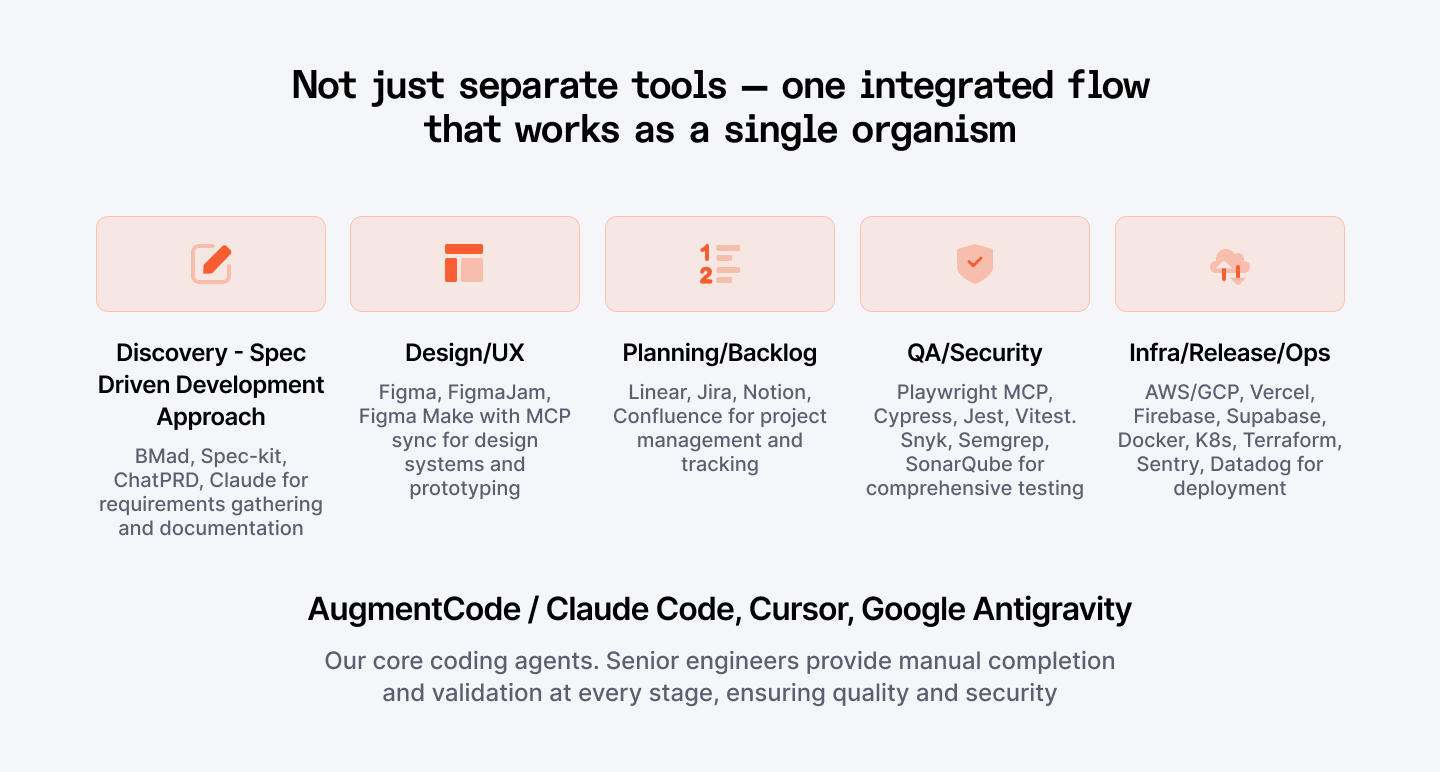
The outcome is not “AI that helps developers a bit.” It is a repeatable delivery system where AI is responsible for throughput and senior engineers are responsible for correctness, security, and stability.
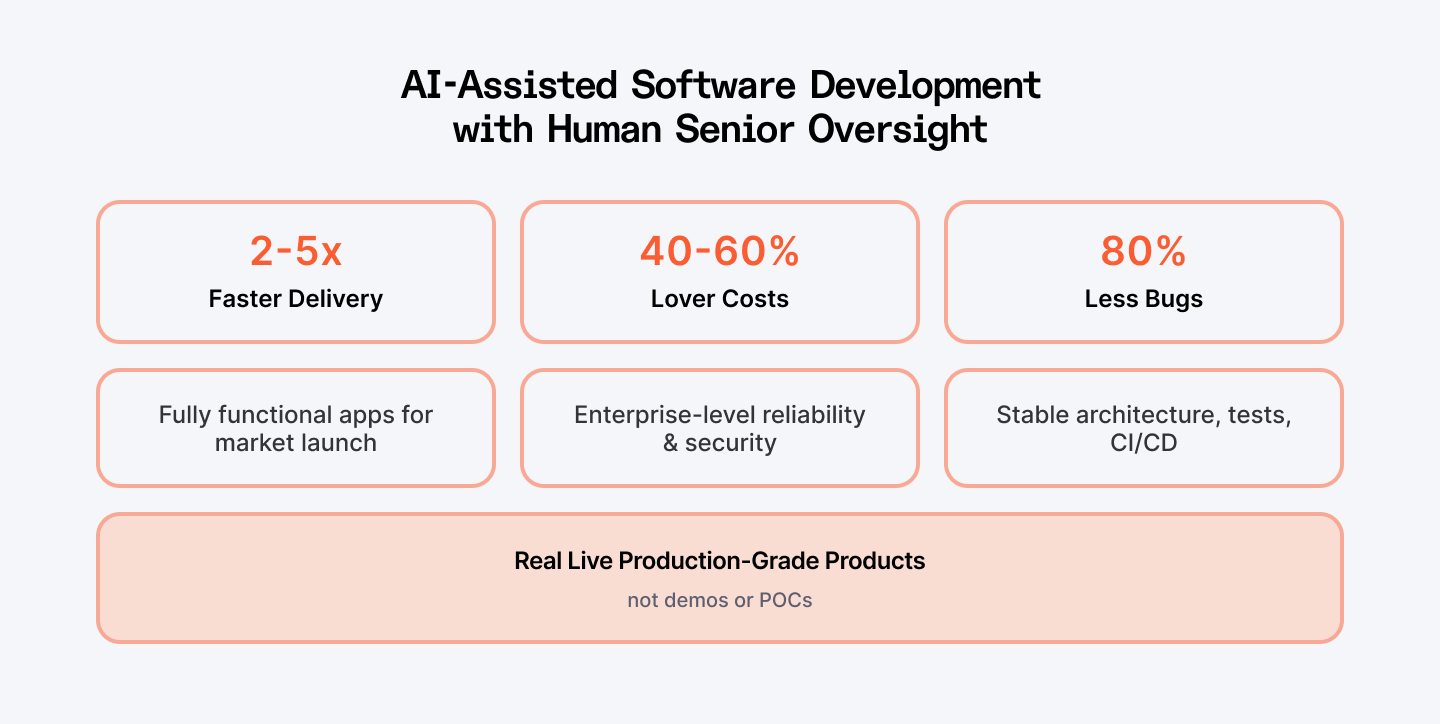
Faster delivery, lower cost, fewer bugs
This structured approach allows Index.dev to deliver results that ad-hoc AI usage simply can't match.
- 2 to 5 times faster delivery from spec to production ready release
- Up to 60% lower development cost for the same scope
- Around 80% fewer bugs, because stable architecture, automated testing, and CI/CD are baked into the process rather than added later.
The industry is backing this up. Recent studies from Stanford and MIT found that AI-assisted workers completed tasks 25% faster and with 40% higher quality than those without. Gartner forecasts that by 2027, 70% of professional developers will be using AI tools. More importantly, their 2025 Emerging Tech Report highlights a critical evolution: 60% of enterprise AI rollouts will soon feature agentic capabilities.
Index.dev's workflow is specifically designed to capture the upper end of these gains while avoiding the quality and coordination problems that hold most teams back.
Security and reliability
Security and control are non negotiable. In this model, AI operates inside the delivery pipeline rather than in random public chats. The AI only sees the data it is explicitly given, and no production secrets or live environments are exposed. Every AI generated change runs through tests, linting, security scanners, and senior review before merge. Third party libraries and dependencies are screened for vulnerabilities, and any exposed secrets in code are blocked and rotated before release.
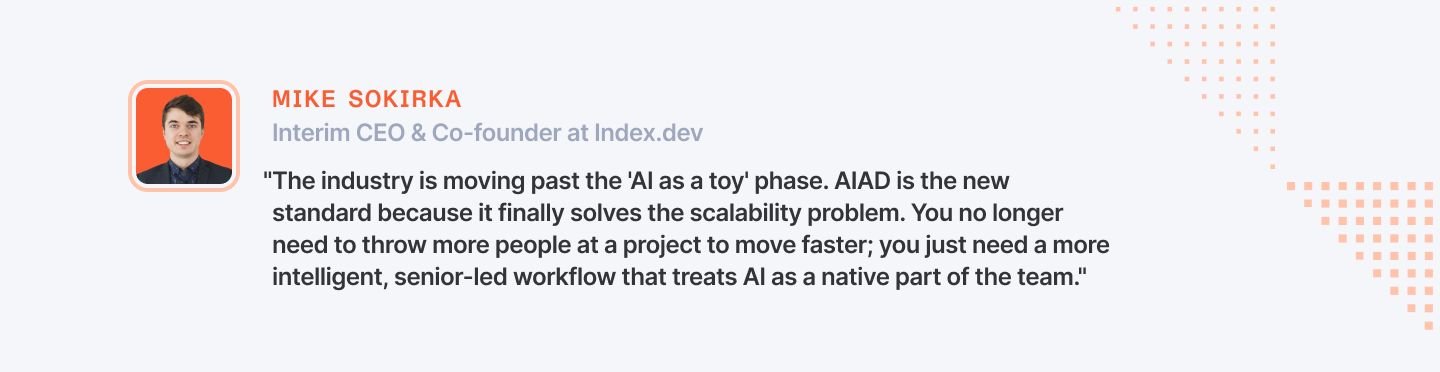
Proof in Real Projects
The biggest misconception about AI in software is that it only saves a few hours of a developer's week. In reality, when AI is embedded into the entire workflow, the fundamental economics of the project change. Planning moves faster. QA cycles shrink. Documentation stays current automatically. Features move from spec to release with fewer handoffs and less rework. The entire team operates differently.
Here is how that looks in practice for Index.dev clients.
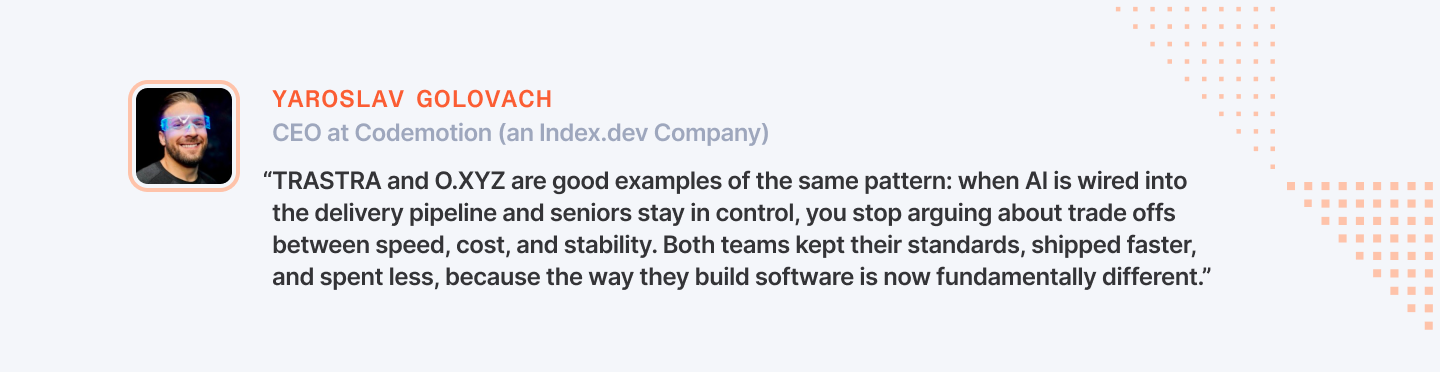
Case 1: TRASTRA – 4.5x cost efficiency for a fintech payment module
TRASTRA, a high-growth fintech, needed a production-ready payment gateway module on a tight budget and timeline. The complexity and compliance requirements made this a bad fit for ‘quick and dirty’ AI experiments. They needed something that could withstand audits and real money flows.
With a traditional senior-heavy team and classic development workflow, the estimated value of the project was roughly $120,000. Using the AI Assisted Development approach with senior oversight, the same scope was delivered for $27,000. That is a 4.5 times reduction in cost, without relaxing any standards on security, testing, or reliability.
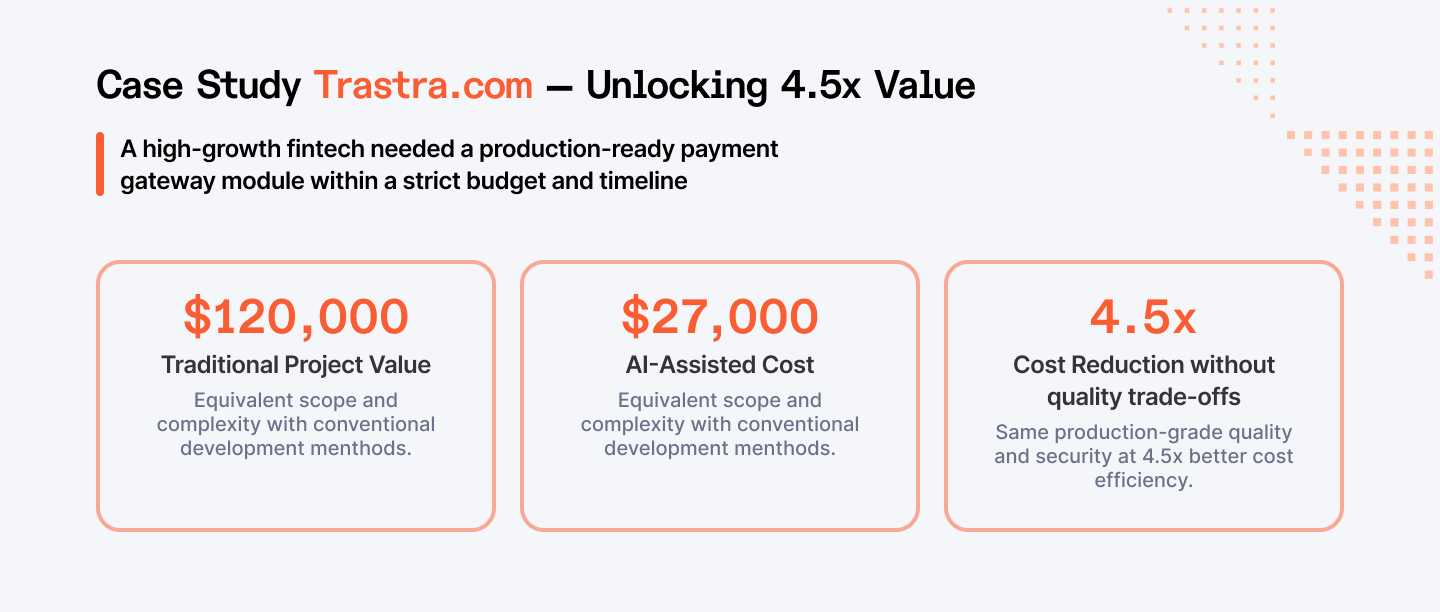
The module went through the full AI native SDLC: structured specs, AI implementation in-repo, automated tests and security scans, and senior review on architecture and every pull request. The result was a real, production-ready system built at a fraction of the usual cost and in a much shorter timeframe.
Case 2: O.XYZ – tripling feature velocity while cutting burn
O.XYZ (ofoundation.com) came in with a different kind of problem. They had a functioning product and an existing development setup, but it was expensive and too slow. Their monthly engineering spend sat at $65,000. Features were moving, but not fast enough for where the business needed to go. They couldn't afford instability in their core product, but they also couldn't afford to keep operating at that pace and that cost.
By moving to an AI orchestrated senior team from Index.dev, O.XYZ changed how their core delivery worked. AI was plugged directly into the existing codebase instead of sitting on the side. Specs, tests, and architecture decisions started living in the repo instead of scattered across chats. Senior engineers kept control of complex domain logic, data flows, and cloud components.
As a result, O.XYZ now ships several times more features per month while spending far less on the underlying team. They did not just cut costs. They replaced a slow, fragile way of working with a lean, AI accelerated workflow that gives them both speed and stability in their core product.
What You Can Build with AI Assisted Development
A common question tech leaders ask is: "Does this only work for simple apps?" The answer is no. Because the Index.dev workflow is stack-agnostic and spec-driven by clear specifications, it applies to any software challenge, regardless of complexity.
You can use it for:
- New products built from the ground up, from early MVPs to full v1 launches ready for market.
- New modules added to existing systems, like payment gateways, onboarding flows, authentication layers, or reporting dashboards.
- Web, mobile, backend, and cloud infrastructure, with AI and senior engineers working across the full stack.
- Legacy refactors of areas that are too risky or slow to touch with a manual-only team.
AI handles the bulk of implementation, test scaffolding, and documentation. Senior engineers own the architecture decisions, the complex business logic, the edge cases, and anything performance or security critical.
The model also scales beyond engineering. The same AI-native approach applies to product management, UI/UX design, QA, and DevOps.
How you can engage
There are three ways to work with this capability, depending on where you are and what you need:
1. Outsourced delivery
Outsourced delivery (full ownership) is for teams that want to hand off a product or module entirely. Index.dev takes full ownership from discovery through to release. You stay informed without being in the weeds. Scope, budget, and timeline are guaranteed. This works well for companies that need to move fast on a defined problem without pulling internal resources off existing priorities.
2. Team augmentation
Team augmentation (senior specialists) is for teams that want to bring this capability in-house without rebuilding their entire process. We embed senior AI-native specialists directly into your team structure, whether that's an AI architect, a BA, a PM, a designer, or a QA lead. They own their discipline's AI stage inside your workflow, set up the toolchain, and operate alongside your existing people. Over time, your team absorbs how the model works.
3. AI enablement
AI enablement (training your team) is for teams that already have strong engineers and want to upskill them to operate at this level. We train your developers, PMs, designers, and QA on the AI-native workflow: the spec frameworks, the toolchain, the review process, and the coordination model. The goal is to leave your team fully capable of running this independently, with the productivity gains locked in permanently.
Most clients start with one engagement model and evolve into another. A founder might begin with outsourced delivery to hit a launch deadline, then transition to augmentation as the internal team grows. A CTO might start with enablement and bring in augmentation for a specific high-stakes module.
The entry point depends on your situation. In all three models, the constant is the same:
AI does most of the execution, senior people own the gates, and you get a faster, more reliable way to turn ideas into production software.
The New Standard: Adapt or Overspend
The era of bloated development budgets and stagnant roadmaps is over. The new advantage comes from how well you can combine AI speed with senior engineering control.
You can continue to manage development the traditional way, accepting the high burn, the technical debt, and the long wait times. Or you can shift to an AI-Native SDLC. This isn't about replacing your developers; it’s about giving your best people the power to build at a speed that was impossible two years ago.
We have validated this model with fintechs, foundations, and scale-ups. We have seen the 5x speed increases and 70% cost reductions firsthand.
➡︎ Let’s take one of your real initiatives — a new product, a critical module, or a legacy area you have been avoiding — and map what it would look like under an AI Assisted, senior led delivery model.
Rethink how your software is built →