If you're running engineering hiring across multiple regions, you already know the chaos. Each office probably has its own sourcer doing their thing, agency bills keep climbing, and you're still scrambling to fill critical roles. But there's a different approach that's working. When you combine a solid sourcing engine with a proper CRM, you get something more powerful: a single pipeline feeding all your regions, dramatically lower agency spend, and consistent technical standards across the board. The math is simple: more hires, less variance, fewer emergency calls to expensive agencies.
AI recruiting tools let your teams flip the script on passive talent sourcing. Instead of waiting for candidates to find you, you're building live pipelines that feed qualified prospects directly to your hiring managers. The smart play? Start with a 30-60 day pilot. Make sure your vendors commit to fairness audits and proper DPA terms upfront. Then track what matters: time-to-first-qualified, your interview-to-offer conversion, offer acceptance rates, and how many recruiter hours you're saving per hire.
This article is tool-first and practical. We're assuming you're here because you need to buy, pilot, and scale AI recruiting tools to automate candidate sourcing across large organizations. We'll also show you how platforms like Index.dev fit into a modern recruiting stack.
Slash hiring time with Index.dev's AI recruiting pilot. Combine smart sourcing, skills assessment, and expert vetting for faster, better hires.
Quick Reality Check
Why Act Now
The market has shifted in ways that make manual sourcing almost obsolete for large organizations. Tight technical labor markets, hybrid work complexity, and truly global roles mean the old playbook doesn't scale anymore. We're seeing three persistent constraints across enterprise hiring: scale (hiring many roles consistently), speed (cutting time-to-hire), and quality (finding people who actually perform and stick around).
Traditional job posting and manual hunting simply can't handle multi-region, multi-timezone operations. AI recruiting tools handle the heavy lifting - reach, screening, initial outreach - which frees up your recruiters to focus on what humans actually excel at: reading between the lines, assessing cultural fit, making nuanced decisions.
Who this Guide Is for
Talent acquisition leaders, TA operations folks, engineering managers, and HR technologists at large organizations who need to hire technical talent across regions. If you want to adopt AI recruiting tools safely, measurably, and at enterprise scale, this guide will get you there.
What the Article Covers
A decision-ready map of tools and platforms for automated candidate sourcing, a 90-day pilot playbook, KPI and governance checklists.
Where this Applies
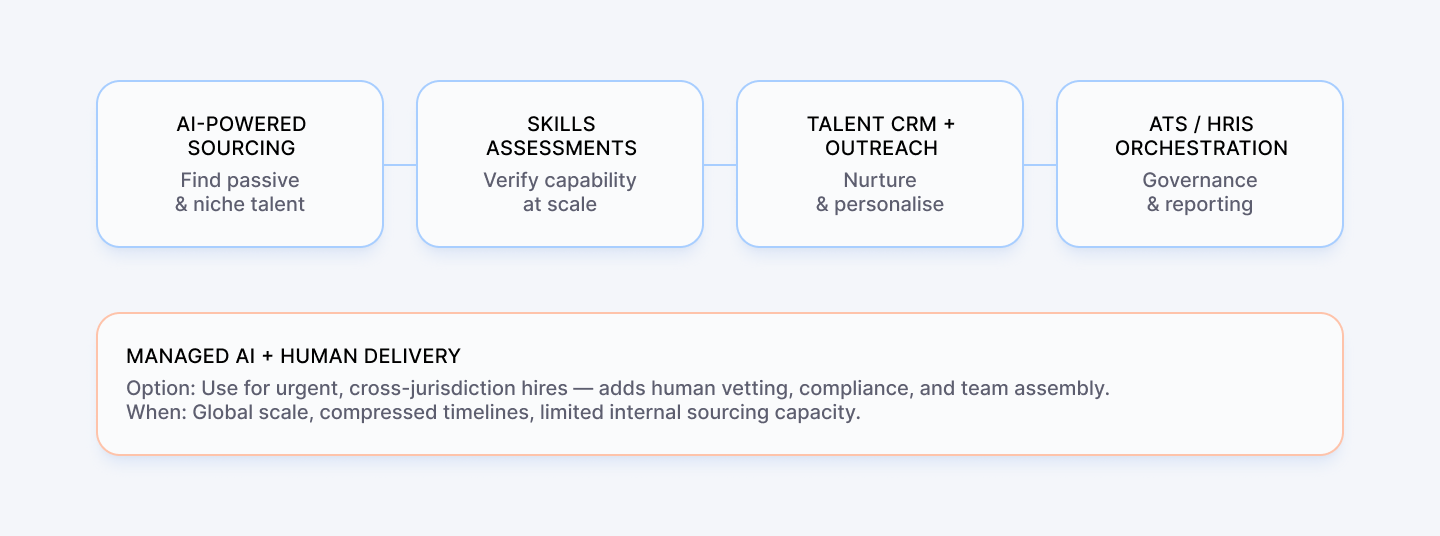
Large organizations and enterprise HR stacks (multi-region, multi-legal jurisdictions) — face three recruiting constraints: volume (talent scale), speed (time-to-fill), and quality (fit & retention). Tools automate the heavy lifting:
Why this Approach
Automation reduces manual search, widens the candidate pool, and removes time-consuming admin. But speed without governance increases risk (bias, privacy, candidate experience). The balanced approach here pairs AI capability with human controls.
How to Get Started
Pick one hard-to-fill role family, run a 30-60 day pilot combining sourcing + assessment + outreach + ATS integration, measure core KPIs, then scale if the pilot meets thresholds and passes bias/privacy audits.
A practical enterprise stack combines:
- An agentic sourcing engine (to reach passive and niche candidates)
- A talent CRM (to nurture long-lead prospects)
- Skills assessment tools (to gate technical ability)
- AI-assisted outreach (to scale personalized connections)
- ATS/HRIS orchestration (to govern workflows)
For global hires and high-velocity engineering needs, add a managed AI+human delivery partner to reduce ramp and handle regional compliance. Early adopters routinely see quantifiable wins in time-to-first-qualified candidate, interview-to-offer ratios, and recruiter productivity, as long as pilots involve robust integration, bias audits, and vendor governance documentation.
Read the complete guide to AI-powered talent acquisition.
What’s Broken in Manual Sourcing
- You post a job. You wait. Passive candidates - the ones you actually want - rarely apply.
- Your sourcers spend hours crafting Boolean searches that return either nothing or everything.
- Recruiters juggle scheduling, follow-ups, and administrative busy work.
- And the resumes that do come in? Half are noisy, some are completely AI-generated, and they waste your interviewers' time.
Sound familiar? Then read on.
Quick decision recipe
- If the bottleneck is no candidates, buy a sourcing engine.
- If the bottleneck is unqualified candidates, add assessments.
- If the bottleneck is low response or offer acceptance, add CRM + AI outreach.
- If time and compliance are critical, engage a managed delivery partner (like Index.dev) to accelerate hiring with human vetting.
Start small. Measure everything. Keep humans in the decision loop.
What an Enterprise Hiring Stack Looks Like
Think of your AI recruiting tools stack like a factory line. Each component handles a specific function:
1. AI Sourcing Engines: Finding Hidden Talent
What they do: Crawl public profiles, forums, portfolios. Provide semantic search that goes way beyond Boolean. Run agentic searches until they find the targets you need.
Representative platforms: SeekOut (huge public profile index), hireEZ (agentic sourcing + ATS rediscovery).
Why it matters: Sourcing engines surface candidates that job ads never reach. They're especially valuable for niche technical roles and senior leadership positions. They expand diversity and reduce your reliance on agencies when agency spend gets out of control.
Enterprise signal: Low passive pipeline, heavy reliance on agencies
2. Talent CRM/Nurture: Converting Long Pipelines
What they do: Capture passive prospects, manage event invites, run drip campaigns with personalized content, create segmented talent pools, track pipeline health.
Representative platforms: Beamery (talent lifecycle + nurture automation).
Why it matters: Engineering and senior leadership hiring often takes months. A talent CRM keeps engagement warm and measurable throughout those long cycles.
Enterprise signal: Many warm leads but low move-to-interview rates. Use for long-lead hires.
3. ATS/HRIS + Workflow Intelligence: The Central Nervous System
What they do: Where all candidate records land. Enforces workflow and compliance. Centralizes candidates, integrates assessments, provides AI suggestions for JD drafting and candidate scoring.
Representative platforms: Greenhouse (built-in AI features), Workday Recruiting (AI agents, enterprise HRIS tie-ins).
Why it matters: Toolchain cohesion becomes critical when multiple sourcing tools and vendors feed into CRMs and ATS systems. ATS intelligence reduces bias and administrative drag.
Enterprise signal: Fragmented data across spreadsheets/teams. Need robust reporting and compliance.
4. Skills and Assessment Suites: Objective Technical Validation
What they do: Build and run coding assessments, code review scoring, role-based tests, take-home projects, automated scoring, interview sandboxes, and proctored checks.
Representative platforms: HackerRank, Codility.
Why it matters: Filters out applicants who merely game keywords or use AI-written resumes; raises confidence in technical fit where verification matters more than resume claims. Use these to block embellished resumes.
Enterprise signal: Increasing incidence of AI-generated or embellished resumes.
5. AI Outreach, Chatbots, and Conversational Screening: Scale with Personalization
What they do: Generate personalized outreach messages, handle initial Q&A with chatbots, automatically schedule interviews.
Representative platform note: LinkedIn’s AI-assisted messages show large uplifts in candidate responses (44% higher acceptance and faster replies).
Why it matters: Automated sourcing improves response rates while reducing recruiter follow-up time.
Enterprise signal: Low message response rates or heavy recruiter time spent on scheduling.
6. Managed AI + Human Delivery: Speed with Quality Control
What they do: When you need many vetted people quickly without ramping internal resources. Combines AI-assisted sourcing with human vetting and managed delivery of teams or individual candidates.
Representative example: Index.dev’s AI assistant (“Mind”) does initial sourcing and ranking; human experts finalize vetting and assemble teams. This hybrid model shortens time-to-first-qualified-candidate while maintaining quality.
Why it matters: Urgent global hiring, limited internal sourcing capacity, or complex compliance needs.
Enterprise signal: Hiring timelines that must compress without compromising quality. Index.dev is an example of this model (AI-assisted sourcing + human vetters + managed delivery).
Optional: Asynchronous Video Screening (Use Carefully)
Automated video interviews (one-way recordings or AI-scored responses) can help recruiters scale early screening and cut scheduling delays. They’re most useful when communication or presentation skills are part of the role, or when recruiter bandwidth is tight.
But video should never be the sole gate: Pair it with skills assessments and human review. Require explicit candidate consent and offer alternatives (phone or live screen) to protect fairness and accessibility. Most large organizations treat video as a convenience filter, not a final verdict - it speeds the funnel, but governance and candidate experience come first.
Procurement and Governance: The Non-Negotiables
When your legal team asks for must-haves, hand them this list:
Bias Audit & Disclosure
Require an independent bias/fairness audit and published summary before procurement (NYC AEDT requires bias audits and candidate notices where applicable).
DPA & Data Residency
Include a GDPR-ready Data Processing Agreement, local data-residency options, and exportability for candidate records.
Sample DPA clause (example): “Vendor shall process Candidate Personal Data only per Customer instructions, store EU candidate data within EU data centers unless otherwise agreed, and provide an auditable export of all candidate records within 10 business days on request.”
Explainability SLAs
Vendors must provide feature-level explanations for candidate matches on request, and a maximum response SLA (e.g., 5 business days). Clear API rate limits, webhooks, and enterprise SLAs for uptime/latency.
Right to Audit
Contract clause granting periodic technical audits (third-party or joint) for model updates and fairness checks.
Explainability & Auditability
Vendors must document model features and change logs; be willing to support a third-party audit.
Security & Compliance Docs
SOC 2 Type II, ISO 27001 (or equivalent), penetration test summaries, and incident response SLAs.
Integration & Identity
SCIM 2.0 provisioning + SSO (SAML/OIDC), documented API endpoints, rate limits and pagination behavior, and a data migration/export plan.
Pilot Terms
Fixed pilot seat count, trial duration, defined success KPIs, and clear cancellation terms.
Onboarding & Support Model
Named CSM, implementation tasks and a realistic onboarding timeline.
Pricing & TCO Transparency
Require a TCO worksheet (vendor-provided) describing per-seat vs per-requisition vs managed fee — choose what aligns with volume and ROI horizon.
Building Your Enterprise-Grade Stack
- Start with the bottleneck:
- If sourcing is weak, prioritize a sourcing engine; if quality is low, add assessments; if acceptance is low, add CRM + outreach.
- If sourcing is weak, prioritize a sourcing engine; if quality is low, add assessments; if acceptance is low, add CRM + outreach.
- Integrate, don’t bolt-on:
- Verify native connectors or API support for ATS, the talent CRM, SSO/SCIM, and assessment providers.
- Verify native connectors or API support for ATS, the talent CRM, SSO/SCIM, and assessment providers.
- Pilot a single role family:
- 30-60 days on one role family with explicit KPIs and bias checks for outreach. Measure time-to-first-screen, interview rate, offer rate.
- 30-60 days on one role family with explicit KPIs and bias checks for outreach. Measure time-to-first-screen, interview rate, offer rate.
- Add governance:
- Run bias audits, anonymized shortlisting, and record model explanations (especially where jurisdictions like NYC’s Local Law 144 or GDPR apply).
- Run bias audits, anonymized shortlisting, and record model explanations (especially where jurisdictions like NYC’s Local Law 144 or GDPR apply).
- Scale with managed partners:
- For global, high-velocity hiring consider an AI+human delivery model to avoid local compliance and sourcing ramp issues.
Pricing Models and Pilot Seat Patterns
Vendors price differently; procurement prefers clarity over hard numbers.
Common Enterprise Pricing Models
- Per-seat monthly: Best for low-volume pilots (recruiter seats + sourcer seats).
- Per-requisition: Used when hiring volume is project-based.
- Managed flat fee: Common for managed AI+human delivery (fixed fee per hire or per project).
- Pilot structure: Ask for a 30-60 day pilot with: N seats, M job families, predefined success KPIs and a capped pilot fee or free trial seats.
Do not accept opaque per-candidate or overage traps. They require caps and a transition price schedule.
ROI Worked Example
This is illustrative, so adapt to your numbers.
Assume:
- Pilot fee: $8,000/month (flat + 3 seats).
- Recruiter fully-loaded cost: $60/hr.
- Hires/month target: 6.
- Recruiter-hours saved per hire: 6 hours (conservative).
Savings:
- Per hire = 6 × $60 = $360.
- For 6 hires = $2,160/month saved on recruiter time.
Net pilot delta = $8,000 - $2,160 = $5,840.
But wait: add agency savings (if you're replacing external search firms) and faster delivery value (earlier product releases). Ask vendors for a TCO worksheet and don't sign until they show you the payback model for your specific organization.
Takeaway: Show vendors a simple TCO worksheet and ask them to fill in expected recruiter-hours saved per hire plus projected reduction in agency spend. Use those numbers in procurement to calculate payback.
Implementation: 90-Day Plan
Short version: pilots wire up in a few weeks; full enterprise rollouts take longer.
Expect:
Week 0–2: Readiness & Procurement
- Map current stack: ATS, HRIS, assessment, CRM, SSO.
- Choose a pilot role family (e.g., backend engineers).
- Procure trial seats for one sourcing engine + one assessment + a CRM or managed partner for managed delivery if speed is critical.
Week 3–6: Pilot Execution
- Run two A/B sourcing queries and compare interview-quality leads per week.
- Gate the top 20 candidates with a short assessment (20–30 minutes).
- Send AI-personalized outreach to 50 top matches; measure reply rate and time-to-screen.
Week 7–12: Audit & Scale
- Conduct bias and explainability audit; review candidate experience (NPS) and audit fairness.
- Full HRIS/workday rollout can take months. Legal, payroll, and residency rules add time.
- Integrate successful tools with ATS, set up dashboards, and expand to two additional role families/teams.
Plan for a named implementation owner on both sides and a production cutover checklist.
KPIs to Watch
- Time to first qualified candidate:
- Target: shrink by 50% vs baseline.
- Target: shrink by 50% vs baseline.
- Interview → Offer ratio:
- Target: +15–30% uplift.
- Target: +15–30% uplift.
- Offer acceptance:
- Aim for measurable lift (e.g., 45% → 55% in early pilots).
- Aim for measurable lift (e.g., 45% → 55% in early pilots).
- Recruiter hours saved per hire:
- Measure this; it’s the clearest TCO metric.
- Measure this; it’s the clearest TCO metric.
- Quality of hire:
- 90-day retention/perf is the ultimate check.
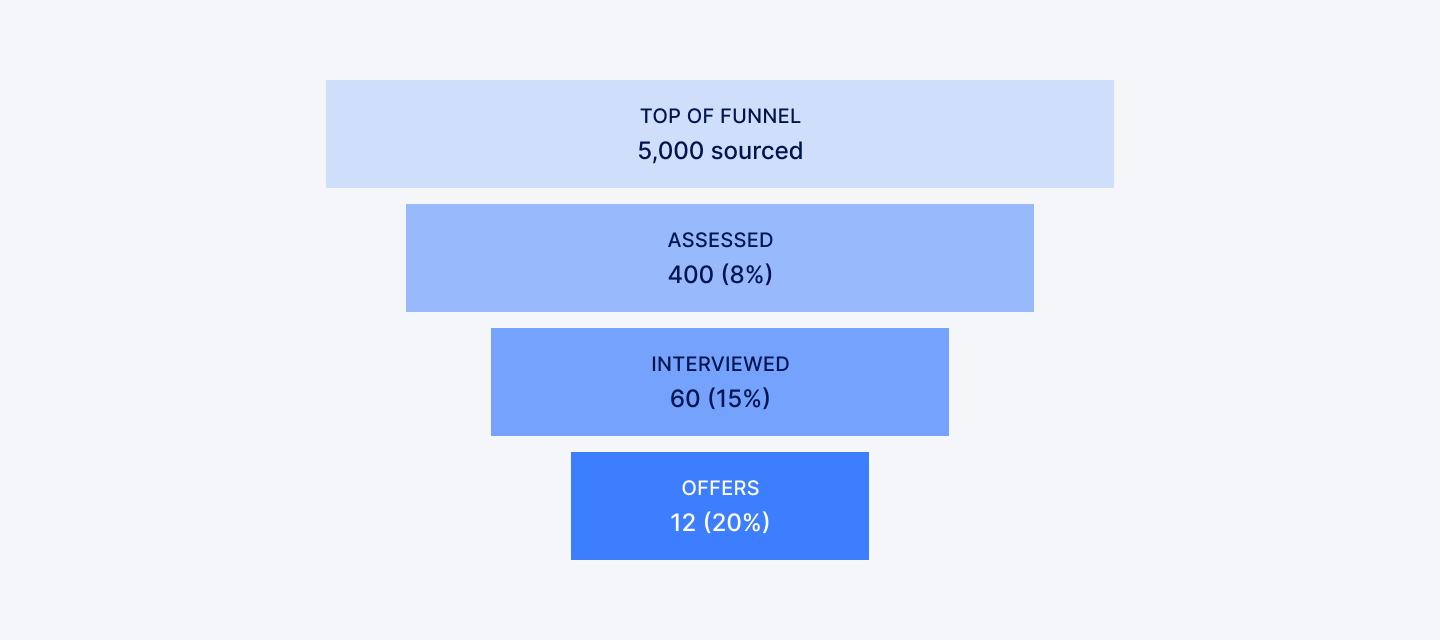
Example funnel: top-of-funnel → assessed → interviewed → offered — use your baseline numbers to fill.
Post-production Monitoring
Put ownership with TA Ops and Data.
Cadence:
- Weekly: Pipeline volume, interviews/week.
- Monthly: Fairness checks and sample explainability requests.
- Quarterly: Third-party audits and model-change reviews.
- Trigger: Any model update affecting >5% of shortlists triggers an immediate audit.
Risks and Safeguards
- Bias & fairness: Require vendor fairness documentation, anonymized shortlisting options, third-party audits for models where decisions materially affect outcomes.
- Candidate experience erosion: Humanize AI outreach, provide real human touchpoints before offers.
- Fake/AI-generated applications: Mitigate with proctored or live assessments and take-home validated tests.
- Compliance & data residency: Require vendor transparency and exportable candidate records. Ensure contractual SLAs for GDPR and local laws.
- Explainability: Vendors should provide model feature importance and decision rationale for shortlisted matches.
- Candidate experience degradation: Use personalized outreach templates.
- Human-in-loop: Final offers should always require human sign-off.
Explore the best AI hiring platforms to quickly screen, match, and onboard candidates at scale.
Conclusion
AI recruiting tools aren't experimental anymore - they're operational infrastructure that lets large organizations hire reliably, efficiently, and compliantly. When you properly combine sourcing, evaluation, outreach, and ATS management with appropriate controls, hiring becomes scalable: less crisis-driven agency spend, more predictable pipelines, faster time-to-impact for product teams.
Start small, measure relentlessly, govern constantly. Run that 30-60 day pilot on one role family. Require vendor fairness and data-residency terms. Use the KPIs we've outlined here to prove value: time-to-first-qualified, interview→offer conversion, offer acceptance, recruiter hours saved.
If your pilot delivers results, scale the stack across teams - but keep those human checks in place. The goal is improving hiring without sacrificing candidate experience or compliance.
When speed or compliance becomes a blocker, consider managed AI+human delivery options to shorten ramp while retaining human vetting and local compliance expertise.
Go from weeks to days: launch a 30-day AI-powered hiring pilot that blends automation with human expertise for top talent at speed.