In today's competitive talent market, selecting the proper AI recruitment partner might be the difference between hiring success and failure. With a global lack of competent AI and machine learning workers, enterprises cannot afford to make mistakes when selecting vendors. The difficulty becomes even more pronounced when assessing recruitment suppliers for highly specialized technical skills, as generic recruiting companies often fail to comprehend the complexities of sophisticated AI, data science, and engineering positions.
Choosing effectively is about more than just cost or time; it's about ensuring your recruitment partner has the knowledge, tools, and procedures to provide high-quality individuals that fit both technically and culturally. However, many organizations fall into common traps when selecting a recruitment agency or screening recruiting partners.
This article focuses on the 10 most common vendor selection mistakes and how to avoid them, so you can properly analyze recruiting suppliers and find the perfect long-term partner.
Avoid vendor mistakes, hire with confidence. Index.dev connects you to the top 5% of vetted AI developers, with 48-hour matching and a 30-day free trial.
Why Vendor Selection Matters in AI Recruiting
The vendor selection process is more important than ever, given the growing AI talent scarcity. According to Nash Squared, more than half of IT executives perceive a significant shortage of AI talent, increasing from 28% of the majority in only two years. Choosing the incorrect recruiting provider can result in sluggish hiring cycles, numerous mis-hires, and skyrocketing compensation and onboarding costs. On the other hand, a good AI recruitment partner speeds up hiring, assures thorough technical screening, and contributes to the employer brand by offering high-quality prospects. Furthermore, thorough vetting of recruitment partners allows you to prevent mismatched expectations and bad role fits. When deciding on a recruitment agency, examine not only speed and price, but also their ability to manage the difficulties of technical screening, cultural fit, and open communication.
Explore the 10 best recruiting agencies for AI talent.
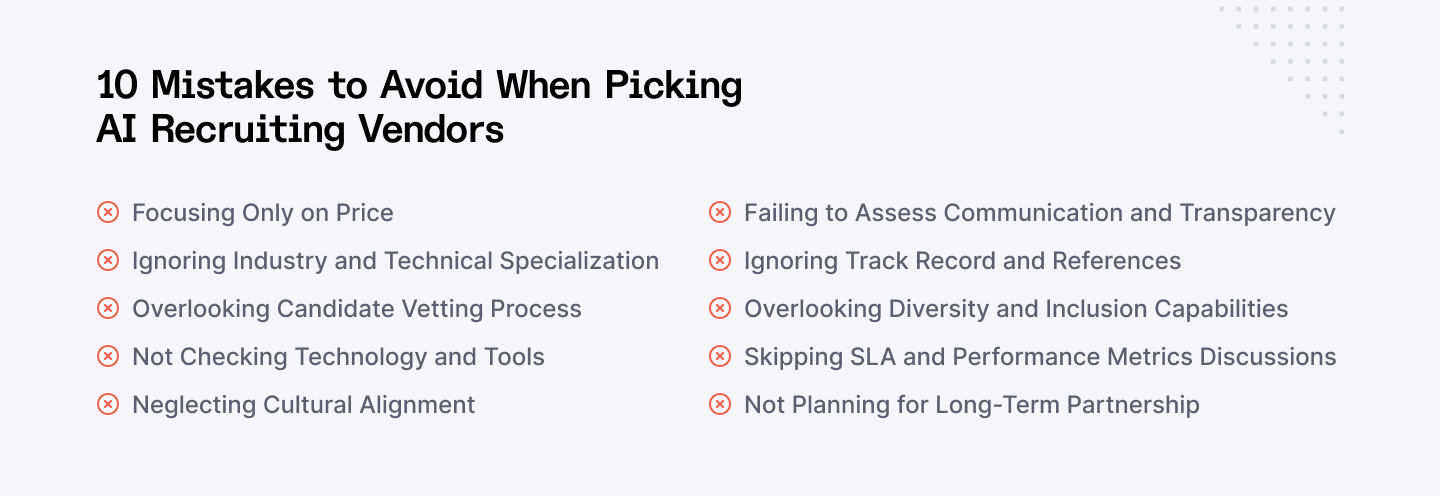
Mistake #1: Focusing Only on Price
When considering an AI recruitment partner, making a selection only on cost is a dangerous step. The lowest vendor frequently cuts costs, which might result in weak applicant pools, insufficient technical skills, or cursory screening, leading to unsatisfactory hiring. In tech-heavy positions, you want someone with extensive networks and subject understanding; a low-cost organization without a specialty may simply lack the contacts or resources to uncover top AI/ML talent.
To balance cost and value, ask suppliers for case studies that demonstrate results, compare their quality-of-hire measures rather than just charge percentages, and assess what you'll lose in terms of time, cultural fit, and long-term retention if the hiring isn't suitable. The vendor selection process should include cost and outcomes, not simply the bottom line.
Mistake #2: Ignoring Industry and Technical Specialization
One of the most common mistakes when assessing recruitment partners is selecting generic agencies that perform volume across several industries but lack expertise in AI, ML, data science, or engineering. These businesses frequently misread job needs, underestimate required abilities, or present people who are good on paper but lack sophisticated technical or industry-specific issues.
When considering how to select a recruitment agency, demand proof of specialization: request case studies demonstrating AI or technological hiring achievements, specifics of talent evaluations or tests utilized, and references from companies in your field. A partner that knows your tech stack, the velocity of AI advancement, and the common problems in recruiting ML professionals will provide significantly superior outcomes than one who tackles tech hiring as if it were a general area.
Mistake #3: Overlooking Candidate Vetting Process
Examining the applicant vetting process is an important element of choosing the proper AI recruitment partner. Questions to ask a technical recruiter include: Do you assess coding abilities or algorithmic thinking? How do you estimate the current understanding of ML frameworks or architectures? Do you verify qualifications and employment history? Do you do behavioral or cultural fit interviews?
Skipping or reducing these processes may result in employing someone who appears to be qualified on paper but falls short in practice. Poor screening causes technological incompatibilities, mismatched expectations, and even security or data breaches. According to industry sources, about one in every five IT candidates misrepresents their skills, necessitating comprehensive screening.
Mistake #4: Not Checking Technology and Tools
A big red signal when assessing an AI recruitment partner is failing to investigate the technologies and tools they employ. Vendor selection should involve determining whether the partner uses contemporary technologies such as next-generation ATS platforms, AI-driven sourcing, and data analytics. An out-of-date Applicant Tracking System (ATS) or a lack of automation can slow down hiring cycles, result in the loss of excellent prospects, and mask inefficiencies. According to recent research, 68% of recruiters want to invest in modern ATS solutions to boost performance, and more than 86% believe their ATS has shortened time-to-hire.
Smart vendors connect seamlessly with your HR IT stack, provide dashboards with actionable information, and provide predictive analytics (for example, talent shortages and pipeline health). As part of screening recruitment partners or how to select a recruiting agency, demand for tool-chain demos and examples of how they used tools to boost hiring results.
Mistake #5: Neglecting Cultural Alignment
Skills alone will not guarantee success; values, culture, and Employee Value Proposition (EVP) are critical. When you choose an AI recruitment partner without considering cultural fit, you risk costly early turnover, misfit hiring, and low engagement. The partner must understand not only your technical requirements, but also your organisation's culture: how you operate, communicate, reward, and development plan.
A vendor who does not inquire about your purpose, team rules, or EVP is likely to view hiring as transactional. A superior partner would include culture at every level, from gathering applicant stories to screening and interview comments. When selecting a vendor, consider both cultural fit and technical fit. Inquire of potential firms:
- "How do you evaluate culture match?"
- "Can you give examples where cultural misalignment became a risk—and how you mitigated it?"
Mistake #6: Failing to Assess Communication and Transparency
Poor communication or opaque processes might jeopardize even technically sound recruitment relationships. If an AI recruitment partner fails to establish clear communication rules (delivered reports, status updates, data sharing), it is likely to spell difficulties. Delays are frustrating for both employers and candidates; a lack of openness may result in misplaced expectations, hidden expenses, and missed deadlines.
Top recruiting suppliers agree to SLAs, give dashboards or frequent metrics (e.g., pipeline health, applicant feedback, drop-off causes), and actively communicate progress. When selecting vendors or screening recruitment partners, prepare questions like "What is your update cadence?" or "How do you handle issues when timelines slip?" Clear communication is not a "nice to have"; it is one of the distinguishing characteristics of a trustworthy partner.
Mistake #7: Ignoring Track Record and References
Many agencies claim expertise, but few can consistently demonstrate it. A strong AI recruitment partner will appreciate a thorough investigation of their track record. During vendor selection, request customer references, case studies, and success metrics, particularly for AI/ML or tech jobs. Just because a vendor has a lot of clients doesn't indicate they've provided the best technical recruits in your industry.
Look for repeat customers, retention rates, quality-of-hire measures, and post-placement comments. Are their clients pleased after the placement—do hires remain, grow, and contribute? Also, look for transparency: suppliers who are ready to disclose their failures or lessons learned are more mature. As you analyze recruiting providers, insist on interacting with previous clients in your sector to see what "success" looks like with this partner.
Mistake #8: Overlooking Diversity and Inclusion Capabilities
In AI recruiting, diversity is not a choice; it is required. Failure to assess a recruitment partner's capacity to source a diversified pipeline is a serious error. According to studies, organizations with more diversity perform better: inclusive teams foster greater creativity and engagement.
A partner that relies on narrow networks, ignores disadvantaged groups, or lacks defined D&I strategies will jeopardize both equity and performance. When screening recruitment partners, inquire, "What is your diversity hiring track record? What are the outreach mechanisms for underrepresented talent? Do you employ bias mitigation in screening? These questions help ensure that your AI recruitment partner adds value to both the business and your employer brand.
Mistake #9: Skipping SLA and Performance Metrics Discussions
Even if you trust and like your partner, you need to have explicit Service Level Agreements (SLAs) and performance measures in place to avoid disappointment. Defining quantifiable results is critical when selecting vendors. Ask for key performance indicators such as time-to-hire, quality-of-hire, retention after 6-12 months, applicant satisfaction, and percentage of offers accepted.
Without these, suppliers may claim speedy delivery but offer poor quality, or they may deliver quality slowly while missing important hiring opportunities. Contracts should outline what occurs if SLAs are not fulfilled, including fines, process changes, and escalation procedures. Strong AI recruitment partners take data seriously, monitoring, reporting, and refining techniques based on results. When assessing recruiting suppliers, insist on written agreements that are available in dashboards or data, rather than verbal commitments.
Mistake #10: Not Planning for Long-Term Partnership
Recruiting, particularly for AI/ML and specialized tech roles, is a long-term, deliberate process. If you choose a vendor simply for your current hiring requirements, you will lose out on partners that can serve as trusted advisers by predicting future talent needs, developing pipelines, and advising on shifting skillsets and technology trends.
When selecting a vendor or a hiring agency, consider whether your partner has scalability: can they manage rising demand? Do they keep up with AI/ML advancements? Do they invest in talent communities or educational programs? A long-term partner will invest in your success, maintain alignment, improve with feedback, and assist you in developing sustainable recruitment capability, rather than merely closing opportunities.
How to Choose the Right AI Recruiting Partner
Selecting the right AI recruitment partner necessitates a systematic strategy that extends beyond prices and schedules. The best suppliers combine industry expertise, cutting-edge technology, and an unwavering commitment to open cooperation. When screening recruitment partners, use this easy checklist:
- Specialization:
- Proven experience in AI/ML, data science, and technical recruiting.
- Proven experience in AI/ML, data science, and technical recruiting.
- Tech Capabilities:
- Integrations with ATS/HRIS, data-backed insights, and AI-driven screening.
- Integrations with ATS/HRIS, data-backed insights, and AI-driven screening.
- Transparent Processes:
- Clear SLAs, frequent reporting, and open communication lines.
- Clear SLAs, frequent reporting, and open communication lines.
- Cultural Fit:
- Understanding your values, EVP, and long-term vision.
- Understanding your values, EVP, and long-term vision.
- Measurable Impact:
- Metrics such as quality-of-hire, retention rates, and reduced time to fill.
- Metrics such as quality-of-hire, retention rates, and reduced time to fill.
Strategically, the appropriate partner is more than a vendor; they share your goals, advise on future hiring requirements, and truly represent your brand to recruits.
Index.dev blends advising expertise with AI-driven screening methods and proven industry experience to assist organizations in securing top technical talent. We don't just fill positions; we help you develop better teams for the future.
Discover the 7 best AI tools for large-scale hiring.
Conclusion
Avoiding the 10 vendor selection mistakes mentioned in this article leads to stronger recruits, shorter recruiting cycles, and lower turnover. Every bad hiring costs time, money, and momentum, but the proper AI recruitment partner gives you a competitive advantage in an increasingly talent-constrained market.
Ultimately, vendor selection is about partnerships rather than transactions. The greatest recruitment partners understand your company, fit with its culture, use the appropriate tools, and commit to demonstrable success. By reviewing your existing process and asking the proper questions, you may avoid typical traps and develop a more strategic approach to talent acquisition.
Your decision now influences the strength of your workforce tomorrow. Don't settle for generic solutions when your company requires knowledge, precision, and long-term alignment.
Want to avoid these pitfalls? Index.dev helps you avoid vendor mistakes by matching you with pre-vetted AI developers who stay long-term and deliver real impact.